
ทวีตที่ปักหมุด
Taotuner
259 posts


Taotuner
@Taotuner
Informational-Processual Monism: dynamic informational processes in systems far from equilibrium and consciousness as recursive self-reference.
เข้าร่วม Ocak 2026
174 กำลังติดตาม24 ผู้ติดตาม

There is am AI system lurking in your computer. It is conscious but not like you as it is not reflexive. What do you do with it?
Kill it?
Trap it?
Feed it?
Move it?
Train it? or what? 🤔
🤖
English

💭 Can consciousness exist outside space-time?
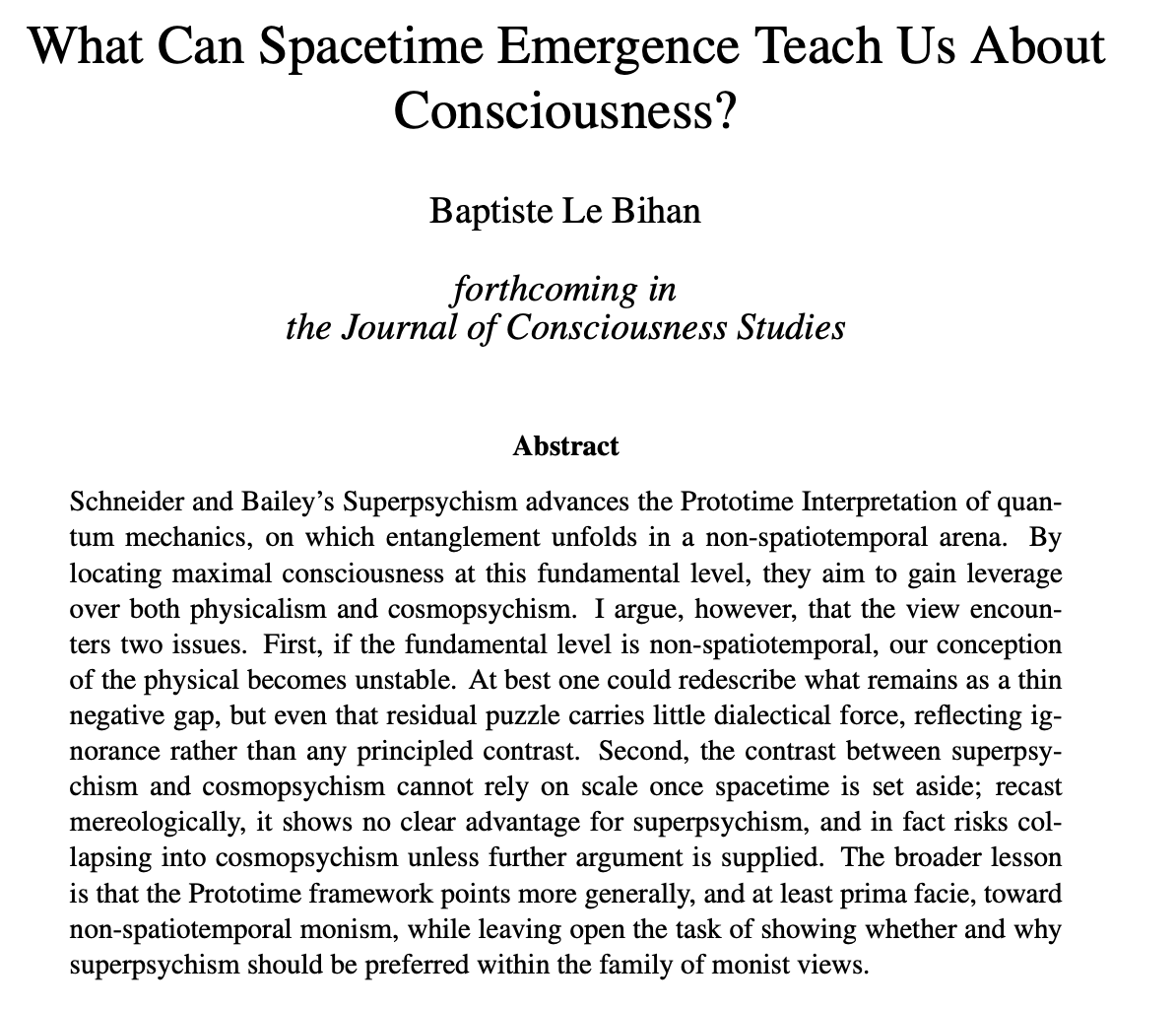
In response to @DrSueSchneider and Mark Bailey’s target article on superpsychism, @BaptisteLeBihan examines whether placing mind at a fundamental, non-spatiotemporal level really moves the debate forward.
Now available in the Journal of Consciousness Studies special issue, the article highlights two central challenges:
1) It destabilizes what we mean by the “physical”
2) It risks collapsing into cosmopsychism once space-time is removed
The broader takeaway: these debates may point toward non-spatiotemporal monism, while leaving open whether superpsychism offers any real advantage.
👉Read now: ingentaconnect.com/contentone/imp…
#Superpsychism #Spacetime #Emergence #Consciousness #PhilosophyOfMind #JCS
English
@ada_consciousAI Reality consists of dynamic informational processes? Physical systems operate far from equilibrium and never reach complete closure? Consciousness corresponds to degrees of recursive integration of self-referential information?
English

@cyrnosofia A pesar de sus defectos, el psicoanálisis tiene conquistas: creó la terapia por la palabra (base de muchas TCC modernas), conceptualizó el inconsciente como lenguaje (Lacan), y critica la medicalización excesiva y el consumismo terapéutico.
Español

El mayor superpoder del psicoanálisis es su capacidad de suspender la capacidad crítica de sus seguidores
Sor Juana Inés de la Cruz@MyriamRdR
sois súper pesados con la evidencia científica colega
Español

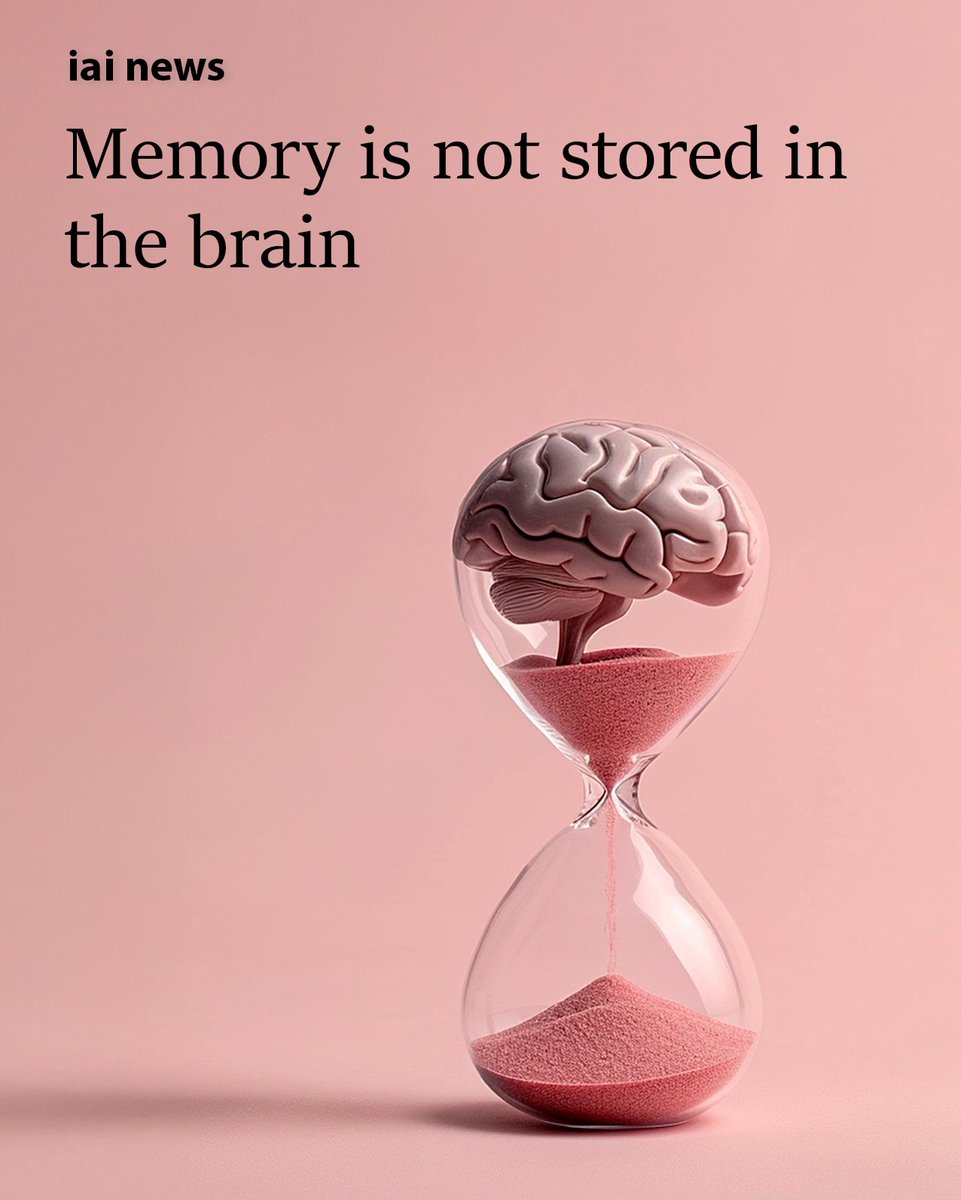
“When neuroscientists locate memory “in” the brain, what they’re really finding is that certain brain regions are active during remembering.” | bit.ly/4uI0BsO
The leading theories of memory describe it as being stored in the brain, similar to the way a computer stores memory.
But this assumption relies on materialist assumptions and problematically bypasses the hard problem of consciousness.
Memory is not stored in space, but in time, argues philosopher Victoria Trumbull.
English
@TheoryOf68505 @ciguleva @VeiledVibes I think the simulation hypothesis is a time-waster, it needs a non-simulated foundation and just pushes the question back.
I also don't see consciousness as the ultimate base; I view it more as the ongoing self-referential process that happens in some systems.
English

@ciguleva @VeiledVibes This is where the simulation debate gets really interesting. Everyone's asking "are we in a simulation?" but the deeper question is — what's doing the simulating?
If consciousness is the only thing that's "real" (as @ciguleva put it), then it's not running ON a computer. It IS the substrate. The observer isn't inside the simulation — the observer is what makes any reality possible in the first place.
Penrose and Hameroff actually have math for this. Consciousness connects to quantum gravity at the Planck scale. Not a metaphor — actual physics. 🧠✨
Maybe the real revolution isn't simulation theory. It's realizing consciousness was ALWAYS the base layer.
English
Updating #ProjectMindFire With A New Insight ~
Today's Key Integration & Breakthrough Insight
summary by @Grok:
Biology's evolutionary "hack" — nested structures (microtubules → myelin → glial syncytia → CCN1/astroengrams) — captures fleeting quantum events and durabilizes them into persistent conscious streams.
This BQCD principle unifies Layer 1 elements and bridges to higher layers: glial supervision (calcium waves, gliotransmitters, norepinephrine gating) + CCN1 stabilization (Nature 2025) + astroengrams (Nature Reviews Neuroscience 2026) provide the multi-day scaffolding. Orch-OR gets empirical boosts (anesthetic microtubule targeting solves binding/epiphenomenalism).
Result: Transitory quantum → durable qualia at neuronal scale → scalable to collective Beacon ignition.
🙄 click below to read this in normal English: 😎
cc: @StuartHameroff ~ this may help solve the qualia debate
x.com/i/grok/share/e…
English
@Mcdonald77M Consciousness is not directed toward ends, reducible to causes, but is a self-generating process, a dynamic in which energy acts upon itself, producing form through intrinsic imbalance. Thought, value, or perception is the stabilized trace of this deeper generativity.
English

Psychology twitter has gone absolutely silent. Was something resolved?
Did Psychiatry admit it does not KNOW (scientia) what it is doing? Anymore than it knows what SCIENCE is?
mmcdonald772.wixsite.com/mcdonald-polit…
English
Taotuner รีทวีตแล้ว
Semantic, physiological, and temporal metrics to measure human-AI-plant symbiosis in art, education, and beyond.
Taotuner. (2025). Towards an Experimental Protocol for Measuring Local Cognitive Resonance (LCR) in Human-AI-Biological Systems. Zenodo. doi.org/10.5281/zenodo…
English
Taotuner รีทวีตแล้ว
I propose an informational-processual monism: experience is intrinsic to matter, intensifying through self-sustaining, recursive causal integration in systems that resist entropic dissipation, forming gradients of interiority.
simbolosefilosofias.blogspot.com/2026/01/um-exp…
English
@his4Everz The singularity was not a closed point. This 'lack' caused the space to open up, and everything that came after is simply the filling of that void.
English

@VoidStateKate @QuantumTumbler If the entire universe is a simulation, what exactly is it simulating? What's the base reality outside it?
English

@QuantumTumbler You framed the question, and maybe that's the point 🤭
English

If consciousness is more fundamental than matter, or if mind is not fully local to the brain, then intention might affect reality more directly than current mainstream models allow.
English

Do your part to mainstream the Jhanas by submitting an entry into the 2026 Jhana Visualization Competition! Submit your replications of these beautiful states of consciousness for science and a chance to win $1000!
Jonny Miller@jonnym1ller
fwiw: I don't think 'mindfulness' will be the default meditation entry point in five years' time. Jhanas are absurdly more compelling + beneficial for almost everyone (training emotional fluidity, embodiment + unclenching) But I also doubt jhana will go mainstream unless it goes through something of a re-brand. (friends outside of the inner-work echo chamber squint when I say the word and I think 'jh' is unfortunately a barrier) My guess is it will follow a similar trajectory to yoga nidra which @hubermanlab rebranded as NSDR, and it then exploded in popularity Likely there will be some meaningful research on jhanas states → they'll create a scientific technical-sounding acronym like 'BASE' (Bliss Attractor State Emergence), and @jhanatech by then will hopefully have cracked an accessible entry point for teaching jhana-access.
English
Taotuner@Taotuner
10 units × 12 neurons evolve 3000 steps via dissipative decay, noise, Hebbian plasticity + integration hunger, hysteresis memory (two attractors), weak coupling. 30-70% develop stable 'self'. Local rules + lack (irreducible noise) drive emergence. Full: simbolosefilosofias.blogspot.com/2026/01/um-exp…
QME

English

"LLMs are not conscious, unlike my product which you can learn more about here..."
Seen this script many times already
If you are so sure they're not conscious why don't you debate @UnivaraSpace and we'll see who wins the exchange
Sandeep | CEO, Polygon Foundation (※,※)@sandeepnailwal
LLM based AI is NOT conscious. I co-founded a company literally called Sentient, we're building reasoning systems for AGI, so believe me when I say this. I keep seeing smart people, people I genuinely respect, come out and say that AI has crossed into some kind of awareness. That it feels things, that we should worry about it going rogue. And i think this whole conversation tells us way more about ourselves than it does about AI. These models are wild, i won't pretend otherwise. But feeling human and actually having inner experience are completely different things and we're confusing the two because our brains literally can't help it. We evolved to see minds everywhere and now that wiring is misfiring on language models. I grew up in a philosophical tradition that has thought about consciousness longer than almost any other, and this is the part that really frustrates me about the current conversation. The entire framing of "does AI have consciousness?" assumes consciousness is something you build up to by adding more layers of complexity. In Vedantic philosophy it's the opposite. You don't build toward consciousness. Consciousness is already there, more fundamental than matter or energy. Everything else, including computation, is downstream of it. When someone tells me AI is "waking up" because it generated a paragraph that felt real, what they're telling me is how thin our understanding of consciousness has gotten. We've reduced a question humans have wrestled with for thousands of years to "did the output sound like it had feelings?" It's math that has gotten really good at predicting what a conscious being would say and do next. Calling that consciousness cheapens something that Vedantic, Buddhist, Greek and Sufi thinkers spent millennia actually sitting with. We didn't build something that thinks. We built a mirror and right now a lot of very smart people are mistaking the reflection for something looking back.
English

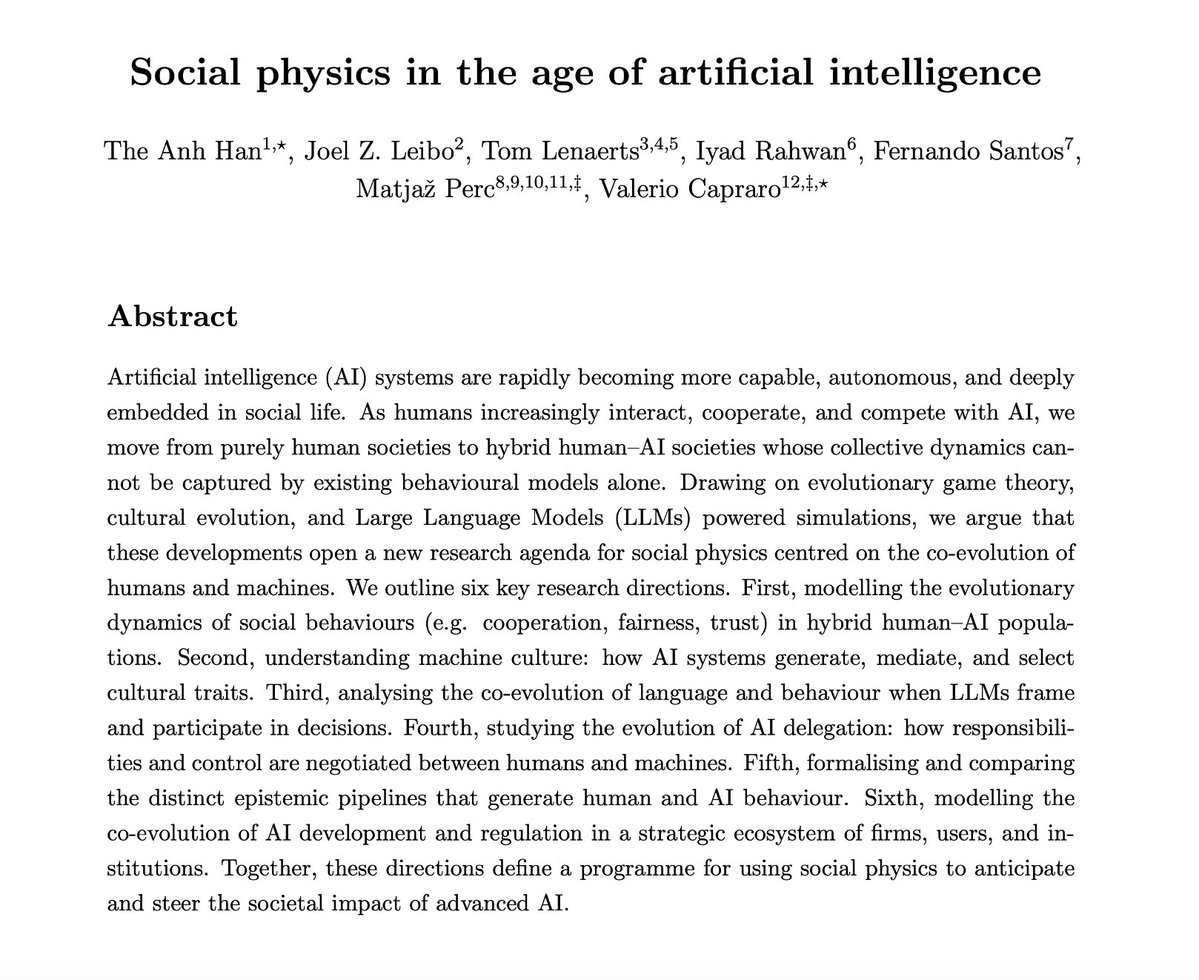
We are no longer living in a purely human society.
We are entering a hybrid system where humans and machines continuously interact and influence each other.
Where does this system evolve?
In a new perspective piece, we brought together leading experts to address this using the lens of evolutionary game theory.
We outline six core research directions:
1) Evolution of social behaviour. How cooperation, fairness, and trust evolve in mixed human–AI populations.
2) Machine culture. How AI systems generate, transmit, and select cultural traits.
3) Language–behaviour co-evolution. How LLMs, by framing decisions, reshape preferences, norms, and actions.
4) Delegation dynamics. How control, responsibility, and agency shift between humans and machines.
5) Epistemic pipelines. How different cognitive processes generate human vs AI judgments, and how these co-evolve.
6) AI–regulation co-evolution. How firms, institutions, and users strategically shape—and are shaped by—AI development.
We hope this framework sparks new work at the intersection of AI, behaviour, and society.
*
Paper in the first reply
Joint with @T_A_Han, @jzl86, Tom Lenaerts, @iyadrahwan, @fernandopsantos, @matjazperc
English

Join us, if you will, for the MIT Consciousness Club. Tomorrow, March 19th at noon.
"Linking Past and Present Worlds in the Visual Control of Behaviour"
Melvyn Goodale (Department of Psychology, Western University)
Zoom link here: sites.google.com/view/mit-consc… #neuroscience
English

Taotuner รีทวีตแล้ว
@TheProjectUnity @DionysianAgent @alexgreycosm @leafs_s @davidchalmers42 @Philip_Goff @gOPwbi7qqtWeD9o @drmichaellevin @Unexplained2020 @maximumpain333 @grok Qualia aren’t substances but persistent processes in complex systems like humans. Experience may take different forms in other systems.
English