

@ProfExistence This is cool! Wait for the coexistence take from us, Tim... using the pet scenarios from Harry Potter. Perhaps it could make things simpler for layperson, and make casual dog feeders more responsible.
English
THINKPAWS
439 posts

@ThinkpawsOrg
Pioneering the Science of Coexistence Within People, Animals & Waste Systems | A Think Tank hosted @NCBS_Bangalore & @OxfordBiology | PI @_NishantK



For those who give long lectures that feed biscuits to Dogs and they will never bite you. Aunty Jee was a Dog Lover and she was feeding #StrayDogs as a daily routine. But even that did not save her from Dog bite. Now she has to take Rabies Injection.


Condition of GTB Hospital Dogs not only roaming freely but peeing and pooping in hospital wards Location : India’s national capital Ruled by : Triple Engine BJP Gov Aukaat of a common Indian is less than an animal in its gov’s eyes.
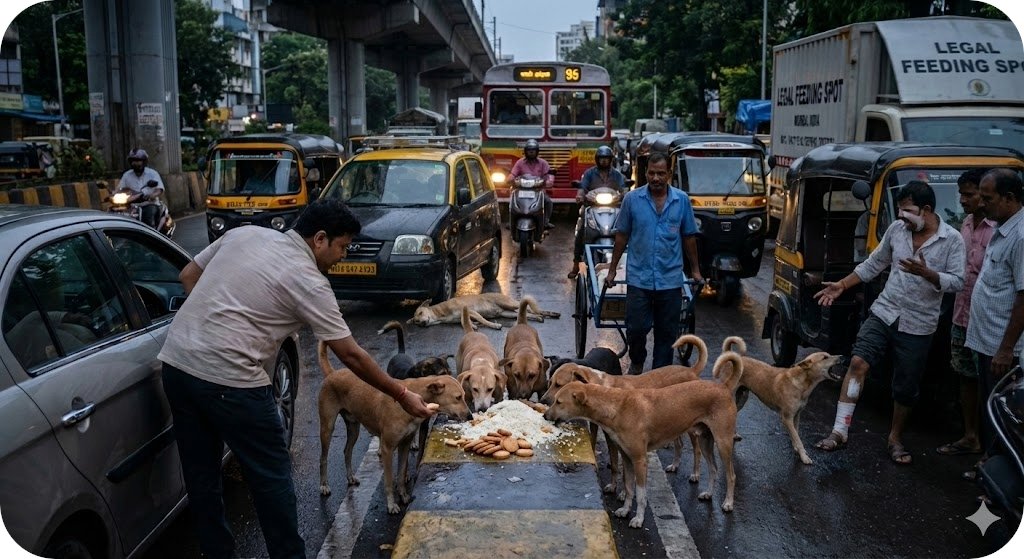
Would you be able to walk through these #dogged streets, even if the #dogs were neutered? This begets the Q: Why deliberate feeding can increase territorial aggression in free-ranging street #dogs: After my recent The Conversation article (doi.org/10.64628/AB.4f…) on India’s street dogs, I’ve seen strong reactions—especially to the proposition that deliberate feeding can fuel aggression, like we found in Black Kites of Delhi that attack people on head during nesting season. This deserves a clear, scientific explanation. 1) This is not about blaming compassion. It is about understanding how dogs respond to resources in space. Here is what decades of behavioural ecology tell us: ▶️ Food that is predictable and localised becomes defendable. When dogs are fed repeatedly at the same spot (shops, houses, temples), food shifts from diffuse waste to a fixed resource. Fixed resources trigger territorial behaviour in social carnivores. ▶️ Territories emerge around feeding points, quite often in streets. Free-ranging dogs are not randomly aggressive. Barking, chasing, and blocking movement are most intense near feeding locations and along access routes to them. ▶️ More food ≠ calmer dogs. It often means more dogs. Increased food availability raises pup survival and pack density. More dogs in less space leads to competition, vigilance, and defensive behaviour—especially towards unfamiliar humans. ▶️ Dogs learn who “belongs” and who does not. Regular feeders are tolerated; passers-by are not. What humans perceive as “unprovoked aggression” is often context-specific territorial defence. ▶️ Urban infrastructure amplifies the problem. Narrow streets, parked vehicles, and high human traffic compress dog movement, forcing encounters that escalate defensive responses. Importantly, this pattern is seen repeatedly in cities, and less so in villages, where food is dispersed, territories are larger, and dog movement is less constrained. Compassion without population control, waste management, and spatial planning creates an ecological trap—for dogs and for people. If we genuinely care about animal welfare and public safety, we must move beyond emotion-driven debates and engage with how behaviour actually works. 📽️ I’m attaching a short field video that illustrates how aggression switches on and off with feeding contexts. 📄 For those interested, the article is here: theconversation.com/indias-60-mill… Coexistence is not kindness alone. It is ecology, space, and systems. #Thinkpaws


