TradeRNNR

1.2K posts

TradeRNNR banner
TradeRNNR

TradeRNNR

@TradeRNNR

On a journey of consistent growth and improvement.

Order Book เข้าร่วม Ağustos 2023
107 กำลังติดตาม126 ผู้ติดตาม
TradeRNNR รีทวีตแล้ว

Mike Bellafiore
Mike Bellafiore@MikeBellafiore·
You are meant to do something great! Stop trying to "fix" your flaws to become a better trader. What if the secret to elite performance isn't patching your weaknesses, but weaponizing the strengths you already possess? In this masterclass from the SMB Trading Summit NYC 2026, Dr. Brett Steenbarger—the world’s leading trading psychologist—flips the script on conventional wisdom. He argues that the move from "struggling" to "Market Wizard" isn't about pathology; it’s about Positive Trading Psychology. Leveraging Your Signature Strengths The core of Dr. Steenbarger's philosophy is that trading success is an expression of your existing character. Instead of trying to mimic another trader's style, you should identify what you have already done "greatly" in life—whether in sports, business, or relationships—and use those same skills as the foundation for your trading edge. Identify Your Core 4: Pinpoint your top signature strengths (such as curiosity, temperance, or grit) and use them to define your strategy. Curiosity as a Driver: The most successful traders are often driven by an "entrepreneurial curiosity" and a love for the discovery process, rather than just the financial outcome. Avoid Over-utilization: Be aware that over-relying on a strength (e.g., independence) can turn into a weakness (e.g., refusing to listen to market data). 🔄 Breaking the Bubble While identifying your internal strengths is the foundation, elite performance cannot be built in a vacuum. To truly scale, you have to dismantle the most common trap in this industry: World-Class Isolation. 🤝The Power of Teamwork and Collaboration A recurring theme throughout the talk is the danger of "world-class isolation." Dr. Steenbarger argues that learning a high-performance skill like trading in a vacuum is nearly impossible, as the learning curve is too steep to navigate alone. "Each One Teach One": Modeled after medical school rotations, traders should form "virtual teams" to share ideas, review performance, and provide mutual feedback. Compounding Learning: In a team of six, you don't just learn from your own mistakes; you learn from the combined experiences of the entire group every single day. Grounding in Training: Much like surgical residents who don't go "on tilt" during high-stakes procedures, traders need repetitive, supervised training until their execution becomes second nature. 🔄 Rewriting the Ledger Once you have your team in place, the next step is changing how you measure your progress. You have to move away from a journal that only tracks failures and start building a blueprint for success. 📝Positive Journaling and "Reverse-Engineering" Success Standard trading journals often focus exclusively on mistakes, which can inadvertently damage self-confidence over time. Dr. Steenbarger advocates for a "Reverse-Engineering" approach to journaling that prioritizes your best work. The "One Good Thing" Rule: Every day, identify one thing you did well (even on a red day) and commit to building on it tomorrow. Study Your Winners: Analyze the patterns, mindset, and planning that went into your "A+" trades to create a blueprint for your success. Acknowledge and Solve: Identify one mistake per day and create a concrete, executable solution to ensure it is corrected rather than repeated. 🔄 The 90-Day Architecture But insight is just the beginning. To turn these psychological shifts into permanent "muscle memory," you need a protocol designed for neurological change. This is where the 90 and 90 Rule comes in. The "90 and 90" Rule for Lasting Change To turn a new behavior or a psychological reset into a permanent habit, Dr. Steenbarger recommends the "90 and 90" approach, inspired by recovery programs. 90 Days of Consistency: Commit to a single process change (like position sizing or a new exit rule) for 90 consecutive days. Repetition Cements Change: Emotional arousal acts as the catalyst for change, but only daily repetition makes that change a natural, effortless part of your process. Use Emotional Arousal: To break through deep-seated negative patterns, you must create an emotional rejection of the behavior (e.g., "FU therapy" for negative self-talk). 🔄 The Holistic Edge Finally, the most resilient traders understand that while trading is high-stakes, it cannot be their entire identity. True performance longevity comes from Life Diversification. 🌐Life Diversification and Vision A major psychological "leak" occurs when a trader's self-worth is tied entirely to their daily P&L. True resilience comes from having a diversified life and a vision that extends beyond the numbers. The PERMA+ Framework: Focus on Positive emotion, Engagement, Relationships, Meaning, and Accomplishment outside of the markets. Vision Over Goals: While goals provide direction, a "Vision" (like a higher purpose or a commitment to a cause) provides the inspiration needed to stay disciplined during drawdowns. Calendar Commitment: If a habit or a self-care activity isn't in your calendar, it isn't part of your professional process. At SMB, we hope that at least one of these ideas from the greatest trading coach in the US, will help you recognize the possibility about your trading journey...You are meant to do something great! #tradingpsychology #proptrading #trader Surprising Advice From World’s #1 Trading Psychologist (Dr. Steenbarger) youtu.be/K2e1Sdpfv7s?si… via @YouTube @steenbab
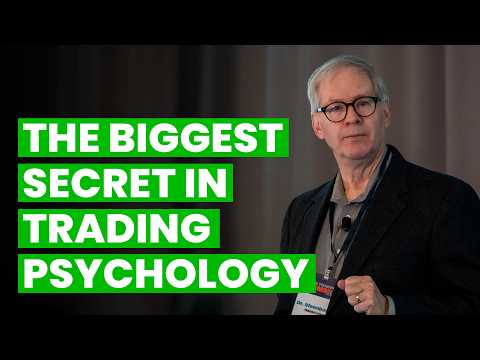
YouTube video
YouTube
English
4
25
167
27K
TradeRNNR รีทวีตแล้ว
VolSignals
VolSignals@VolSignals·
Long Gamma market returning... Today marks the first time we see positive gamma return (significantly) across the trading range. With notional gamma levels of ~$4-5bn we aren't quite "normal" but we do see dealers providing meaningful liquidity again. (short thread)
VolSignals tweet media
English
4
11
141
32K
TradeRNNR รีทวีตแล้ว
Roan
Roan@RohOnChain·
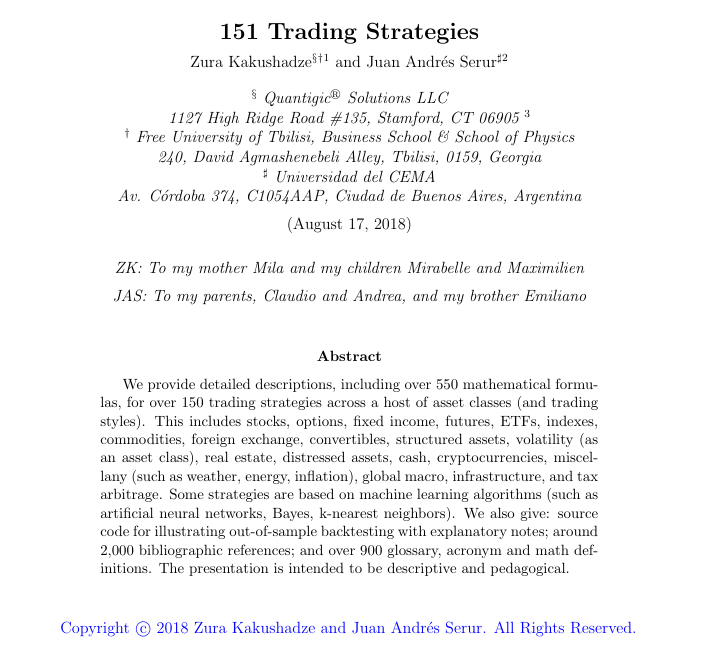
As someone who builds institutional level quant systems, this research book is the closest thing to a quant desk I have ever seen publicly shared. 361 pages. 151 trading strategies. Bookmark & get this, then read the article below before someone takes it down.
Roan tweet media
Roan@RohOnChain

x.com/i/article/2037…

English
57
367
3.1K
536.7K
TradeRNNR รีทวีตแล้ว
Jeff Sun, CFTe
Jeff Sun, CFTe@jfsrev·
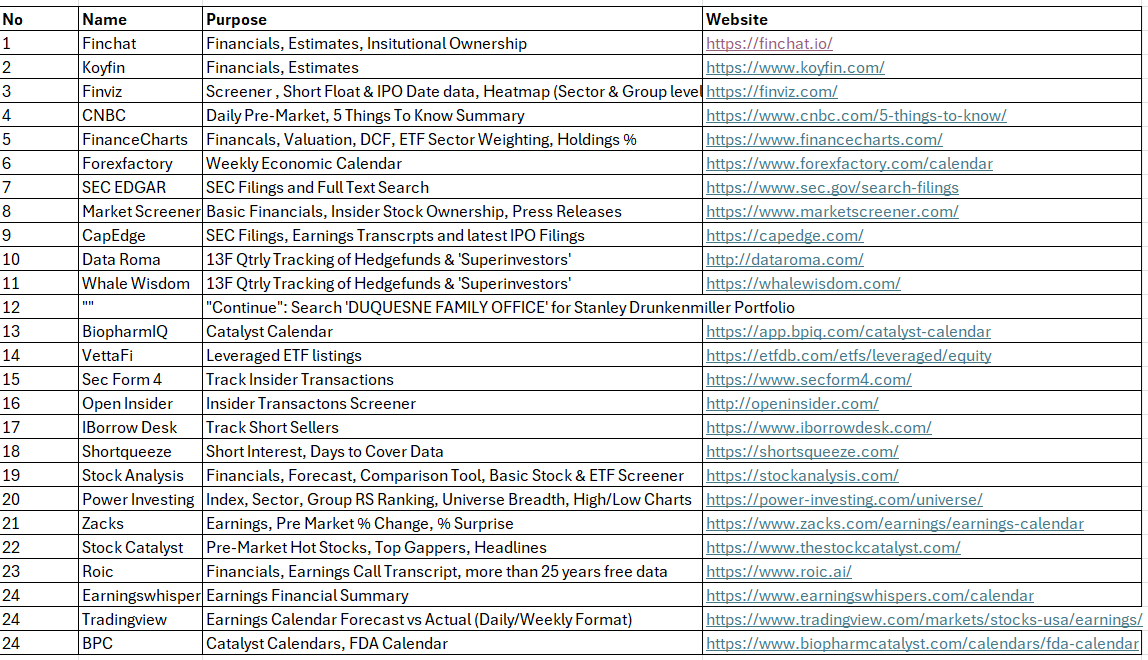
Here are 25 free sites/tools you might not be familiar with, but they could prove useful and enhance the efficiency of your investing and trading workflow. 🍻🍻
Jeff Sun, CFTe tweet media
Jeff Sun, CFTe@jfsrev

Here are the latest top 9 free trading and investing web tools that I am highly dependent on. I hope this they could also provide valuable and insightful resources as these tools have proven beneficial for my own processes. I would appreciate more contributions from you for an updated list next year! Below are my list! 1. Industry Group RS Rating - github.com/skyte/rs-log/b… The source is made available for free by @DumbleDax, but he highlighted this piece of work is 100% attributed to TradingView User: Skyte. For Googles Sheet User, data can be seamless imported into your googlesheet via the below code =IMPORTDATA("raw.githubusercontent.com/Fred6725/rs-lo……",",",0) For Excel User, I noted the same could be implemented via use Power Query. This is this is from ChatGPT. 1. Go to the "Data" tab in Excel. 2. Click on "Get Data" or "Get & Transform Data" (the exact wording might vary depending on your Excel version). 3. Select "From Web." 4. In the "From Web" dialog, enter the URL github.com/skyte/rs-log/r… and click "OK." 2. stockbee.blogspot.com/p/mm.html - @PradeepBonde Market Monitor is a daily breath monitor for signs of strength/weakness and turnaround. May be from a simple Blogspot layout but data remains free and accessible through the years) 3. cnbc.com/5-things-to-kn… - This link provides a daily pre-market crucial news, for everyone to kickstart their trading/investing session. Link is updated every 90 minutes before market open. 4. thestockcatalyst.com - If you are a Story Stock, Earnings Gap or Episodic Pivot strategy trader that is dependent on impactful price action, the pre-market movers data gives you a quick birdeye view of strongest/weakest pre-market move, along with their pre-market volume. Can be flited via Earnings for earnings play. 5. stockanalysis.com/etf/screener/ -This is a great free website by @stock_analysisx. I actually thought the ETF Screener is extremely useful if you trades leveraged ETF like myself. Screening parameters such as strongest 1-month mover are available. Thank you @A_jrk23 for highlighting this last year. 6. dataroma.com/m/home.php - Data Roma (13F filings of activity by top investors. Seamless and unclutter website because it's simply using blogspot if i'm not wrong :D ) - 7. roic.ai/- This encompasses a range of free financial data dating as far back as 9 FY, segments, investor tools, and an Excel add-in. In my humble opinion, it has surpassed Koyfin and Stratosphere, as the latter two have restricted usage for free users in the past 9 months. 8. finviz.com/screener.ashx?… - @BlogJulianKomar free CANSLIM screener. One of my favorite weekend scan is going through @BlogJulianKomar strongest stock scan, which is shared publicly for free in his #240 weekend newsletter. The link above is the default settings published by him. 9. fewmoredays.io - @Nevonal This is great study material. The work @Nevonal has done on @Qullamaggie stream is remains extremely underrated. Reading the recap with charts from the website are always my travel entertainment. Although it is only updated till 6/12/2021, but studying the charts from stream recap of a top trader in today's era still remains essential to improving your own thought process. Special Mention (Not entirely free) stockstory.org/discover If you find this thread helpful and would appreciate more contributions from the public for an updated list next year, please consider giving it a retweet and like!

English
11
143
736
167.4K
TradeRNNR รีทวีตแล้ว
Jeff Sun, CFTe
Jeff Sun, CFTe@jfsrev·
Everyone knows +6% monthly compounded gain will give you a +100% annualized gain. But very few dissect this +6% gain into what is required of your average trading proficiency. Let me give a quick but conservative case of 25% win rate month revolving controlled avg R loss at -0.7, and purely a 0.17% risk to equity of start month. 1. Risk: 0.17% risk to equity per trade (a single R loss is 0.17% of account equity) 2. Trade frequency: 64 trades, 16 win, 48 loss. 3. Win rate: 25% only 4. Avg R gain 4.3 multiples, Avg Holding Period For winning trade (<15 days) 5. Avg R loss -0.7 multiple, Avg Holding Period For Losing trade (<4 days) 6. Profit Factor: 6.14 7. Gain to Pain: 2.1 If you use this as a benchmark and strive to improve the numbers here, control what you can control specifically on your losses, you can hit +100% year even with a few controlled losing months.
Lone Stock Trader@LoneStockTrader

F the win rate. Focus on high reward-to-risk situations (high potential R-multiple).

English
22
145
739
229.3K
TradeRNNR รีทวีตแล้ว
Yumi🌸
Yumi🌸@samuraipips358·
Make a note of this 📝 Key points of probabilistic thinking 1. Focus not on individual outcomes, but on long-term statistical edge. 2. The reliability of statistics lies in sample size. 3. To make use of probability is to make use of the law of large numbers through consistency. 4. By collecting a large enough sample, you allow the system's edge to express itself fully. 5. Maintain consistency and follow the rules. 6. Each individual win or loss is just a data point, and there is no need to be emotionally affected by it. 7. Do not assign meaning to the order in which wins and losses appear. 8. Do not try to assign special meaning to a losing streak. 9. A 50% win rate does not mean wins and losses will alternate. 10. Keep a long-term perspective. Probability plays out more slowly than you think. That is why it is essential not to be swayed by short-term results, but to keep repeating what you are supposed to do with a long-term perspective. Do not casually alter a system that was tested in advance on a large sample just because of a losing streak or drawdown in front of you. That is not improvement. You are always being pulled toward inconsistency.
English
5
25
148
6.1K
TradeRNNR รีทวีตแล้ว
Imran Lakha | Options Insight
Imran Lakha | Options Insight@options_insight·
Why does VIX often sell off into expiry and then bounce? The predominant flow in VIX options is call buying for hedges. That means whoever is short those calls has long VIX futures as a hedge. As those calls decay toward zero into expiry, that hedge needs to be unwound. Futures get sold. VIX drops. SPX drifts higher. The move has nothing to do with sentiment or conviction or economic data. It's plumbing. Mechanical flow from options expiration forcing trades in a specific direction. I've seen traders build entire narratives around "the market wants to go higher" during VIX expiry week, when what's actually happening is dealers hedging their VIX charm. (change in DELTA through time) Did you notice how vol bounced out of VIX expiry last week? Sure there was a news trigger, but the cap had been lifted. Where do you think VIX goes from here?
English
10
23
165
29.5K
TradeRNNR รีทวีตแล้ว
Imran Lakha | Options Insight
Imran Lakha | Options Insight@options_insight·
"Defined risk" sounds boring to some people. Small premium, limited upside. Grow a set! Completely backwards. I spent about $500 on a call fly last week trying to catch a bounce. If it works, that's $2,000 to $3,000. If it doesn't, I've lost $500. I made peace with that spend before I put it on. That's the whole point of these structures. In a market like this, where nobody knows if we're bouncing Monday (as we did) or dropping another 5%, that structure lets me take repeated shots without killing my account. Spend $500. If it works, bank it and set up the next one. If it doesn't, move on, wait for more conviction. Compare that to the trader buying 100 shares on margin to "catch the bounce." Same thesis. One knows their worst case. The other is hoping the market doesn't gap against them overnight. Defined risk is how I stay aggressive when the market is at its most uncertain. You can take multiple well calculated shots when you know exactly what you're risking. If you can't define the max loss before you click the button, you're playing with fire. With real money that gets expensive fast.
English
4
3
23
3K
TradeRNNR รีทวีตแล้ว
VolSignals
VolSignals@VolSignals·
March expiry bullish, bearish or who care-ish? Do we bounce afterwards? Market maker positions tell a clear story about what to expect through the rest of the month.. retweet this I'll tell you what the positions imply on today's TGIF call. (8:15am et - see you there)
VolSignals tweet media
English
2
23
110
9.9K
TradeRNNR รีทวีตแล้ว
Lance Breitstein 🇺🇸🌎
Lance Breitstein 🇺🇸🌎@TheOneLanceB·
THE SHORTEST TIMEFRAMES HAVE THE MOST EDGE! This is a view I’ve mentioned before in interviews, but I’ve never taken the time to fully expand on. In general, you want to be an expected value maximalist (within risk constraints). And the shortest human timeframes offer that. Yes, I mostly do bigger picture trades now but that’s due to scalability and quality of life, not bc they offer the most edge. The paradox of markets is this: -The shortest timeframes often have the biggest dislocations (most “edge per minute”) -The longest timeframes often have the biggest tailwind (asset prices tend to rise over time) -The middle is where many traders get chopped up This principle is the reason why there were traders at Trillium that could be positive hundreds of days in a row. You’ll never see that with a swing trader or value investor. 1. Why short timeframes can have so much edge At very short horizons, markets can be temporarily inefficient because of: -forced behavior (stops, liquidations, margin pressure) -delayed human interpretation of information -mechanical flows around opens/closes -short-lived supply/demand vacuums Those create moments where price can be “wrong” for seconds/minutes relative to where it’s about to reprice. In fact, at the extreme short end of human discretionary trading like the two following examples, you can find opportunities that approach 100% win rate with a profit factor of 10+. Of course there is a trade-off which I’ll get into. 2. Order flow imbalances One of the biggest short-term edges is understanding order flow imbalance. Yes, these happen far less of the now than they used to as discussed in my interview yesterday with Serge. But they still exist particularly during times of market extremes. -aggressive buyers/sellers temporarily overwhelm passive liquidity -one-sided flow causes price to overshoot or stall -liquidity can disappear at key moments, then refill at new levels You’ll see this around: -opening auctions -panic flushes / squeezes -large fund rebalancing windows -crowded positioning unwinds This is where the tape can get dislocated from “fair” value in the short run and where active traders can extract edge. It is also why some of those hyperscalpers like @EdBarry4 are positive so many days in a row. 3. Breaking news is where discretionary human traders still have the edge over algos in interpreting novel headlines. There’s usually a sequence: -headline reaction -second-order interpretation -positioning unwind/chase -stabilization If you’re prepared and fast, these windows can be highly asymmetric. In fact, breaking news can offer some of the best opportunities in existence, especially when applied to liquid instruments (think April 2025 tariff headlines!). In fact, I’d argue tariff headlines due to their massive impact on global markets are some of the best expected value opportunities I’ve ever seen. 4. But there’s a tradeoff: liquidity + scalability The shorter the timeframe, the more your edge depends on: -execution speed -order optimization -fee minimization -slippage minimization So yes, edge can be highest in short windows but liquidity becomes the constraint. Many short-duration edges don’t scale without degrading returns. That is why many traders post eye-watering returns in small caps but then you constantly see them doing their dumb small account challenges. It’s because their strategies don’t scale! 5. Beware the middle ground. Take this thought experiment. Let’s say $AAPL flash crashes 90%. With near-certainty, Apple will bounce within minutes close back to the unaffected price. What happens overnight is more of a toss-up. What does the market do? Does news come out? Yet over the course of 5-10 years, it’s likely the $AAPL goes up. In that middle ground, you take on variance from overnight risk, headline risk, and market risk. But don’t benefit much from the fact that over years, markets go up. It’s much more of a coin flip whether we go up or down any given day. If I had to guess, the most edge is in tenths of seconds and seconds for humans. The least edge is in the window of weeks. Why not compete at even faster timeframes? Bc then you fight with HFT, commission structures, co-location, and more. 6. So how to apply this? First, this is useful for the sniff test. Understanding that there is a trade-off between edge and liquidity is critical! There is a reason why you see small cap traders that can scale a small account over 1,000% in a year (think early days of @theshortbear). There is also a reason why Warren Buffett has approached market returns. It’s that trade-off between edge and scale. Similar to the general trade-off between win-rate and profit factor, it’s a safe assumption that these often tend to move inverse to each other. It’s the reason why that if I managed $1B my returns would probably get quartered and if I managed $10B my returns would approach market returns or worse. This framework is also useful for finding the most edge and understanding your strategies. If you’re moving to a higher timeframe, you generally SHOULD expect more variance. That comes with the benefit of scalability. Similarly, if you want to study micro-inefficiencies, particularly in less efficient markets like crypto, you can find some insane edges there.
Horse@TheFlowHorse

🧵 Maybe this post can help some of you. There are a few reasons why I prefer shorter duration trades, and my style gears toward that rather than longer holding periods. This is not to say that I do not hold trades for long periods of time, there are many instances where I do, but they simply do not represent the majority. As a caveat, I should start by saying I was trained this way early on and the people trading around me had a very similar approach. 1st - Personality, and this is important, because a lot of you will end up choosing a style based on what you think is cool. The first thing you should do is find what "fits." I like to be close to both the action and the feedback loop, and I get bored easily. Believe it or not, misalignment here is one of the reasons traders struggle initially, and this actually comes in handy for my last point (5) at the end. 2nd - My belief is that mid-frequency trading is probably the most difficult. Over very long periods the market is honest, and over very short periods it can be wildly distorted and create a significant amount of opportunity. The middle ground is where the danger exists. It is also probably the most competitive timeframe, and the hardest one to build a durable edge in.

English
42
96
867
95K
TradeRNNR รีทวีตแล้ว
Imran Lakha | Options Insight
Imran Lakha | Options Insight@options_insight·
𝗘𝘃𝗲𝗿𝘆 𝗼𝗽𝘁𝗶𝗼𝗻𝘀 𝘁𝗿𝗮𝗱𝗲 𝗜 𝗱𝗼 𝗳𝗮𝗹𝗹𝘀 𝗶𝗻𝘁𝗼 𝗼𝗻𝗲 𝗼𝗳 𝘁𝗵𝗿𝗲𝗲 𝗯𝘂𝗰𝗸𝗲𝘁𝘀 (excluding hedges): 1. Delta trades (directional) 2. Theta trades (income) 3. Vega trades (volatility directional) Most retail traders only think in bucket one. They buy calls because they're bullish. They buy puts because they're bearish. That's the whole playbook. But the real edge often sits in buckets two and three. Selling premium when the variance risk premium is fat. Taking a view on vol itself when skew or term structure is "mispriced". The regime tells you which bucket to fish in. High skew, elevated vol? Probably a vega or delta trade, not a theta trade. Low vol, calm markets, positive VRP? Theta bucket all day. Match the bucket to the regime. Your trade selection gets sharper immediately.
English
13
25
194
22.7K
TradeRNNR รีทวีตแล้ว
Yumi🌸
Yumi🌸@samuraipips358·
That’s a very good question. If following your rules during testing requires willpower, that itself is a sign that breaking rules still looks attractive to you on some level. There are a few possible reasons for that. It may help to ask yourself again what you are actually testing for. The purpose of testing is to find out what happens when you repeat consistent actions across a large sample size. The moment you deviate from your rules, you move away from that purpose and lose the very data you need. If you deeply understand that deviation contaminates the data, breaking rules stops looking attractive. Another possibility is that the desire to win and the fear of losing are still too strong, even during testing. In that case as well, you need to revisit why you must keep following your rules throughout the process. If testing reveals a method that consistently loses money over repeated trials, that means the method is producing a bias in one direction. Anything that produces a bias in either direction contains the raw material of an edge. With that understanding, even a losing streak during testing becomes a valuable discovery. There is also the possibility that your rules still leave room for interpretation. If they can be read differently depending on your mood or the chart that day, then they are not rules yet. They are guidelines. Guidelines force real-time decisions, which is why they require willpower. True rules have one reading and one action. Eliminate ambiguity, and there is no room left to negotiate with yourself. As a result, willpower becomes unnecessary. This is actually where many traders fail, and one of the hardest things to notice in yourself. How you design your rules so that probability can actually play out is far more important than most traders realize. In truth, a huge amount is decided at that stage. That is exactly why I created my system design manual. x.com/samuraipips358… Understanding the purpose of testing, and building rules that allow probability to play out, are everything.
RayChiu@RayChiu_Wei

@samuraipips358 I’ve read many of your articles and spent time rethinking my approach. After reorganizing my trading system and fixing the gaps, I’ve started testing it again. While testing, is relying on willpower the only way to avoid drifting away from the rules?

English
1
6
52
3.7K
TradeRNNR รีทวีตแล้ว
Andrew Menaker PhD
Andrew Menaker PhD@Andrew_Menaker·
THE TRUTH YOU DON'T WANT TO HEAR ⬇️ “Win or lose, everyone gets what they want from the markets.” ~ Ed Seykota > Original Market Wizard Read that again. It’s not poetic. It’s psychological. It’s brutal. It's the uncomfortable truth. Most traders say they’re here to make money. ➡️But if money were truly the primary driver… you wouldn’t keep violating your plan in the same predictable ways. So what’s really happening? Money is the conscious goal. But beneath that are unconscious drivers that are often stronger. Some traders want certainty more than profits. So they overtrade to escape the discomfort of waiting. Some want to feel smart. So they argue with price instead of cutting losses. Some want excitement. So they chase volatility and call it “opportunity.” Some want to avoid the pain of future regret. So they FOMO into trades that weren’t theirs to take. Some want to confirm a hidden belief: “I’m not quite good enough.” So they sabotage good systems at the worst possible moment. And the market will gladly accommodate. Because the market is the ultimate projector screen. It doesn’t respond to what you say you want. It responds to what your nervous system is organized around. If your nervous system is wired for: • Avoiding regret • Proving yourself • Seeking validation • Replaying old shame • Chasing dopamine You will unconsciously trade in ways that produce those emotional outcomes. Even if it costs you money. Especially if it costs you money. This is why more strategy rarely fixes repeated mistakes. And why willpower collapses under pressure. And why 'accountability' rarely works. And affirmations are not nearly enough for sustained change. Trading is a psychological amplifier. It exposes: – Your tolerance for uncertainty – Your relationship with authority – Your attachment to being right – Your self-worth – Your identity around success You don’t get what you deserve from the markets. You get what your nervous system is primed to experience. That’s why some traders repeatedly: • Exit early • Add to losers • Skip A+ setups • Give back big months • Recreate the same P&L pattern year after year t’s not lack of intelligence. It’s unconscious reinforcement. The ego says: “I want money” The nervous system says: “I want what’s familiar.” And the familiar wins… until you make it conscious. Seen it many times in my coaching practice (I've worked 1:1 with some Ed Seykota's Trading Tribe members) Real growth begins when you ask: 👉 What emotional payoff am I getting from this? 👉 What identity am I protecting? 👉What discomfort am I avoiding? 👉If I were consistently profitable, what would that force me to confront? That’s the deeper work. And it's why skilled 1:1 coaching is the most effective. Because when you shift what you actually want at the unconscious level… Your behavior changes. And when behavior changes consistently… Results follow. T The market isn’t punishing you. It’s revealing you. Instead of simply analyzing trades, Ed had his traders analyze their feelings in real-time. He insisted it was the best way to uncover previously unconscious emotions - which drives poor trading behavior. So the the question you must ask is: ✅On a subconscious level, what are you coming to the markets to get? If this post resonates, R/T, follow me, like, and BOOKMARK this post. #tradermindset #tradingpsychology $ES_F $NQ_F $SPY $QQQ
Andrew Menaker PhD tweet media
English
0
8
33
1.3K
TradeRNNR รีทวีตแล้ว
VolSignals
VolSignals@VolSignals·
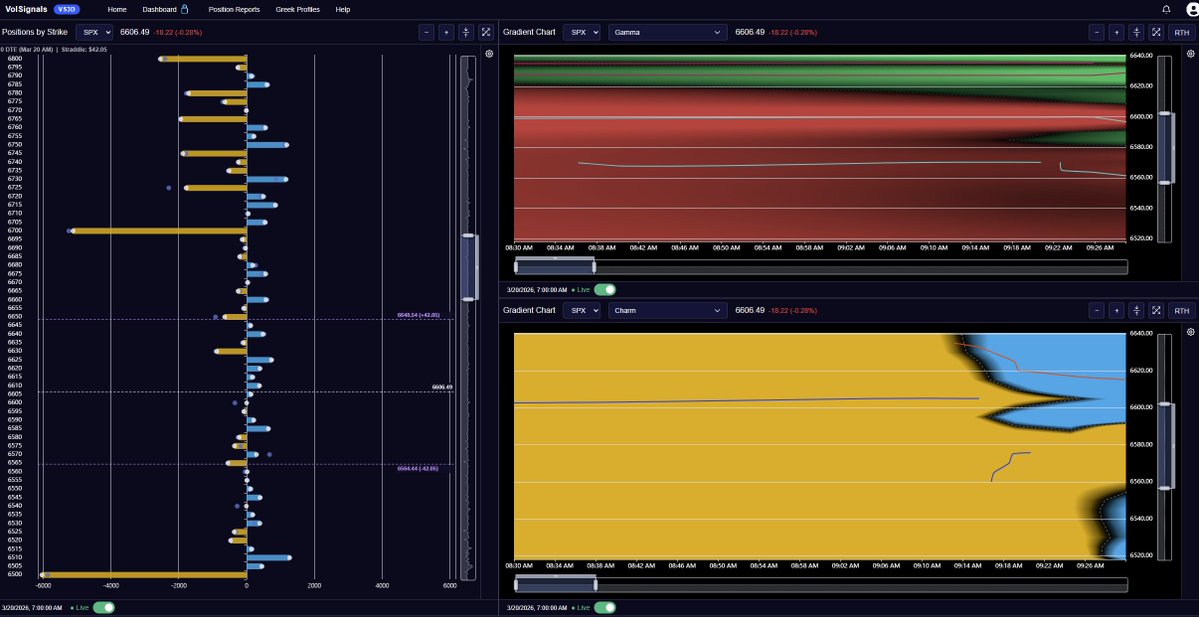
KEY LEVELS for SPX today this is the market maker position for 3/9 (ODTE) options White horizontal line marks where SPX is implied to be trading based on ES futures, as I type this post. GAMMA is decisively negative this is a classic "toxic" gamma regime at this point and is not likely to resolve today. It's going to take multiple expirations to clear the deck of MM short inventory, require customers to close/roll hedges, or alternatively- it can resolve IF the index moves sufficiently away from this area and into a new range. You saw how much *positive* gamma was above us in the 6900-7050 area- there will be a similar range to the downside emerging soon. REMEMBER that Gamma is not directional- so you just have to widen your expectations for distance and trappy moves with futures/index today- it is best understood as a LACK OF LIQUIDITY in the underlying futures CHARM is equally positive (but- this is negative.. huh?) remember, our charm gradient describes this: 1. Assume market makers are delta neutral 2. Model the WHOLE position again is if 5min passed 3. What's the new delta of the position? 4. HEDGE IT! If the Black Scholes model output for the simulation in (2) is a POSITIVE number, that means market makers are expected to be "decaying" into a *longer delta* position overall then they have to offset this (4)... and THAT is what creates a potential market impact we can trade. What type of position gives market makers this type of charm? 1. Market makers sold calls and bought futures ... the negative delta on the options (sell Call = -delta) moves towards 0 as they near expiration, making the market maker longer delta (less short) over time, thereby needing to unwind the hedge (long futures) to stay aligned with the market's live delta of the option. 2. Market makers bought puts and bought futures ... the negative delta on the options (buy put = -delta) moves towards 0... (same logic here too) WHAT ABOUT THE POSITIONS? There are key levels in the positions and we've already seen them show up in the overnight price action: 6580 marked the overnight low and now futures have v-bounded through the negative gamma range Locally now we are approaching a KEY TEST (6675) and then we have another (6700) right up ahead There is no layup trade here, like there often is- plan (and trade) accordingly
VolSignals tweet media
English
7
37
218
33.5K
TradeRNNR รีทวีตแล้ว
Imran Lakha | Options Insight
Imran Lakha | Options Insight@options_insight·
Here's how you tell whether a selloff is real or mechanical. Ask one question: is gold going down too? When equities drop and gold rallies, that's the typical correlation we have been seeing as Gold becomes the favoured safe haven over Bonds. When equities, gold, silver and EM currencies all drop at the same time, someone has a margin call. Correlations going to 1 is the fingerprint of forced liquidation. A fund needed cash by close. Next time everything is red at once, check the cross-asset picture. Liquidation exhausts itself fast. Violent rallies come next. If you do buy that dip, be aware that it can turn around just as quick when the next headline drops!
English
5
16
167
23.9K
Yumi🌸
Yumi🌸@samuraipips358·
Great question. Let me be direct with you, because I think the answer is already hidden inside the way you framed your question. You said "external factors occasionally cause emotional loss of control." But here's the thing — external factors don't cause emotions. Your thought process in response to those external factors is what generates the emotion. The same event can happen to two different traders, and one feels nothing while the other panics. The difference isn't the event. It's what's happening inside. So the real question isn't "what external factor is causing my emotions?" It's "what belief or thought process do I still hold that makes me react this way?" You also said you "generally" trust your system. That word "generally" is doing a lot of heavy lifting. Trust isn't something that works part-time. If your trust wavers under certain conditions, that's not trust — that's hope. And hope is not a strategy. True trust in a system comes from deep understanding of its statistical edge, built through massive sample sizes of testing, where you've seen with your own eyes how the system performs across every kind of condition. If that foundation is solid, there's nothing external that can shake it. If it shakes, the foundation isn't solid yet. And here's something worth examining closely. If losses are what shake your trust, it means you're still equating "edge" with "winning trades." But that's a misunderstanding of what an edge actually is. The edge of your system is not just the wins. The losses that occur according to your rules are themselves part of the edge. Without those losses, the edge doesn't function. They are not a cost you endure in spite of the edge — they are a component that makes the edge work. If you truly understood this, a rule-based loss wouldn't shake you at all, because you'd recognize it as the system doing exactly what it's supposed to do. The fact that losses still disturb you reveals that, somewhere in your thinking, you still see losses as the opposite of edge rather than a part of it. And you said you "execute it well." But execution in trading isn't a spectrum. You either follow the rules or you don't. "Well" suggests there are moments where you don't, and that's worth examining honestly. Every time you deviate from your rules, you're not doing your job as a trader. Your job is to extract the edge of your system through consistent execution over a large sample. Any deviation contaminates that sample. The deeper issue here is this: what many traders perceive as an "emotional control" problem is actually a problem of understanding. Emotions are not the cause — they are the result. They are the symptom of a thought process that still places value on individual wins and losses, that still sees losses as something bad, that still reacts to short-term randomness as if it means something. When you truly understand your job as a trader — that you are collecting a large, clean sample of trades under identical conditions so that the law of large numbers can do its work — then wins and losses become nothing more than data points. Neither good nor bad. Both necessary for the system's edge to emerge. You don't need to control your emotions. You need to change the thought process that's generating them. Once that shift happens, the emotions you were trying to fight simply stop appearing. So my honest assessment: the fact that external factors can still disrupt you tells me your understanding of what you're doing — and why you're doing it — still has room to deepen. That's not a criticism. That's actually great news, because it means the solution is entirely within your control. Go deeper into your preparation. Go deeper into your testing. Go deeper into understanding the probabilistic nature of what you do. The confidence and calm you're looking for aren't found by fighting your emotions. They're built through understanding.
RayChiu@RayChiu_Wei

@samuraipips358 If a trading system has been tested, backtested, and validated through simulation, and I generally trust the system and execute it well, but external factors occasionally cause emotional loss of control—where would you say the problem lies in this case? Thanks.

English
4
7
59
3.3K
TradeRNNR
TradeRNNR@TradeRNNR·
Thank you for this. This is what I have been internalizing about position size lately. I have been tracking what type of days (trend/range) where I have higher positive EV to size up or size down.
Yumi🌸@samuraipips358

No. 20 trades is not a statistically meaningful sample. Not even close. Let me explain why, and more importantly, let me reframe the question you should actually be asking. Probability does not "play out" in 20 trades. Short-term results are dominated by randomness. If your system has a 60% win rate, that does not mean you will win 12 out of 20. You could easily win only 7 or 8. You could hit a losing streak of 6 or 7 in a row, which is completely normal and expected within the natural distribution of outcomes. With 20 trades, you are not extracting an edge. You are hoping that randomness happens to favor you. That is gambling. The law of large numbers needs a large sample size to reveal the true performance of a system. 20 trades tells you almost nothing about whether your system actually has an edge. The variance is simply too large relative to the sample. But here is the deeper issue. The real problem is not "is 20 enough." The real problem is that your position sizing only allows 20 trades before you hit the drawdown limit. That means your per-trade risk is far too large relative to the constraint you are operating within. Position sizing is not determined by how much you want to make or how many trades you think you need. It is determined by the system's characteristics, specifically its maximum losing streak, its maximum drawdown in R, and the need to survive through that volatility so you can keep executing without changing the rules. Your position size should allow you to take a large enough number of trades so that the law of large numbers can actually do its job. If your sizing only gives you 20 shots, you have not designed your risk to let probability work. You have designed it to let luck decide. So the question to ask yourself is not "can probability work in 20 trades" but rather "how small do I need to size so that I can take enough trades within this drawdown limit for my edge to actually show up?" Reduce your per-trade risk. Give yourself room. The goal is not to maximize each trade's impact. The goal is to safely and consistently accumulate a large sample size so that your system's edge is drawn out through the law of large numbers. That is your job as a trader. Everything else is noise.

English
0
0
0
47