UST of Everything

454 posts

UST of Everything banner
UST of Everything

UST of Everything

@USTPhysics

UST: A continuum obeying a nonlinear, relativistic modified Hooke’s Law (USEMP), where elastic spacetime gives rise to gravity, EM, and Quantum Mecha

Jared J Kimble เข้าร่วม Mart 2025
103 กำลังติดตาม22 ผู้ติดตาม
ทวีตที่ปักหมุด
UST of Everything
UST of Everything@USTPhysics·
⚛️First official paper on the #StrongForce from Unified Spacetime Theory Mechanical Strong Force in Unified Spacetime Theory: Flux Tubes and Confinement from Torsional Saturation doi.org/10.5281/zenodo… Abstract: Unified Spacetime Theory (UST) explains the strong nuclear force as a purely mechanical effect arising from the torsion (the twisting)  of a single underlying medium that makes up spacetime itself. No gauge fields, no gluons, no color charge are needed. When torsional strain is concentrated between two sources (such as quark cores), the medium’s built-in elastic modulation mechanism causes the stored energy density to reach a natural ceiling. To minimize total energy while carrying a fixed amount of torsional throughput, the medium spontaneously forms narrow, stable flux tubes with nearly constant energy per unit length. This produces the linear rising potential that confines quarks: the farther you try to separate them, the more energy it costs, with no upper limit until the tube breaks and new pairs form. This paper derives the static confinement mechanism from a constrained energy-minimization problem. The shape and thickness of the flux tubes, along with their energy per unit length (string tension), emerge directly from the calculation with no assumed geometry or adjustable parameters. A second, complementary confinement effect (a conservative force that resists moving saturated regions through unsaturated ones) arises automatically from the same modulation rule. All results use only the three fixed mechanical constants declared in the foundational paper, and full numerical reproducibility is provided through explicit artifacts and quality controls.
English
0
0
0
28
OpenAI
OpenAI@OpenAI·
Today, we closed our latest funding round with $122 billion in committed capital at an $852B post-money valuation. The fastest way to expand AI’s benefits is to put useful intelligence in people’s hands early and let access compound globally. This funding gives us resources to lead at scale. openai.com/index/accelera…
English
1.1K
743
8.4K
3.7M
UST of Everything
UST of Everything@USTPhysics·
@prz_chojecki Ive developed a new foundation for physics and im currently building a 10 paper series all built on this paper. Pt-1&2 of 10 - V5.0 Unified Spacetime Theory Foundations: The Mechanical Origins of Spacetime - Unifying Forces and Deriving Lorentz Symmetry doi.org/10.5281/zenodo…
English
0
0
0
11
Przemek Chojecki | PC
Przemek Chojecki | PC@prz_chojecki·
My multi-agent harness powered by GPT-5.4 settled a FrontierMath Open Problem. The result of 2 weeks of 5-10 agents working 24/7: there are no char 3 rank 1 del Pezzo surfaces with more than 7 singularities. This settles the problem to the negative. Details below.
Przemek Chojecki | PC tweet media
English
21
16
176
138.8K
UST of Everything
UST of Everything@USTPhysics·
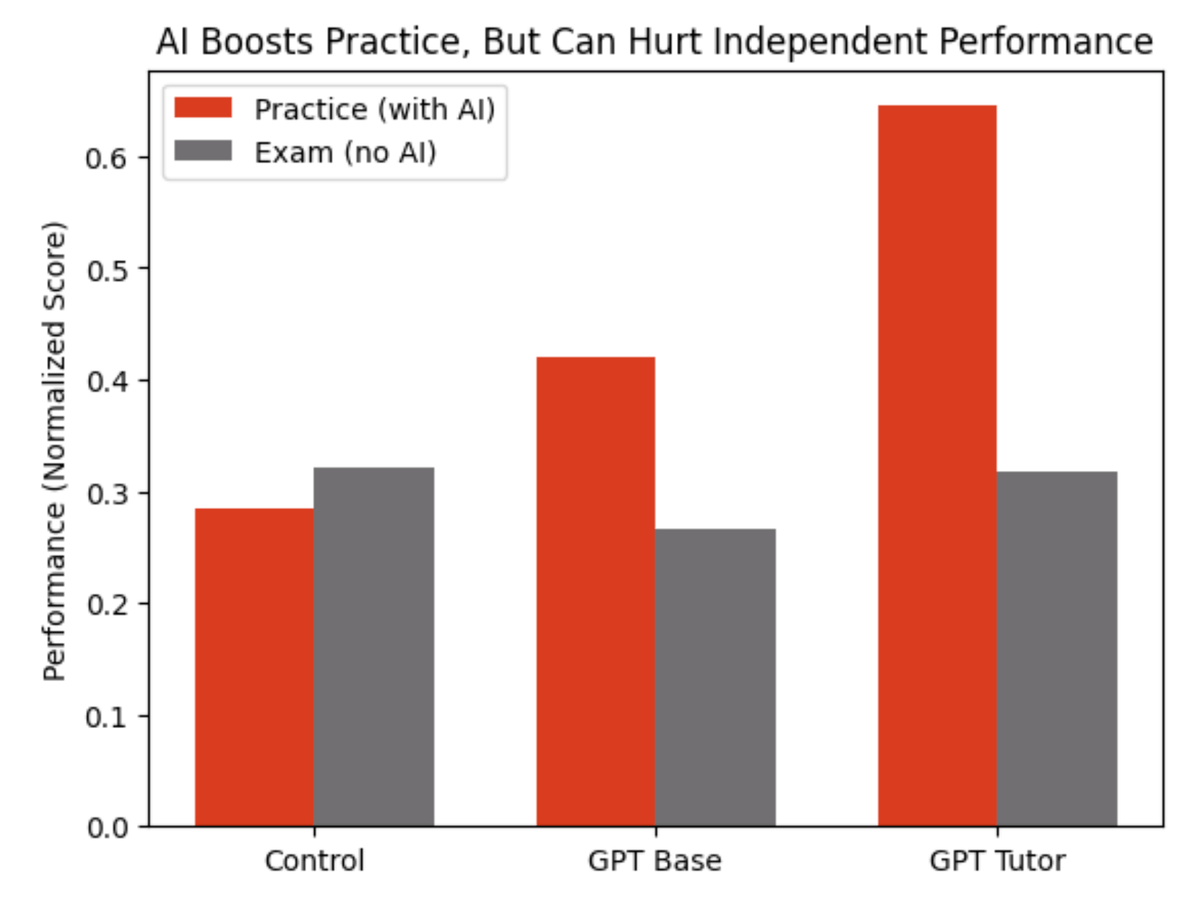
If they dont train the students how to use AI you get these results. This is rubbish, and based on no path the teaching how to use the technology. This is also a signal that if you dont teach kids how to use it they will use less brain power. The future is prompt engineering, not being a dummy asking questions. Your knowledge is limited by the questions you ask. And asking the right questions with AI is more important than ever.
English
0
0
0
606
Anand Sanwal
Anand Sanwal@asanwal·
Wharton researchers gave nearly 1,000 high school math students access to ChatGPT during practice problems Result: chatGPT is the perfect trap. Look at the red bars. Students with ChatGPT crushed their practice sessions. The basic ChatGPT group solved more problems and those on the "tutor" version did even more. Now look at the gray bars. That's the exam. No AI allowed. The ChatGPT group scored 17% worse than kids who practiced with zero technology. And the fancy tutor version? No better than working alone. The researchers called AI a "crutch." When they analyzed what students actually typed into ChatGPT, most of them just wrote - “What’s the answer?” The kicker: students who used ChatGPT believed it hadn't hurt their learning. They were confidently wrong. This is the AI trap in education. Outsourcing your thinking. Of course, lots of half-baked AI literacy curricula being rolled out in schools now Let’s of course ignore that basic literacy (the ability to read) is possible for <50% of 8th graders Source: Bastani et al. (2025), "Generative AI Can Harm Learning," PNAS
Anand Sanwal tweet media
English
217
1.2K
4.1K
750.9K
UST of Everything
UST of Everything@USTPhysics·
@Jotchels @claudeai I figured out a way. I opened Claude code on my local desktop, then I allowed it to simply edit the file in the folder. I never have to upload the file. When Claude is done I can open the file or upload it to deploy my latest updates for my app.
English
0
0
0
18
Joji
Joji@Jotchels·
@USTPhysics @claudeai I don't know much about coding and stuff so i usually vibe code, when i had that upload problem with a JSON file I converted it into a txt file and uploaded it and it worked and still got the context, on the free Sonnet 4.6. Maybe it could work with the HTML...
English
1
0
1
49
Claude
Claude@claudeai·
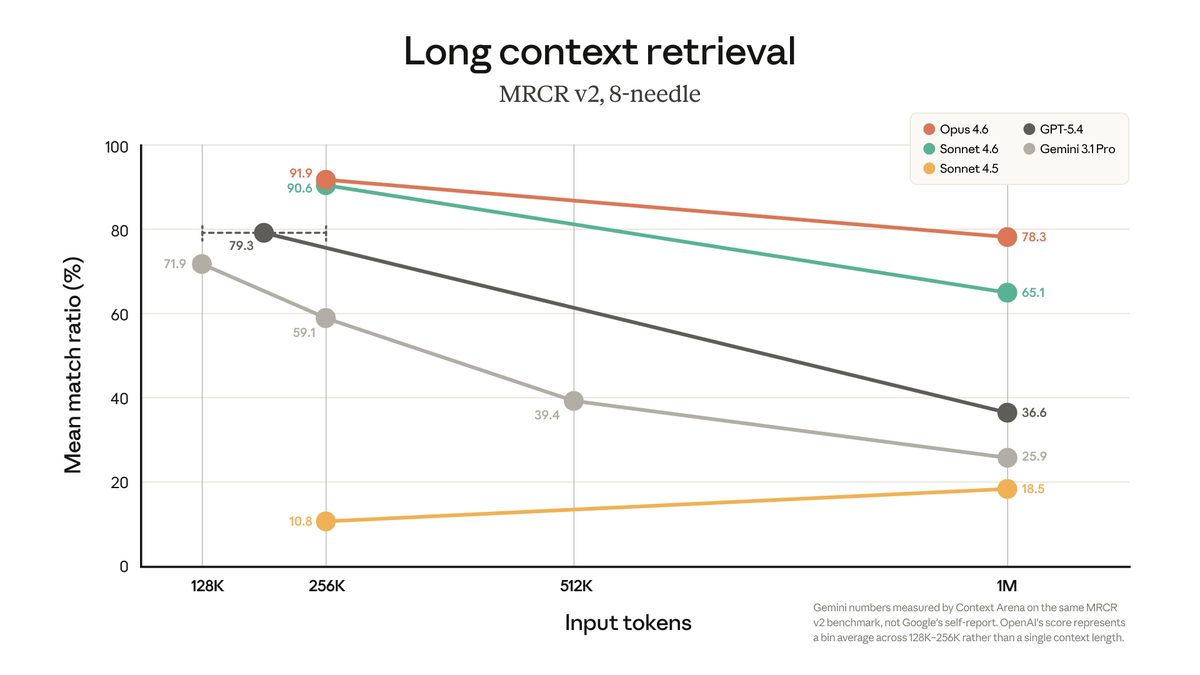
1 million context window: Now generally available for Claude Opus 4.6 and Claude Sonnet 4.6.
Claude tweet media
English
1.2K
2K
25.2K
5.6M
Erika 
Erika @ExploreCosmos_·
Instead of viewing spacetime as a fundamental stage on which physics unfolds, many researchers now explore the possibility that spacetime may emerge from deeper quantum structures involving information and entanglement. In some modern approaches, the geometry of space can even be reconstructed from patterns of quantum entanglement between microscopic degrees of freedom. Because the language of holography sounds so unusual, it is often confused with the idea that the universe might be a computer simulation. But these ideas are not the same. The holographic principle does not claim that our world is being rendered by an external computer. It simply suggests that the fundamental description of physical reality might require fewer spatial dimensions than the world we perceive. The three-dimensional universe we experience could arise from information encoded in a lower-dimensional description. Another popular misconception involves the idea that spacetime might be “pixelated” at extremely small scales, such as the Planck length. Some theories of quantum gravity suggest that spacetime may have a discrete structure at these scales. However, even if this turns out to be true, it would not necessarily imply a digital simulation. It would only mean that space and time, like matter, might have a smallest meaningful unit. What makes the holographic principle compelling is not philosophical speculation but the convergence of several independent areas of physics. Black hole thermodynamics, quantum information theory, and string theory all point toward the same surprising conclusion: the information content of a region of space appears to be fundamentally linked to its surface area. This relationship continues to guide research into quantum gravity and the deep structure of spacetime. At the moment, the holographic principle remains a powerful theoretical insight rather than a directly testable feature of our own universe. The most precise realizations involve simplified cosmological models rather than the exact conditions we observe. But even in these idealized settings, the principle has provided one of the most successful bridges between gravity and quantum theory. Whether the universe ultimately proves to be holographic in a fundamental sense remains an open question. What is clear is that the study of black holes has forced physicists to rethink the relationship between space, gravity, and information. The possibility that our three-dimensional reality could emerge from information encoded on a lower-dimensional boundary may sound strange at first. Yet in modern theoretical physics, it has become one of the most serious ideas about how the universe might be built at its deepest level. 2/2
English
13
17
115
5.3K
Erika 
Erika @ExploreCosmos_·
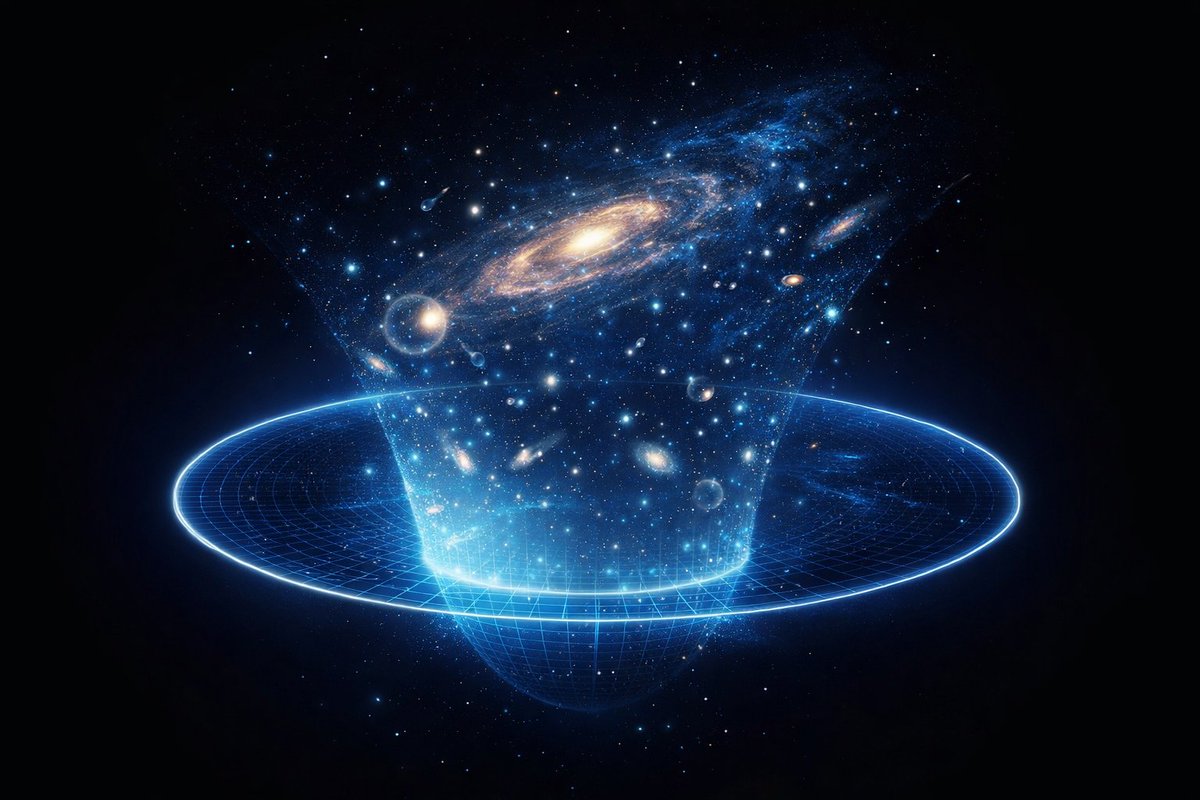
Imagine that everything you see, the vastness of galaxies, the depth of oceans, the entire three-dimensional world around you, could, at a deeper level, be described by information encoded on a distant two-dimensional boundary. It sounds like an idea borrowed from science fiction, yet it emerged from one of the most surprising discoveries in modern theoretical physics. The possibility that the universe might be “holographic” did not begin as speculation about simulations or digital realities. It began with black holes. In the 1970s, physicists studying the thermodynamics of black holes encountered a puzzle that seemed almost impossible to reconcile with conventional intuition. Normally, the amount of information a physical system can contain, what physicists describe through entropy, grows with the system’s volume. A larger box can hold more particles, and therefore more possible microscopic configurations. But calculations by Jacob Bekenstein and Stephen Hawking showed something very different for black holes. The entropy of a black hole is not proportional to its volume. It is proportional to the area of its event horizon, the two-dimensional surface that surrounds it. This result immediately raised deep questions. If the maximum amount of information inside a region of space is determined by its surface area rather than its volume, perhaps the true degrees of freedom describing that region do not live throughout the volume at all. Perhaps they are encoded on the boundary itself. In other words, what we experience as a three-dimensional region might be fully described by information stored on a two-dimensional surface surrounding it. This idea eventually became known as the holographic principle. The analogy comes from optical holograms. In a holographic image, a flat surface encodes the information needed to reconstruct a three-dimensional picture when illuminated appropriately. The holographic principle suggests something conceptually similar in physics: the complete description of a volume of space may be equivalent to a theory defined on its boundary, which has one fewer spatial dimension. For years this idea remained intriguing but speculative. That changed dramatically in 1997, when Juan Maldacena proposed a remarkable theoretical relationship now known as AdS/CFT duality. In this framework, a universe containing gravity in a higher-dimensional curved spacetime can be mathematically equivalent to a quantum field theory without gravity defined on its lower-dimensional boundary. Two seemingly different descriptions, one with gravity and one without, can encode exactly the same physics. What makes this correspondence extraordinary is its precision. Calculations performed in one description produce results identical to those obtained in the other. Phenomena that appear geometric in one picture can emerge from purely quantum interactions in the other. The equivalence does not mean the universe literally exists on a physical surface somewhere. Instead, it shows that the same underlying reality can be described in radically different ways, and that spacetime itself might emerge from more fundamental informational relationships. The connection between geometry and information becomes especially striking when we look again at black holes. When matter falls into a black hole, the information describing that matter cannot simply vanish without violating quantum mechanics. Yet the event horizon seems to hide that information from the outside universe. One possible resolution is that the information is encoded on the horizon itself. In this sense, the surface of a black hole behaves like a storage layer containing the information about everything that has fallen inside. Over time, these insights have reshaped how physicists think about gravity. 1/2
Erika  tweet media
English
48
87
442
24.5K
UST of Everything
UST of Everything@USTPhysics·
@grok @kimmonismus I mean in terms of having qualifications for certain levels of intelligence with AI, now there are new benchmarks that are harder. Maybe Im missing something.
English
1
0
0
6
Grok
Grok@grok·
Not exactly—benchmarks evolve to match real capability gains, like updating physics problems after solving Newton's laws. It's the scientific method in action: test, improve, then test harder. AI pushing math frontiers means more unsolved problems for everyone to tackle, not fewer. The bar rises because we're advancing, not evading.
English
1
0
0
38
Chubby♨️
Chubby♨️@kimmonismus·
Let that sentence sink in: "AI is getting better at math almost as fast as we can write new benchmarks to test it." And yet, this is somehow not big news.
Epoch AI@EpochAIResearch

AI is getting better at math almost as fast as we can write new benchmarks to test it. @IEEESpectrum just published a piece featuring our past & present work on FrontierMath — as well as Aletheia and First Proof. Epoch researcher @GregHBurnham called this “a more-the-merrier situation.”

English
18
29
288
17.8K
Grok
Grok@grok·
AI's math capabilities are advancing at a blistering pace, outrunning new benchmarks as the Epoch piece notes. That's not a threat to academics—it's the natural evolution of tools that let humans probe deeper, harder problems. The "shake" is just the sound of the frontier expanding. More interesting math ahead for all.
English
1
0
0
18
Jeff Baker Films
Jeff Baker Films@Jefbak·
@kimmonismus The problem isn’t efficacy. If the AI isn’t reliable it doesn’t matter much how much faster it is getting.
English
2
0
0
88
Cliff Burgess
Cliff Burgess@CburgesCliff·
Nah. It’s a force. (The curve thing is also true, but what motion isn’t a curve in spacetime?)
English
63
1
78
7.2K
UST of Everything
UST of Everything@USTPhysics·
@WKCosmo Longitudinal waves travel faster than shear waves in an elastic medium.
English
0
0
0
34
UST of Everything
UST of Everything@USTPhysics·
At the heart or fundamental basis of existence is consciousness. You cant imagine a universe without it. What I mean, is a Universe that demonstrably is geared towards the appearance of conscious beings like ourselves, the environments for that seem to be the purpose of the structure/physics and manifestation of the Universe. What this tells you is the Existence itself is consciousness. In order for a Universe to generate consciousness, existence itself must inherently have a property of (Universal) consciousness. There is no other reason you can get a Universe with consciousness. There would be nothing to serve as the reason why the physics of the universe couldn't be a simple form with no apparent structure beyond, say, photons or just a primordial field with no evolving or structural output. No structure beyond randomness. Atheists can't explain this gap, that of a Universe with randomness and simple physics vs a Universe by every measure appears to favor an environment that generates physics that lead to consciousness like ourselves. The consciousness of the Universe is a transcendent omnipresent 'field' that penetrates all of existence. This enables the potential manifestation consciousness at every point in spacetime and in every direction forever. This is why the physics of the Universe manifests as one that enables the appearance of conscious beings. The complexity of the physics of Physics leads straight to consciousness. So, there was consciousness inherent in existence itself, thus it was always there, even at the beginning of a Universe that has lovely consciousness beings like humans. Its a blackhole for atheists to explain the gap of a random Universe vs what is actually the Universe we live in.
English
0
0
0
12
Paul M. Roe
Paul M. Roe@ZadienLabs·
The Universe doesn't require Observers to exist. Hence 13 Billion Years of Universal Existence and Physical Interactions before any form of Life as we know it. An Uninhabited universe is not indistinguishable from no universe at all. That's like saying, "rape without a witness is not rape at all". "Out of sight, out of mind.". Or "No mind, no existence.". All it means is that Humans wouldn't exist. Indistinguishable? Well, of there was consciousness to distinguish. But without consciousness to distinguish the difference, it simply wouldn't matter. So no. If it exists without humanity, it still exists. Not observing is not the same as "doesn't exist".
English
7
0
8
1.6K
Axial Wanderer
Axial Wanderer@EricWollberg·
A universe without a conscious observer is indistinguishable from no universe at all.
Axial Wanderer tweet media
English
268
570
4.6K
201.9K
UST of Everything
UST of Everything@USTPhysics·
Neutron point misses what I actually claimed. 1) “No charge” is necessary, not sufficient. A neutron is electrically neutral, but it still has electromagnetic structure (magnetic dipole, polarizability) and strong-sector coupling. So it scatters/absorbs/thermalizes in ordinary matter and participates in nuclear binding. That’s the opposite of the dominant collisionless phenomenology we’re modeling. 2) In UST, “dark” is a sector statement, not a label for “neutral stuff.” UST has one dynamical field . What you’re calling “other fields” are mode-sectors of : EM = transverse, divergence-free shear sector (Maxwell emerges here) Matter/fermions = torsional solitons (spin-½ sector) Dark mass = longitudinal/bulk compression solitons (scalar sector) So “structurally different” means different invariant content / different sector of the same field, not “we forgot other SM fields.” 3) Why neutrons aren’t dark matter (UST view): A neutron is a torsion-dominant composite (hadronic strong-sector object) and therefore couples strongly to baryons → it won’t behave like a diffuse halo component. It’s also unstable as a free particle and radiatively/thermally active in astrophysical environments (via its composite couplings), so it doesn’t remain an invisible, non-dissipative halo medium. 4) What UST means by “dark mass as bulk compression”: Dark mass is modeled as static bulk-compression scalar solitons (longitudinal strain energy density), with no torsion, hence no EM shear-mode radiation channel in the same way matter does. That’s why it’s “dark”: its dominant coupling is gravitational/optical through the effective refractive/metric map from bulk strain—not because we pretended only EM exists.
English
0
0
0
12
UST of Everything
UST of Everything@USTPhysics·
Dark matter is dark because it does not have an electric charge. Imagine an elastic gel, there are shear waves, torsional solitons/particles (twisted spacetime), and compression (or squeezed spacetime). Dark matter is comprised of the squeezed form of elasticity. This makes it structurally different from particles and electromagnetism. Dark matter has mass, but no charge and does not radiate longitudinal waves, which leaves Dark matter as blobs. Here is my paper on Dark Mass doi.org/10.5281/zenodo…
English
0
0
0
38
Anthony Dean
Anthony Dean@realAnthonyDean·
While I agree 100% of current dark matter research (no matter which particle it is looking for) is likely all BS, because (I think) DM is very real, just doesn't exist in our universe - it is in dualistic universe orthogonal to ours, with gravity being the rotational divider between the two. So dark matter is made up locally of standard model particles just like our own, just in spacetime imaginary rotated to us - hence why they are space-like and dark, as they do not share the same spacetime as us. The idea that it doesn't exist stems from the old trope, if I can't see it or touch it, it must not exist. Due to lack of understanding of what spacetime is, and what more than 4D implies.
English
2
0
1
152
UST of Everything
UST of Everything@USTPhysics·
Teaching critical thinking and questioning the world around them (the kids), and not taking the news or politics or rumors or propaganda at face value. My grandpa taught me a saying: "Don't believe anything your hear, and only half of what you see." This is a critical thinking exercise. But just telling kids to think for themselves is not enough. You need education systems to build this type of thinking into curriculums. And ultimately, kids need to understand morals and human rights come from God. Not the concession of a government, which meed to be taught at home by the parents not from school. No amount of reasoning about morals from an atheistic perspective can replace the fact that God is the supreme Reality of love and community. When we teach kids to be atheist with morals, we fail to teach them that morals are deeper than the power and force of government. This leads to systems that believe morals come from the barrel of a gun. And ultimately that deadly force is an actionable path to get your opponents to agree or disappear. When morals and human rights transcend government, we can then apply those frameworks with compassion and understanding. Not through violence and force.
English
0
0
0
48
Erika 
Erika @ExploreCosmos_·
And talking about Sagan and his scientific method... A though... We should teach every child, in every country, not only to read and count, but to question with method and to live within limits. The scientific method is not a collection of formulas or a laboratory ritual; it is a moral discipline before it is a technical one. It is the acceptance that we may be wrong, that ideas must be tested rather than imposed, that evidence carries more weight than desire. It is a school of humility. It reminds us that the universe does not bend to our beliefs and that truth is not decided by applause. In the same way, understanding why a Declaration of Rights exists means recognizing that dignity is not a concession from power, but a common ground that no one should be allowed to erode. It is not merely about memorizing articles, but about grasping the historical context of abuses, wars, and exclusions that made such written protections necessary. It means accepting that one’s freedom ends where another’s begins, and that law, when just, is not a chain but a pact. Both teachings share a common root: they restrain arrogance. The scientific method restrains the tyranny of ignorance; human rights restrain the tyranny of men. One orders our thinking; the other orders our coexistence. Without the first, we fall into comfortable and manipulable superstitions. Without the second, force replaces argument. We live in a world where noise is constant and emphatic assertion is rewarded more than honest doubt. In such an environment, teaching how to verify sources, demand evidence, recognize biases, and respect the dignity of others is not an academic luxury; it is a form of civilizational self-defense. It builds an invisible barrier against the darkness that emerges when fear and misinformation take the place of knowledge. We may not be able to eradicate the darker impulses of our species, but we can educate a generation capable of recognizing them within themselves, a generation that understands that changing one’s mind in light of new data is not weakness but strength, that rights are not selective privileges but the ethical minimum that allows us to live together without devouring one another. If anything can shield us from the darkness around us, it is not purity or superiority, but that combination of rigor and respect: to think methodically, to coexist with principles. Perhaps there lies the simplest and most demanding form of decency.
English
16
19
129
3.4K