

Aashish Bansal | brandecode
9.1K posts
Aashish Bansal | brandecode
@Unbelted
@Abiertales' dad. MVP at @brandecode. Ex-Head #SocialMedia @Infosys. #DigitalMarketing Ex-@Ogilvy. Branding. UX. Humor. Storytelling.
Bangalore เข้าร่วม Nisan 2009
876 กำลังติดตาม1.1K ผู้ติดตาม


On #AnantAmbani’s birthday, efforts through Anant Arham Aahar have stood out as part of #AnantSeva…
Children are being served meals across locations, making sure they are included in the celebrations too. It’s nice to see how widely these efforts have been carried out. Yeh ek aisa gesture hai jo seedha dil tak pahunchta hai.
Such initiatives ensure that joy is shared in the most meaningful way. Really thoughtful to see this kind of approach.
Jaipur, India 🇮🇳 English
Was in Chennai this weekend and this is what I observed:
1. Cleaning crews working at night
2. Another set of cleaning crews working the morning shift
3. Clean roads
4. Not all roads were as smooth as the arterial ones
5. Posters are a menace everywhere. Metro pillars are the preferred places to showcase the posters.
6. Very few flex banners, considering that it’s election season
7. Elliot’s Beach was unrecognisable from 15 years back!
8. Eateries catering to muliple cuisines have grown exponentially. I remember Cream Center being one of the only places serving multi-cuisine fare.
9. Nalli at Chennai still holds fort
10. Chennai Silks seemed to have gone down the synthetic material route
11. Lots of new chain hotels.
Stocked bars!
12. Traditional restaurants still serve amazing food
13. Overheard a Chennai family order Paneer 65!
Observations based on Velachery, Elliott’s Beach, Mylapore.
English
Got the City for the reason you have mentioned. D Max was under consideration.
The challenges of getting in and out of the car will increase with their age and health conditions. My parents find it easier to move out from a Shoffr BYD than the City now. Things were different 7 years ago.
English

Heart says Thar Lelo
Parents comfort says Seltos Lelo
Ease of comfort for getting in and out for parents says Honda City Lelo
😭
English
I’m guessing that Starlink was brought on-board just so that the pun can finally be posted 😆
Elon Musk@elonmusk
Some might call this a cunning move 😉
English
🫡💪
Cdr Abhilash Tomy KC, NM@abhilashtomy
Naval HQ asked for my ETA at Mumbai when I was at Cape Horn. I wanted to tell them sailboats have destinations, not ETAs. I gave them a holiday instead. On 26 January, I was rounding the Horn, hoisting the tricolor just a mile south of that storied rock. Amidst the gale of congratulatory signals, Navy HQ sent a query only a bureaucrat could: What is your ETA? With half the globe still beneath my keel and the winds unpredictable, the salt in me wanted to write back, that sailboats had destinations, not ETAs. But my previous mails had already tested the headquarters' patience for humor and sarcasm. I decided a bold calculation was safer than a cheeky proverb. If the past was an indicator, my voyage was being steered by a celestial ledger. We had slipped moorings on Kerala Foundation Day, rounded Leeuwin on 12-12-12 (the Mayan apocalypse), passed New Zealand on Christmas, crossed the International Date Line on New Years and hit the Horn on Republic Day. By that logic, landfall had to be a holiday. I checked the charts and staked my reputation on Easter Sunday, with All Fools’ Day as the backup. The boat did not disappoint. I turned 34 years old at 34°W. The hull turned four years at 4°W. We crossed the Prime Meridian on Valentine’s Day, where a heavy swell put me in a poetic mood; remembering Pablo Neruda whose home I had once visited, I felt the ocean wanting to do to me what spring does to cherry trees. We rounded the Cape of Good Hope on Copernicus’ birthday, passed Mauritius on its National Day and crossed the Equator on the Equinox. Out of pure respect for the sun, I permitted it to cross the line ahead of me. Finally, as predicted, we made landfall on Easter Sunday. I was received by friends and naval brass in an intimate reception hosted onboard INS Delhi by the C-in-C Admiral Shekhar Sinha @shekhar19541, who shook hands in congratulations and uttered the words: You have created history out of geography. 151 days at sea had an emaciating effect on my sea-legs, so much so that two Admirals had to hoist me up the ladder of INS Delhi. By the time I stepped onto firm land, it was past midnight, All Fools’ Day. The irony was perfect. Before casting off, immigration officials at Yellow Gate had refused to stamp my passport because my destination was Mumbai. They claimed it made no sense to leave for where I already was. Yet I returned five months later, 20kg lighter, skin and hair bronzed by salt and sun. When I went to be stamped back into existence on the 1st of April, the official’s hands trembled as if seeing a resurrection. In his shock, he stamped my passport upside down. I had left Mumbai to find Mumbai, but found myself instead. I found that Melville was prescient, having foretold with the utmost clarity of a clairvoyant exactly what I would feel over a century and a half later: Here was a man some twenty thousand miles from home, by the way of Cape Horn that is... and yet he seemed entirely at his ease; preserving the utmost serenity; content with his own companionship; always equal to himself. Today, that story is exactly 13 years old. @indiannavy @CaptDKS
ART
Hi @IndianOilcl, what is the waiting time for an LPG cylinder to be delivered after the invoice has been generated? 7 days and counting and the agency, Mahabala Gas Agency, has mentioned that it will take 10-14 more days.
Your communication doesn’t match the ground reality @PetroleumMin. Is your agency hoarding and diverting the cylinders?
English
@prakdadlani @law_ninja Dropped you a DM and shared with a client who has built something like this, covering the entire procurement to pay valie chain + getting visibility into data for the manufacturing process.
English
Spot on!! @law_ninja 🔥
I am living this reality as an Desi SME founder myself.
We’ve been actively hunting for AI solutions to automate our workflows.
Quotes range from ₹2.5 lakhs per month from one, ₹20 lakhs for a single project from another.
For most MSMEs, that’s simply not feasible.
We run on WhatsApp, Excel, and Jugaad. Tools are cheap or free. The talent exists. What’s missing are individuals who actually come in, understands our processes, and builds practical, AFFORDABLE automation.
63 million MSME's. 250 million jobs.
This is not a niche, it's India’s biggest untapped AI opportunity.
AI Workflow Architects, builders, and solution providers if you’re reading this, the market is waiting.
Come talk to real SMEs like us. Take a reasonable monthly retainer and become our go to AI solutions partner. Build practical proof of concepts with us, learn from real use cases, and then scale those solutions across millions of businesses.
The upside for Bharat is enormous.
The gap is massive. Let’s fill it.
DMs open.
Ramanuj Mukherjee@law_ninja
Indian MSMEs run on WhatsApp, Excel, and trust. AI hasn't touched them. Yet. India has 63 million MSMEs. 31% of GDP. 250 million jobs. Ask any owner in Surat, Ludhiana, Tirupur, or Nagpur if they use AI in their business. Most will say yes. They mean WhatsApp. Or someone on their team opened ChatGPT once. That is not automation. That is not a workflow. That changes nothing about how the business actually runs. Real AI deployment, the kind where a process runs without a human triggering it, where data moves between systems automatically, where follow-ups go out without someone typing them, that is essentially at zero in Indian MSMEs. Not 7%. Not 2%. Essentially zero. Why this is the biggest untapped market in India right now. India's large enterprises are moving fast. 47% of them have AI running in production (EY-CII, 2025). Their MSME suppliers, distributors, and vendors? Still on Excel. Still on manual data entry. Still on phone calls to confirm orders. The gap between enterprise and MSME on AI is not a technology problem. It is a deployment problem. The tools exist. n8n, Make, Claude API, GPT-4, Zapier. All available. Most either free or under Rs 5,000 a month. What doesn't exist is a person who walks into the MSME, understands the workflow, and builds it. That person is the AI Workflow Architect. What this person actually does. Real example. A garment exporter in Tirupur processes 200 orders a week. Each order needs: Buyer email parsed PO data entered into Tally - Production schedule updated - Shipping documents generated - Buyer follow-up sent Currently: 2 data entry operators. 8 hours each. 5 days a week. - An AI Workflow Architect builds this in 4 weeks: - Email parser using Claude API or GPT-4 - Tally integration via API - Auto-generated shipping docs - WhatsApp follow-up bot Cost to client: Rs 2-3 lakh one-time. Rs 15,000 per month to maintain. Savings to client: Rs 40,000 per month in salaries. ROI in 6 months. This is not complicated. It is not being done because nobody is walking in to do it. The IT crisis and the MSME gap are the same story. Fresher IT hiring: 600,000 in FY22. Down to 120,000 by FY25. An 80% drop in three years. (Source: Xpheno) TCS cutting 12,000 jobs. NITI Aayog warns of 15-20 lakh IT jobs at risk. Everyone is looking at that number and panicking about what's ending. Nobody is looking at the 63 million businesses that need someone to deploy AI into their operations. The same disruption that kills the BPO seat creates the AI deployment market. These are not separate events. They are the same event, viewed from different angles. The skill set is learnable. In months, not years. - No CS degree needed. No advanced Python. - Prompt engineering learning time: 2 weeks - One automation platform like n8n or Make: 3-4 weeks - API basics, connecting tools to each other: 3-4 weeks - Reading a business process and mapping it: ongoing Three months of focused learning. Then you go find one MSME that has a painful manual process and you fix it. This is the time, this is the opportunity. India's future for next 3 decades will depend on this.
English
@ShivrattanDhil1 Tranquility - it’s in the name 🙂
English

Completely cut off from the chaos no big cities around, just pure tranquility. A place where peace meets the true essence of architecture.
Still hidden from the masses, untouched and unaware to most.
I won’t name it, or I’ll get blamed for bringing the crowd but trust me, it’s one of India’s finest gems! 🫶🏻💯


English

@Kenu73 Pretty much at all the places - Hanoi, Da Nang, Hoi An, HCMC, and more so beyond the cities when out on excursions.
English

@Unbelted Interesting where was this? I saw this in Japan and China but couldn't see in Vietnam.
English
Vietnamese English is one the toughest for me, the MTI is strongest that I have seen.
English
@nitinwelde If you are headed to Ho Chi Minh City, take some time out for the War Remnants Museum. If in Da Nang, visit the Museum of Cham Sculpture.
English

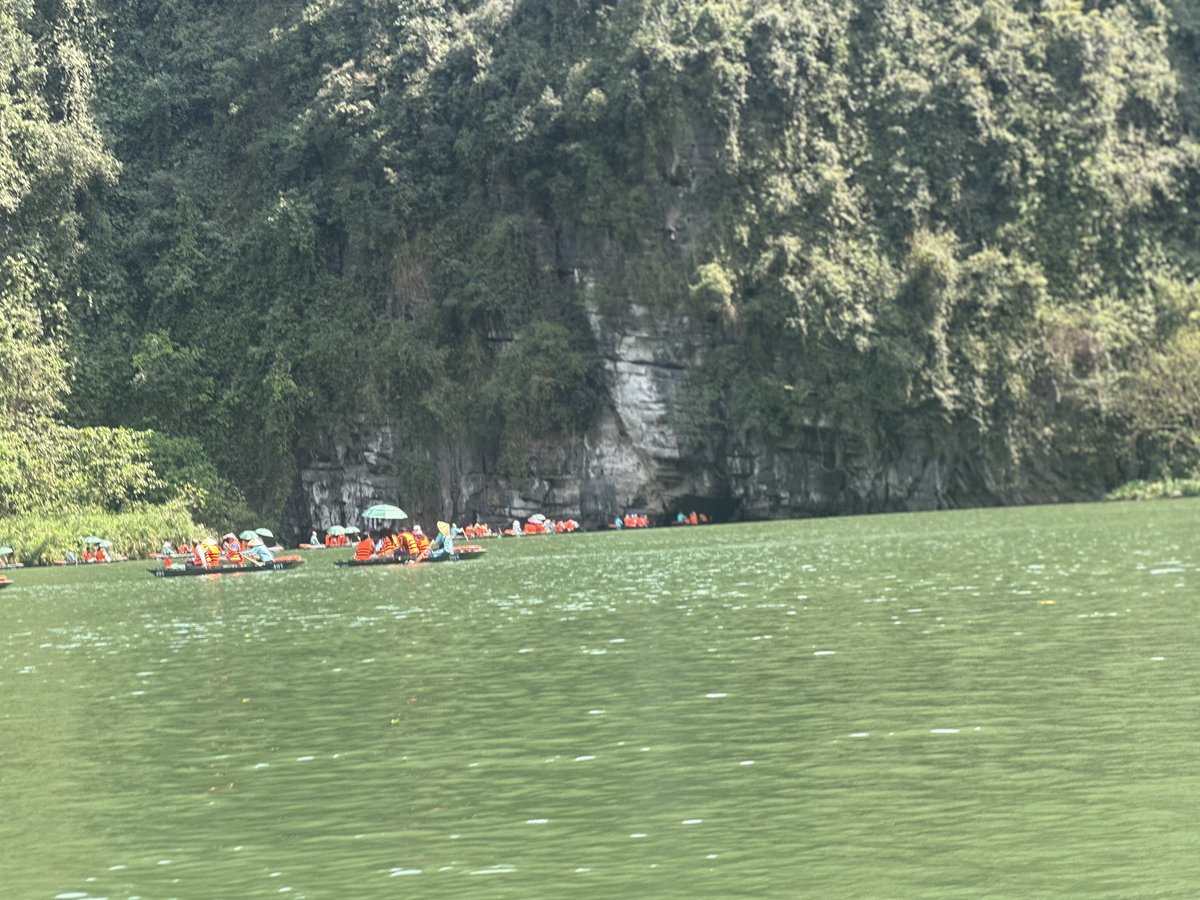
- This boat ride was real fun. Very beautiful landscape.
- The speed of the language is quite fast.
- In your opinion which Indian language is fastest when it comes to speaking.
English
I’ve started reading the fairly high number of unread books that I have gathered over the years. And I am going old school, just the way I would, during my school years - with a physical dictionary next to me and a notebook to take notes.
It’s phenomenal how the brain gets rewired to rebuild lost habits even after decades.
English
@keerthisiddeshw @girishmallya You can do it today to get closure 😆
English

@Unbelted @girishmallya Thank you for sharing this
I'll try using AI next time to see what's the best shoe it will recommend
English
What's your take on asics gait analysis and why do you think they sell few particular shoes like kayano/GT?
گریش Girish Mallya@girishmallya
@keerthisiddeshw AI analysis of the shoe sole is a much better option to analyze. It got mine spot on. I have heard about this problem with Asics gait analysis
English
@ShreyasTambe1 @vjshankar Probably meant 'face'
Stumbled on this post - more power to you
English
@vjshankar Fake is not recognised??What do you mean by that?
English
Folks, go and buy stuff from @GoAthlos. Bought my 5” distance shorts from them before TMM 2026 with apprehension.
Ran a few long runs in them and they were swapped in as the race-day shorts with the big name existing race day shorts going out. No chafing. No discomfort.
Good luck with what you are building, @wanderingraptor!
Pravin Dhake@wanderingraptor
Been 2 weeks since our Meta ad account was locked out, and yet revenues are steady. On one hand, glad we've built @GoAthlos not to be completely dependent on Meta, but also dreading that it's a matter of time before organic momentum dies. Amidst all this, I've managed to stay surprisingly calm. Ask me anything about geopolitics, Urdu poetry, fiction, or fabrics.
English
@Unbelted I don't think I will be staying in hostels. Not for me. Need a room of my own.
English
Planning a solo trip this summer to Ireland.
2-3 weeks.
AI suggested Doolin, Dingle, Killarney for the bulk of the trip.
London / Dublin for flying in / out.
English