
Works in Progress

2.5K posts

Works in Progress banner
Works in Progress

Works in Progress

@WorksInProgMag

Works in Progress is a magazine of new and underrated ideas to improve the world. Subscribe to our new print edition now. We are proud to be part of @Stripe.

เข้าร่วม Ocak 2020
26 กำลังติดตาม23.5K ผู้ติดตาม
ทวีตที่ปักหมุด
Works in Progress
Works in Progress@WorksInProgMag·
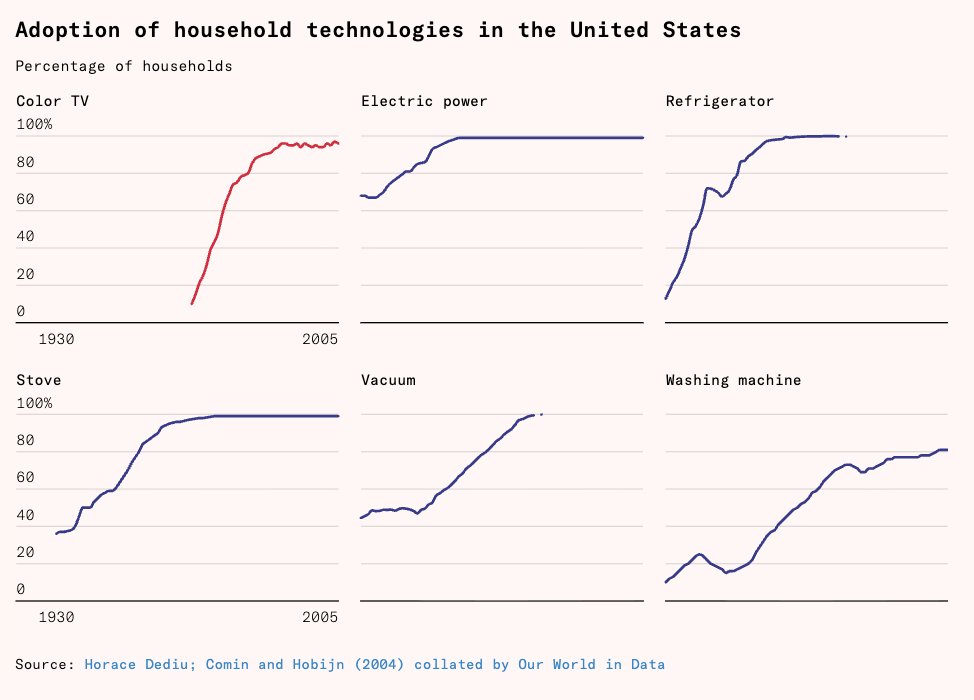
Television was the most eagerly anticipated technology of the postwar years. But it faced a coordination problem: programs were needed to attract viewers, viewers to attract advertisers, and advertisers to fund programs. Americans, accustomed to free radio, had no appetite for anything resembling the BBC license fee. worksinprogress.co/issue/how-tv-l… The solution, as it turned out, was live sports. Television sports are easy to produce, as they come with their own venues and followings. While early televisions were too expensive for households, bars discovered that a single set could attract enormous custom. The desire to watch sports drove an extraordinary expansion in television sales. In doing so, it solved the coordination problem and probably started the television age. New at Works in Progress from @vpostrel.
Works in Progress tweet media
English
13
75
476
34.4K
Works in Progress
Works in Progress@WorksInProgMag·
Due to its extremely fragmented system of land ownership, Japan faced some of the world’s toughest planning problems when it needed to build modern infrastructure. They solved this by letting homeowners replan whole neighborhoods by supermajority vote. You can now listen to our piece on Japanese land readjustment and learn about similar systems in Germany, Israel and Angola. How to redraw a city by @AnyaM8_ is available on Works in Progress Out Loud. Spotify: open.spotify.com/episode/5DQeHk… Apple: podcasts.apple.com/gb/podcast/how… YouTube: youtube.com/watch?v=FCAX-2… Substack: worksinprogress.news/p/how-to-redra…
YouTube video
YouTube
English
2
24
152
50.1K
Works in Progress
Works in Progress@WorksInProgMag·
Whereas other plants have a single most useful element, wild cabbage has many. This makes it perfect for breeding. New in Works in Progress by Alex Wakeman.
Sam Bowman@s8mb

Wild cabbage is the 'root' of many other vegetables – kale is the closest thing we eat to the original. Nearly all the spin-offs, including Brussels sprouts, kohlrabi, cauliflower and gai lan, were developed by our prehistoric ancestors. Why are cabbages so good for this kind of selective breeding? The more inbreeding you do to create new varieties, the more harmful mutations you repeat. Whereas some species have only one copy of each gene – making most mutations fatal – and humans have two, some cabbage varieties have three or even four copies, which makes them extremely resistant to harmful mutations. That means you can do intensive inbreeding of them with less of a risk of corrupting the strain with mutations. We don't know exactly where cabbages originated, but language and myths give us a clue. Ancient Greek texts include recipes, myths about cabbages growing from the sweat of Zeus, and sayings such as ‘μὰ τὴν κράμβην’ (roughly translating to ‘by the cabbages!’). They also distinguish between curly leaved cabbages and flat leaved kinds. Ancient Egyptians, Celts and Fertile Crescent cultures don't mention cabbages at all. New at Works in Progress, the bio-history of the world's most versatile vegetable. worksinprogress.co/issue/sculptin…

English
0
1
10
1.9K
Works in Progress
Works in Progress@WorksInProgMag·
Works in Progress articles are now available in audio, read by @StuartJRitchie. New episodes of Works in Progress Out Loud will be released each week, including pieces from new issues and the back catalogue. Today's episode is "Two Is Already Too Many": why South Korea's fertility has crashed and what other countries can do to avoid the same fate. Listen and subscribe now. Spotify: open.spotify.com/episode/60b9KO… Apple: podcasts.apple.com/gb/podcast/two… Youtube: youtube.com/watch?v=lMjO0C… Subsack: worksinprogress.news/p/introducing-…
YouTube video
YouTube
Works in Progress tweet media
English
7
7
51
37K
Works in Progress
Works in Progress@WorksInProgMag·
Rather than expand the NIMBY coalition, reformers should try to divide it. Most objectors are self-interested and support development near them if they benefit from it. New in Works in Progress, by @davidrfoster0 and Joseph Warren.
Sam Bowman@s8mb

Some NIMBYs are unreasonable fanatics. But most are not: they just want what's best for their neighbourhood. Separating that majority from the minority might be how we can dismantle the vetocracy that has taken hold across most of the Western world. worksinprogress.co/issue/the-nimb… There are big strides being made towards upzoning in most developed countries. The mood has shifted decisively and nearly all sensible people now agree that we need many more homes in prosperous cities. But even the biggest successes can falter if the NIMBY coalition can regroup and create new barriers to development after pro-housing reforms have happened. • Ambitious upzoning reforms have happened in Oregon, Minneapolis, California and Montana but still haven't delivered significantly higher housebuilding because of other barriers that NIMBYs have resorted to instead. • After passing parliament with bipartisan support, New Zealand’s Medium Density Residential Standards were reversed following public backlash, political infighting, and a change of government. • New South Wales Premier Chris Minns abandoned a sweeping transit-oriented development plan after pushback from local governments and the Greens. • The Tories not only retreated from a major pro-development planning reform – which I predicted would fail in advance – but left land use rules *stricter* than they had been before. Unpicking the NIMBY coalition can help to make sure these efforts succeed and stick. New at Works in Progress, how new developments that enhance the places they happen in can give the reasonable majority safe, liveable and stable neighbourhoods – and 'drain the swamp' around the fanatics who will never be happy.

English
0
2
4
2.2K
Works in Progress รีทวีตแล้ว
Sam Bowman
Sam Bowman@s8mb·
Ending Europe's stagnation might be the most important thing in the world right now. Capitalism and liberal democracy have their deepest roots in Europe, but its economic sclerosis is making it irrelevant. • Five US companies spend more on R&D annually than the entire public sector of every European country combined. • Europe's AI sector is worth less than one hundredth of America's. • It is five times more expensive to fire someone in Germany or France than in America. Staff turnover in the US is ten times higher than it is in Germany. • There is no shortage of European entrepreneurs – the problem is that many of them are moving away to set up their businesses. One in ten US startups has a European co-founder. • EU countries shut down 80 gigawatts' worth of coal-fired power plants during the 2010s, with most of the shortfall being made up by expensive, unreliable wind and solar power. • The EU charges about six times more per ton of carbon than China does, and about 50 percent more than California. Most US states don't price carbon emissions at all. On the Works in Progress Podcast, I sat down with @pietergaricano and @Aria_Babu to talk about what's gone wrong and what Europeans can do to return to the growth and dynamism that once made Europe the world's preeminent civilization. Listen now! Spotify: open.spotify.com/episode/1rKwPY… Apple: podcasts.apple.com/gb/podcast/why… Youtube: youtube.com/watch?v=_JGhRC… Substck: worksinprogress.news/p/why-europe-h…
YouTube video
YouTube
English
14
35
160
30.1K
Works in Progress
Works in Progress@WorksInProgMag·
The new issue of Works in Progress is now out, with pieces on how labor law holds back Europe, the reason why communist reformers usually failed, why we live in the golden age of vaccines, and much more. worksinprogress.news/p/issue-22-why…
Sam Bowman@s8mb

Works in Progress issue 22 is live. worksinprogress.co With essays on: • Communism had its optimistic, pro-growth reformers too, but they always failed. Today's would-be reformers can learn from them. • Marriage customs very different to our own, including the "menstrual huts" used by the Dogon people of Mali to reduce the risk of cuckoldry. Apparently, it works! • How one ugly shrub gave us cabbages, broccoli, Brussels sprouts, kolrahbi and cauliflowers. Gee, thanks. Plus: why labour laws hold back European tech; how Victorian cities could 10x in under a century; the gold plating of American water; and why today is a golden age of vaccine development. Read now! worksinprogress.co

English
1
3
18
3.4K
Works in Progress รีทวีตแล้ว
Pieter Garicano
Pieter Garicano@pietergaricano·
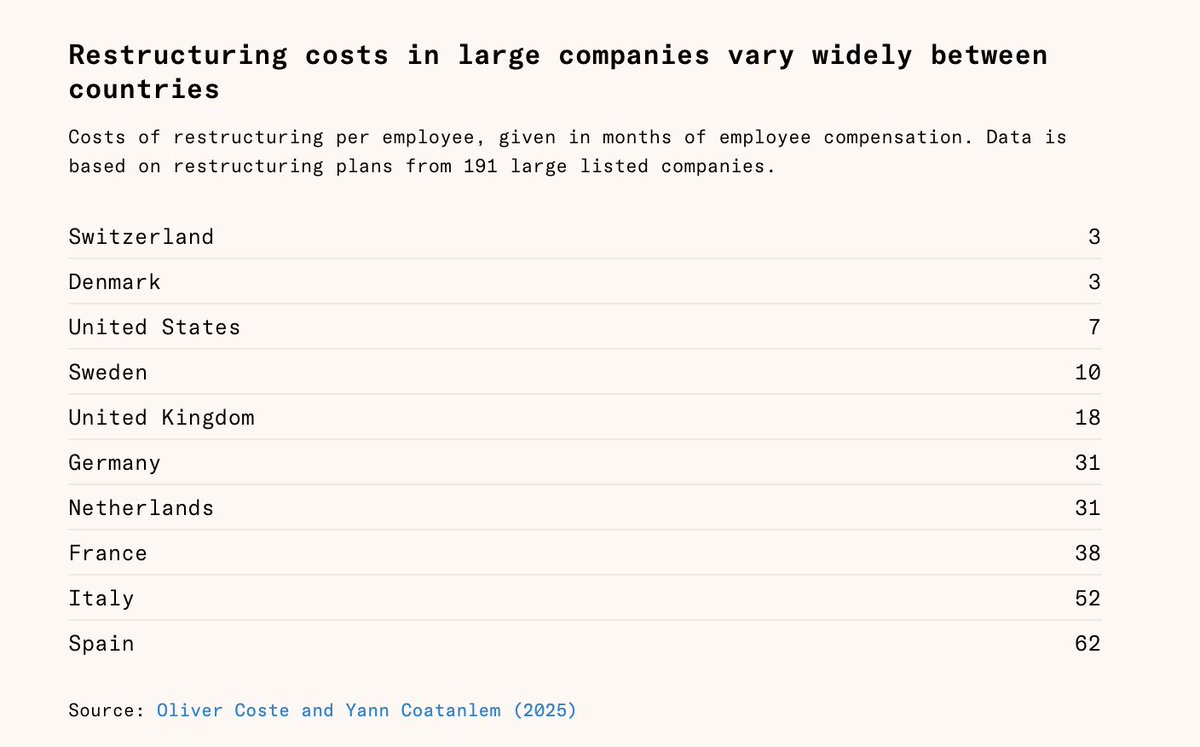
Why don't European companies innovate? It is common to blame expensive energy, high taxes, anti-growth politicians, interest groups, and green regulations. But California has the same problems, and has created the world's most innovative companies. Europe's problem is labor law. Compared with America, it's far harder to let workers go when a business doesn't work out. worksinprogress.co/issue/why-euro… - It costs a large company roughly four times more to fire a worker in Germany or France than the US. - German law requires employers to consider age, years of service, family obligations, and disability status when deciding who to lay off. Employees who would be least impacted by losing their job are prioritized for dismissal. - German employees who take on a caregiving role are fully protected from dismissal for two years from the date they begin caregiving. - Factory closures in Germany regularly lead to payments of over €200,000 per employee. - French companies must be prepared to show a court that their financial results are struggling enough to make layoffs necessary. - To avoid the difficulties of formal dismissals, many European companies entice workers to depart voluntarily, with payouts of up to four years' salary. Taken together, a German worker is ten times less likely to be fired in a given year than an American worker. This high cost of firing makes failures more expensive. It pushes big European companies away from taking risks and leads them to concentrate on safe, unchanging areas. Europe has the ingredients needed to succeed. Its citizens are educated and inventive; it has excellent infrastructure and the rule of law; and its culture is not that different from the one it had fifty years ago, when its companies were world-beating. If Europe wants to a Tesla or a Google, it only needs to make it cheaper for companies to fail. My new piece for @WorksInProgMag.
Pieter Garicano tweet media
English
134
258
1.2K
422.1K
Works in Progress
Works in Progress@WorksInProgMag·
Nuclear power was meant to be the energy of the future. Now, it is expensive, maligned and unpopular. In Episode 11 of the Works in Progress podcast, Ben, Sam and Alex discuss what went wrong with nuclear in most of the world – and what went right in France.
Sam Bowman@s8mb

Nuclear power is back. After decades of stagnation, people are starting to wonder how we can build nuclear reactors as quickly and cheaply as we did in the 20th Century I sat down with @chalmermagne and @bswud to talk about why nuclear power can be so good, why it flopped, and how to get it back again. We discuss: • The astonishing energy density of uranium – 100g of it produces the same energy as 1.5 tons of coal – and why it matters • Why nearly every country in the world forgot how to do cheap nuclear at the same time • How the French state built 37 reactors in ten years • Why even solar power optimists should want a nuclear renaissance Plus: Why nuclear meltdowns aren't as scary as people think! Listen now. Links below! Spotify: open.spotify.com/episode/2ZFBC2… Apple: podcasts.apple.com/us/podcast/wor… Youtube: youtube.com/watch?v=xkQ6-k…

English
4
0
19
3.5K
Works in Progress รีทวีตแล้ว
Sam Bowman
Sam Bowman@s8mb·
Just off the press:
Sam Bowman tweet media
English
60
131
3.3K
123.1K
Works in Progress
Works in Progress@WorksInProgMag·
Diphtheria, measles, rabies and polio are just some of the diseases that have been almost eradicated thanks to vaccines. The first vaccines were produced by sharing pus from smallpox pustules, or by injecting brain tissue from rabid dogs into rabbits' brains. Today, thanks to genome sequencing and electron microscopes, we can design vaccines rapidly and precisely to resemble elements of the viruses they protect against, but without any risk of infection. In the last five years alone, we've developed the first effective vaccines against four new diseases. And the rate of progress is speeding up. The golden age of vaccines is ahead of us. New at Works in Progress from @salonium. worksinprogress.co/issue/the-gold…
English
1
9
37
8.2K
Works in Progress รีทวีตแล้ว
Ben Southwood
Ben Southwood@bswud·
What if there’s a way to have a whole life trial on any new drug, available right now? High rates of consanguinity in certain communities means almost any genetic mutation that’s compatible with life exists currently. Drugs work similarly to genetic mutations in that they often ‘switch off’ the production of a protein — the same way someone with a mutation in the gene that produces that protein exists — almost as if they’re naturally taking the drug and have been their whole life. PH1 sufferers lack an enzyme which causes kidney stones that eventually build up, leading to kidney failure and death. Scientists wondered if creating a drug that blocks another enzyme could prevent these stones from forming. They now want to know: 1. Is this drug safe? 2. Is it safe to take forever? Enter a British Pakistani woman found by chance on the Genes and Health cohort (a database of ethnically South Asian people who are much more likely to have homozygous genetic mutations due to consanguinity). She naturally lacked the enzyme which the proposed drug blocks, equivalent to being on this drug since birth. The fact that she had lived a healthy life proved it could work The reverse is also true: if scientists fail to find a single living person in this database with a mutation equivalent to a drug then this is strong evidence that that drug will lead to death. We can then skip fruitless and expensive trials and focus on drugs which work. Who’d have guessed consanguinity could be the key to accelerating saving lives? worksinprogress.co/issue/natures-…
English
2
10
51
9.6K