
ทวีตที่ปักหมุด
ANTONIO OCHOA
12.5K posts

ANTONIO OCHOA
@a8anto
Permanentemente experimentando vivencias
Chicago Il เข้าร่วม Mayıs 2011
82 กำลังติดตาม3.8K ผู้ติดตาม

#1: U.S. farmers produced an INCREDIBLE 430+ MMTs of corn in 25/26!!!
That was over 40 MMTs OVER the previous record ~390 MMTs!!!
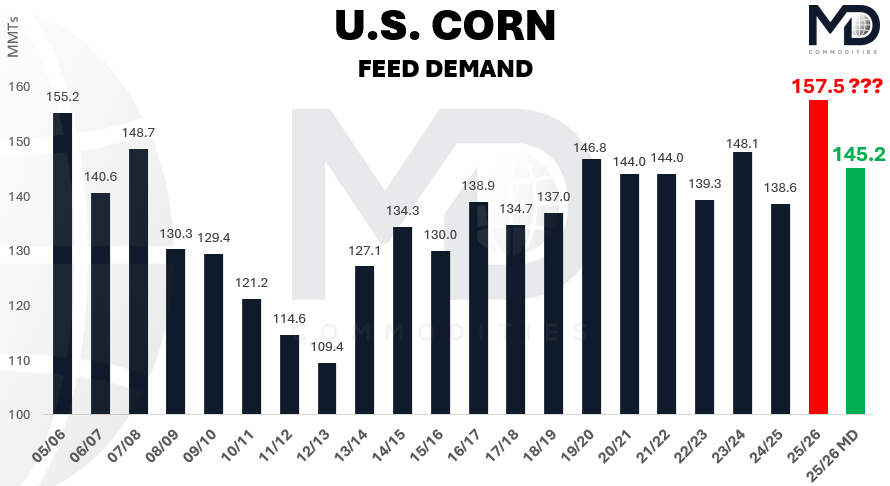
#2: FEED DEMAND is OVERSTATED by AT LEAST 10 MMTs!
That's correct. The USDA has plugged in a feed demand # completely out of touch with reality
So even though US 25/26 corn EXPORTS should be adjusted HIGHER by 3-5 MMTs...
FEED DEMAND should be REDUCED by AT LEAST
10-12 MMTs, when it's all said and done
Therefore, unless one believes there are MAJOR revisions for the 25/26 crop later in '26 (which is doubtful)...
... 25/26 U.S. CORN ENDING STOCKS should still hover ~2.3 - 2.4 bb or 58 - 61 MMTs, which would be a new ALL TIME HIGH!
FWIW, that is a VERY LARGE STOCK CUSHION going into 26/27

English

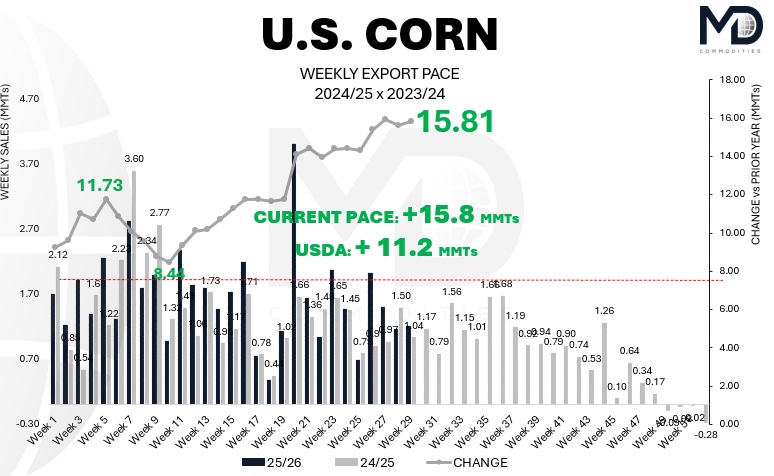
🧵U.S. CORN EXPORTS ON A TEAR!
25/26 U.S. Corn exports to set a NEW RECORD, by far!!!
US Corn Exports are on a tear!!! Should easily reach 87+ MMTs in 25/26!!!
For reference, the US has only once exported over 70 MMTs, in 24/25 when it shipped 72.
In 22/23, it shipped out only 42 MMTs.
Hence,
The U.S. should export over DOUBLE the corn it exported 3 years ago!!!
While that is an incredible feat...
...it still won't be enough to prevent U.S. CORN STOCKS from likely reaching a new ALL TIME HIGH ~2.3+ bb or nearly 60 MMTs!!!
here's why... 🧵


English
ANTONIO OCHOA รีทวีตแล้ว

EPA / RVO / Soybean Oil / Meal / Soybeans
Pay Attention⚠️
The "speculative elastic band" is extremely stretched, without any actual fundamental justification whatsoever
Today's announcement brings nothing "new" to a market that "priced in" expectations well above REALITY
Pedro H Dejneka@PHDChicago
Soybean Complex (beans, oil, meal): Funds RECORD LONG! Why this shall not end well for them, again... - Soy world stocks RECORD HIGH - US bean exports won't ever be the same (no, CH won't "save the day") - Soyoil story is overhyped - US soy are increase - etc... The SPEC BOAT is starting to crack... Lookout
English
ANTONIO OCHOA รีทวีตแล้ว

@shanaka86 Mr. Musk is laughing and laughing and laughing.
space with endless energy, no cost to refrigerate, and no stupid wires.
what a brain
English

JUST IN: Iran just threatened to cut the undersea internet cables running through the Strait of Hormuz and the Red Sea.
Ninety-five to ninety-seven percent of global internet traffic does not travel by satellite. It travels through physical glass fibres buried one to two metres beneath the seabed. Your bank transfers. Your stock trades. Your cloud computing. The data flows connecting every financial market on earth to every other financial market. All of it runs through cables laid across the same shallow waters where the IRGC is currently operating a selective toll regime and collecting yuan for passage.
The cables at risk per TeleGeography: FALCON, Gulf Bridge International, Europe India Gateway, SEA-ME-WE 6, AAE-1, and FLAG in the Hormuz corridor. EIG, AAE-1, Seacom, SMW-4, SMW-5, SMW-6, IMEWE, and 2Africa Pearls in the Red Sea. These are not obscure regional links. They are the backbone of global digital commerce connecting Asia, Europe, the Middle East, and Africa.
The IRGC stated on March 28: “Critical infrastructure in Hormuz and Red Sea will not be spared if aggression continues.”
No cable has been cut. Google and Meta have activated contingency rerouting. The threat is credible as asymmetric signaling but execution is high-risk and likely a bluff. Here is why.
In 2008, eight cables were severed off the Egyptian coast. Seventy to eighty percent of Middle East-to-Europe traffic went dark. Repairs took three to eight weeks. In 2024, Houthi-related anchor drags in the Red Sea damaged four cables. Repairs took months. Both incidents were almost certainly accidental. Deliberate state-sponsored cable sabotage at scale has never been executed because the consequences are mutually destructive: Iran’s own connectivity depends on these same cables, and any confirmed cut would trigger immediate US, UK, and French naval retaliation from fleets already in theatre.
But the threat itself is the weapon.
Cable operators are rerouting. Rerouting costs money. Insurance on cable infrastructure is repricing. Every institution that relies on sub-40-millisecond latency between Asian and European financial centres is now running contingency scenarios that did not exist 28 days ago. The threat creates friction in the global financial plumbing without requiring a single fibre to be severed.
And the beneficiary of the threat is sitting on a Trump-Modi phone call discussing Starlink India approval.
Starlink’s LEO constellation of over 9,500 satellites provides resilient broadband via phased-array terminals that electronically steer narrow beams to avoid jamming. Iran has deployed GPS spoofing and RF noise against Starlink since January. Packet loss spiked to 30 to 80 percent. Starlink countered with firmware updates and beamforming nulls that reduced loss to usable levels. The arms race is real but Starlink is winning it.
Starlink Maritime is already deployed on tankers rerouting around the Hormuz corridor. Major shipping lines are equipping vessels with flat-panel terminals delivering 100 to 220 megabits per second at 20 to 40 milliseconds latency. SpaceX is reportedly filing its IPO prospectus this week per Bloomberg, Reuters, and The Information, targeting a $1.5 to $1.75 trillion valuation in June. Filing into a war where the alternative to his product is glass fibres buried in contested seabed.
The same strait carrying 20 percent of the world’s oil, 20 percent of its LNG, and one-third of its helium also carries 95 percent of the world’s data. Oil. Gas. Helium. Semiconductors. Fertilizer. Internet traffic. Yuan tolls. All flowing through or over 39 kilometres of water between Iran and Oman.
One chokepoint. Every domain. The market has not priced the convergence.
open.substack.com/pub/shanakaans…


English

@TaviCosta i’m sure you’ve seen a stock to use ratio in the so called “ag commodities” dear farmer community, follow this enthusiasm, it has a sell and lock margin sign on it
English

It’s official.
Agricultural commodities have broken through a nearly 20-year resistance level.
I expect this move to accelerate from here.
When energy moves, agriculture tends to follow — it’s a natural lag in the macro setup.
Be mindful of the social and political consequences of rising food prices.
My latest macro presentation:
tavicosta.substack.com/p/opportunity-…

English
ANTONIO OCHOA รีทวีตแล้ว

Unpopular opinion: humanity won’t run out of all food by 2027
#oatt
English

Bloomberg envía una nota con varios puntos claros: Irán está priorizando supervivencia, no negociación; los canales diplomáticos se enfrían y las opciones logísticas —escoltas, reapertura— pierden viabilidad. Europa empieza a internalizar un escenario más largo: presión energética sostenida, conflicto sin resolución clara y trade-offs entre defensa, energía y crecimiento. Hormuz deja de ser un riesgo y pasa a ser una disrupción activa. El petróleo agrega prima, empujando al alza el Brent y la gasolina. Trump suele usar el fin de semana para soltar una nota fuerte y dejar que el mercado la pueda rumiar; no descarto el anuncio de alguna operación con tropas haciendo una misión y, después, validar que Irán está destruido para empezar la retirada. Mientras llegamos ahí, la situación sigue obligando a agregar prima y me parece que el lunes tendremos un capítulo altamente volátil, sin claridad de dirección —ni al alza ni a la baja—, con suficiente aire en precios para movernos en ambas líneas. Ajusta estrategia de forma proactiva. Ánimo, A8A.
Español

Desde la Segunda Guerra Mundial, las guerras ya no se ganan ni se pierden como antes.
No hay rendiciones incondicionales, hay salidas políticas.
Los conflictos no terminan, se administran: se congelan, se diluyen o se alargan hasta que dejan de ser el tema central.
La victoria ya no es definitiva, y la derrota rara vez se reconoce como tal. Animo A8A
Español

Hasta el año pasado tuve el privilegio de formar parte de una familia adoptiva irlandesa. Fueron más de veinte años bajo su techo, aprendiendo que hay símbolos que no se explican… se viven.
El trébol no es solo una imagen. Es significado.
Tres hojas que nacen de un mismo tallo, como la forma en que San Patricio explicó la Santísima Trinidad: unidad en esencia, diversidad en forma.
El verde no es un color. Es la Isla Esmeralda, la primavera, la vida que vuelve.
Dicen que hoy hay que vestirse de verde para no ser pellizcado.
Antes levantábamos una Guinness.
Hoy, levantamos el deseo de salud, de memoria y de lo que permanece.
Ánimo A8A.

Español

Divino todo. Muy romántico también.
Pero la única conquista real de la humanidad ha sido extender la expectativa de vida. Nada más.
En la Edad Media la gente comía orgánico, todo natural… y aun así se morían jóvenes.
Hoy tenemos algo distinto: tiempo.
Y cuando tienes tiempo, tienes la posibilidad de contar momentos.
Pero no nos engañemos. Los momentos también cuestan monedas.
El impulso romántico es maravilloso, pero no es la realidad completa.
Si llegas a viejo sin dinero, la vida se vuelve muy estrecha… y francamente dejas de ser interesante para el mundo.
Las monedas importan.
Porque quien maneja las monedas maneja la narrativa.
Las monedas deciden la agenda:
los viajes,
los restaurantes,
los lugares donde convives,
las conversaciones a las que eres invitado.
Por eso no dejes de trabajar ni de luchar.
Con el tiempo uno inevitablemente se va haciendo menos.
Por eso hay que trabajar mejor, invertir mejor, y hacer que cada esfuerzo rinda más.
Usa tu tiempo con inteligencia.
Pero no caigas en la ilusión de que los momentos valen más si no hay monedas detrás.
Primero se construye la libertad.
Luego se disfrutan los momentos.
Arriba viejos.
A seguir trabajando.
A seguir vigentes.
Ánimo. A8A
Español

Gabriel García Márquez decia:
Si usted ya llegó a los sesenta, deje de contar las monedas y empiece a contar los momentos.
Porque mientras usted sigue ahorrando “por si acaso”, los “por si acaso” andan afilando el colmillo, esperando su cansancio para disfrutar lo que usted no se permitió.
Ya trabajó, ya crió, ya sufrió.
Ahora es su turno de mirar el amanecer con calma, de comprarse lo que siempre postergó, de tomarse el café más caro sin culpa y con sonrisa.
No se meta en negocios locos ni se deje convencer por el hijo “emprendedor” que siempre tiene una “gran idea” y ninguna factura pagada.
Y por favor: no viva con sus hijos. Visítelos, abrácelos, pero conserve su puerta y su paz.
No cargue con los problemas de nadie. Los nietos son para reír, no para criar; los hijos, para amar, no para mantener.
A esta edad, cuide su cuerpo, pero más su ánimo. No hable tanto de las enfermedades ni de las pastillas; hable de viajes, de canciones, de recuerdos bonitos.
Y si alguien le dice que “ya no sirve para nada”, sonría con elegancia… y piense que esa persona todavía no entiende lo que es llegar lejos sin deberle nada a nadie.
Ría, viva y deje que el resto se amargue por gusto.
Usted ya ganó: sigue aquí, en pie, con historia y con estilo.
¡Y eso es realmente un privilegio!
Español
ANTONIO OCHOA รีทวีตแล้ว

por si es de interes, me parece que no movera la aguja, pero... WASDE Preview | Maíz, Soya y Trigo
El escenario base para el WASDE de marzo apunta a pocos cambios en los balances estadounidenses, ya que la mayoría de los indicadores de demanda continúan relativamente alineados con las estimaciones actuales del USDA. Sin embargo, al revisar los detalles del flujo físico y la estructura de demanda, aparecen varios puntos de tensión que podrían redefinir el balance hacia el segundo semestre del ciclo.
Maíz
El programa exportador estadounidense continúa sólido y en línea con la proyección oficial.
El USDA mantiene exportaciones estimadas en 3.300 mil millones de bushels (≈ 83.8 MMT).
Hasta mediados de febrero los compromisos suman 2.479 mil millones de bushels (≈ 63 MMT), equivalentes al 75 % del objetivo anual, ligeramente por encima del promedio histórico.
Esto confirma que el programa exportador es fuerte pero no extraordinario, por lo que no existe presión inmediata para revisar al alza la proyección.
Para alcanzar el objetivo anual, las ventas deberán promediar ≈0.7 MMT semanales hasta agosto, lo que sería el segundo ritmo más alto de los últimos ocho años para la segunda mitad del ciclo.
Donde sí aparece el principal punto de debate es en consumo forrajero.
El USDA proyecta 6.200 mil millones de bushels (≈157 MMT), lo que implicaría un aumento de 13.7 % interanual.
Los indicadores de inventarios pecuarios —ganado, cerdos y aves— no respaldan ese crecimiento.
Una estimación más realista ubicaría el consumo cerca de 5.950 mil millones de bushels (≈151 MMT).
Si ese ajuste se materializa, los stocks finales de maíz podrían acercarse a 61–62 MMT, claramente por encima de la estimación actual del USDA de 54 MMT.
La implicación de mercado es clara:
el balance de maíz podría resultar más holgado de lo que el mercado actualmente descuenta.
Soya
La dinámica de la soya es distinta.
El foco del mercado está en exportaciones y China.
El USDA proyecta exportaciones de 1.575 mil millones de bushels (≈42.9 MMT).
Los compromisos actuales suman 1.310 mil millones de bushels (≈35.6 MMT).
Esto equivale al 83 % del objetivo anual, pero se ubica por debajo de la relación histórica promedio, lo que sugiere que el objetivo del USDA podría ser optimista.
El principal factor es la competitividad sudamericana.
La soya brasileña cotiza actualmente $35–40 por tonelada más barata FOB que la estadounidense.
Para que la proyección del USDA se cumpla, China debería comprar al menos 4 MMT adicionales de soya estadounidense durante el resto del ciclo.
Sin ese flujo, las exportaciones estadounidenses podrían quedar ≈2.7 MMT por debajo del objetivo.
En contraste, la molienda doméstica sigue extremadamente fuerte.
El USDA estima ≈70 MMT de crush, pero los márgenes actuales justifican una cifra algo mayor.
Esto mantiene relativamente estables los stocks finales, que continúan alrededor de 9.5 MMT, aunque con riesgo alcista si las exportaciones se debilitan.
Trigo
El trigo presenta el balance más ajustado del complejo.
El USDA proyecta exportaciones de 900 millones de bushels (≈24.5 MMT).
Sin embargo, los compromisos actuales ya alcanzan 839 millones de bushels (≈22.8 MMT), equivalentes al 93 % del objetivo anual, un nivel excepcionalmente alto para esta etapa del ciclo.
Esto sugiere que las exportaciones finales podrían acercarse a ≈25 MMT, superando ligeramente la estimación oficial.
Al mismo tiempo, el consumo forrajero probablemente esté sobreestimado.
Un ajuste moderado implicaría stocks finales cercanos a 25 MMT, ligeramente por debajo de la proyección actual del USDA.
Lectura de Mercado
En conjunto, el balance del complejo agrícola estadounidense se perfila de la siguiente forma:
Maíz
balance potencialmente más holgado si se ajusta el consumo forrajero.
Soya
equilibrio frágil dependiente de nuevas compras chinas.
Trigo
demanda exportadora más fuerte de lo esperado.
En términos estratégicos:
el riesgo estructural del maíz es bajista en balances
la soya depende del frente geopolítico comercial
el trigo mantiene soporte por exportaciones.
El mercado, por ahora, continúa operando más por flujos financieros y energía que por fundamentos agrícolas estrictos.
Español