Asmir

430 posts

Asmir banner
Asmir

Asmir

@asmirkn

building Mover-OS, documenting what i learn

London เข้าร่วม Eylül 2022
156 กำลังติดตาม190 ผู้ติดตาม
Asmir
Asmir@asmirkn·
i haven't had the need for another vault tbh, i am a firm believer in the 1 vault system, let me explain this is what i do right now, i have a system (moveros.dev), i go about my day working with claude code it uses those sessions and my conversations with it as raw input, i then have automated workflows that take those sessions and then filter out the noise to capture the decisions i made, how i was feeling , roadblockers, how i overcame them etc and they store those in another folder in my vault if it is anything to do outside of working with claude code i simply just write that in my daily note and that also gets processed by ai to connect to everything else that is in my vault. no need to vault switch i allow Ai to write to my vault because i have constrained the outputs it can store in there, low signal stuff never makes it through. the benefit of this is that everything is in one main folder (the vault), i don't need to think about two vaults or what goes where because i have removed the bottleneck of low signal stuff in the first place. now the Ai not only helps me learn external stuff but it is actively aiding me with understanding myself, keeping me locked in on the most highest leverage tasks and not repeating the patterns that hinder me etc. the knowledge i curate is also internal knowledge that i have learnt through working on projects and overcoming roadblocks and those get logged automatically as well etc. all in 1 vault interconnected where Ai can exist at the same time as well due to it's superior pattern recognition
English
0
0
0
35
kepano
kepano@kepano·
I like @karpathy's Obsidian setup as a way to mitigate contamination risks. Keep your personal vault clean and create a messy vault for your agents. I prefer my personal Obsidian vault to be high signal:noise, and for all the content to have known origins. Keeping a separation between your personally-created artifacts and agent-created artifacts prevents contaminating your primary vault with ideas you can't source. If you let the two mix too much it will likely make Obsidian harder to use as a representation of *your* thoughts. Search, bases, quick switcher, backlinks, graph, etc, will no longer be scoped to your knowledge. Only once your agent-facing workflow produces useful artifacts would I bring those into the primary vault.
Andrej Karpathy@karpathy

LLM Knowledge Bases Something I'm finding very useful recently: using LLMs to build personal knowledge bases for various topics of research interest. In this way, a large fraction of my recent token throughput is going less into manipulating code, and more into manipulating knowledge (stored as markdown and images). The latest LLMs are quite good at it. So: Data ingest: I index source documents (articles, papers, repos, datasets, images, etc.) into a raw/ directory, then I use an LLM to incrementally "compile" a wiki, which is just a collection of .md files in a directory structure. The wiki includes summaries of all the data in raw/, backlinks, and then it categorizes data into concepts, writes articles for them, and links them all. To convert web articles into .md files I like to use the Obsidian Web Clipper extension, and then I also use a hotkey to download all the related images to local so that my LLM can easily reference them. IDE: I use Obsidian as the IDE "frontend" where I can view the raw data, the the compiled wiki, and the derived visualizations. Important to note that the LLM writes and maintains all of the data of the wiki, I rarely touch it directly. I've played with a few Obsidian plugins to render and view data in other ways (e.g. Marp for slides). Q&A: Where things get interesting is that once your wiki is big enough (e.g. mine on some recent research is ~100 articles and ~400K words), you can ask your LLM agent all kinds of complex questions against the wiki, and it will go off, research the answers, etc. I thought I had to reach for fancy RAG, but the LLM has been pretty good about auto-maintaining index files and brief summaries of all the documents and it reads all the important related data fairly easily at this ~small scale. Output: Instead of getting answers in text/terminal, I like to have it render markdown files for me, or slide shows (Marp format), or matplotlib images, all of which I then view again in Obsidian. You can imagine many other visual output formats depending on the query. Often, I end up "filing" the outputs back into the wiki to enhance it for further queries. So my own explorations and queries always "add up" in the knowledge base. Linting: I've run some LLM "health checks" over the wiki to e.g. find inconsistent data, impute missing data (with web searchers), find interesting connections for new article candidates, etc., to incrementally clean up the wiki and enhance its overall data integrity. The LLMs are quite good at suggesting further questions to ask and look into. Extra tools: I find myself developing additional tools to process the data, e.g. I vibe coded a small and naive search engine over the wiki, which I both use directly (in a web ui), but more often I want to hand it off to an LLM via CLI as a tool for larger queries. Further explorations: As the repo grows, the natural desire is to also think about synthetic data generation + finetuning to have your LLM "know" the data in its weights instead of just context windows. TLDR: raw data from a given number of sources is collected, then compiled by an LLM into a .md wiki, then operated on by various CLIs by the LLM to do Q&A and to incrementally enhance the wiki, and all of it viewable in Obsidian. You rarely ever write or edit the wiki manually, it's the domain of the LLM. I think there is room here for an incredible new product instead of a hacky collection of scripts.


English
31
50
1.1K
126K
Asmir
Asmir@asmirkn·
bro am i retarded, why aren't we doing this for our personal lives? right now i have a very aligned system (moveros.dev) that takes data from my daily life, all actions i do, every project i work on, what i eat, sleep, how i perform, etc and it creates files within obsidian that are basically my entire conscious life now using those conscious details it extracts what's hidden due to its pattern recognition, and give some underlying patterns about myself, i have had more self reflection through this then doing any other thing in life an even better part about this is that because it knows my downsides, it can help me overcome them when i use it on a day to day basis and generally just allow me to perform better in life, it's quite cool
English
0
0
0
158
himanshu
himanshu@himanshustwts·
and here is the full architecture of the LLM Knowledge Base system covering every stage from ingest to future explorations.
himanshu tweet media
Andrej Karpathy@karpathy

LLM Knowledge Bases Something I'm finding very useful recently: using LLMs to build personal knowledge bases for various topics of research interest. In this way, a large fraction of my recent token throughput is going less into manipulating code, and more into manipulating knowledge (stored as markdown and images). The latest LLMs are quite good at it. So: Data ingest: I index source documents (articles, papers, repos, datasets, images, etc.) into a raw/ directory, then I use an LLM to incrementally "compile" a wiki, which is just a collection of .md files in a directory structure. The wiki includes summaries of all the data in raw/, backlinks, and then it categorizes data into concepts, writes articles for them, and links them all. To convert web articles into .md files I like to use the Obsidian Web Clipper extension, and then I also use a hotkey to download all the related images to local so that my LLM can easily reference them. IDE: I use Obsidian as the IDE "frontend" where I can view the raw data, the the compiled wiki, and the derived visualizations. Important to note that the LLM writes and maintains all of the data of the wiki, I rarely touch it directly. I've played with a few Obsidian plugins to render and view data in other ways (e.g. Marp for slides). Q&A: Where things get interesting is that once your wiki is big enough (e.g. mine on some recent research is ~100 articles and ~400K words), you can ask your LLM agent all kinds of complex questions against the wiki, and it will go off, research the answers, etc. I thought I had to reach for fancy RAG, but the LLM has been pretty good about auto-maintaining index files and brief summaries of all the documents and it reads all the important related data fairly easily at this ~small scale. Output: Instead of getting answers in text/terminal, I like to have it render markdown files for me, or slide shows (Marp format), or matplotlib images, all of which I then view again in Obsidian. You can imagine many other visual output formats depending on the query. Often, I end up "filing" the outputs back into the wiki to enhance it for further queries. So my own explorations and queries always "add up" in the knowledge base. Linting: I've run some LLM "health checks" over the wiki to e.g. find inconsistent data, impute missing data (with web searchers), find interesting connections for new article candidates, etc., to incrementally clean up the wiki and enhance its overall data integrity. The LLMs are quite good at suggesting further questions to ask and look into. Extra tools: I find myself developing additional tools to process the data, e.g. I vibe coded a small and naive search engine over the wiki, which I both use directly (in a web ui), but more often I want to hand it off to an LLM via CLI as a tool for larger queries. Further explorations: As the repo grows, the natural desire is to also think about synthetic data generation + finetuning to have your LLM "know" the data in its weights instead of just context windows. TLDR: raw data from a given number of sources is collected, then compiled by an LLM into a .md wiki, then operated on by various CLIs by the LLM to do Q&A and to incrementally enhance the wiki, and all of it viewable in Obsidian. You rarely ever write or edit the wiki manually, it's the domain of the LLM. I think there is room here for an incredible new product instead of a hacky collection of scripts.

English
23
98
1.2K
69.3K
Asmir
Asmir@asmirkn·
i have been doing this on steriods for the last 6 months, i feel like people are going to feel very stupid for not curating their own knowledge bases once we reach a point where LLMs have higher context and they run locally. right now i have a very aligned system (moveros.dev) that takes data from my daily life, all actions i do, every project i work on, what i eat, sleep, how i perform, all my failures etc and it creates files within obsidian that are basically my entire conscious life now using those conscious details it extracts what's hidden due to its pattern recognition, and give some underlying patterns about myself, corrects my behaviour etc. I have had more self reflection through this then doing any other thing in life an even better part about this is that because it knows my downsides, it can help me overcome them when i use it on a day to day basis and generally just allow me to perform better in life, it's quite cool
English
0
0
1
134
JUMPERZ
JUMPERZ@jumperz·
karpathy is showing one of the simplest AI architectures that actually works.. dump research into a folder, let the model organise it into a wiki, ask questions, then file the answers back in. the real insight is the loop...every query makes the wiki better. it compounds.. now thats a second brain building itself. i think this is so good for agents if applied right instead of pulling from shared memory every session, they build a living knowledge base that stays. your coordinator is not just coordinating tasks anymore.. it is maintaining institutional knowledge so every execution adds something back to the base. the bigger implication is crazy tho. agents that own their own knowledge layer do not need infinite context windows, they need good file organisation and the ability to read their own indexes. way cheaper, way more scalable, and way more inspectable than stuffing everything into one giant prompt.
JUMPERZ tweet media
Andrej Karpathy@karpathy

LLM Knowledge Bases Something I'm finding very useful recently: using LLMs to build personal knowledge bases for various topics of research interest. In this way, a large fraction of my recent token throughput is going less into manipulating code, and more into manipulating knowledge (stored as markdown and images). The latest LLMs are quite good at it. So: Data ingest: I index source documents (articles, papers, repos, datasets, images, etc.) into a raw/ directory, then I use an LLM to incrementally "compile" a wiki, which is just a collection of .md files in a directory structure. The wiki includes summaries of all the data in raw/, backlinks, and then it categorizes data into concepts, writes articles for them, and links them all. To convert web articles into .md files I like to use the Obsidian Web Clipper extension, and then I also use a hotkey to download all the related images to local so that my LLM can easily reference them. IDE: I use Obsidian as the IDE "frontend" where I can view the raw data, the the compiled wiki, and the derived visualizations. Important to note that the LLM writes and maintains all of the data of the wiki, I rarely touch it directly. I've played with a few Obsidian plugins to render and view data in other ways (e.g. Marp for slides). Q&A: Where things get interesting is that once your wiki is big enough (e.g. mine on some recent research is ~100 articles and ~400K words), you can ask your LLM agent all kinds of complex questions against the wiki, and it will go off, research the answers, etc. I thought I had to reach for fancy RAG, but the LLM has been pretty good about auto-maintaining index files and brief summaries of all the documents and it reads all the important related data fairly easily at this ~small scale. Output: Instead of getting answers in text/terminal, I like to have it render markdown files for me, or slide shows (Marp format), or matplotlib images, all of which I then view again in Obsidian. You can imagine many other visual output formats depending on the query. Often, I end up "filing" the outputs back into the wiki to enhance it for further queries. So my own explorations and queries always "add up" in the knowledge base. Linting: I've run some LLM "health checks" over the wiki to e.g. find inconsistent data, impute missing data (with web searchers), find interesting connections for new article candidates, etc., to incrementally clean up the wiki and enhance its overall data integrity. The LLMs are quite good at suggesting further questions to ask and look into. Extra tools: I find myself developing additional tools to process the data, e.g. I vibe coded a small and naive search engine over the wiki, which I both use directly (in a web ui), but more often I want to hand it off to an LLM via CLI as a tool for larger queries. Further explorations: As the repo grows, the natural desire is to also think about synthetic data generation + finetuning to have your LLM "know" the data in its weights instead of just context windows. TLDR: raw data from a given number of sources is collected, then compiled by an LLM into a .md wiki, then operated on by various CLIs by the LLM to do Q&A and to incrementally enhance the wiki, and all of it viewable in Obsidian. You rarely ever write or edit the wiki manually, it's the domain of the LLM. I think there is room here for an incredible new product instead of a hacky collection of scripts.

English
41
207
2.5K
271.7K
Asmir
Asmir@asmirkn·
man its insane to me that i have been doing this for the last 6 months and you just tweet about it, i feel like people are going to feel very stupid for not curating their own knowledge bases once we reach a point where LLMs have higher context and they run locally. right now i have a very aligned system (moveros.dev) that takes data from my daily life, all actions i do, every project i work on, what i eat, sleep, how i perform, etc and it creates files within obsidian that are basically my entire conscious life now using those conscious details it extracts what's hidden due to its pattern recognition, and give some underlying patterns about myself, i have had more self reflection through this then doing any other thing in life an even better part about this is that because it knows my downsides, it can help me overcome them when i use it on a day to day basis and generally just allow me to perform better in life, it's quite cool.
English
0
0
0
31
Andrej Karpathy
Andrej Karpathy@karpathy·
LLM Knowledge Bases Something I'm finding very useful recently: using LLMs to build personal knowledge bases for various topics of research interest. In this way, a large fraction of my recent token throughput is going less into manipulating code, and more into manipulating knowledge (stored as markdown and images). The latest LLMs are quite good at it. So: Data ingest: I index source documents (articles, papers, repos, datasets, images, etc.) into a raw/ directory, then I use an LLM to incrementally "compile" a wiki, which is just a collection of .md files in a directory structure. The wiki includes summaries of all the data in raw/, backlinks, and then it categorizes data into concepts, writes articles for them, and links them all. To convert web articles into .md files I like to use the Obsidian Web Clipper extension, and then I also use a hotkey to download all the related images to local so that my LLM can easily reference them. IDE: I use Obsidian as the IDE "frontend" where I can view the raw data, the the compiled wiki, and the derived visualizations. Important to note that the LLM writes and maintains all of the data of the wiki, I rarely touch it directly. I've played with a few Obsidian plugins to render and view data in other ways (e.g. Marp for slides). Q&A: Where things get interesting is that once your wiki is big enough (e.g. mine on some recent research is ~100 articles and ~400K words), you can ask your LLM agent all kinds of complex questions against the wiki, and it will go off, research the answers, etc. I thought I had to reach for fancy RAG, but the LLM has been pretty good about auto-maintaining index files and brief summaries of all the documents and it reads all the important related data fairly easily at this ~small scale. Output: Instead of getting answers in text/terminal, I like to have it render markdown files for me, or slide shows (Marp format), or matplotlib images, all of which I then view again in Obsidian. You can imagine many other visual output formats depending on the query. Often, I end up "filing" the outputs back into the wiki to enhance it for further queries. So my own explorations and queries always "add up" in the knowledge base. Linting: I've run some LLM "health checks" over the wiki to e.g. find inconsistent data, impute missing data (with web searchers), find interesting connections for new article candidates, etc., to incrementally clean up the wiki and enhance its overall data integrity. The LLMs are quite good at suggesting further questions to ask and look into. Extra tools: I find myself developing additional tools to process the data, e.g. I vibe coded a small and naive search engine over the wiki, which I both use directly (in a web ui), but more often I want to hand it off to an LLM via CLI as a tool for larger queries. Further explorations: As the repo grows, the natural desire is to also think about synthetic data generation + finetuning to have your LLM "know" the data in its weights instead of just context windows. TLDR: raw data from a given number of sources is collected, then compiled by an LLM into a .md wiki, then operated on by various CLIs by the LLM to do Q&A and to incrementally enhance the wiki, and all of it viewable in Obsidian. You rarely ever write or edit the wiki manually, it's the domain of the LLM. I think there is room here for an incredible new product instead of a hacky collection of scripts.
English
826
1.5K
14K
1.4M
Asmir
Asmir@asmirkn·
@ashen_one @karpathy yo bro imma put you on, use moveros.dev, been building it for the last 6 months and have smoothed out all the downsides. try it!
English
0
0
1
7
ashen
ashen@ashen_one·
@karpathy what does ur obsidian look like tho i like cant figure out how to maxxx it out to use daily
English
3
0
2
375
Asmir
Asmir@asmirkn·
genuinely if you are not curating your local knowledge bases, you are going to feel so stupid when the models get local and have higher context windows, that's why i have a system (moveros.dev) that extracts knowledge from my daily life and the projects i do and stores them, it then uses that knowledge to establish patterns and looks for blindspots helping me make better decisions everyday. literally like jarvis
English
0
0
0
62
elvis
elvis@omarsar0·
Building a personal knowledge base for my agents is increasingly where I spend my time these days. Like @karpathy, I also use Obsidian for my MD vaults. What's different in my approach is that I curate research papers on a daily basis and have actually tuned a Skill for months to find high-signal, relevant papers. I was reviewing and curating papers manually for some time, but now it's all automated as it has gotten so good at capturing what I consider the best of the best. There are so many papers these days, so this is a big deal. You all get to benefit from that with the papers I feature in my timeline and on @dair_ai. The papers are indexed using @tobi qmd cli tool (all of it in markdown files along with useful metadata). So good for semantic search and surfacing insights, unlike anything out there. I am a visual person, so I then started to experiment with how to leverage this personal knowledge base of research papers inside my new interactive artifact generator (mcp tools inside my agent orchestrator system). The result is what you see in the clip. 100s of papers with all sorts of insights visualized. I keep track of research papers daily, so believe me when I tell you that this system is absolutely insane at surfacing insights. This is the result of months of tinkering on how to index research and leverage agent automations for wikification and robust documentation. But this is just the beginning. The visual artifact (which is interactive too) can be changed dynamically as I please. I can prompt my agent to throw any data at it. I can add different views to the data. Different interactions. I feel like this is the most personalized research system I have ever built and used, and it's not even close. The knowledge that the agents are able to surface from this basic setup is already extremely useful as I experiment with new agentic engineering concepts. I feel like this knowledge layer and the higher-level ones I am working on will allow me to maximize other automation tools like autoresearch. The research is only as good as the research questions. And the research questions are only as good as the insights the agents have access to. Where I am spending time now is on how to make this more actionable. I am obsessed about the search problem here. The automations, autoresearch, ralph research loop (I built one months ago) are easier to build but are only as good as what you feed them. Work in progress. More updates soon. Back to building.
Andrej Karpathy@karpathy

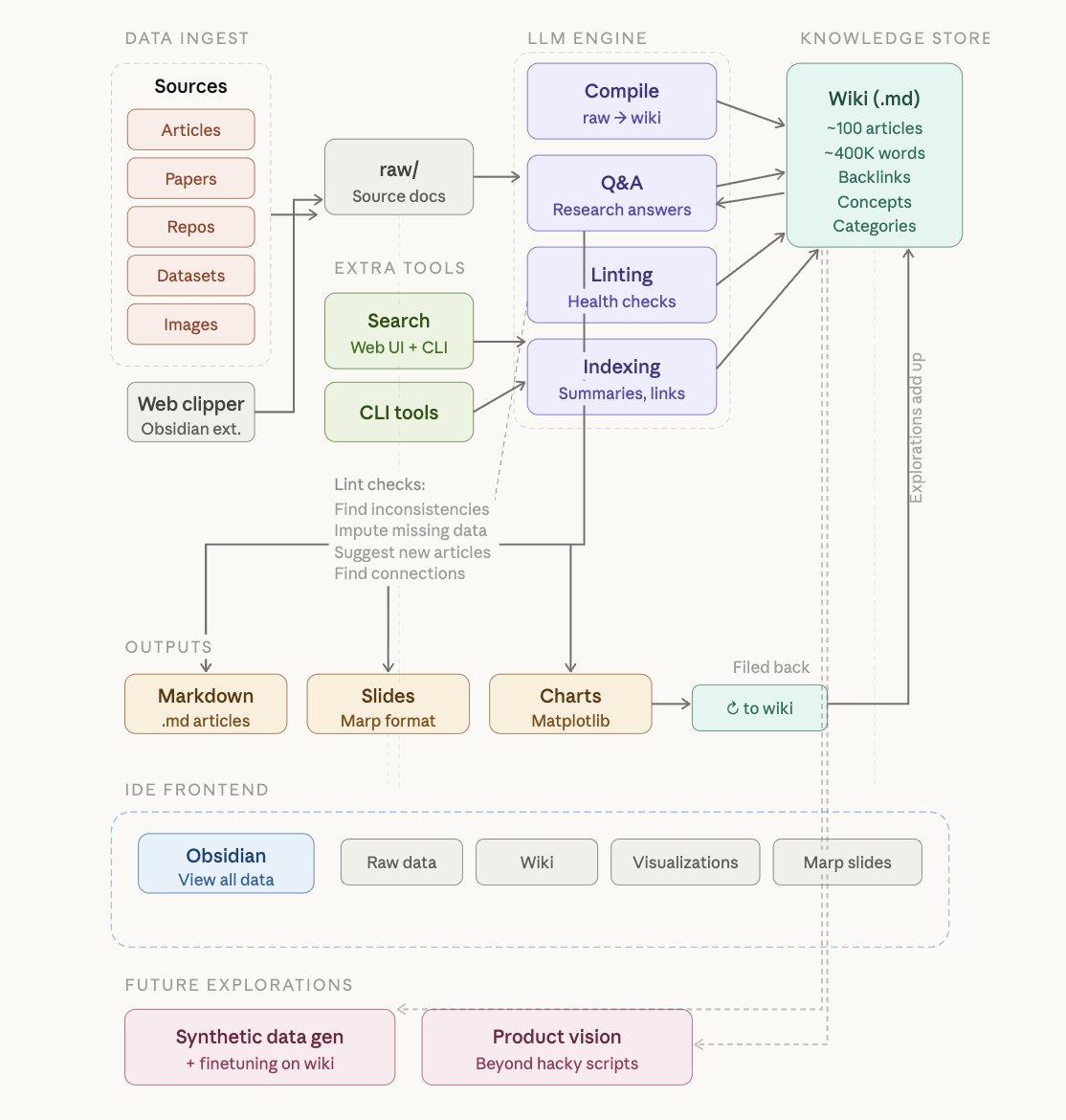
LLM Knowledge Bases Something I'm finding very useful recently: using LLMs to build personal knowledge bases for various topics of research interest. In this way, a large fraction of my recent token throughput is going less into manipulating code, and more into manipulating knowledge (stored as markdown and images). The latest LLMs are quite good at it. So: Data ingest: I index source documents (articles, papers, repos, datasets, images, etc.) into a raw/ directory, then I use an LLM to incrementally "compile" a wiki, which is just a collection of .md files in a directory structure. The wiki includes summaries of all the data in raw/, backlinks, and then it categorizes data into concepts, writes articles for them, and links them all. To convert web articles into .md files I like to use the Obsidian Web Clipper extension, and then I also use a hotkey to download all the related images to local so that my LLM can easily reference them. IDE: I use Obsidian as the IDE "frontend" where I can view the raw data, the the compiled wiki, and the derived visualizations. Important to note that the LLM writes and maintains all of the data of the wiki, I rarely touch it directly. I've played with a few Obsidian plugins to render and view data in other ways (e.g. Marp for slides). Q&A: Where things get interesting is that once your wiki is big enough (e.g. mine on some recent research is ~100 articles and ~400K words), you can ask your LLM agent all kinds of complex questions against the wiki, and it will go off, research the answers, etc. I thought I had to reach for fancy RAG, but the LLM has been pretty good about auto-maintaining index files and brief summaries of all the documents and it reads all the important related data fairly easily at this ~small scale. Output: Instead of getting answers in text/terminal, I like to have it render markdown files for me, or slide shows (Marp format), or matplotlib images, all of which I then view again in Obsidian. You can imagine many other visual output formats depending on the query. Often, I end up "filing" the outputs back into the wiki to enhance it for further queries. So my own explorations and queries always "add up" in the knowledge base. Linting: I've run some LLM "health checks" over the wiki to e.g. find inconsistent data, impute missing data (with web searchers), find interesting connections for new article candidates, etc., to incrementally clean up the wiki and enhance its overall data integrity. The LLMs are quite good at suggesting further questions to ask and look into. Extra tools: I find myself developing additional tools to process the data, e.g. I vibe coded a small and naive search engine over the wiki, which I both use directly (in a web ui), but more often I want to hand it off to an LLM via CLI as a tool for larger queries. Further explorations: As the repo grows, the natural desire is to also think about synthetic data generation + finetuning to have your LLM "know" the data in its weights instead of just context windows. TLDR: raw data from a given number of sources is collected, then compiled by an LLM into a .md wiki, then operated on by various CLIs by the LLM to do Q&A and to incrementally enhance the wiki, and all of it viewable in Obsidian. You rarely ever write or edit the wiki manually, it's the domain of the LLM. I think there is room here for an incredible new product instead of a hacky collection of scripts.
English
37
87
895
75.3K
Asmir
Asmir@asmirkn·
@anothercohen my normal usage has been $150 per day but in the past two days coincidentally it has doubled to $300 even though i am doing less work compared to before.
Asmir tweet media
English
1
0
17
878
Alex Cohen
Alex Cohen@anothercohen·
Have not once hit a weekly limit with Claude and the Max plan and somehow in the last two days I'm hitting both daily and weekly limits. What is going on?
English
125
27
769
68.3K
Asmir
Asmir@asmirkn·
@TTrimoreau you can just do things/ everything around you was made by people no smarter than you
English
1
0
1
15
Thomas Trimoreau
Thomas Trimoreau@TTrimoreau·
Name a mindset that changed everything
English
60
1
46
1.5K
Asmir
Asmir@asmirkn·
yes because if it's a real use case that actually transforms how you work entirely, you won't just open source it because it's an actual moat, take moveros.dev for example, it actually tracks your entire life, all your projects, learns from them, makes you focus on the high leverage tasks in your life, automates things for you etc. Way too valuable to just give away on a platter.
English
0
0
0
30
EP
EP@eptwts·
anyone else feel like the AI space has been polluted with so much generic BS? everyones so obsessed with features/benchmarks, yet we rarely see REAL use-cases shared take openclaw as an example, i've yet to see one convincing use case that makes it superior to tools we had beforehand
English
85
5
281
24.2K
Dragan Maricic
Dragan Maricic@dramaricic·
I follow builders who actually ship. If you're: – building a SaaS – working on a side project – trying to get first users Drop your project below Let’s connect 🤝
English
280
3
216
9.6K
Asmir
Asmir@asmirkn·
i did send you a dm, and dw the people you see automating away everything are usually experiencing worse productivity then actually getting proper work done, AI is not at the stage where you can just let it run wild, you still need to be very much in the loop especially if you want high quality work done, for mundane tasks here and there you can just let it run wild but for any proper work i am usually monitoring it. You also need the right skills and commands so you dont have to prompt it again and again, i made something called moveros.dev and it seems like that would really help you, essentially it organises your entire life, understands what you need to do, helps you get it done whatever it takes, once you're done with a project it extracts your learnings, mistakes and remembers them so it's a self improving system. I have a discount code for 30% off MOVINGINAPRIL for people like you who are really invested in this kind of stuff. Let me know if you have any other questions!
English
0
0
0
14
BeauDeZopha
BeauDeZopha@EquitableMeme·
How i can better leverage Claude code. To finish my ai governance and audit architecture. Right now, I just use Claude as a Red Team. But, I am seeing others use agents and leverage Claude to build out their work further, even when they are not working on it. Which sort of seems like "cheating" to me a bit, but whatever, this is all a new frontier. And as ahead of the game as I am,. I still feel incredibly behind, for there is just vs much o do not know. Thank you for the communication.
English
1
0
0
48
Asmir
Asmir@asmirkn·
If you know about claude code and what it can do, there's a moral obligation upon you to tell your friends/family and help them alter how they work forever.
English
1
0
2
136
Asmir
Asmir@asmirkn·
@elgermerlo Get it! here's a 30% discount code: MOVINGINAPRIL
English
0
0
0
17
BeauDeZopha
BeauDeZopha@EquitableMeme·
@asmirkn Hey, so.. I would actually really appreciate any guidance you have to offer, so if you're willing, I am all ears, friend.
English
1
0
0
14
Asmir
Asmir@asmirkn·
@atulit_gaur All you need is a good cofounder, nah dw it's not a human it's moveros.dev and you'll get anything done.
English
1
0
1
17
atulit
atulit@atulit_gaur·
the amount of ideas I have right now - I need to be spiritually unemployed for at least 6 months to build them all
English
11
1
64
2.3K
Asmir
Asmir@asmirkn·
@JasonBotterill We need to move on from web based ai in 2026. Come to claude code or codex, use it with moveros.dev and genuinely watch your life change.
English
0
0
1
16
Asmir
Asmir@asmirkn·
@cailynyongyong You'd absolutely hate moveros.dev but for me it actually helps keep focus on the most high leverage tasks in my life
English
0
0
0
10
Cailyn Y.
Cailyn Y.@cailynyongyong·
istg claude is getting sick of my stupid decisions and stopping me from doing things
Cailyn Y. tweet media
English
7
0
20
1.6K
Asmir
Asmir@asmirkn·
@buccocapital That's why every executive needs to have a proper system if they use Ai, something like Superpowers or GSD or moveros.dev come to mind
English
0
0
0
193
BuccoCapital Bloke
BuccoCapital Bloke@buccocapital·
You must understand that every tech executive has AI psychosis They’re puking out Claude-generated markdown files full of hallucinations asking if this means they can fire 500 people They’re turning Google sheets into the shittiest vibe-coded apps in the world
English
80
221
3.6K
282.5K
CC
CC@criscrinkl·
@jack who's writing the programs
English
7
0
26
2.6K
jack
jack@jack·
everything is programming
English
2.4K
3.4K
19.8K
813.4K