@JustinAdai36741 @WHLeavitt If the Iranians want him to be king, there's no way that he'll refuse
English
Chris Weller
12.2K posts


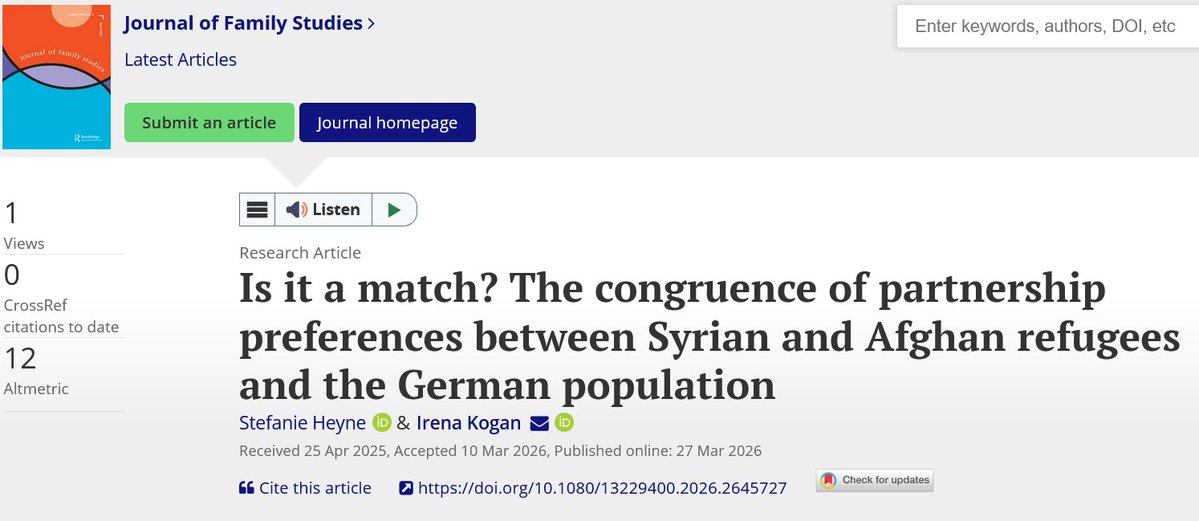
Male refugees from Afghanistan and Syria in Germany show a keen interest in forming relationships with local women, but the local women show little interest in forming relationships with them. Germany, in particular, received over 1,4 million refugees between 2014 and 2016, predominantly from Muslim-majority countries such as Syria and Afghanistan. The majority of these arrivals consisted of young, single men within prime marriageable age brackets. This study examines partnership preferences of male refugees from Afghanistan and Syria who arrived in Germany between 2014 and 2016 and female residents of similar age. Overall, our results indicate a high level of openness among male refugees towards partnering with female members of the resident population, but a comparatively low level of openness among the latter towards partnering with recently arrived male refugees. This implies a substantial incongruence in partnership preferences among the two groups. Regarding the educational level of a potential partner, we found that all respondents prefer highly educated partners over those with lower levels of education. This suggests that, for refugees, securing a highly educated partner might serve as a means of upward social mobility and integration into higher-status networks in the host society. Furthermore, it is possible that highly educated women, due to their greater exposure to diverse social environments and potentially less discriminatory attitudes, are perceived as more open to intergroup partnerships, making them a more attractive choice for refugees seeking acceptance and social integration. On the other hand, the reluctance of resident women to accept partnerships with refugees is largely explained by their rejection of the ‘imported’ religious Islam. It is possible that resident women perceive the religious practices of newly arrived refugees as different from their own, reinforcing a social distance that limits intergroup partnerships. Moreover, this reluctance might not only reflect religious differences but also concerns about gender norms or perceived lifestyle incompatibilities.

Male refugees from Afghanistan and Syria in Germany show a keen interest in forming relationships with local women, but the local women show little interest in forming relationships with them. Germany, in particular, received over 1,4 million refugees between 2014 and 2016, predominantly from Muslim-majority countries such as Syria and Afghanistan. The majority of these arrivals consisted of young, single men within prime marriageable age brackets. This study examines partnership preferences of male refugees from Afghanistan and Syria who arrived in Germany between 2014 and 2016 and female residents of similar age. Overall, our results indicate a high level of openness among male refugees towards partnering with female members of the resident population, but a comparatively low level of openness among the latter towards partnering with recently arrived male refugees. This implies a substantial incongruence in partnership preferences among the two groups. Regarding the educational level of a potential partner, we found that all respondents prefer highly educated partners over those with lower levels of education. This suggests that, for refugees, securing a highly educated partner might serve as a means of upward social mobility and integration into higher-status networks in the host society. Furthermore, it is possible that highly educated women, due to their greater exposure to diverse social environments and potentially less discriminatory attitudes, are perceived as more open to intergroup partnerships, making them a more attractive choice for refugees seeking acceptance and social integration. On the other hand, the reluctance of resident women to accept partnerships with refugees is largely explained by their rejection of the ‘imported’ religious Islam. It is possible that resident women perceive the religious practices of newly arrived refugees as different from their own, reinforcing a social distance that limits intergroup partnerships. Moreover, this reluctance might not only reflect religious differences but also concerns about gender norms or perceived lifestyle incompatibilities.

Chrupalla gibt Machtwechsel 2029 in Sachsen und im Bund als Ziel aus to.welt.de/LSLXzFv





Link: #abstract" target="_blank" rel="nofollow noopener">tandfonline.com/doi/full/10.10…



Friedrich Merz zeigt sich „tief enttäuscht“ vom Scheitern der Chatkontrolle in Brüssel – und will sie jetzt auf nationaler Ebene durchsetzen. Bis zum Sommer soll ein entsprechender Entwurf im Kabinett beschlossen werden. apollo-news.net/schwerer-rueck…