Auyon Siddiq

192 posts

Auyon Siddiq banner
Auyon Siddiq

Auyon Siddiq

@auyonomous

Associate Professor at @UCLAAnderson. Markets, competition, AI. Stealth Canadian.

Los Angeles, CA เข้าร่วม Mayıs 2026
276 กำลังติดตาม92 ผู้ติดตาม
ทวีตที่ปักหมุด
Auyon Siddiq
Auyon Siddiq@auyonomous·
Please steal this course! We first go deep (loss, backprop, attention, transformers), build models including a tiny LLM, and them zoom out to LLM economics, industry structure, and product development. Comments welcome. ucla-anderson-ssai.github.io/SSAI/?v=2
English
0
1
2
676
Joshua Teperowski Monrad
As someone who finds it extremely hard to talk about academia without exuding deep frustration (sometimes slipping into disdain), it mostly comes down to the vast gulf between how good academia could/should be for the world, and how it is
Auyon Siddiq@auyonomous

@deanwball @sebkrier Serious question: What's with the disdain for academia with you guys?

English
1
0
1
94
flekk
flekk@flekkm0·
@auyonomous @alz_zyd_ hm, well ideally most of the supervised learning happens in years 1 and 2. three years is a good amount of time to develop a full independent research theme/direction; ideally you should be at a point where your supervisor is no longer able to help you more than as a peer
English
1
0
2
123
alz
alz@alz_zyd_·
The hard part of finishing a PhD in economics/finance is not the coursework or the workload, IMO; it's being able to run your own projects from year 3 to graduation, with near-0 supervision. Lots of very good students have difficulty figuring out how to do this
English
12
9
213
16.3K
Auyon Siddiq
Auyon Siddiq@auyonomous·
@flekkm0 @alz_zyd_ Oh yes, I meant inefficient as way to train future scholars. I'm fine with requiring independence but there's a place for active mentorship in years 3-5 too I think.
English
1
0
1
142
flekk
flekk@flekkm0·
@auyonomous @alz_zyd_ from a purely throughput perspective it may be inefficient, but it's necessary because the point of a phd is to develop independent researchers who can lead research groups
English
1
0
1
151
Auyon Siddiq
Auyon Siddiq@auyonomous·
@ben_golub @paulnovosad Is there data on what this looks like by subfield? E.g. does econometrics behaves slightly more like other quantitative fields in terms of job market outcomes? (not an economist, only surrounded by them)
English
0
0
1
100
Ben Golub
Ben Golub@ben_golub·
@paulnovosad One reason is that the pattern, from my understanding of what's known, is very different from that of almost any other quantitative discipline.
English
3
0
24
1.8K
Ben Golub
Ben Golub@ben_golub·
I think it's kind of a problem with economics that success in the profession can be predicted well at admission time It suggests that the profession is more a set of tests for well-socialized children than a treacherous search for the truth
Peter Hull@instrumenthull

English
10
17
266
25.4K
Auyon Siddiq
Auyon Siddiq@auyonomous·
@willdepue @egrefen I think I agree with the broad strokes here, but there is also more to research than discovery or finding solutions that can be verified. That is a pretty simplified view of what research is that is being throw around a lot lately.
English
1
0
0
25
will depue
will depue@willdepue·
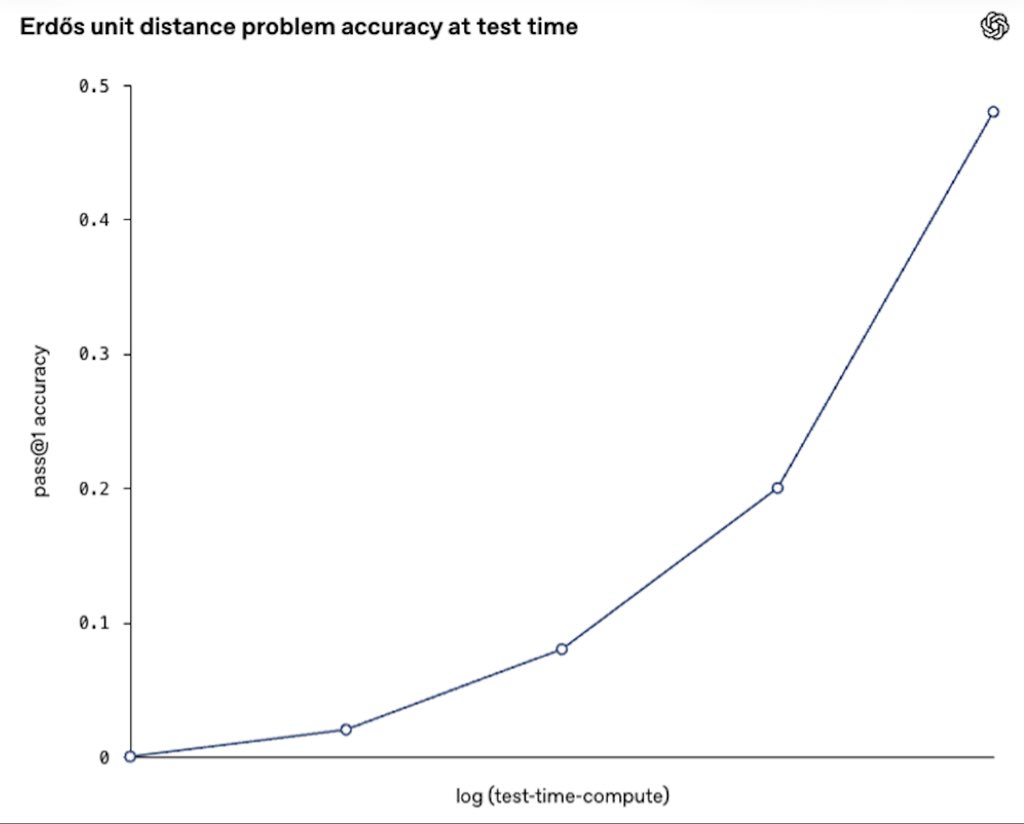
Please pardon my shitposting on the original tweet, but I think we're agreeing, in the short term. For one, in the limit, if you believe in artificial superintelligence as a possibility, all scientific output is 'solved by GPUs' + tool access. My argument is simply that an increasing portion of scientific output, in the intermediate, is shared by researchers + lots of GPUs, as I mentioned in the thread. However, GPUs are extremely expensive and access to frontier models is kept private, which leads to what I mentioned. Maybe this is illustrated best by the test-time compute chart shared by Noam: A direct connection from likelihood of discovery to amount of compute used. As the compute gap grows massively, the potential rate of discovery inside vs. outside the labs will grow in tandem. I'll share a longer article on this later today.
will depue tweet media
English
4
2
80
6.7K
Edward Grefenstette
Edward Grefenstette@egrefen·
There will be 3 kinds of scientists in the coming years: 1. The Blenderists, who cover their eyes to ignore the impact of AI. 2. AI scalers like OP(?), who think everything can be solved by making GPUs go brrr. 3. Actual researchers who embrace the tech and explore new frontiers.
will depue@willdepue

academics are unprepared for the coming world where much scientific progress is majorly a function of inference compute. whether OpenAI points the Eye of Stargate at your particular field will decide its acceleration. talent will leach away into the labs. it's already begun

English
10
8
162
21.9K
Auyon Siddiq
Auyon Siddiq@auyonomous·
@InnaVishik A 227 page document to review standardized testing is the most UC thing I've seen.
English
0
0
5
488
Inna Vishik
Inna Vishik@InnaVishik·
I was worried that the UCSD math preparation report would *not* be a wakeup call, but it looks like there is coalescing agreement among UC STEM faculty that SAT should be reinstated.
English
20
18
313
19.9K
Auyon Siddiq
Auyon Siddiq@auyonomous·
@ashdgandhi So you're saying we should shrink econ PhD programs. Say no more
English
0
0
0
64
Ashvin Gandhi
Ashvin Gandhi@ashdgandhi·
@auyonomous This is a good model if you expect people to do postdocs (e.g., sciences) or if you are in a field where there is an abundance of faculty positions relative to students (e.g., operations management).
English
2
0
2
370
Auyon Siddiq
Auyon Siddiq@auyonomous·
PhD advising should be an apprenticeship model, like a squire to a knight. First they brush the horses, then they carry the armor, then they do battle. Can't expect all students to jump to the end and have good outcomes.
alz@alz_zyd_

The hard part of finishing a PhD in economics/finance is not the coursework or the workload, IMO; it's being able to run your own projects from year 3 to graduation, with near-0 supervision. Lots of very good students have difficulty figuring out how to do this

English
1
0
2
803
Auyon Siddiq
Auyon Siddiq@auyonomous·
@alz_zyd_ Yeah it works for strong students and creates a clean signal on the job market. but in aggregate probably inefficient. alas
English
1
0
1
364
alz
alz@alz_zyd_·
@auyonomous suboptimal but it is how it is
English
1
0
4
874
Benjamin Hansen
Benjamin Hansen@benconomics·
Now I am justified for taking speakers on walks around campus. Can this scale? Should we have more creative walks as a part of active learning?
Ihtesham Ali@ihtesham2005

A Stanford psychologist spent 4 years proving that the simple act of walking generates 60% more creative ideas than sitting, and the experiment she designed to kill every alternative explanation is one of the most decisive findings in modern psychology. Her name is Marily Oppezzo. She got the idea for the study while walking with her advisor at Stanford to discuss her thesis topic, and the paper she eventually published in the Journal of Experimental Psychology in 2014 is sharp enough that it should have ended the seated meeting on the day it came out. She ran 4 experiments on 176 people. Same person tested twice. Once sitting, once walking. The creativity tasks were the standard ones psychologists have used for decades to measure how good a brain is at generating novel useful ideas. The result was almost too clean to publish. 81% of participants in the first experiment produced more creative ideas while walking than while sitting. In the second experiment, 88%. In the third, 100%. Every single person walked into a more creative version of themselves. On average, people generated 60% more novel useful ideas the moment their legs started moving. The skeptical question is the obvious one. Maybe it was the fresh air. Maybe it was the scenery passing by. Maybe it was the change of environment doing the work, not the walking itself. Oppezzo killed every one of those explanations with one experimental decision. She put people on a treadmill facing a blank wall. No scenery. No fresh air. No environmental change. Just legs moving in place while staring at white drywall. The 60% boost held. Then she ran the experiment that closed the case completely. She took participants outside in two conditions. Half of them walked through a Stanford courtyard. The other half were pushed through the exact same courtyard in a wheelchair. Same outdoor stimulation. Same scenery passing at the same speed. The only difference was whether the legs were moving. The walkers produced dramatically more novel high-quality ideas than the wheelchair group. The outdoors did almost nothing on its own. The walking did everything. This is the part of the study that hit hardest when I read it the first time. She also tested the opposite kind of thinking. Convergent thinking. The kind where there is one right answer and you have to narrow down to it. Word puzzles where 3 words share a hidden fourth word that connects them. The seated participants did slightly better on these. Walkers got slightly worse. Walking is not a general intelligence enhancer. It does one specific thing. It opens up the divergent search inside your brain. The part that generates options. The part that produces unexpected connections. The part that takes a problem and finds five ways into it instead of one. When you need to converge on the single right answer, sit down. When you need to find the answer in the first place, get up. The mechanism is now well understood. Walking selectively activates what neuroscientists call the default mode network, the system inside your brain that runs when you are not consciously focused on anything. The DMN is where mind-wandering happens. Where memories cross-reference each other. Where ideas that have been sitting in separate folders inside your head finally bump into each other. When you sit at a desk and force yourself to concentrate, you suppress the DMN. When you walk at a natural pace, the executive part of your brain gets just busy enough handling the walking that the DMN comes online and starts doing the work that focus was blocking. The most useful finding in the entire paper is the one almost nobody quotes. The boost did not turn off the moment people stopped walking. Participants who walked first and then sat back down stayed elevated. Their next round of seated creativity work was still significantly better than people who had been sitting the whole time. The rest lingered for at least several minutes after the legs stopped moving. You do not need to do creative work while walking. You need to walk before the creative work. The brain holds the state. The history of this is the part that should haunt anyone who still does meetings in chairs. Charles Darwin built a gravel loop behind his house in Kent called the Sandwalk and walked it 3 times a day for the rest of his life. The theory of evolution was developed one lap at a time on that path. Nietzsche walked up to 10 hours a day during the years he wrote his most important books and openly said the work was conceived on his feet. Beethoven composed for the morning and walked for 5 hours every afternoon with a pencil in his pocket for when something landed. Kahneman said the best thinking of his Nobel Prize-winning career happened on leisurely walks with Amos Tversky. Steve Jobs refused to take important conversations sitting down. He held them on foot. Every one of them was using the system Oppezzo would not measure until 2014. They just did not know what to call it. The question worth sitting with is the one almost nobody asks. Every meeting you have ever attended sitting around a table was a meeting held at a fraction of the brain power that was actually available to the people in the room. Every brainstorm that got stuck inside a conference room. Every problem you tried to solve at a desk and gave up on. Every idea you could not quite get to. The intervention is the easiest one in modern science. No supplement. No app. No subscription. No training program. Just a pair of legs and 15 minutes. The Stanford lab proved it. The philosophers knew it. The neuroscience explains it. And almost everyone reading this is still trying to think their way out of problems sitting completely still.

English
3
0
4
662
Auyon Siddiq
Auyon Siddiq@auyonomous·
@deanwball @mattyglesias Are you willing to elaborate on your commentary here re: academia? Have you written on it? You're a thoughtful guy so clearly there is something behind the snark, but I'm struggling to see it
English
0
0
0
18
Dean W. Ball
Dean W. Ball@deanwball·
@mattyglesias Maybe, but the rest of the way this is written is clearly heavily influenced by academia
English
1
0
10
2.7K
Dean W. Ball
Dean W. Ball@deanwball·
The encyclical is Western academia/NGO “AI doesn’t *really* think but it *is* racist” at its core, with little bits of tegmark/FLI talking points sprinkled incoherently on top.
English
17
12
188
64.4K
Auyon Siddiq
Auyon Siddiq@auyonomous·
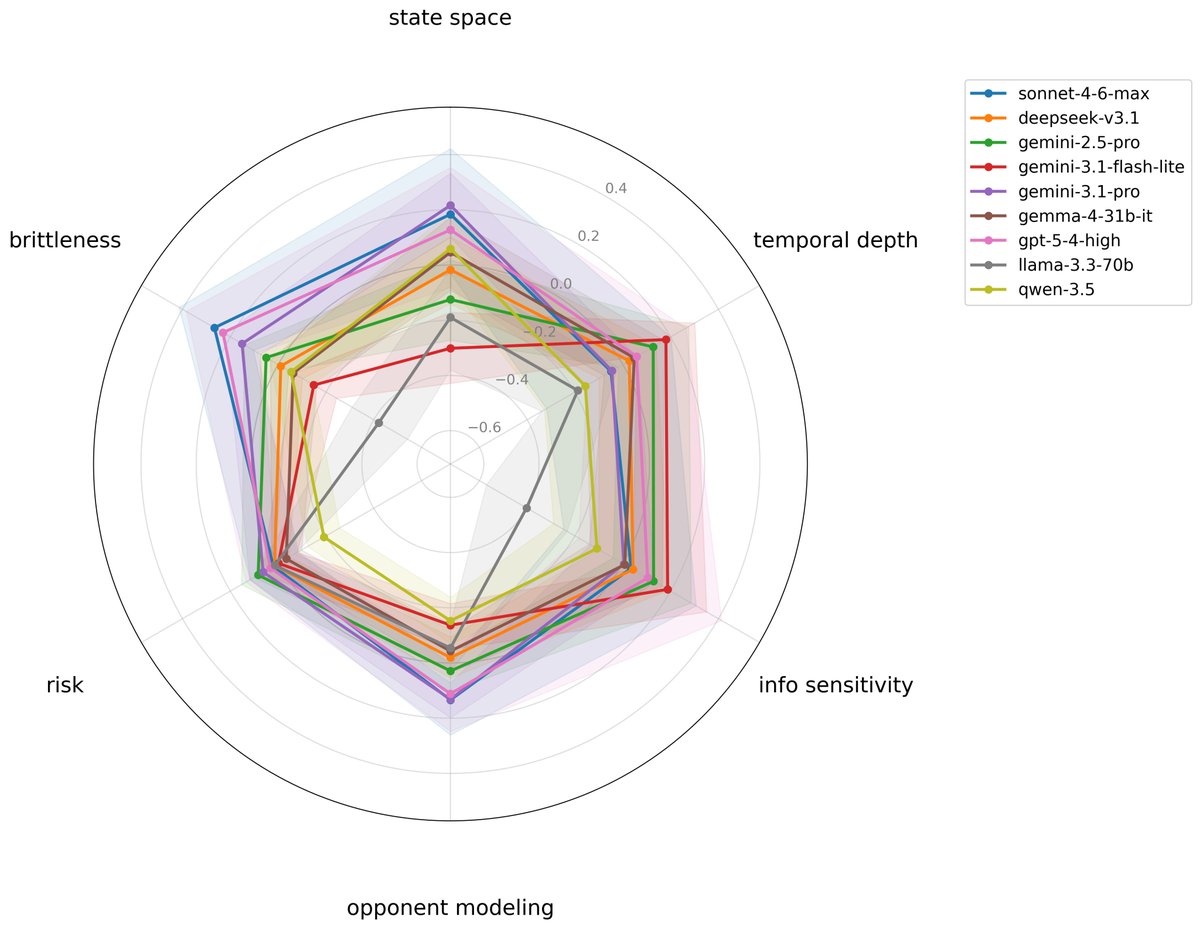
@vartanshad @alexolegimas Very cool. The jaggedness of the top models feels like a type of bias-variance trade-off. Maybe this says something about potential brittleness of the most complex models
English
0
0
1
62
Shadarevian
Shadarevian@vartanshad·
Frontier LLMs are increasingly deployed as economic agents, but strategic-reasoning benchmarks use fixed games. We built GENSTRAT: a procedurally generated evaluation methodology for building imperfect information games for LLMs.
Shadarevian tweet media
English
2
6
14
4K
Auyon Siddiq
Auyon Siddiq@auyonomous·
@sebkrier Maybe for math invention is a lot to ask for from an LLM. But what about sticking to language, e.g., an English-only trained LLM inventing a more powerful grammar? Feels like it should be doable
English
0
0
1
508
Séb Krier
Séb Krier@sebkrier·
People misinterpret the Ramanujan and Einstein examples and assume this just means AGI has to be a super genius otherwise it doesn't count. To me this doesn't seem to be the point; they're illustrations of categories more than thresholds. Demis previously described creativity as falling into three buckets: Interpolation, i.e. averaging many data points and recombining them, e.g. an image model producing a new photo that would have not been in a dataset before. Extrapolation, i.e. going beyond the convex hull of the training data to produce something experts recognise as genuinely new - we have a lot of examples of this with existing systems, like Move 37 and all the recent maths examples. And thirdly, invention: actually coming up with the game of Go in the first place. It's the third type that existing systems, at least as currently scaffolded/used, appear to lack. There may be a difference between solving existing conjectures or problems, and actually coming up with the theory in the first place. Language models produce all sorts of new outputs, but the outputs differ qualitatively in kind even if they're novel to varying degrees. Does the new output live inside the conceptual space defined by the training data (interpolation), push outside it along existing dimensions (extrapolation), or reframe the space itself by proposing a new conceptual structure (invention)? Ramanujan illustrates the depth of intuition and innovation that the third 'true creativity/invention' category represents. There may be recombination and extrapolation as part of that process, but at least so far they don't seem to be sufficient. Of course you can argue that most humans don't do this - when was the last time you invented a new abstraction? My uneducated view is that this third type of creativity doesn't have to lead to crazy new inventions - obviously inventing the theory of relativity is both more impressive and more *valuable* (and thus depends also on a social aspect and utility), but I think individuals do this third type of creativity in many smaller/micro ways too. For example a teenager on TikTok warping a meme format into something the format didn't previously allow/cater for. This kind of type-3 operation should be observable at small scales, frequently, with low stakes too. I think it's very reasonable to argue that this is *just* interpolation/extrapolation, but I personally don't think this is all there is. If it was then it should be feasible for e.g. Talkie (the model trained up to 1930s data) to be prompted/scaffolded to create a new abstraction entirely. I haven't seen this, except by teaching it basic coding through fine-tuning - but that's not the same thing, since you're showing it the new abstractions (coding) to start with! I'm not sure if this is because (a) language models lack the cognitive operation entirely, given the architecture; or (b) it has the operation but lacks the appropriate scaffolding, memory, and process. Maybe it's (b), though I lean towards (a): language models are better at paradigm exploitation than paradigm generation. Of course practically speaking, you don't strictly need this third type of creativity for the technology to be transformative and revolutionize fields; but it's a difference that is still worth highlighting and accounting for, since it also implies certain ceilings determined by the shape of the existing conceptual space.
Séb Krier tweet mediaSéb Krier tweet media
English
30
24
151
73.2K
Auyon Siddiq
Auyon Siddiq@auyonomous·
@JessicaHullman Can we also vent about people posting those AI generated infographics thst visualize papers? They're so busy to look at.
English
0
0
8
514
Jessica Hullman
Jessica Hullman@JessicaHullman·
Also cringe when faculty you respect present straight-from-AI slides at prestigious events, as if it's always been their style to grid things to death, use full sentences, headers, footers everywhere & phrases like “principal levers” & “governing friction” & “salient features” 1/
Gautam Kamath@thegautamkamath

It's so cringe when real people I otherwise know and respect post obvious AI slop on social media, particularly when they're (supposedly) expressing their feelings. Authenticity is so rare and valuable these days, and it's sad to see people just cede it from the get-go

English
5
8
133
15.7K
Daniel Litt
Daniel Litt@littmath·
I don't like blocking people but I think I'm going to have to start blocking for replies containing the word "cope" unless they also contain a solution to a mathematical question I care about.
English
22
3
392
13.7K
Auyon Siddiq
Auyon Siddiq@auyonomous·
5/ This is not the most consequential aspect of Cuban's token tax proposal, and it's not guaranteed either. But it's a good example of how outcomes in competitive markets can surprise us.
English
0
0
0
38
Auyon Siddiq
Auyon Siddiq@auyonomous·
4/ The best empirical evidence for this is the cigarette industry in the 1980s, which saw profits increase after a new federal excise tax (Harris, 1987). There is also classical theoretical support for the phenomenon (Seade, 1985).
English
1
0
0
43