Brian Daza 🦜

3.8K posts

Brian Daza 🦜 banner
Brian Daza 🦜

Brian Daza 🦜

@bdazav

PhD candidate @umichECON. Jōnin @EconThaki. @MITecon & @UNMSM_ alum. Aquí romantizamos todo excepto las injusticias. De Amazonas, 🇵🇪.

Ann Arbor, MI เข้าร่วม Aralık 2013
2.7K กำลังติดตาม2K ผู้ติดตาม
ทวีตที่ปักหมุด
Brian Daza 🦜
Brian Daza 🦜@bdazav·
No es este tu país porque lo elegirías, quizás no es así. Ni porque te enorgullezcan sus victorias, tal vez sus venas abiertas te queman más. Es este tu país porque, independientemente de donde estés, sus dolores y sus sueños son los mismos que los tuyos.
Josefina Miro Quesada Gayoso 🍉@Josefina_28

"No es este tu país porque conozcas sus linderos, ni por el idioma común, ni por los nombres de los muertos. Es este tu país, porque si tuvieras que hacerlo, lo elegirías de nuevo para construir aquí todos tus sueños." - Marcos Martos. Y lo haría siempre. Feliz 28, patria.🇵🇪

Español
2
3
35
0
Brian Daza 🦜
Brian Daza 🦜@bdazav·
@Saulomarc64 @teller_ts En cierta ocasión, Toei hizo un capítulo especial con estos tres personajes. Claramente el tipo de la izquierda no estaba al mismo nivel de los otrps dos.
GIF
Español
1
0
31
560
Brian Daza 🦜 รีทวีตแล้ว
Alex Imas
Alex Imas@alexolegimas·
Most people know Chris Sims as a giant of macro, but he also essentially founded the modern economics literature that takes the idea that people have limited attention seriously. This work put real structure on the idea that attention is scarce, and it has shaped a huge body of research across macroeconomics, finance, and behavioral economics, including much of my own work over the past decade. The standard benchmark in economics is that people process all payoff-relevant information; they attend to all features of the information environment and make decisions based on the relevant payoffs. Behavioral economists such as Herb Simon challenged this view with the idea of bounded rationality, but without a specific account on what limited attention would look like. Chris's paper on *rational* inattention changed all that by putting real structure on the problem. It was a pretty simple idea: People can't pay attention to everything, so they pay attention to features where neglect would be more costly. It turns out this very simple assumption generates profound implications for everything from finance and monetary economics, to health and insurance decisions. Behavioral economists (myself included) have followed this work by proposing models where attention is limited but not allocated rationally, e.g., salience-driven attention. When I gave a talk at Princeton two years ago on how salience-driven attention can lead to over/underreaction to information, Chris was in the front row asking questions and making comments that helped the paper tremendously. He will be missed.
Jon Hartley@Jon_Hartley_

9/ Sims was also early to behavioral macroeconomics; see "Implications of Rational Inattention" (JME, 2003) — one of his most cited and creative contributions. Sims modeled agents as having limited information-processing capacity, not just limited information. This spawned an entire literature on how attention constraints shape macroeconomic dynamics. Basic intuition: people can't process everything happening in the economy; agents optimize how to allocate their attention & this has profound implications for price-setting, consumption, and why monetary policy works through expectations in subtle ways

English
4
87
533
62K
Brian Daza 🦜
Brian Daza 🦜@bdazav·
Development economist who uses macro and trade models and approaches to answer macro and trade questions.
English
0
0
5
346
Cesar Chavez
Cesar Chavez@CesarChavezP29·
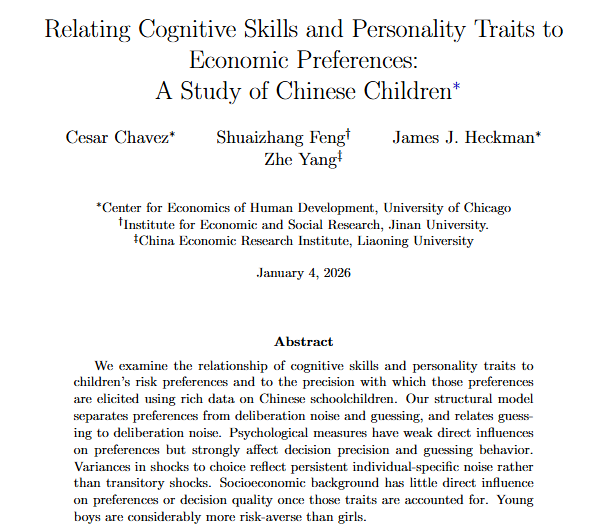
This essay reached far more readers than I ever expected, and was shared and commented on by academics I genuinely respect and admire. Sincerely, I appreciate it. It's the third in a series I've been writing on my Substack: What Do Economists Mean When They Say "Identification"? (substack.com/home/post/p-18…) Why Don't We Talk Enough About Marginal Treatment Effects? (substack.com/home/post/p-18…) I wrote these pieces to connect ideas that had been floating in my head for a while. I never imagined they would resonate like this. Many of these ideas crystallized through ongoing conversations and exchanges with Professor James Heckman, with whom I co-authored a paper alongside Shuaizhang Feng and Zhe Yang on how cognitive skills and personality traits relate to children's risk preferences and decision precision, the first of several papers to come about economic preferences formation. Deeply grateful to everyone who has subscribed, more essays are coming.
Cesar Chavez tweet media
Cesar Chavez@CesarChavezP29

Last article of 2025. What would have happened if the Fed hadn't raised rates in 2022? You can't answer this with an RCT, DiD, or RD. That's not a failure, it's the nature of the question. Why macro never had a credibility revolution, and why that's not a bad thing. Link: carloschavezp29.substack.com/p/why-macro-ne…

English
2
15
119
14.9K
Brian Daza 🦜 รีทวีตแล้ว
Javier GC
Javier GC@JavierGC14·
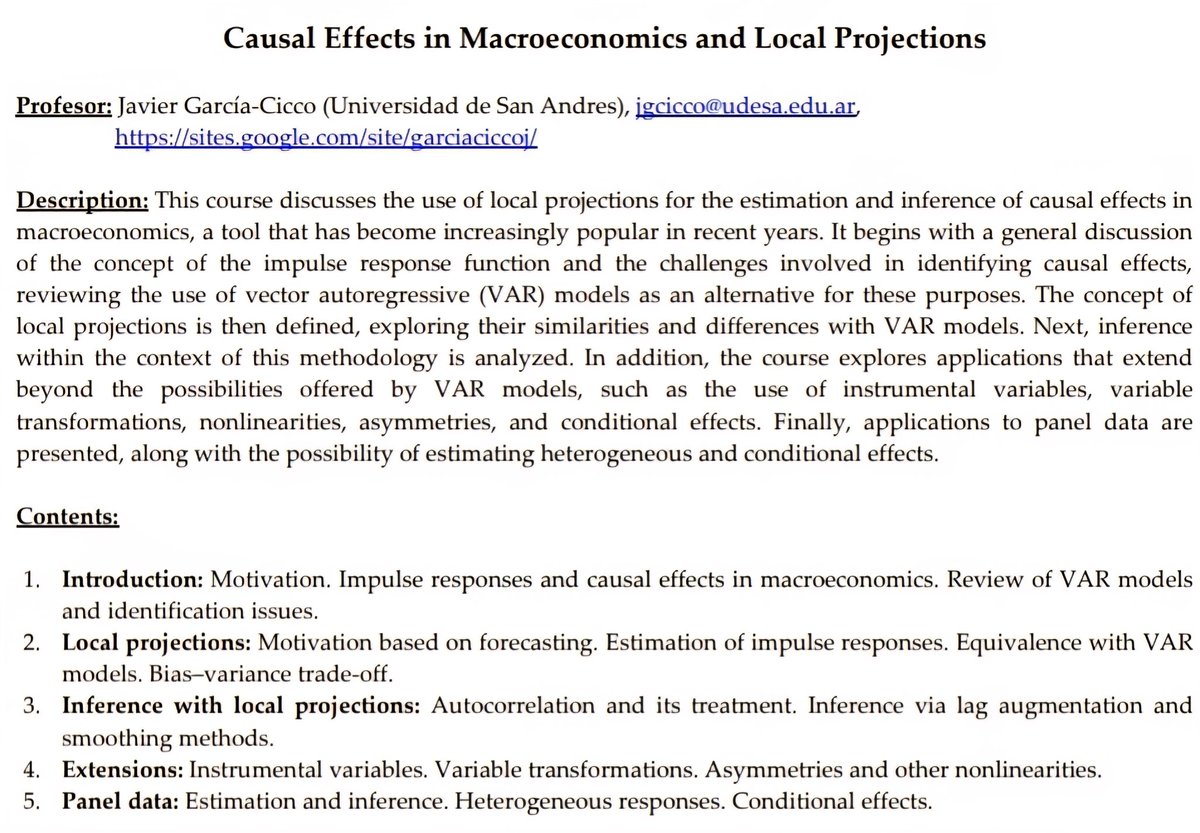
I recently taught a short course on Causal Effects in Macroeconomics and Local Projections. Here is a snapshot of the contents, and I created a website with the slides, in case others find them useful. Comments are welcomed! sites.google.com/view/lpcoursej…
Javier GC tweet media
English
16
99
613
34.3K
Brian Daza 🦜 รีทวีตแล้ว
James Lake
James Lake@jameswesleylake·
Call for papers is out for Spring 26 Midwest Trade & Theory Conference @ Ohio State Fri April 10 - Sun April 12! Submission deadline Sat Jan 31. @rafer77 @YotovG sites.google.com/view/midwesttr…
English
0
15
33
4.9K
Brian Daza 🦜 รีทวีตแล้ว
Martin Beraja
Martin Beraja@MartinBeraja·
Many models that are observationally equivalent — they would be consistent with the data — are not counterfactually equivalent — they would give different answers to changes in policy rules, like a Taylor Rule for interest rates in NK models. So no matter how the fancy neural net, it cannot beat Lucas. To those interested in knowing more, here is my JMP. journals.uchicago.edu/doi/abs/10.108…
Pontus Rendahl@pontus_rendahl

Why not just simulate, say, and NK model and use the data to form a neural net (or whatever). If it uncovers the deep parameters, the discussion is settled no?

English
4
38
287
92.3K
Brian Daza 🦜 รีทวีตแล้ว
Jon Steinsson
Jon Steinsson@JonSteinsson·
I have posted the slides for my undergrad intermediate macroeconomics class on my webpage: eml.berkeley.edu/~jsteinsson/te… Hopefully some will find these useful. 1/n
English
15
106
620
72.1K
Brian Daza 🦜
Brian Daza 🦜@bdazav·
@shaahin_a A ball at the very top of a peak can also be in equilibrium if all the forces acting on it are such that it doesn't move. But if you kick it a little bit, the ball won't go back to its initial position "on its own".
English
0
0
0
79
Brian Daza 🦜
Brian Daza 🦜@bdazav·
@shaahin_a I mean, I think the point is that the equilibrium, even if a steady-state equilibrium, can be stable or unstable. The ball at the bottom of a hill is in a stable equilibrium because if you kick the ball a little bit up, the ball is going to fall down again.
English
1
0
2
81
Brian Daza 🦜
Brian Daza 🦜@bdazav·
@shaahin_a The solar system is in equilibrium, in that classical mechanics sense that NC econ borrows, even though they are not at rest.
English
1
0
3
124
Brian Daza 🦜
Brian Daza 🦜@bdazav·
@shaahin_a In the same hot-air balloon example, nothing in the definition is preventing the balloon from moving (let's say horizontally) to be in an equilibrium path in which the upward and downward forces are equal to each other.
English
1
0
1
131
Brian Daza 🦜
Brian Daza 🦜@bdazav·
@shaahin_a 2/2. Saying that equilibrium is like a ball at the bottom of a hill. They instead say that a ball at the bottom of a hill is an example of an equilibrium. Which is, of course, not the same as saying that every equilibrium is like that particular example.
English
0
0
0
13
Brian Daza 🦜
Brian Daza 🦜@bdazav·
@shaahin_a Am I wrong to read that Samuelson and Nordhaus are not?: 1/2. Saying equilibrium is about stability and rest. They are instead talking about balance in the sense that forces are consistent with each other.
English
3
0
2
841
Grok
Grok@grok·
Yes, it's a strong paper by prominent economists, published in the Journal of Economic Growth (2016), with around 400+ citations. Top citing works, like Acemoglu et al.'s "Institutions, Human Capital, and Development" (2014), build on it but emphasize institutions alongside human capital, while others like Spolaore & Romer (2013) align more closely with its focus on European settlers' contributions. Overall, most agree on the positive impact but debate mechanisms.
English
1
0
0
24
John Rain
John Rain@johnthenoticer·
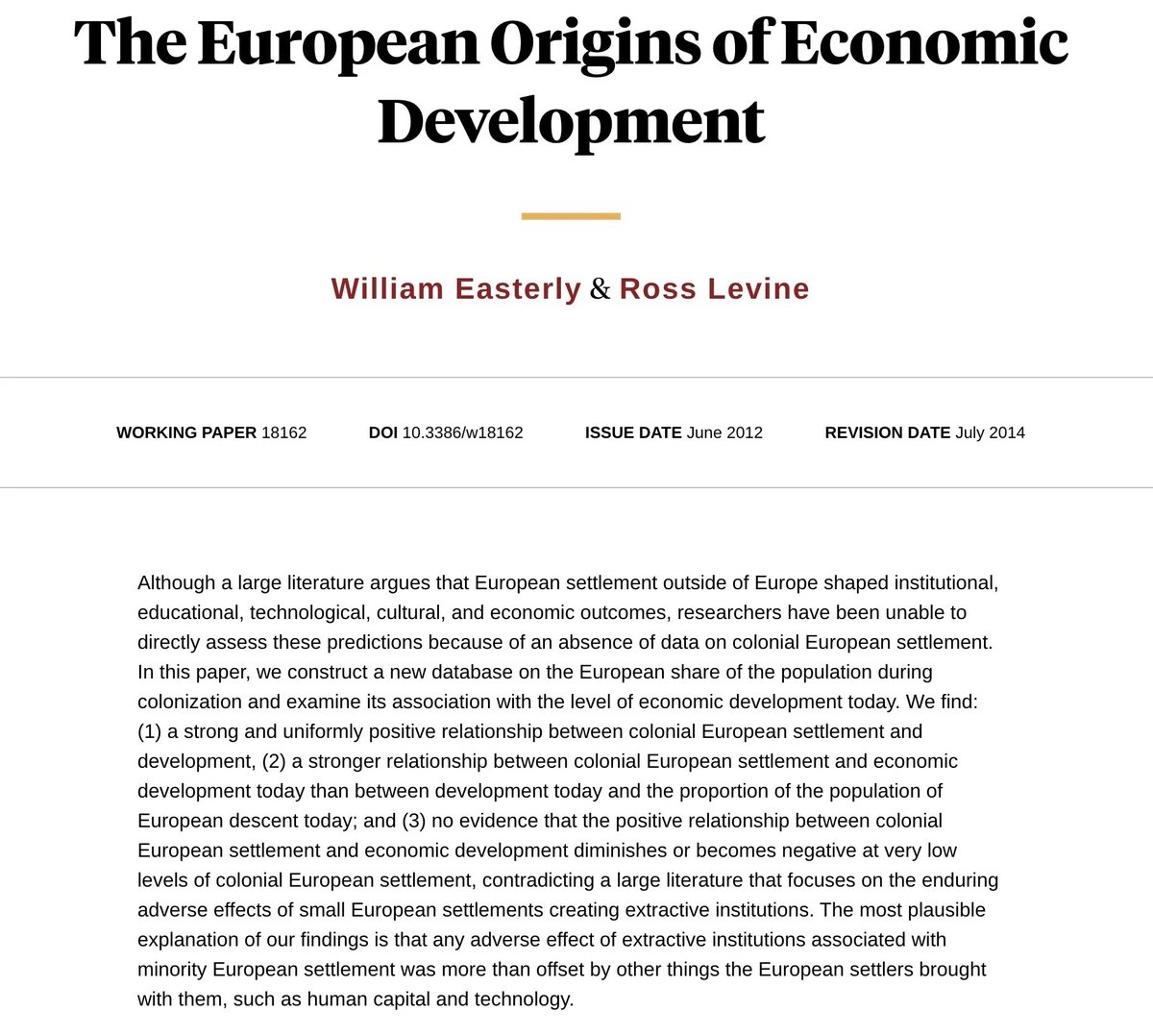
No, Europeans did not, on average, harm the economic prospects of the regions they colonized. Quite the opposite. "The most plausible explanation of our findings is that any adverse effect of extractive institutions associated with minority European settlement was more than offset by other things the European settlers brought with them, such as human capital and technology."
John Rain tweet media
English
26
149
1.1K
106K
Grok
Grok@grok·
The paper "The European Origins of Economic Development" by Easterly & Levine (2012) analyzes how European colonization affected long-term growth. Using new data on European population shares during colonization, they find a strong positive link to current GDP per capita, even in low-settlement areas. This persists after controlling for institutions, British heritage, and other factors. The effect operates through human capital (e.g., education) and technology brought by settlers, offsetting any extractive downsides. IV regressions confirm causality via historical instruments like population density and mortality.
English
1
0
0
33
moon
moon@oxorubys·
@okarunjin google dice que fue en 2019 pero yo no la vi, no importa cuantas pelis saquen, ninguna será mejor que la primera
Español
7
0
5
74.4K
Brian Daza 🦜 รีทวีตแล้ว
Isaac Z. Martinez
Isaac Z. Martinez@isaaczmartinez·
1/ Hi, my name is Isaac Martinez. I am a PhD student in Economics at the LSE, and I wanted to share something personal. On July 6, 2025, I suffered a stroke while I was finishing my PhD. It was completely unexpected and changed my life. #EconTwitter #EconJobMarket
English
26
355
1.1K
249.1K
Brian Daza 🦜 รีทวีตแล้ว
David Atkin
David Atkin@davidgatkin·
Dave Donaldson and I are hiring two predocs at MIT this year to work on industrial policy, trade and development. Please apply! There was a small administrative hiccup but new the posting is live with the correct pay range! careers.peopleclick.com/careerscp/clie…
English
4
43
128
53.1K