Brian Manning

13K posts

Brian Manning banner
Brian Manning

Brian Manning

@brianmanning

Entrepreneur and deep tech investor in AI, autonomous vehicles, cloud, cybersecurity, defense, digital assets, power, robotics, space.

USA เข้าร่วม Haziran 2008
302 กำลังติดตาม4.3K ผู้ติดตาม
Brian Manning รีทวีตแล้ว
Shay Boloor
Shay Boloor@StockSavvyShay·
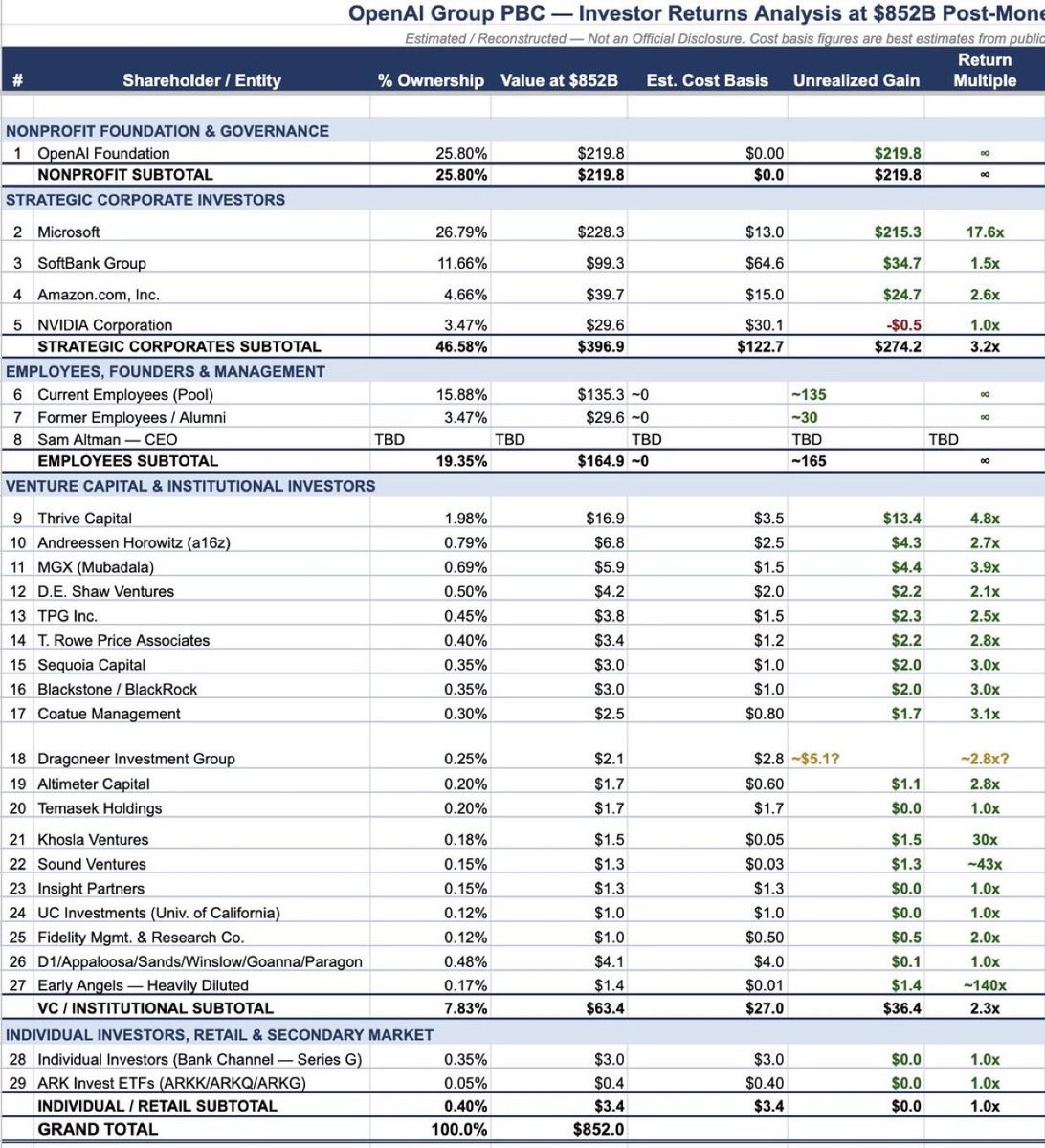
LEAKED OPENAI CAP TABLE • $MSFT ~27% • OpenAI Foundation ~26% • OpenAI employees ~19% • SoftBank ~12% • VC & Institutional investors ~8% • $AMZN ~5% • $NVDA ~4%
Shay Boloor tweet media
English
59
126
853
132.1K
Brian Manning รีทวีตแล้ว
Serenity
Serenity@aleabitoreddit·
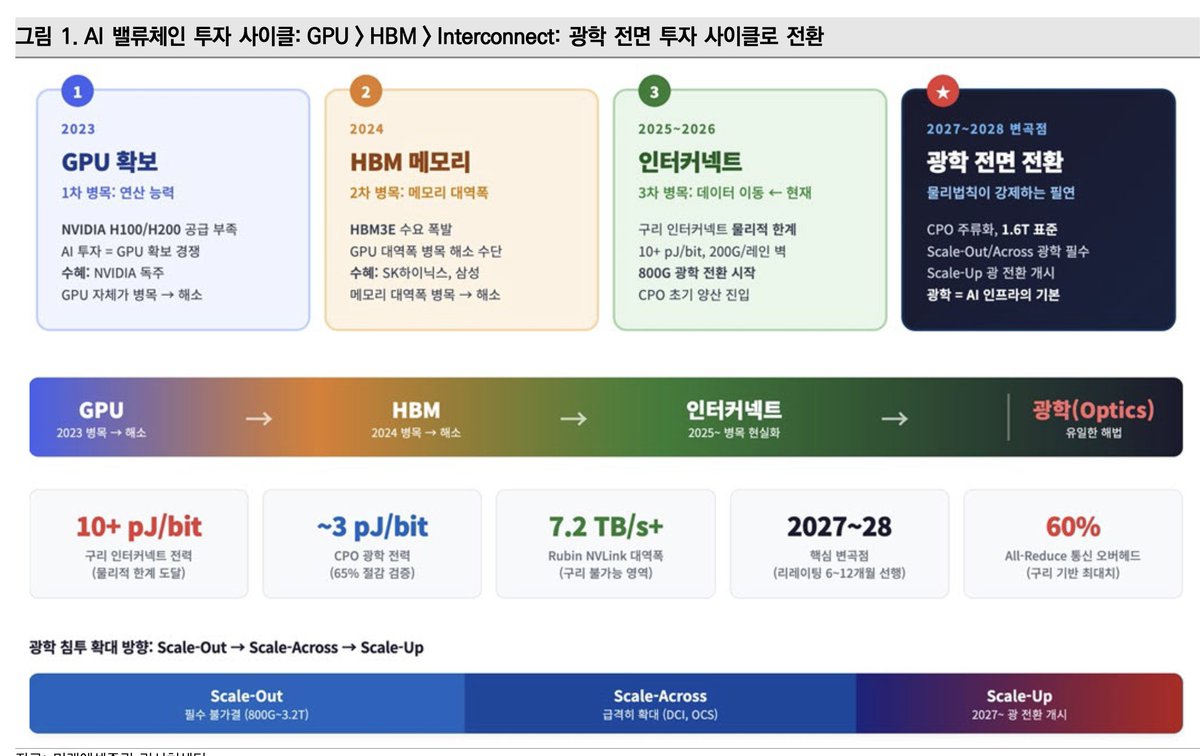
I think I nailed the institutional bottleneck rotation. -> Caught the tail end of memory name rise with $SNDK, Samsung, SK Hynix, $MU -> Frontran institutions with photonics with names like $AAOI, $AXTI $LITE, $COHR. -> Doing it again now by adding heavily toward SiPh, ELS, and CPO: $SIVE, $TSEM, $SOI, $AEHR, Win Semi, and others. Of course if you want to play it safe: $MRVL (captive), $AVGO (captive), $TSM, and $NOK all do it as well, but they're larger players. And getting direct exposure to the next supercycle is ideal. I still think there's tons of room to grow for memory to EML optical transceivers, but the largest boom is at the start/inflection point of a new architectural cycle. Macro messing up some trades aside, expecting capital rotation soon toward CPO / ELS supply chains. TLDR from analyst note: The AI infrastructure investment supercycle follows a strict "bottleneck resolution" sequence: Compute/GPUs (2023) -> Memory/HBM (2024) -> Interconnect/Networking (2025+). Translation: "We judge that the third investment cycle of the AI value chain has officially begun. Following GPUs (2023) and HBM (2024), post-2025, optical interconnects will become the fastest-growing core segment. 2027–2028 will be a critical inflection point where CPO commercialization. 1.6T standardization, and Scale-Up optical transitions align, structurally expanding the TAM of related industries" Some takeaways: 1. CPO (Co-Packaged Optics) is moving from the lab to commercial mass production 2. 2027-2028 is the major structural inflection point (good idea to frontrun this now in 2026 from testing with $AEHR to ELS with $SIVE or packaging with $POET). 3. The Total Addressable Market (TAM) for optical components, materials, and testing equipment is expected to structurally expand 3x to 5x (I think this is sandbagging a bit).
Serenity tweet media
Serenity@aleabitoreddit

CPO Landscape Mirae Analyst Note: Scale-Across: CPO ASIC: $AVGO, $MRVL Optical Transceiver: $COHR, $LITE, Innolight DSP/PAM4: $AVGO, $MRVL Coherent DCI: $CIEN, $NOK OCS Equipment: iPronics, Polatis Optical Cable / Fiber: $GLW, Prysmian, Furukawa HCF: $LITE, OFS DCI Coherent: Ciena, Nokia, Huawei Optical Amplifier: $LITE, $COHR OCS Gateway: KDDI Scale-Up: SiPh Foundry: imec, $GFS, $TSM SiPh Modulator: $NVDA (in-house MRM), $INTC ELS: NTT, Furukawa, $LITE, $COHR THz Interconnect: R&D Stage? CPO Test: "Expanding entry of new players" Micro Lens / Optical Systems: "Expanding entry of new players" TLDR: Scale Up CPO is coming next. Think the analyst note missed a bunch of upstream names and conflated ELS with light source. But it's helpful to see who they think the leading players are as a very high-level view.


English
36
111
1K
169.2K
Brian Manning รีทวีตแล้ว
Jason Luongo
Jason Luongo@JasonL_Capital·
I don't understand why people are still researching stocks manually in 2026 Claude can break down entire companies, stress-test your thesis, and find risks you're missing in seconds Here are 10 prompts to turn it into your personal stock research analyst:
Jason Luongo tweet media
English
12
46
394
58.5K
Brian Manning รีทวีตแล้ว
CK Capital
CK Capital@CKCapitalxx·
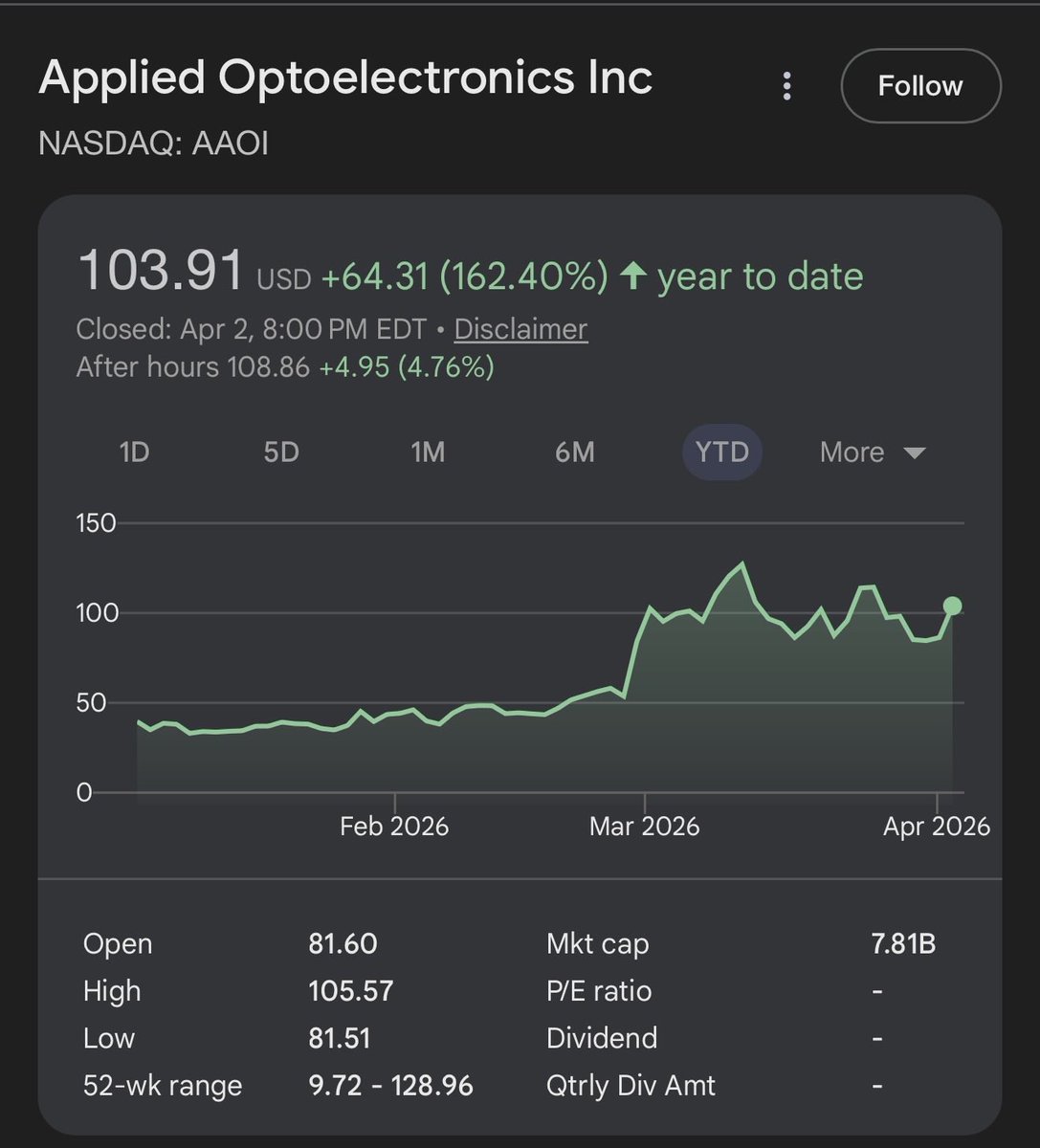
$LITE is worth $59 billion. $COHR is worth $49 billion. $AAOI is worth $7 billion. All three are in the same business. All three supply the optical infrastructure powering AI data centers. All three are validated by the largest hyperscalers on earth. Here is why $AAOI closes that gap and what $50 billion looks like. $LITE grew revenue 65% last year. $COHR grew 30%. $NVDA invested $2 billion in each of them. $AAOI grew revenue 130% last year. Just landed $124 million in new 800G orders since mid March alone from multiple separate hyperscalers. First volume order for 1.6T transceivers already secured. CEO said 99% confident in $1 billion revenue in 2026. Monthly transceiver orders projected to hit $378 million by mid-2027. That is a $4.5 billion annualized run rate from a single product line. The difference between $AAOI and its peers is not the technology. $AAOI’s in-house InP laser fabrication is a genuine moat that $LITE and $COHR both rely on external supply chains to compete with. The difference is awareness. $LITE and $COHR have been institutional names for years. $AAOI was a penny stock in 2023 trading at $2. The re-rating is still in early innings. Here is what the path to $50 billion looks like on ~68 million fully diluted shares. $10B market cap — $147/share. Needs $1B revenue confirmed. Already guided. $20B market cap — $294/share. Needs 800G and 1.6T scaling across 3+ hyperscalers. Already happening. $30B market cap — $441/share. Needs Sugar Land Texas facility fully ramped. In construction now. $40B market cap — $588/share. Parity with $COHR. Justified on faster growth alone. $50B market cap — $735/share. Parity with $LITE. $AAOI growing at 2x the rate of $LITE right now. $LITE trades at roughly 25x forward revenue. $AAOI trades at 7x. Same sector. Same customers. Same AI demand wave. $AAOI growing faster than either. The hyperscalers have voted with their wallets. Multiple $100M+ orders in weeks. Two separate customers validated. 800G and 1.6T both in volume production. $7 billion market cap for the fastest growing optical company in the sector is the most obvious gap in this entire theme.
CK Capital tweet media
English
32
81
656
65.3K
Brian Manning รีทวีตแล้ว
Mark Cuban
Mark Cuban@mcuban·
Every entrepreneur that knows how to use AI is trying to find ways to build AI native companies that completely displace incumbents. For the incumbents, it’s the “Innovator’s AI Dilemma” If those startups get traction, and they can’t buy them, the CEOs will face multiple huge Dilemmas: 1. Do they tear down their companies and reinvent them as native AI ? 2. How do they explain it to public shareholders ? You will know AI is having a huge impact on public companies when there are two types of lawsuits: - Shareholders that sue the company for tearing down the company and crushing the stock price - Shareholders that sue the company for NOT tearing down the company and crushing the stock price I think most CEOs don’t come close to understanding AI in enough detail to even begin to consider these decisions. Hint: Asking your AI models the best paths from where you are now, to being an AI native version that can achieve the same economics has to be one of your initial steps. If asking your models questions doesn’t make sense to you, you are in deep shit
English
213
152
1.4K
276.5K
Brian Manning รีทวีตแล้ว
Sharbel
Sharbel@sharbel·
🚨 Google Just Made OpenClaw Free (GEMMA 4): 0:00 - Why Gemma 4 matters 0:48 - #3 open model in the world 1:24 - What Gemma 4 actually does 2:01 - What this means for OpenClaw 3:03 - How to set up Gemma 4 3:58 - My honest take after running Claude for 3 months
English
76
293
2.8K
293.9K
Brian Manning รีทวีตแล้ว
Andrej Karpathy
Andrej Karpathy@karpathy·
LLM Knowledge Bases Something I'm finding very useful recently: using LLMs to build personal knowledge bases for various topics of research interest. In this way, a large fraction of my recent token throughput is going less into manipulating code, and more into manipulating knowledge (stored as markdown and images). The latest LLMs are quite good at it. So: Data ingest: I index source documents (articles, papers, repos, datasets, images, etc.) into a raw/ directory, then I use an LLM to incrementally "compile" a wiki, which is just a collection of .md files in a directory structure. The wiki includes summaries of all the data in raw/, backlinks, and then it categorizes data into concepts, writes articles for them, and links them all. To convert web articles into .md files I like to use the Obsidian Web Clipper extension, and then I also use a hotkey to download all the related images to local so that my LLM can easily reference them. IDE: I use Obsidian as the IDE "frontend" where I can view the raw data, the the compiled wiki, and the derived visualizations. Important to note that the LLM writes and maintains all of the data of the wiki, I rarely touch it directly. I've played with a few Obsidian plugins to render and view data in other ways (e.g. Marp for slides). Q&A: Where things get interesting is that once your wiki is big enough (e.g. mine on some recent research is ~100 articles and ~400K words), you can ask your LLM agent all kinds of complex questions against the wiki, and it will go off, research the answers, etc. I thought I had to reach for fancy RAG, but the LLM has been pretty good about auto-maintaining index files and brief summaries of all the documents and it reads all the important related data fairly easily at this ~small scale. Output: Instead of getting answers in text/terminal, I like to have it render markdown files for me, or slide shows (Marp format), or matplotlib images, all of which I then view again in Obsidian. You can imagine many other visual output formats depending on the query. Often, I end up "filing" the outputs back into the wiki to enhance it for further queries. So my own explorations and queries always "add up" in the knowledge base. Linting: I've run some LLM "health checks" over the wiki to e.g. find inconsistent data, impute missing data (with web searchers), find interesting connections for new article candidates, etc., to incrementally clean up the wiki and enhance its overall data integrity. The LLMs are quite good at suggesting further questions to ask and look into. Extra tools: I find myself developing additional tools to process the data, e.g. I vibe coded a small and naive search engine over the wiki, which I both use directly (in a web ui), but more often I want to hand it off to an LLM via CLI as a tool for larger queries. Further explorations: As the repo grows, the natural desire is to also think about synthetic data generation + finetuning to have your LLM "know" the data in its weights instead of just context windows. TLDR: raw data from a given number of sources is collected, then compiled by an LLM into a .md wiki, then operated on by various CLIs by the LLM to do Q&A and to incrementally enhance the wiki, and all of it viewable in Obsidian. You rarely ever write or edit the wiki manually, it's the domain of the LLM. I think there is room here for an incredible new product instead of a hacky collection of scripts.
English
2.2K
5.2K
45.9K
13.7M
Brian Manning รีทวีตแล้ว
Andrej Karpathy
Andrej Karpathy@karpathy·
Wow, this tweet went very viral! I wanted share a possibly slightly improved version of the tweet in an "idea file". The idea of the idea file is that in this era of LLM agents, there is less of a point/need of sharing the specific code/app, you just share the idea, then the other person's agent customizes & builds it for your specific needs. So here's the idea in a gist format: gist.github.com/karpathy/442a6… You can give this to your agent and it can build you your own LLM wiki and guide you on how to use it etc. It's intentionally kept a little bit abstract/vague because there are so many directions to take this in. And ofc, people can adjust the idea or contribute their own in the Discussion which is cool.
Andrej Karpathy@karpathy

LLM Knowledge Bases Something I'm finding very useful recently: using LLMs to build personal knowledge bases for various topics of research interest. In this way, a large fraction of my recent token throughput is going less into manipulating code, and more into manipulating knowledge (stored as markdown and images). The latest LLMs are quite good at it. So: Data ingest: I index source documents (articles, papers, repos, datasets, images, etc.) into a raw/ directory, then I use an LLM to incrementally "compile" a wiki, which is just a collection of .md files in a directory structure. The wiki includes summaries of all the data in raw/, backlinks, and then it categorizes data into concepts, writes articles for them, and links them all. To convert web articles into .md files I like to use the Obsidian Web Clipper extension, and then I also use a hotkey to download all the related images to local so that my LLM can easily reference them. IDE: I use Obsidian as the IDE "frontend" where I can view the raw data, the the compiled wiki, and the derived visualizations. Important to note that the LLM writes and maintains all of the data of the wiki, I rarely touch it directly. I've played with a few Obsidian plugins to render and view data in other ways (e.g. Marp for slides). Q&A: Where things get interesting is that once your wiki is big enough (e.g. mine on some recent research is ~100 articles and ~400K words), you can ask your LLM agent all kinds of complex questions against the wiki, and it will go off, research the answers, etc. I thought I had to reach for fancy RAG, but the LLM has been pretty good about auto-maintaining index files and brief summaries of all the documents and it reads all the important related data fairly easily at this ~small scale. Output: Instead of getting answers in text/terminal, I like to have it render markdown files for me, or slide shows (Marp format), or matplotlib images, all of which I then view again in Obsidian. You can imagine many other visual output formats depending on the query. Often, I end up "filing" the outputs back into the wiki to enhance it for further queries. So my own explorations and queries always "add up" in the knowledge base. Linting: I've run some LLM "health checks" over the wiki to e.g. find inconsistent data, impute missing data (with web searchers), find interesting connections for new article candidates, etc., to incrementally clean up the wiki and enhance its overall data integrity. The LLMs are quite good at suggesting further questions to ask and look into. Extra tools: I find myself developing additional tools to process the data, e.g. I vibe coded a small and naive search engine over the wiki, which I both use directly (in a web ui), but more often I want to hand it off to an LLM via CLI as a tool for larger queries. Further explorations: As the repo grows, the natural desire is to also think about synthetic data generation + finetuning to have your LLM "know" the data in its weights instead of just context windows. TLDR: raw data from a given number of sources is collected, then compiled by an LLM into a .md wiki, then operated on by various CLIs by the LLM to do Q&A and to incrementally enhance the wiki, and all of it viewable in Obsidian. You rarely ever write or edit the wiki manually, it's the domain of the LLM. I think there is room here for an incredible new product instead of a hacky collection of scripts.

English
668
1.8K
18.7K
3.4M
Brian Manning รีทวีตแล้ว
Marc Andreessen 🇺🇸
Silly Business Theory is right: in the future the best work, greatest progress, most valuable innovations won't come from laboring under the false consciousness that work must be hard and serious to produce value. The best work is going to come from people playing and having fun.
47fucb4r8curb4fc8f8r4bfic8r@47fucb4r8c69323

The more I look at this the more impressed I am and the more I realize how grateful we should be to Tao. 1. He acknowledges ignorance: this is something academics almost never do since their cultural capital is tied up in them knowing things. But he can since, well, he's Terence Tao. 2. He is explicitly acknowledging his use of GenAI to fight the stigma of using AI. If the child prodigy turned UCLA prof who studied with Erdos uses AI, it is legitimate technology. (please start using this sentence with AI skeptics btw) 3. He is also showing how AI is best used: as a kind of syntactic tool that finds connections in possibility space and has access to a larger library of information than our brains can. There's more here but the cool internet thing is a list of three. I often lament Tao has too playful of a mode of operating, feeling like he plays with linear algebra when he should be doing foundations of mathematics. But not only does this moment prove my view wrong, it also proves just how much Silly Business Theory #SBT is right: in the future the best work, the greatest progress, and the most valuable innovations won't come from people laboring under the false consciousness of Protestantism and Marxism that asserts work must be hard and serious to produce value. The best work is going to come from people playing and having fun. We're on the cusp of a near utopian explosion in human potential and quality of life. And you're bearish?!?!?!?!??????!?

English
66
77
1K
214.9K
Brian Manning รีทวีตแล้ว
Stocks World
Stocks World@anandchokshi19·
Peter Lynch turned $18M into $14B. His 6 rules for multi-bagger stocks selection: 1. Trailing P/E < 25 2. Forward P/E < 15 3. Debt/Equity < 35% 4. EPS Growth > 15% 5. PEG Ratio < 2 6. Market Cap > $5B
English
39
156
1.7K
202.1K
Brian Manning
Brian Manning@brianmanning·
The next AI Bottlenecks 🔖🤖
Serenity@aleabitoreddit

I think I nailed the institutional bottleneck rotation. -> Caught the tail end of memory name rise with $SNDK, Samsung, SK Hynix, $MU -> Frontran institutions with photonics with names like $AAOI, $AXTI $LITE, $COHR. -> Doing it again now by adding heavily toward SiPh, ELS, and CPO: $SIVE, $TSEM, $SOI, $AEHR, Win Semi, and others. Of course if you want to play it safe: $MRVL (captive), $AVGO (captive), $TSM, and $NOK all do it as well, but they're larger players. And getting direct exposure to the next supercycle is ideal. I still think there's tons of room to grow for memory to EML optical transceivers, but the largest boom is at the start/inflection point of a new architectural cycle. Macro messing up some trades aside, expecting capital rotation soon toward CPO / ELS supply chains. TLDR from analyst note: The AI infrastructure investment supercycle follows a strict "bottleneck resolution" sequence: Compute/GPUs (2023) -> Memory/HBM (2024) -> Interconnect/Networking (2025+). Translation: "We judge that the third investment cycle of the AI value chain has officially begun. Following GPUs (2023) and HBM (2024), post-2025, optical interconnects will become the fastest-growing core segment. 2027–2028 will be a critical inflection point where CPO commercialization. 1.6T standardization, and Scale-Up optical transitions align, structurally expanding the TAM of related industries" Some takeaways: 1. CPO (Co-Packaged Optics) is moving from the lab to commercial mass production 2. 2027-2028 is the major structural inflection point (good idea to frontrun this now in 2026 from testing with $AEHR to ELS with $SIVE or packaging with $POET). 3. The Total Addressable Market (TAM) for optical components, materials, and testing equipment is expected to structurally expand 3x to 5x (I think this is sandbagging a bit).

English
0
0
0
11
Dougie Kass
Dougie Kass@DougKass·
In response to Bill Ackman's tweet below: The health situation regarding your daughter is devastating and everyone hopes for her speedy recovery. That said, her illness is buried in one paragraph (of less than 100 words) surrounded by thousands of words describing a billionaire's "problems" - which were caused by inattention on your part. In reading this tweet and your expansive tweets over the years I am reminded of Max Lucado's quote: "God can't fill you when you are already full of yourself." I don't think I have ever been exposed to anyone in the hedge fund industry (or in business world for that matter) that is so consistently wrapped up in himself, is self absorbed and has an inflated sense of self-importance. ("Narcissistic Personality Disorder" comes to mind). Your 'challenges' don't even register on my "Give a shit meter." @BillAckman @dougkass @WhitneyTilson @tomkeene @lisaabramowicz1 @ferrotv @SquawkCNBC @andrewrsorkin @BeckyQuick @guyadami @saraeisen @BobPisani @SullyCNBC @pboockvar @LanceRoberts @seabreezelp @cnbcfastmoney @HalftimeReport @gnoble79 @KeithMcCullough @SamofAmerica @HedgeyeDJ @ptj_official
Bill Ackman@BillAckman

I am reaching out to the @X community for advice with the likely risk of sharing TMI. I have been sufficiently upset about the whole matter that I have lost sleep thinking about it and I am hoping that this post will enable me to get this matter off my chest. By way of background, I started a family office called TABLE about 15 years ago and hired a friend who had previously managed a family office, and years earlier, had been my personal accountant. She is someone that I trusted implicitly and consider to be a good person. The office started small, but over the last decade, the number of personnel and the cost of the office grew massively. The growth was entirely on the operational side as the investment team has remained tiny. While my investment portfolio grew substantially, the investments I had made were almost entirely passive and TABLE simply needed to account for them and meet capital calls as they came in. While TABLE purchased additional software and other systems that were supposed to improve productivity, the team kept increasing in size at a rapid rate, and the expenses continued to grow even faster. While I would periodically question the growing expenses and high staff turnover, I stayed uninvolved with the office other than a once-a-year meeting when I briefly reviewed the operations and the financials and determined bonus compensation for the President and the CFO. I spent no time with any of the other employees or the operations. The whole idea behind TABLE was that it would handle everything other than my day job so that I would have more time for my job and my family. Over the last six years, expenses ballooned even further, employee turnover accelerated, and I became concerned that all was not well at TABLE. It was time for me to take a look at what was going on. Nearly four years ago, I recruited my nephew who had recently graduated from Harvard and put him to work at Bremont, a British watchmaker, one of my only active personal investments to figure out the issues at the company and ultimately assist in executing a turnaround. He did a superb job. When he returned from the UK late last year after a few years at Bremont, I asked him to help me figure out what was going on with TABLE. When I explained to TABLE’s president what he would be doing, she became incredibly defensive, which naturally made me more concerned. My nephew went to work by first meeting with each employee to understand their roles at the company and to learn from them what ideas they had on how things could be improved. He got an earful. Our first step in helping to turn around TABLE was a reduction in force including the president and about a third of the team, retaining excellent talent that had been desperate for new leadership. Now here is where I need your advice. All but one of the employees who were terminated acted professionally and were gracious on the way out (excluding the president who had a notice period in her contract, is currently still being paid, and with whom I have not yet had a discussion). The highest compensated terminated employee other than the president, an in-house lawyer (let’s call her Ronda), told us that three months of severance was not enough and demanded two years’ severance despite having worked at the company for only two and one half years. When I learned of Ronda's request for severance, I offered to speak with her to understand what she was thinking, but she refused to do so. A few days ago, we received a threatening letter from a Silicon Valley law firm. In the letter, Ronda’s counsel suggests that her termination is part of longstanding issues of ‘harassment and gender discrimination’ – an interesting claim in light of the fact that Ronda was in charge of workplace compliance – and that her termination was due to: “unlawful, retaliatory, and harmful conduct directed towards her. Both [Ronda] and I [Ronda’s lawyer] have spoken with you about [Ronda’s] view of what a reasonable resolution would include given the circumstances. Thus far, TABLE has refused to provide any substantive response. This letter provides the last opportunity to reach a satisfactory agreement. If we cannot do so, [Ronda] will seek all appropriate relief in a court of competent jurisdiction.” The letter goes on to explain the basis for the “unsafe work environment” claim at TABLE: “In early 2026, Pershing Square’s founder Bill Ackman installed his nephew in an unidentified role at TABLE, Ackman’s family office. [His nephew]—whose only work experience had been for TABLE where he was seconded abroad for the last four years to a UK watch company held by Ackman—began appearing at TABLE’s offices and conducting interviews of employees without a clear explanation of his role or the purposes of these interviews. During this period, he made a series of inappropriate and genderbased [sic] comments to multiple employees that created an unsafe work environment. Among other things, [his nephew] made remarks about female employees’ ages (“Tell me you are nowhere near 40”), physical appearance (“Your body does not look like you have kids”), as well as intrusive questions about family planning and sexual orientation (“Who carried your son? Who will carry your next child?”). These incidents were reported to senior leadership at TABLE and Pershing Square. Rather than being addressed appropriately, the response from senior management reflected, at best, willful blindness to the inappropriateness of [his nephew]’s remarks and, at worst, tacit endorsement.” The above allegations about my nephew had previously been brought to my attention by TABLE’s president when they occurred. When I learned of them, I told the president that I would speak to him directly and encouraged her to arrange for him to get workplace sensitivity training. The president assured me that she would do so. When I spoke to my nephew, he explained what he actually had said and how his actual remarks had been received, not at all as alleged in the legal letter from Ronda’s counsel. I have also spoken to others at the lunch table who confirmed his description of the facts. In any case, he meant no harm, was simply trying to build rapport with other employees, and no one, as far as I understand, was offended. Ironically, Ronda claims in her legal letter that TABLE didn’t take HR compliance seriously, yet Ronda was in charge of HR compliance at TABLE and the person who gave my nephew his workplace sensitivity training after the alleged incidents. In any case, Ronda, as head of compliance, should have kept a record or raised an alarm if indeed there was pervasive harassment or other such problems at the company, and there is no evidence whatsoever that this is true. So why does Ronda believe she can get me to pay her nearly $2 million, i.e., two years of severance, nearly one year of severance for each of her years at the company? Well, here is where some more background would be helpful. Over the last two months, I have been consumed with a major family medical issue – one of my older daughters had a massive brain hemorrhage on February 5th and has since been making progress on her recovery – and I am in the midst of a major transaction for my company which I am executing from a hospital room office next to her . While the latter business matter is publicly known, the details of my daughter’s situation are only known to Ronda because of her role at our family office. Now, let’s get back to the subject at hand. Unfortunately, while New York and many other states have employment-at-will, there has emerged an industry of lawyers who make a living from bringing fake gender, race, LGBTQ and other discrimination employment claims in order to extract larger severance payments for terminated employees, and it needs to stop. The fake claim system succeeds because it costs little to have a lawyer send a threatening letter and nearly all of the lawyers in this field work on contingency so there is no or minimal cash cost to bring a claim. And inevitably, nearly 100% of these claims are settled because the public relations and legal costs of defending them exceed the dollar cost of the settlement. The claims are nearly always settled with a confidentiality agreement where the employee who asserts the fake claims remains anonymous and as a result, there is no reputational cost to bringing false claims. The consequences of this sleazy system (let’s call it ‘the System’) are the increased costs of doing business which is a tax on the economy and society. There are other more serious problems due to the System. Unfortunately, the existence of an industry of plaintiff firms and terminated employees willing to make these claims makes it riskier for companies to hire employees from a protected class, i.e., LGBTQ, seniors, women, people of color etc. because it is that much more reputationally damaging and expensive to be accused of racism, sexism, and/or intolerance for sexual diversity than for firing a white male as juries generally have less sympathy for white males. The System therefore increases the risk of discrimination rather than reducing it, and the people bringing these fake claims are thereby causing enormous harm to the other members of these protected classes. So what happened here? Ronda was vastly overpaid and overqualified for the job that she did at TABLE. She was paid $1.05 million plus benefits last year for her work which was largely comprised of filling out subscription agreements and overseeing an outside law firm on closing passive investments in funds and in private and venture stage companies, some compliance work, and managing the office move from one office to another. She had a very good gig as she was highly paid, only had to go into the office three days a week, and could work from anywhere during the summer. Once my nephew showed up and started to investigate what was going on, she likely concluded that there was a reasonable possibility she would be terminated, as her job was in the too-easy-and-to-good-to-be-true category. The problem was that she was not in a protected class due to her race, age or sexual identity so she had to construct the basis for a claim. While she is female and could in theory bring a gender-based discrimination claim, she reported to the president who is female and to whom she is very close, which makes it difficult for her to bring a harassment claim against her former boss. When my nephew complimented a TABLE employee at lunch about how young she looked – in response to saying she was going to her 40-year-old sister’s birthday party, he said ‘she must be your older sister’ – Ronda immediately reported it to our external HR lawyer. She thereby began building her case. The other problem for Ronda bringing a claim is that she was terminated alongside 30% of other TABLE employees as part of a restructuring so it is very difficult for her to say that she was targeted in her termination or was retaliated against. TABLE is now hiring an external fractional general counsel as that is all the company needs to process the relatively limited amount of legal work we do internally. In short, Ronda was eminently qualified and capable and did her job. She was just too much horsepower for what is largely an administrative legal role so she had to come up with something else to bring a claim. Now Ronda knew I was a good target and it was a good time to bring a claim against me. She also knew that I was under a lot of pressure because on March 4th when Ronda was terminated, my daughter had not yet emerged from consciousness, she was not yet breathing on her own, and my daughter and we were fighting for her life. I was and remain deeply engaged in her recovery while at the same time I was working on finishing the closing for the private placement round for my upcoming IPO. Ronda also knew that publicity about supposed gender discrimination and a “hostile and unsafe work environment” are not things that a CEO of a company about to go public wants to have released into the media. And she may have thought that the nearly $2 million she was asking for would be considered small in the context of the reputational damage a lawsuit could cause, regardless of the fact that two years of severance was an absurd amount for an employee who had only worked at TABLE for 30 months. She also likely considered that I wouldn’t want to embarrass my nephew by dragging him into the klieg lights when her claims emerged publicly. So, in summary, game theory would say that I would certainly settle this case, for why would I risk negative publicity at a time when I was preparing our company to go public and also risk embarrassing my nephew. Notably, she hired a Silicon Valley law firm, rather than a typical NY employment firm. This struck me as interesting as her husband works for one of the most prominent Silicon Valley venture firms whose CEO, I am sure, has no tolerance for these kinds of fake claims that sadly many venture-backed companies also have to deal with. I mention this as I suspect her husband likely has been working with her on the strategy for squeezing me as, in addition to being a computer scientist, he is a game theorist. My only advice for him is to understand more about your opponent before you launch your first move. All of the above said, gender, race, LGBTQ and other such discrimination is a real thing. Many people have been harmed and deserve compensation for this discrimination, and these companies and individuals should be punished for engaging in such behavior. Which brings me to the advice I am seeking from the X community. I am not planning to follow the typical path and settle this ‘claim.’ Rather, I am going to fight this nonsense to the end of the earth in the hope that it inspires other CEOs to do the same so we shut down this despicable behavior that is a large tax on society, employment, and the economy and contributes to workplace discrimination rather than reducing it. Do you agree or disagree that this is the right approach?

English
265
123
2K
731.4K
Brian Manning
Brian Manning@brianmanning·
@BillAckman @X 100% agree. If you can afford the risk to stop legal abuse of entrepreneurs (vast majority can't take the risk and some get crushed), please make this your cross to bear. Elon bought X and helped 2024 election change direction of USA.
English
0
0
1
56
Bill Ackman
Bill Ackman@BillAckman·
I am reaching out to the @X community for advice with the likely risk of sharing TMI. I have been sufficiently upset about the whole matter that I have lost sleep thinking about it and I am hoping that this post will enable me to get this matter off my chest. By way of background, I started a family office called TABLE about 15 years ago and hired a friend who had previously managed a family office, and years earlier, had been my personal accountant. She is someone that I trusted implicitly and consider to be a good person. The office started small, but over the last decade, the number of personnel and the cost of the office grew massively. The growth was entirely on the operational side as the investment team has remained tiny. While my investment portfolio grew substantially, the investments I had made were almost entirely passive and TABLE simply needed to account for them and meet capital calls as they came in. While TABLE purchased additional software and other systems that were supposed to improve productivity, the team kept increasing in size at a rapid rate, and the expenses continued to grow even faster. While I would periodically question the growing expenses and high staff turnover, I stayed uninvolved with the office other than a once-a-year meeting when I briefly reviewed the operations and the financials and determined bonus compensation for the President and the CFO. I spent no time with any of the other employees or the operations. The whole idea behind TABLE was that it would handle everything other than my day job so that I would have more time for my job and my family. Over the last six years, expenses ballooned even further, employee turnover accelerated, and I became concerned that all was not well at TABLE. It was time for me to take a look at what was going on. Nearly four years ago, I recruited my nephew who had recently graduated from Harvard and put him to work at Bremont, a British watchmaker, one of my only active personal investments to figure out the issues at the company and ultimately assist in executing a turnaround. He did a superb job. When he returned from the UK late last year after a few years at Bremont, I asked him to help me figure out what was going on with TABLE. When I explained to TABLE’s president what he would be doing, she became incredibly defensive, which naturally made me more concerned. My nephew went to work by first meeting with each employee to understand their roles at the company and to learn from them what ideas they had on how things could be improved. He got an earful. Our first step in helping to turn around TABLE was a reduction in force including the president and about a third of the team, retaining excellent talent that had been desperate for new leadership. Now here is where I need your advice. All but one of the employees who were terminated acted professionally and were gracious on the way out (excluding the president who had a notice period in her contract, is currently still being paid, and with whom I have not yet had a discussion). The highest compensated terminated employee other than the president, an in-house lawyer (let’s call her Ronda), told us that three months of severance was not enough and demanded two years’ severance despite having worked at the company for only two and one half years. When I learned of Ronda's request for severance, I offered to speak with her to understand what she was thinking, but she refused to do so. A few days ago, we received a threatening letter from a Silicon Valley law firm. In the letter, Ronda’s counsel suggests that her termination is part of longstanding issues of ‘harassment and gender discrimination’ – an interesting claim in light of the fact that Ronda was in charge of workplace compliance – and that her termination was due to: “unlawful, retaliatory, and harmful conduct directed towards her. Both [Ronda] and I [Ronda’s lawyer] have spoken with you about [Ronda’s] view of what a reasonable resolution would include given the circumstances. Thus far, TABLE has refused to provide any substantive response. This letter provides the last opportunity to reach a satisfactory agreement. If we cannot do so, [Ronda] will seek all appropriate relief in a court of competent jurisdiction.” The letter goes on to explain the basis for the “unsafe work environment” claim at TABLE: “In early 2026, Pershing Square’s founder Bill Ackman installed his nephew in an unidentified role at TABLE, Ackman’s family office. [His nephew]—whose only work experience had been for TABLE where he was seconded abroad for the last four years to a UK watch company held by Ackman—began appearing at TABLE’s offices and conducting interviews of employees without a clear explanation of his role or the purposes of these interviews. During this period, he made a series of inappropriate and genderbased [sic] comments to multiple employees that created an unsafe work environment. Among other things, [his nephew] made remarks about female employees’ ages (“Tell me you are nowhere near 40”), physical appearance (“Your body does not look like you have kids”), as well as intrusive questions about family planning and sexual orientation (“Who carried your son? Who will carry your next child?”). These incidents were reported to senior leadership at TABLE and Pershing Square. Rather than being addressed appropriately, the response from senior management reflected, at best, willful blindness to the inappropriateness of [his nephew]’s remarks and, at worst, tacit endorsement.” The above allegations about my nephew had previously been brought to my attention by TABLE’s president when they occurred. When I learned of them, I told the president that I would speak to him directly and encouraged her to arrange for him to get workplace sensitivity training. The president assured me that she would do so. When I spoke to my nephew, he explained what he actually had said and how his actual remarks had been received, not at all as alleged in the legal letter from Ronda’s counsel. I have also spoken to others at the lunch table who confirmed his description of the facts. In any case, he meant no harm, was simply trying to build rapport with other employees, and no one, as far as I understand, was offended. Ironically, Ronda claims in her legal letter that TABLE didn’t take HR compliance seriously, yet Ronda was in charge of HR compliance at TABLE and the person who gave my nephew his workplace sensitivity training after the alleged incidents. In any case, Ronda, as head of compliance, should have kept a record or raised an alarm if indeed there was pervasive harassment or other such problems at the company, and there is no evidence whatsoever that this is true. So why does Ronda believe she can get me to pay her nearly $2 million, i.e., two years of severance, nearly one year of severance for each of her years at the company? Well, here is where some more background would be helpful. Over the last two months, I have been consumed with a major family medical issue – one of my older daughters had a massive brain hemorrhage on February 5th and has since been making progress on her recovery – and I am in the midst of a major transaction for my company which I am executing from a hospital room office next to her . While the latter business matter is publicly known, the details of my daughter’s situation are only known to Ronda because of her role at our family office. Now, let’s get back to the subject at hand. Unfortunately, while New York and many other states have employment-at-will, there has emerged an industry of lawyers who make a living from bringing fake gender, race, LGBTQ and other discrimination employment claims in order to extract larger severance payments for terminated employees, and it needs to stop. The fake claim system succeeds because it costs little to have a lawyer send a threatening letter and nearly all of the lawyers in this field work on contingency so there is no or minimal cash cost to bring a claim. And inevitably, nearly 100% of these claims are settled because the public relations and legal costs of defending them exceed the dollar cost of the settlement. The claims are nearly always settled with a confidentiality agreement where the employee who asserts the fake claims remains anonymous and as a result, there is no reputational cost to bringing false claims. The consequences of this sleazy system (let’s call it ‘the System’) are the increased costs of doing business which is a tax on the economy and society. There are other more serious problems due to the System. Unfortunately, the existence of an industry of plaintiff firms and terminated employees willing to make these claims makes it riskier for companies to hire employees from a protected class, i.e., LGBTQ, seniors, women, people of color etc. because it is that much more reputationally damaging and expensive to be accused of racism, sexism, and/or intolerance for sexual diversity than for firing a white male as juries generally have less sympathy for white males. The System therefore increases the risk of discrimination rather than reducing it, and the people bringing these fake claims are thereby causing enormous harm to the other members of these protected classes. So what happened here? Ronda was vastly overpaid and overqualified for the job that she did at TABLE. She was paid $1.05 million plus benefits last year for her work which was largely comprised of filling out subscription agreements and overseeing an outside law firm on closing passive investments in funds and in private and venture stage companies, some compliance work, and managing the office move from one office to another. She had a very good gig as she was highly paid, only had to go into the office three days a week, and could work from anywhere during the summer. Once my nephew showed up and started to investigate what was going on, she likely concluded that there was a reasonable possibility she would be terminated, as her job was in the too-easy-and-to-good-to-be-true category. The problem was that she was not in a protected class due to her race, age or sexual identity so she had to construct the basis for a claim. While she is female and could in theory bring a gender-based discrimination claim, she reported to the president who is female and to whom she is very close, which makes it difficult for her to bring a harassment claim against her former boss. When my nephew complimented a TABLE employee at lunch about how young she looked – in response to saying she was going to her 40-year-old sister’s birthday party, he said ‘she must be your older sister’ – Ronda immediately reported it to our external HR lawyer. She thereby began building her case. The other problem for Ronda bringing a claim is that she was terminated alongside 30% of other TABLE employees as part of a restructuring so it is very difficult for her to say that she was targeted in her termination or was retaliated against. TABLE is now hiring an external fractional general counsel as that is all the company needs to process the relatively limited amount of legal work we do internally. In short, Ronda was eminently qualified and capable and did her job. She was just too much horsepower for what is largely an administrative legal role so she had to come up with something else to bring a claim. Now Ronda knew I was a good target and it was a good time to bring a claim against me. She also knew that I was under a lot of pressure because on March 4th when Ronda was terminated, my daughter had not yet emerged from consciousness, she was not yet breathing on her own, and my daughter and we were fighting for her life. I was and remain deeply engaged in her recovery while at the same time I was working on finishing the closing for the private placement round for my upcoming IPO. Ronda also knew that publicity about supposed gender discrimination and a “hostile and unsafe work environment” are not things that a CEO of a company about to go public wants to have released into the media. And she may have thought that the nearly $2 million she was asking for would be considered small in the context of the reputational damage a lawsuit could cause, regardless of the fact that two years of severance was an absurd amount for an employee who had only worked at TABLE for 30 months. She also likely considered that I wouldn’t want to embarrass my nephew by dragging him into the klieg lights when her claims emerged publicly. So, in summary, game theory would say that I would certainly settle this case, for why would I risk negative publicity at a time when I was preparing our company to go public and also risk embarrassing my nephew. Notably, she hired a Silicon Valley law firm, rather than a typical NY employment firm. This struck me as interesting as her husband works for one of the most prominent Silicon Valley venture firms whose CEO, I am sure, has no tolerance for these kinds of fake claims that sadly many venture-backed companies also have to deal with. I mention this as I suspect her husband likely has been working with her on the strategy for squeezing me as, in addition to being a computer scientist, he is a game theorist. My only advice for him is to understand more about your opponent before you launch your first move. All of the above said, gender, race, LGBTQ and other such discrimination is a real thing. Many people have been harmed and deserve compensation for this discrimination, and these companies and individuals should be punished for engaging in such behavior. Which brings me to the advice I am seeking from the X community. I am not planning to follow the typical path and settle this ‘claim.’ Rather, I am going to fight this nonsense to the end of the earth in the hope that it inspires other CEOs to do the same so we shut down this despicable behavior that is a large tax on society, employment, and the economy and contributes to workplace discrimination rather than reducing it. Do you agree or disagree that this is the right approach?

English
8.6K
919
17.2K
5.9M
Brian Manning รีทวีตแล้ว
TBPN
TBPN@tbpn·
.@MartinShkreli says photonic computing's "time is coming" - "it's a pretty insane speedup versus GPUs." "It's kind of like quantum's ugly little stepsister, but I think it's the belle of the ball." "Recently in Nature, and a few other preeminent journals, especially Chinese companies, have shown you can do MatMuls [matrix multiplication] with light." "It's actually pretty remarkable. Light goes to 100 THz. But more important than that is you can actually do 3D MatMuls, and they're O(1) in complexity," meaning they take the same amount of time no matter how big the problem is. "More and more of the chip and entire global computer infrastructure is going photonic. And maybe the whole thing goes photonic someday. And electricity is actually the odd man out." From his January appearance on the show.
Martin Shkreli@MartinShkreli

x.com/i/article/2029…

English
56
90
1.5K
539.5K