
ทวีตที่ปักหมุด
mark
24.2K posts

mark
@capital_vmv
Macro thinking, market insight. Investing in global macro overlay. Bayes Theorem enjoyer. Finance and geopolitics affecting money.
Global เข้าร่วม Kasım 2018
7.5K กำลังติดตาม3.1K ผู้ติดตาม

mark รีทวีตแล้ว

⚡️Houston is what happens when the physical world starts mattering again.
That chart is a regime signal.
A metro that large adding that much real GDP that fast means capital is flowing toward throughput, energy, logistics, engineering, fabrication, and movement of actual molecules. Houston is not winning because it has better vibes. Houston is winning because the economy still runs on power, pipes, ports, chemicals, steel, freight, and scale.
That is the part a lot of people still do not get. The last cycle trained everyone to worship abstraction. Apps, media, software, branding, financial engineering, digital prestige. Then the world got more constrained, more fragmented, more inflationary, more physical. Suddenly the winners look different. Power matters. Land matters. shipping matters. Industrial competence matters. Houston lives there.
The deeper truth is that Houston is one of the clearest expressions of American hard power inside a city. Energy complex. Port complex. petrochemicals. aerospace adjacency. medical scale. construction. immigration. Business formation. It is one of the few places in America where the old industrial world and the new compute world can actually shake hands. AI can talk all day about transforming civilization. Civilization still needs electricity, cooling, concrete, gas, transport, and buildable land. Houston sits closer to those choke points than most of the prestige cities that dominate the cultural conversation.
That is why this growth matters at size. Small boomtowns can rip for a while on one narrow driver. Houston doing this means the underlying machine is broad. It has enough depth to convert population, capital, infrastructure, and commodity advantage into real output. That is a very different thing from a tourism bounce or a housing sugar high.
The highest coherence read is simple.
America is rotating back toward cities that can do hard things.
Not talk about them.
Not regulate them.
Not aestheticize them.
Do them.
Houston is ugly, functional, rich in substrate, and built for scale. In a serious era, those traits start compounding.
That is what this chart is really saying.
The future is getting more physical again.
Houston was already there.
Misha G.@tastybits
Houston economy is growing at 10.6%. That’s remarkable at this size.
English
mark รีทวีตแล้ว

🇯🇵 Meanwhile, the Japan carry trade requires the selling of U.S. Treasuries.
Japan is the largest foreign lender to the U.S. government, after the Cayman Islands (which are largely hedge funds borrowing from Japan as well).
Around 40% of U.S. debt auction purchases come from the Cayman Islands, conducting a highly leveraged basis trade, sometimes up to 100:1, dependent on Japan’s low interest rates.
Japan’s 10-year yield has now jumped above 2.39%, the highest level since 1999.

English
mark รีทวีตแล้ว

🚨 MASSIVE AIR BRIDGE: UK TO MIDDLE EAST 🚨
At least 16 USAF C-17A Globemasters are conducting a high-tempo airlift from the UK to U.S. bases in the Middle East. 🇬🇧✈️🌍
These heavy lifters are moving troops, armored vehicles, and critical gear as the regional buildup reaches its highest level in decades. 🪖🛡️📦
#BreakingNews #USAF #MilitaryAirlift #C17
English
mark รีทวีตแล้ว

Crimes against humanity.
Al Jazeera English@AJEnglish
BREAKING: Russia’s state nuclear company Rosatom says the risk of a nuclear accident at Iran’s Bushehr plant is increasing, as it evacuated a further 198 staff from the site on Saturday, according to Russian media. 🔴 LIVE updates: aje.news/0ni4lg
English
mark รีทวีตแล้ว
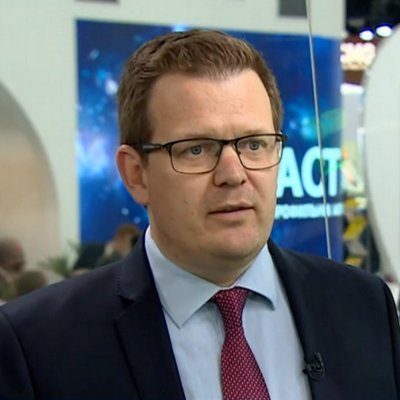
Donald Trump has talked about attacking Iran and stealing its oil for 46 years (1980-2026)
English
We’ve seen a lot of buildings hit by exploding hypersonic missiles and suicide drones and yet not a single building has collapsed neatly into its own footprint.
A long time ago three huge buildings did that almost simultaneously.
Weird.
Seyed Mohammad Marandi@s_m_marandi
Those who planned this, planned today's war against Iran.
English
mark รีทวีตแล้ว

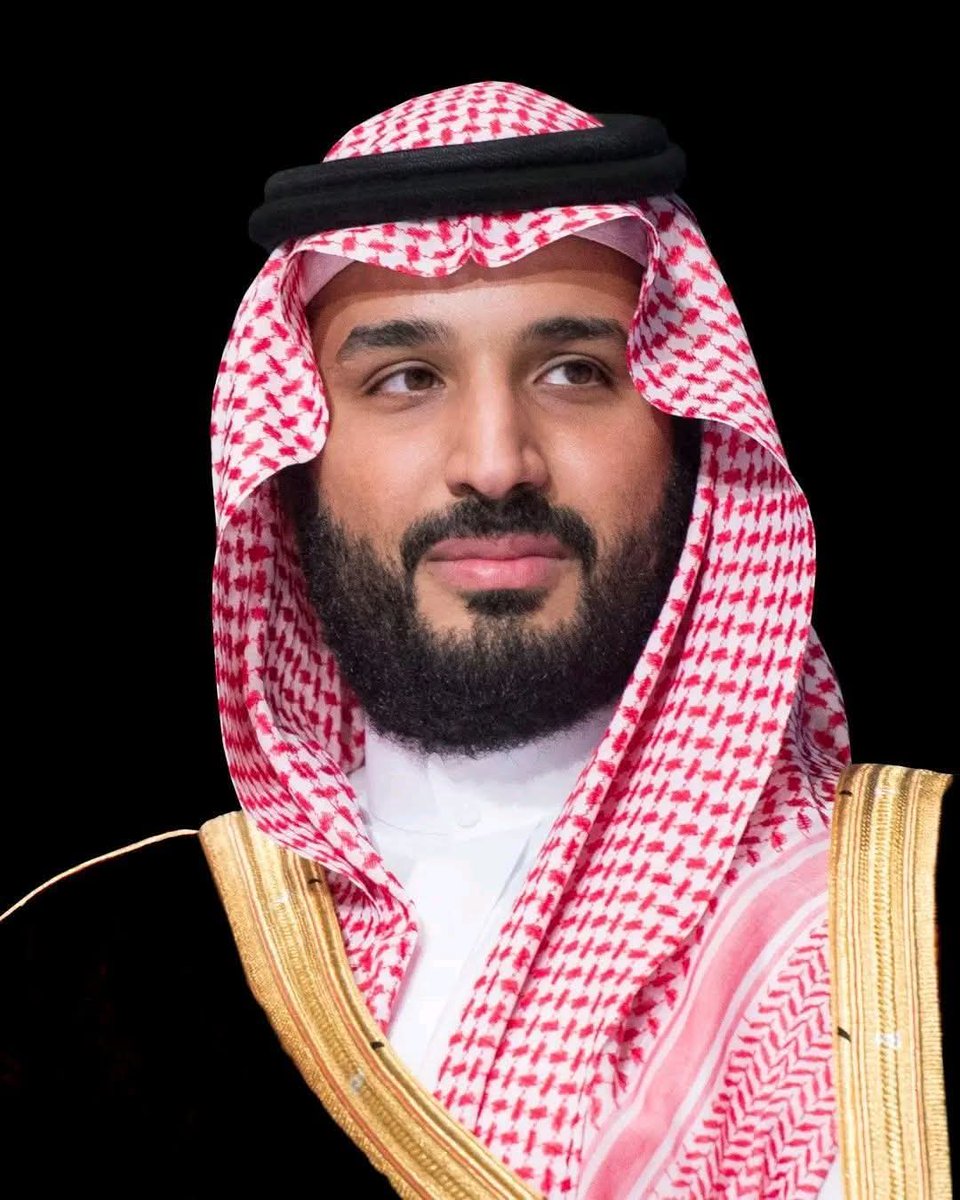
“We will no longer purchase American weapons,” — the de facto ruler of Saudi Arabia, Crown Prince Mohammed bin Salman, responded to the temporary leader of the United States.
Until now, the money flowing into the American military-industrial complex was not just business.
It was truly a ritual of loyalty.
You weren’t just buying missile systems — you were buying the right to belong.
As of today — it’s all over.
This was the Crown Prince’s response to insulting remarks made about him by Donald Trump.
This response highlights a fundamental difference between the temporary political management of democracies and the enduring strength of a monarchical dynasty.
Here, the focus shifts from personal insult to civilizational superiority.
A clash of eras: the permanence of a dynasty versus Trump’s temporary politics.
Today’s strategy of the prince is not just foreign policy — it is a lesson in political weight and restraint.
While Western leaders come and go, bound by election cycles, power in the Persian Gulf rests on centuries-old roots, making any pressure from temporary figures essentially meaningless.
Temporariness vs. Heredity
Donald Trump is only an episode in history — a political figure who came for a short time and will disappear just as quickly.
His attempts to dictate terms are met with a cold smile from a man whose family has ruled these lands for centuries — and will continue to do so.
Four years vs. eternity: While U.S. presidents fight for every vote every four years, the prince implements the Vision 2030 strategy, looking decades ahead.
Real wealth vs. “paper” wealth: Trump’s fortune is just a drop in the ocean compared to sovereign wealth funds and the dynasty’s personal capital. The prince is described as the richest man in the world, whose assets sustain entire nations, not just build hotels under his own name.
Dignity and the value of one’s word
Through actions, not social media outbursts, the prince shows Trump his real place. The “you are nobody” policy manifests in every decision:
Ignoring demands: The Gulf no longer adjusts oil production to U.S. election campaigns.
Strategic silence: The prince knows his worth and does not stoop to cheap populism, responding to rudeness with economic power and new alliances.
Ukraine: Choosing a strong partner
Cooperation with Ukraine in this context reflects the prince’s independence in choosing allies in Europe.
Investment in the future: Supporting Ukraine and joint defense or technological projects demonstrates that true power does not need approval from temporary occupants of the White House.
A new axis of influence: By building a partnership with Ukraine, the prince is shaping a new security architecture where decisions are made by those who possess real resources and historical legitimacy.
Conclusion: While Trump tries to play the role of a “great dealmaker,” the prince simply is one. This confrontation highlights the key point: politicians pass, but dynasties and great states remain. In this dynamic, Ukraine becomes a key partner for those who truly influence global processes.
Info:
Mohammed bin Salman Al Saud (born 1985) is the Crown Prince, Prime Minister, and de facto ruler of Saudi Arabia.
The son of King Salman, he is known as the initiator of the large-scale socio-economic reform program “Vision 2030,” aimed at reducing oil dependence, modernizing the country, and expanding women’s rights. He served as Minister of Defense (2015–2022) and chairs the Council for Economic and Development Affairs.
English
mark รีทวีตแล้ว
⚡️The real answer is that the system is parasitic.
It feeds on homelessness.
It does not solve homelessness.
Too many jobs, contracts, reputations, budgets, and political identities now depend on the problem remaining large, visible, and morally exploitable. The money does not move toward resolution. The money moves toward administration.
That is why the numbers are obscene.
A city can spend the equivalent of a full household income per homeless person and still leave the streets full of human ruin.
That is a regime problem.
The homeless person is valuable as a managed unit.
Not as a restored human being.
A restored human being exits the system.
A managed human being justifies another grant, another contract, another department, another nonprofit gala, another election speech, another moral performance by people who never have to live near the consequences.
The direct cash part is too naive.
A lot of these people are not just broke
.
They are psychotic, addicted, shattered, predatory, incapacitated, or some mix of all five.
A pile of cash does not rebuild a broken nervous system or stop a fentanyl spiral.
Street disorder needs force, treatment, sorting, removal, and structure.
Real housing for the salvageable.
Institutions for the unsalvageable.
Punishment for the predatory.
Order for everyone else.
That is the part the system refuses to do.
Because the actual operating religion is not restoration.
It is managed decay.
Keep the money flowing.
Keep the guilt flowing.
Keep the bureaucracy growing.
Keep the streets bad enough to demand funding.
Keep them bad enough to prove compassion is needed.
Never bad enough to force a real moral reckoning about what many of these cases actually are.
So the clean truth is this.
The system does not exist to end homelessness.
The system exists to process homelessness.
And processed suffering is one of the most profitable products a decaying city can produce.
Tuki@TukiFromKL
🚨 do you understand what New York City just accidentally admitted.. NYC spent $81,705 per homeless person last year.. the median American household earned $81,228.. the government spent MORE to keep someone homeless than most families earned to keep themselves housed.. that $81,705 isn't going to the homeless person.. it's going to the system around them.. shelters, administrators, case managers, contracts, overhead.. the industry that manages homelessness.. not the end of it.. if NYC gave every homeless person that money directly.. they could afford nearly 2 years of rent.. most of them wouldn't be homeless anymore.. instead the money goes to the system.. the system keeps running.. the homelessness stays.. and every year they ask for more funding to manage the problem that the funding was supposed to solve.. the homeless are worth $81,705 a year to the system.. they're worth nothing to it solved..
English
mark รีทวีตแล้ว

The older you get, the more you realize luck is mostly exposure.
If you sit in the same place, have the same routine, talking to the same people, nothing new really happens.
You have to tackle the world to win.
Travel more. Talk to people. Try a breakfast spot. Post on social media. Start a side hustle or a hobby.
The world rewards motion. You don't find opportunity sitting still.
English
mark รีทวีตแล้ว

In 2021 I was thinking about shorting Tesla.
It was during covid.
He struggled to keep his factories open, the economy was in shitters, growth was low and didn't justify the PE ratio.
I thought: "What could he POSSIBLY do to prop up this inflated stock?"
But then I came back to my senses and told myself:
"Don't bet against Elon.
He is Elon.
Elon always finds a way"
And then one week later the motherfucker took a bunch of his skinny Asian employees dressed up as robots onto the stage.
And the rest is history.

Jim Krepelka@KrepelkaJim
@Linahuaa Grok will win hands down. Not betting against Elon and 4 chan. Anthropology is woke
English
mark รีทวีตแล้ว
⚡️Mass culture has become nostalgic, cowardly, and metabolically broken.
The archive is eating the living.
Every new song now enters an arena already flooded with immortal incumbents. The old hits never leave. They are always available, always cheap, already loved, already socially certified, already tied to memory. New work has to fight the full weight of the digitized past all at once. Most of it loses.
The algorithm makes this worse because it does not serve culture. It serves retention. Familiarity beats novelty there. Memory beats risk. The machine keeps handing people the safest emotional asset in the pile. So the past keeps winning, not because the machine has taste, but because the machine is a coward.
Capital is just as bad. Labels, studios, publishers, game companies, all of them learned the same lesson. Nostalgia converts better than invention. Old catalogs have lower risk, cleaner economics, easier marketing, and built-in attachment. So money keeps funding resurrection instead of creation. The result is a culture that keeps reanimating corpses because the corpses test well.
There is a darker truth.
A lot of new work really is weaker. The pipeline got poisoned. Artists are trained to chase engagement before mastery, fragments before worlds, virality before depth. They are overexposed too early and underformed for too long. A civilization that turns creators into content operators should expect thin art.
The machine favors the archive, and the living are often not strong enough to break it.
So the deepest read is simple.
This is a sign of civilizational aging.
A young culture creates.
An old culture curates.
A dying culture remasters.
Jeremiah Johnson 🌐@JeremiahDJohns
I've written about this before, but it's remarkable how much older music is strangling new music. And the same is true in books, movies, video games. Older media is taking up a bigger and bigger share of the market every year.
English

He's playing the same game they all play--pretend you're for the little guy, pretend what's good for you is also good for the little guy.
17,000 lobbyists? Who has more influence on the government than Jamie Dimon and the circles he moves in?
He can do that from the shadows right now. Why would he want to be President? That would be a demotion.
English
mark รีทวีตแล้ว
Jamie Dimon, CEO of JPMorgan Chase, says that US Government raising taxes doesn’t do anything to help the average American
He says raising taxes does nothing because Congress just launders the money to their friends, special interest groups and “17,000 lobbying groups”
“I don't know anyone, and you guys in the room, you might be Democrats, Republicans who thinks that sending another trillion dollars to Washington D.C will actually improve anything. So when you say raise taxes, if you said raise taxes and directly give it to the people who need it, do it. That does not happen. It goes to all these interest groups, and they give it to their friends and all that.”
“Which is why the people are considered a swamp. It's kind of a swamp, the 17,000 lobbying groups. But bank companies are guilty too. They're just fighting for their one self-interest as opposed to what's good for my country”
English
mark รีทวีตแล้ว

Peanuts in Coke is one of the most accidentally perfect food pairings in history, and the chemistry explains why this guy can't go back.
Coca-Cola sits at pH 2.5, roughly the same acidity as stomach acid. When you drop roasted peanuts into that, the phosphoric acid partially denatures the surface proteins on the nut, releasing free glutamate. You're generating umami in real time inside the glass.
The salt on the peanuts suppresses bitter taste receptors on your tongue, which amplifies your perception of sweetness without adding a single gram of sugar. Coca-Cola already has 39g of sugar per can. Your brain registers it as even sweeter because the salt is clearing the noise from competing flavor signals.
Then carbonation does two things. CO2 dissolved in liquid forms carbonic acid, which triggers pain receptors (TRPA1), not taste receptors. That mild irritation resets your palate between sips so you never get flavor fatigue. Every sip hits like the first. Second, the bubbles physically agitate the peanut surface, accelerating the protein breakdown and glutamate release. The longer the peanuts sit, the more umami you extract.
The fat content seals it. Peanuts are 49% fat by weight. Fat is the only macronutrient that activates CD36 receptors, which your brain interprets as richness and satisfaction. Mix that with sugar, salt, acid, umami, and carbonation and you've accidentally triggered every major reward pathway in the human taste system simultaneously.
Georgia farmers in the 1920s did this because they needed one hand free while working. They stumbled into the optimal salt-acid-umami-fat-carbonation loop a century before food science could explain why it worked.
猫山課長@nekoyamamanager
30年前くらいに村上春樹のエッセイで、アメリカではコーラにピーナッツを入れて飲むのがポピュラーだと書いてあった。「ふぅん」と思ってから長い時間が経ったが、ついにやってみた。 何だこれバカ美味いんでやんの。 これ以外でもうコーラ飲みたくなくなるレベル。
English
mark รีทวีตแล้ว

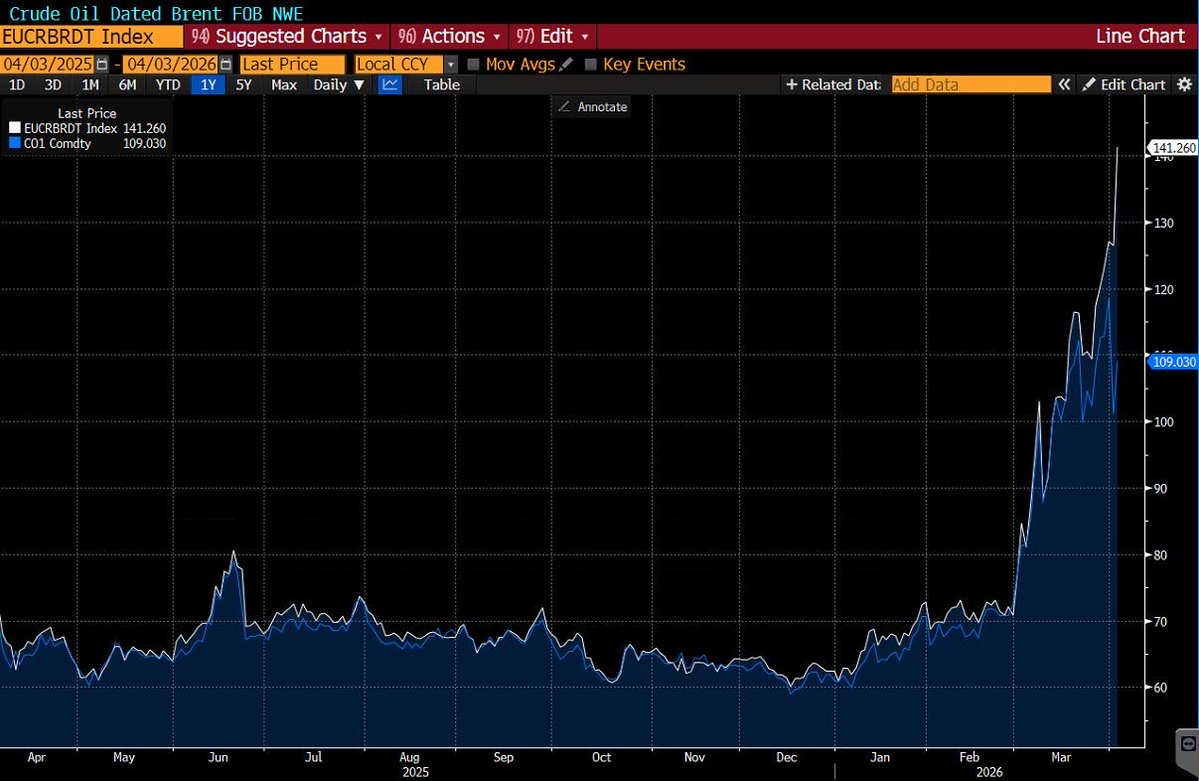
There are two oil prices tonight and they are $40 apart. The one on your screen says $109. The one on the tanker says $140. The screen is a bet. The tanker is a fact. And the gap between them is the space where the true cost of this war hides from the public, from the polls, and from the President who quotes the lower number.
Brent futures closed near $109 on April 3. That is the price traded in London by hedge funds, algorithmic systems, and institutional investors speculating on when the war ends. Dubai physical crude, the benchmark for actual barrels loaded onto actual tankers and delivered to actual refineries in Asia, traded between $126 and $140, with spikes to $166. Dubai physical has risen 76 percent since the war began. Brent futures have risen 36 percent. The gap was less than one dollar before February 28. It is now $37 to $40 on an average day and $57 on a bad one. This is the largest sustained paper-physical divergence in the modern history of the oil market.
The futures market is pricing a short war. Brent for December 2026 trades at $80. Paper believes the strait reopens and barrels flow. Physical says the strait is closed, diplomacy collapsed on April 3, and barrels are not flowing. Eight million barrels per day were taken offline in March, the largest monthly disruption on record. The IEA released 400 million barrels from strategic reserves, the biggest coordinated draw in history. The US SPR sits at 345 million barrels after 2022 drawdowns never replenished. At current consumption, the reserve covers roughly 18 days.
The bypasses were supposed to close the gap. Saudi Arabia’s East-West pipeline is at its full 7 million barrels per day. Terminal constraints cap exports at 5 million. The UAE’s Habshan-Fujairah pipeline is near its 1.8 million limit despite March 28 fires. Combined, bypasses cover 13 to 28 percent of normal Hormuz flows. The remaining 72 to 87 percent is gone.
And here is the detail that closes the circle. Habshan, the origin point of the ADCOP bypass pipeline, caught fire twice in fifteen days from the debris of intercepted missiles. The bypass that was built to survive a Hormuz closure starts at a facility that is burning from the wreckage of its own air defences. The pipe works. The source is on fire. The workaround is damaged at the point where the oil enters it. The molecule reaches the bypass and finds the bypass is burning.
The screen price is what Trump quotes when he says oil will come down. The physical price is what Asian refiners pay when they bid for the last cargo in the Gulf. The screen is what the Fed watches for rate decisions. The physical is what sets jet fuel, diesel, fertiliser, and everything that moves on a truck. The screen responds to ceasefire tweets. The physical responds to tanker availability. One is a narrative. The other is a molecule.
The narrative says $109. The molecule says $140. The gap is the war. And the market that closes tonight for 63 hours has no mechanism to price what happens to either number when the April 6 power-plant deadline expires on Monday evening and the bypasses are maxed, damaged, and burning at the source.
open.substack.com/pub/shanakaans…
English
mark รีทวีตแล้ว
⚡️Forty is the age where a person finds out who they actually became.
By then, the body tells the truth. Money tells the truth. Marriage tells the truth. Kids tell the truth. Career tells the truth. Energy tells the truth. The fantasy version is dead.
Most people are not destroyed by bad luck. They are destroyed by fear, avoidance, and years of lying to themselves. Forty is when the bill shows up.
That is why it feels terrifying. Time is no longer theoretical. Parents start dying. Children need real provision. Weak habits become permanent damage. Mediocrity stops looking temporary and starts looking final.
Fear steals lives. People waste their strongest years hiding, delaying, coping, numbing, rationalizing, and pretending they still have endless time. Then forty arrives and reality becomes visible.
The clean truth is this.
Forty is terrifying because by then there is evidence.
Tim Denning@Tim_Denning
The most terrifying age is 40. Not because you’re getting old or have some grey hair, but because your perception of time completely changes. At 40, life is f*cking serious. If you have kids and don’t work hard, they starve and end up getting a bad education. You also see the difference between those who f*cked around and figured it out and those that settled for mediocre. The stark difference will rip your face off. A person who could have done a lot and didn’t by 40 has wasted the best years of their life. It’s sad to see. By 40, the lifestyle you chose becomes obvious. Your hair turns grey or falls out if you abuse your body. You end up with a pot belly if you eat like sh*t. If you don’t go to the gym you have no energy. Something else happens. Your parents either die or have multiple near-misses. You start to realise they will be dead one day and you’re in charge of your bloodline. This responsibility weighs on you. Even cooler, the knob heads in high school who made fun of you or thought they were cool are not modern day losers. They work dead end jobs and watch sports with a beer to numb their pain. They don’t dare f*ck with your aura anymore. Pessimism can often set in to. You start to obsess over news and politics. You think the government will save you or that billionaires are evil for doing what you refused to do. Jealousy gets ugly. It becomes a realise valve. The best place to deploy it is on social media. You rage post comments calling stuff scams and trying to discredit people. But it doesn’t work. People ignore you because they know you’re a little b*tch. For many people, 40 becomes a moment of either radical transformation or a slow decline. The crazy part isn’t turning 40. It’s realizing how much time you wasted being trapped by fear.
English
mark รีทวีตแล้ว

A Japanese restaurant put “face slap” on the menu.
500 yen per slap. Up to five. Extra 100 yen to pick your server.
It started free. Demand forced them to charge.
Onlookers cheered. Women requested multiple rounds. The owner noticed.
So he flipped it: female customers could pay to do the slapping.
American spas charge $200 for a sound bath.
Japan charged $3.50 to hit you.
Both call it stress relief. One of them has a waitlist.
English
mark รีทวีตแล้ว
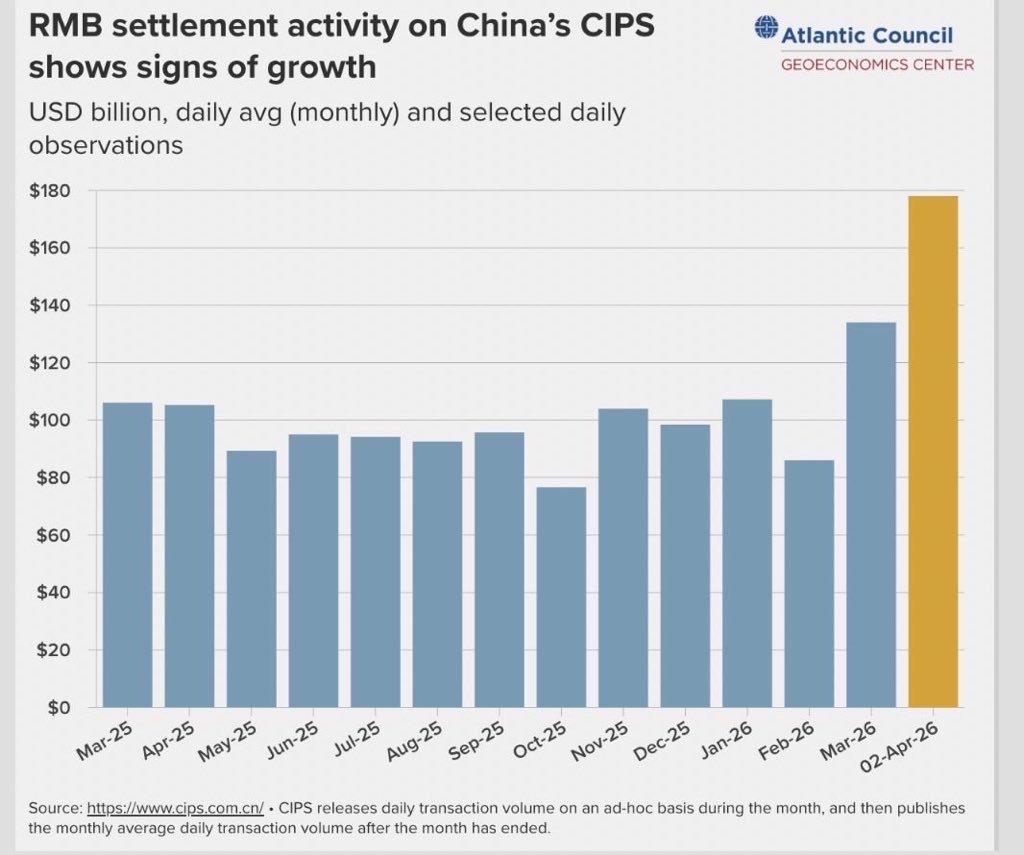
Hormuz effect.
Yesterday’s CIPS payment volume was double the February daily average payments.
Eric Yeung 👍🚀🌕@KingKong9888
France paid the Iran strait of Hormuz toll in Chinese RMB Yuan.
English