Kusha

2.6K posts

Kusha banner
Kusha

Kusha

@compoundlessons

Full-time Trader | @CoinMarketCap | @BloFin_Exchange

free alerts & education → เข้าร่วม Ağustos 2021
95 กำลังติดตาม3.2K ผู้ติดตาม
ทวีตที่ปักหมุด
Kusha
Kusha@compoundlessons·
This year I moved from trading stocks to crypto and put up a 4,023.5% return turning $3,600 → $148,437.06. December 2024 to February 2025, I blew up a client's account from $16,000 to $3,600 trading equity strategies on spot. Having no knowledge of crypto at the time, using metrics that didn't matter. They withdrew. F*ck that. I moved $3,600 of my own money to BloFin in March to prove them wrong for giving up on me. I turned the $3,600 that would've been left into $148,000+ in 9 months. –– 37% win rate. –– Average RR of 5. –– 8 green months in a row and only 1 red month. Every trade documented. I'm 19 now... No job. No education. $5,000 in monthly expenses. I burned the boats. No safety net. No Plan B. I've been in "perform or die" mode since I was 16. I am cut for this sh*t. Built a system from scratch. Laid out the foundation for more. This run taught me shit no course could've taught, Opening doors and making me a dangerous trader. Law of exposure is real. I know it's possible... Proof of concept is there, now it's time to scale. This is the start of my compounding. Watch me. — Kusha Jahan
Kusha tweet media
English
9
1
34
4.1K
Kusha
Kusha@compoundlessons·
there are 7,000+ coins in existence yet there isn't enough real capital, real users, or real demand to sustain even a fraction of them. the structure is always the same. but to make money with this information you need to comprehend the timeline and the psychology behind it. pre-listing, underwriters and early allocators load size at the lowest possible cost basis and by the time the token hits an exchange, the narrative is fully priced in and the smart money is positioned to exit. retail floods in chasing momentum and every buy on the way up is someone else's sell. all crypto is, like any other asset, a transfer of wealth with no new money being created. which is exactly why i go short. if there are thousands of coins with not enough demand to keep them afloat, paired with the supply already being controlled by those with cost bases i couldn't touch prior to listing, why would i waste time chasing something that is prone to collapse. the smart money loaded pre-listing then offloads into retail buying after the exchange listing. with this notion in the air, i apply the 50/80 rule: 50% of leaders falling 80% 80% of leaders falling 50% from highs. this is a timeless metric that played out brutally in stocks but became even more fluid in crypto because the accelerated volatility lets the metric fulfill faster since there are no circuit breakers, no market hours, no institutional stabilizers and retail is trading purely on emotion in a 24/7 market with no floor underneath it. this thesis alone gives me a framework to capitalize on smart money exiting and retail money getting f*cked. but to capitalize you need a rundown of the system i've built and implemented. a coin pre-listing is working from a tiny float, sometimes a few hundred thousand dollars in real liquidity and by the time retail sees it, that number has been hype-cycled into a $10M, $20M valuation with nothing underneath it. the move was never organic, but it terms of % gain it qualifies as a "leader" now that this is a "leader" on paper, i apply my 50/80 metrics to gauge probable fulfillment. i target this method specifically because: in equities the 50/80 rule plays out over months. in crypto it plays out in days, creating an enhanced system for elevated EV. the metrics are timeless and crypto just runs them at 10x speed with a retail audience that mistakes volatility for opportunity. and that's the edge. it's easier to anticipate 99% of these coins going to zero than it is to blow your bag rotating through narratives trying to find the next bitcoin. so this is my thesis: when i look at newly listed coins these proven metrics set the tone and i act on the probability of fulfillment by identifying defined risk via technical analysis to pair it accordingly so i can make the most amount of money in the shortest amount of time risking the least amount of money. understand the rotation of money regarding this concept/asset class and you'd open a door into an EV pipeline.
Kusha tweet media
English
0
2
4
336
Kusha
Kusha@compoundlessons·
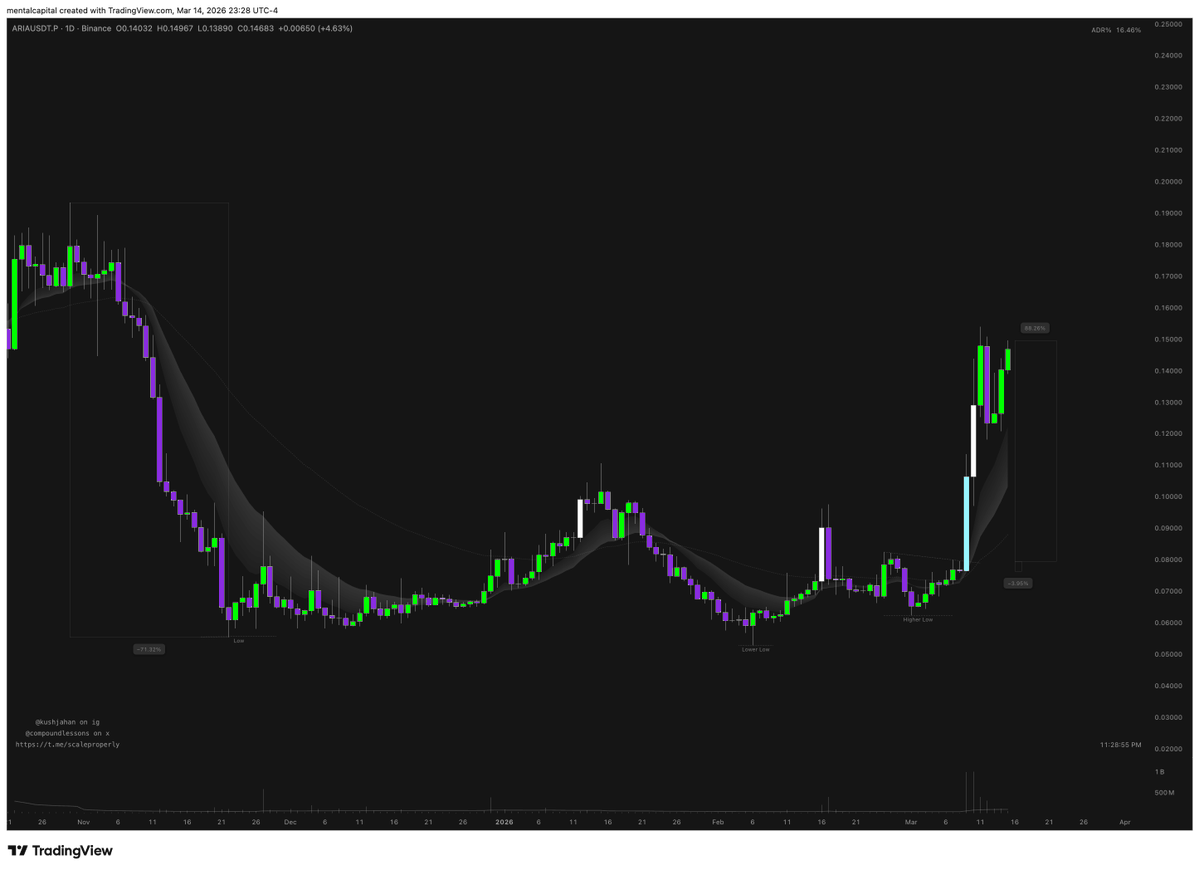
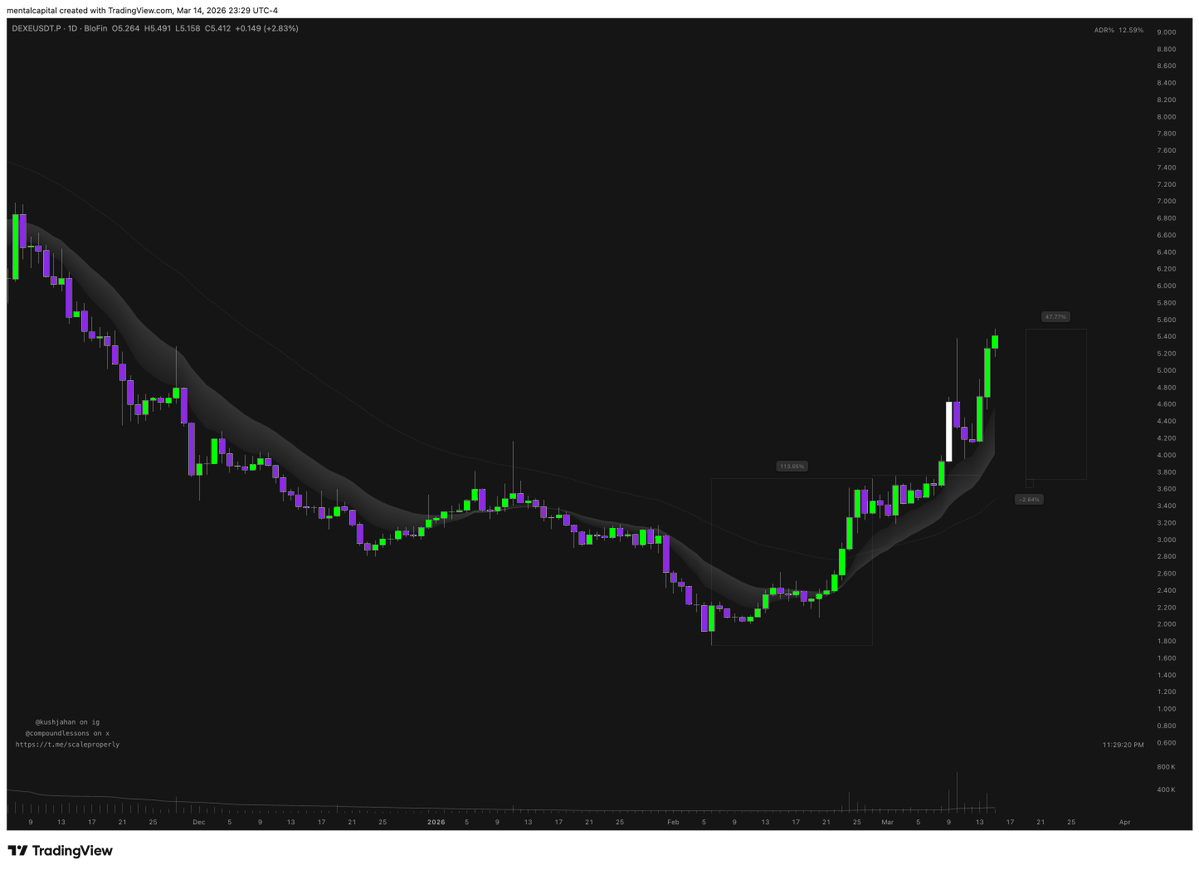
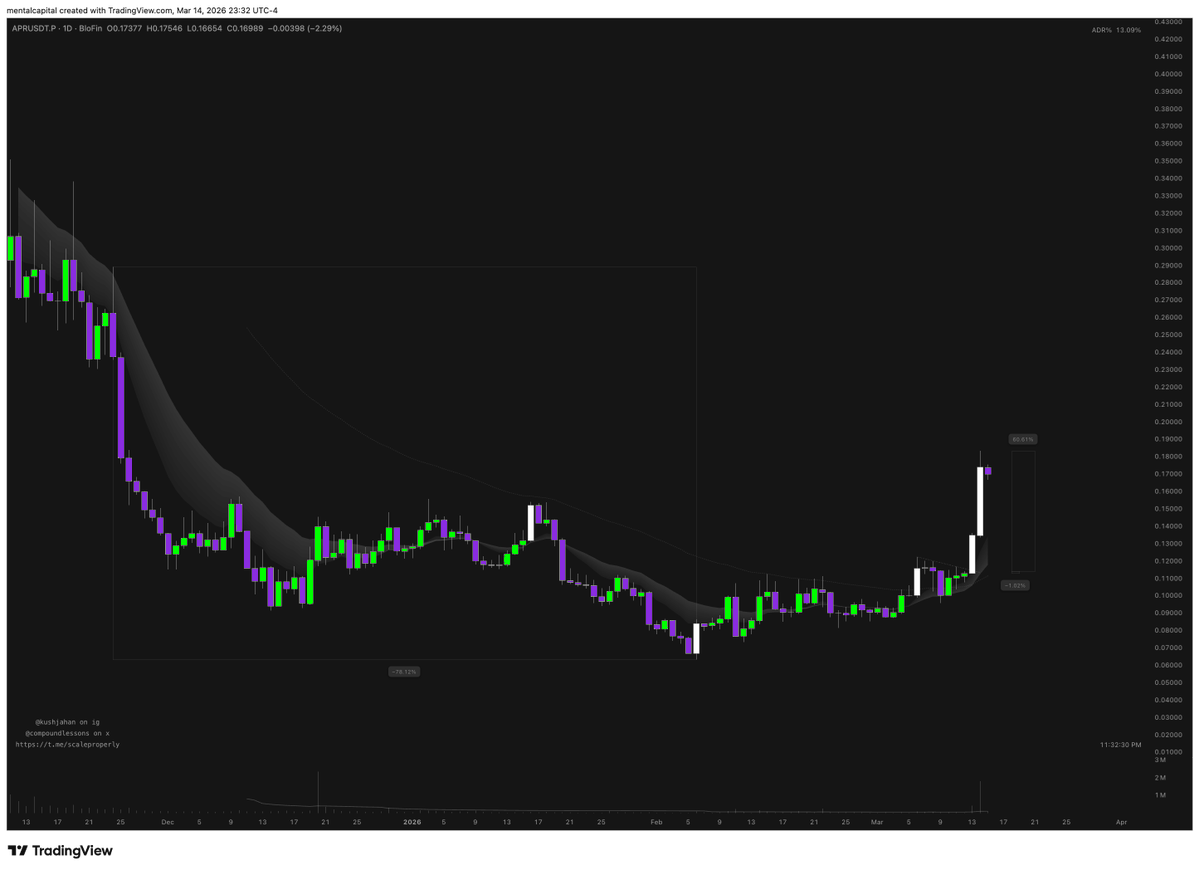
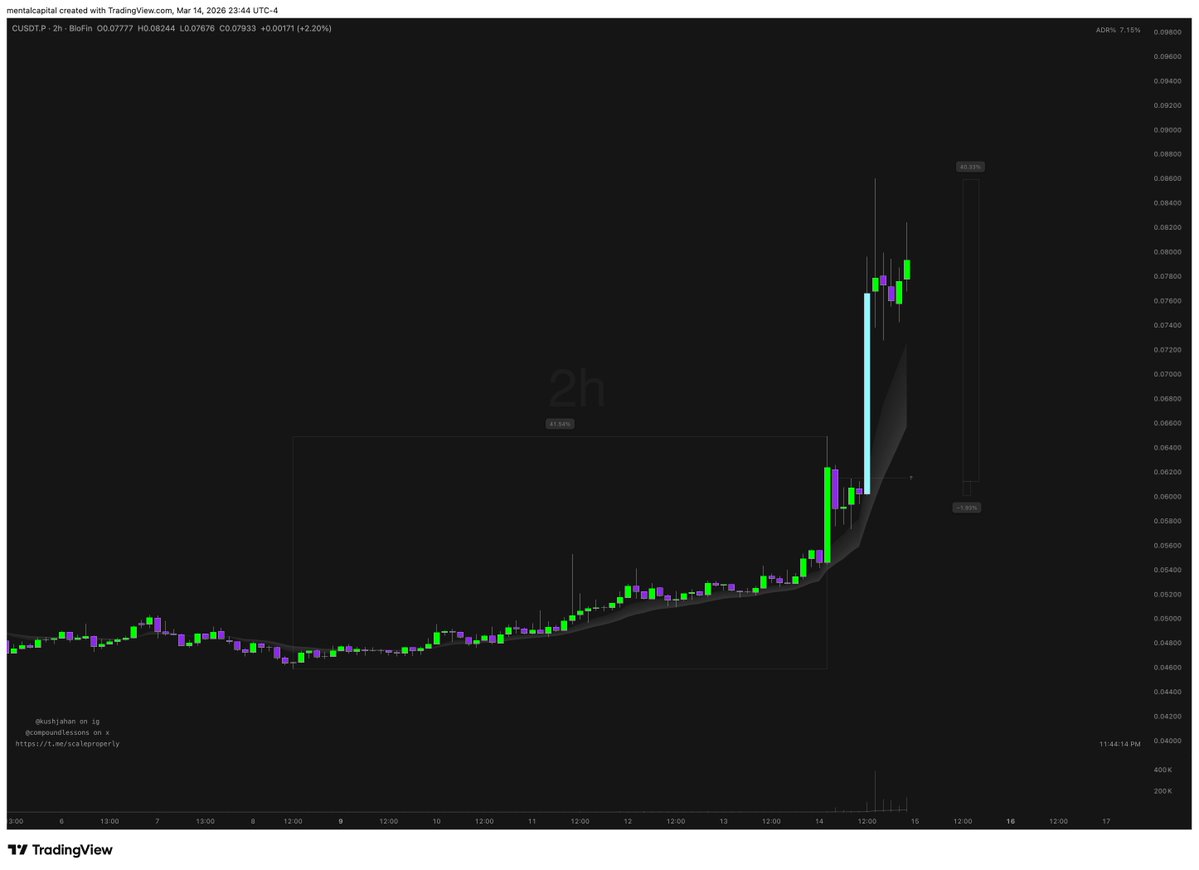
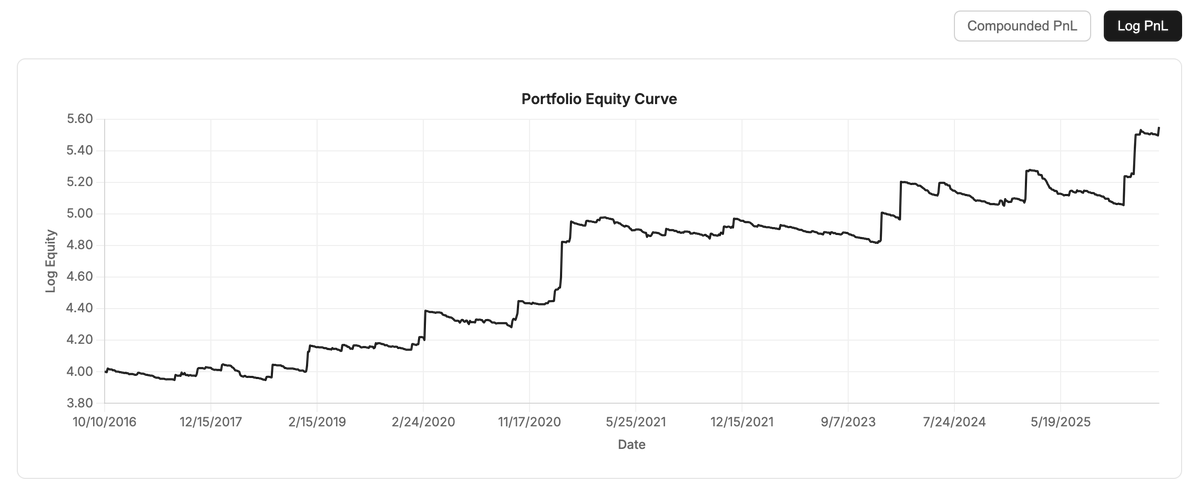
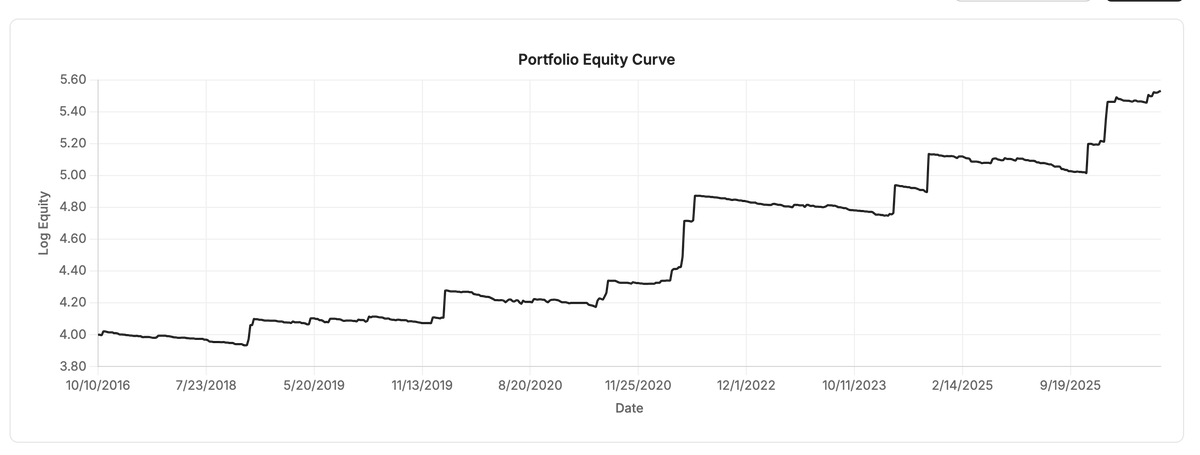
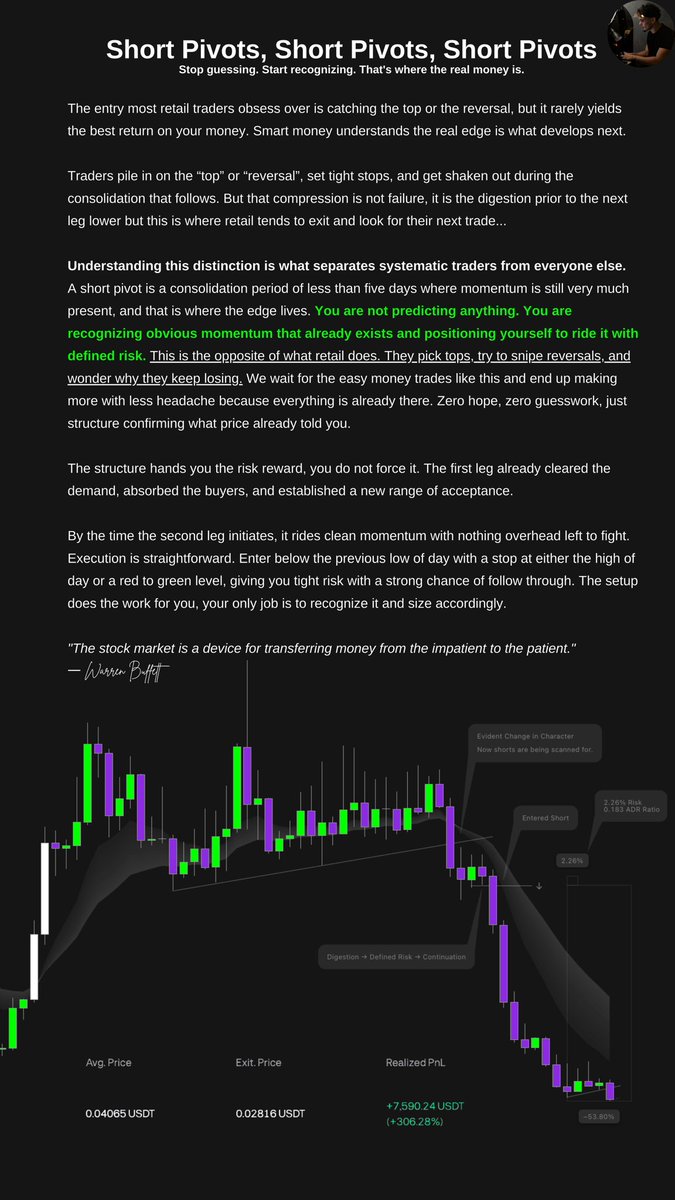
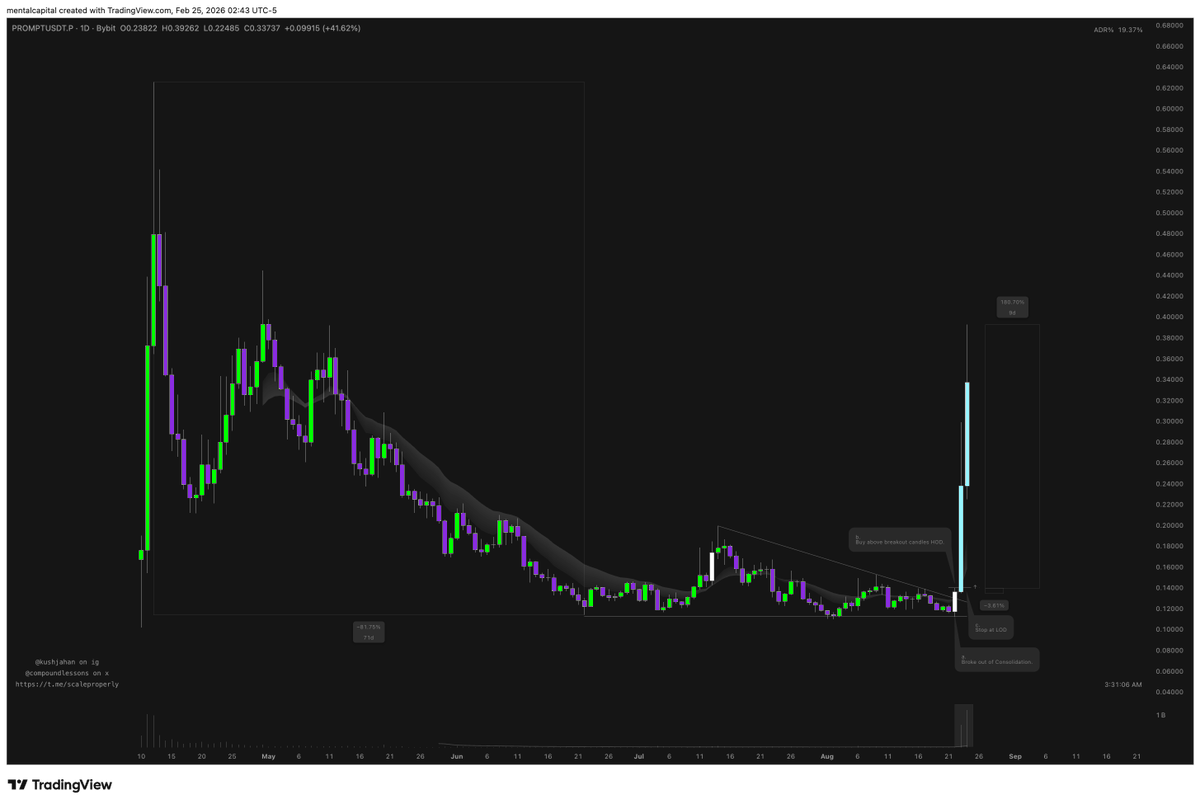
120.72R across 6 days, 4 trades, 4 different setups. cheat entry — 59.42R high tight flag — 18.09R base breakout — 22.34R short pivot — 20.89R all still open, all trailing via methodology set before entry, yet they all met the same criteria: — 3+ tests of resistance — inside candle prior to breakout — moving average respected during consolidation — volume dried up as consolidation continued — above the 50 EMA — stop/ADR ratio below 0.7 if there is one thing to take away from this, study what works, build a thesis, backtest, build conviction, and build a system behind it with quantifiable metrics to eliminate guesswork, then let this system play out over X amount of attempts. setup × duration × size = scalable edge if you have a setup you believe is profitable (via backtesting) and the duration to prove it, size becomes the only variable left to scale.
Kusha tweet mediaKusha tweet mediaKusha tweet mediaKusha tweet media
English
0
1
19
1.7K
Kusha
Kusha@compoundlessons·
@hackertrader “You’ll almost always be in a period of drawdown” — Kristen Quallamaggie Good work man.
English
0
0
3
321
Niv Goren
Niv Goren@hackertrader·
Always heard about it but was finally able to prove it. Market breadth seem to have an edge trading momentum breakout type strategy (it could be overfit, mistake etc etc). From 48% CAGR and 40% DD to 46% CAGR and 25% DD. Shoutout to the guy behind this: tradermonty.github.io/market-breadth…
Niv Goren tweet mediaNiv Goren tweet media
English
7
4
57
13.2K
Starsky439
Starsky439@observer1116·
@compoundlessons I'm just tired of getting a massive win and lost it completely in a failed breakout...😔
English
1
0
1
212
Kusha
Kusha@compoundlessons·
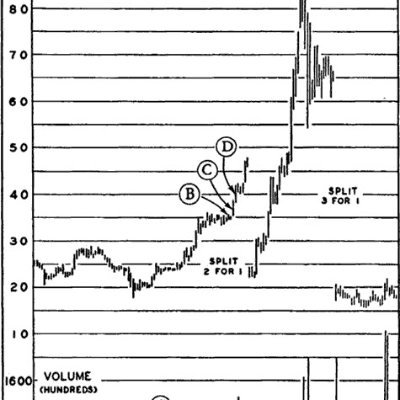
I made 92,000+ on this one setup alone in 9 months and this is how I can speak on trading breakouts. You need to understand that the chart doesn't lie, conviction comes from the setup, the structure, the compression, the level, every breakout is telling a story before price even moves and when the consolidation is tight, the level is holding and volume is contracting into the range, the chart is demanding the move before it happens, because at that point you are not predicting anything, you are just reading it and interpreting the weight each variable that is presented holds. After thousands of hours studying breakouts, with even those dating back to the early 1900s through decades of historical data, pattern recognition stops being a skill and becomes instinct. I could teach a monkey how to read a chart at this point, and that instinct hardened into a system. Now leaving me with a repeatable, rules based framework built to remove emotion and replace it with precision execution. (essentially quantified) The framework exists. The formula is already on paper, all backed by my effort and performance: – thousands of hours of study condensed into a replicable system – setups traced back to the early 1900s through decades of historical data via modelbook – a scoring framework built to translate conviction directly into size (weighted system) – rules that remove emotion and replace it with execution (quantified intuition) – a methodology tested across crypto and equities in live market conditions, now proven timeless. Most traders spend years making expensive mistakes trying to figure this out alone. the information is not hidden. the edge is not luck. it is pattern recognition built through repetition, refined through loss, and structured into a process that is scalable. and by the time you figure this out by yourself (if you ever do in so, a vehicle where 99% fail) you've missed the first leg in the cycle and have to sit on the sidelines and chase. sense of urgency is vital, find a mentor, study, cut the bs and execute because time doesn't care about where you are in regards to opportunity persisting.
Kusha tweet media
English
3
21
187
15K
Kusha
Kusha@compoundlessons·
@ChipVitale kind words, thank you man. you’ve witnessed me every almost every phase of my trading career. don’t think I don’t see the work you put in behind the scenes either…
English
0
0
1
604
CTVIII🤖 | TradeTracs
CTVIII🤖 | TradeTracs@ChipVitale·
@compoundlessons Goated. One of, if not THE the hardest working trader I know even compared to those who have 10-20+ years of time on you. Yet you outwork them all🤝there is only one path forward ☝️
English
1
0
1
673
Kusha
Kusha@compoundlessons·
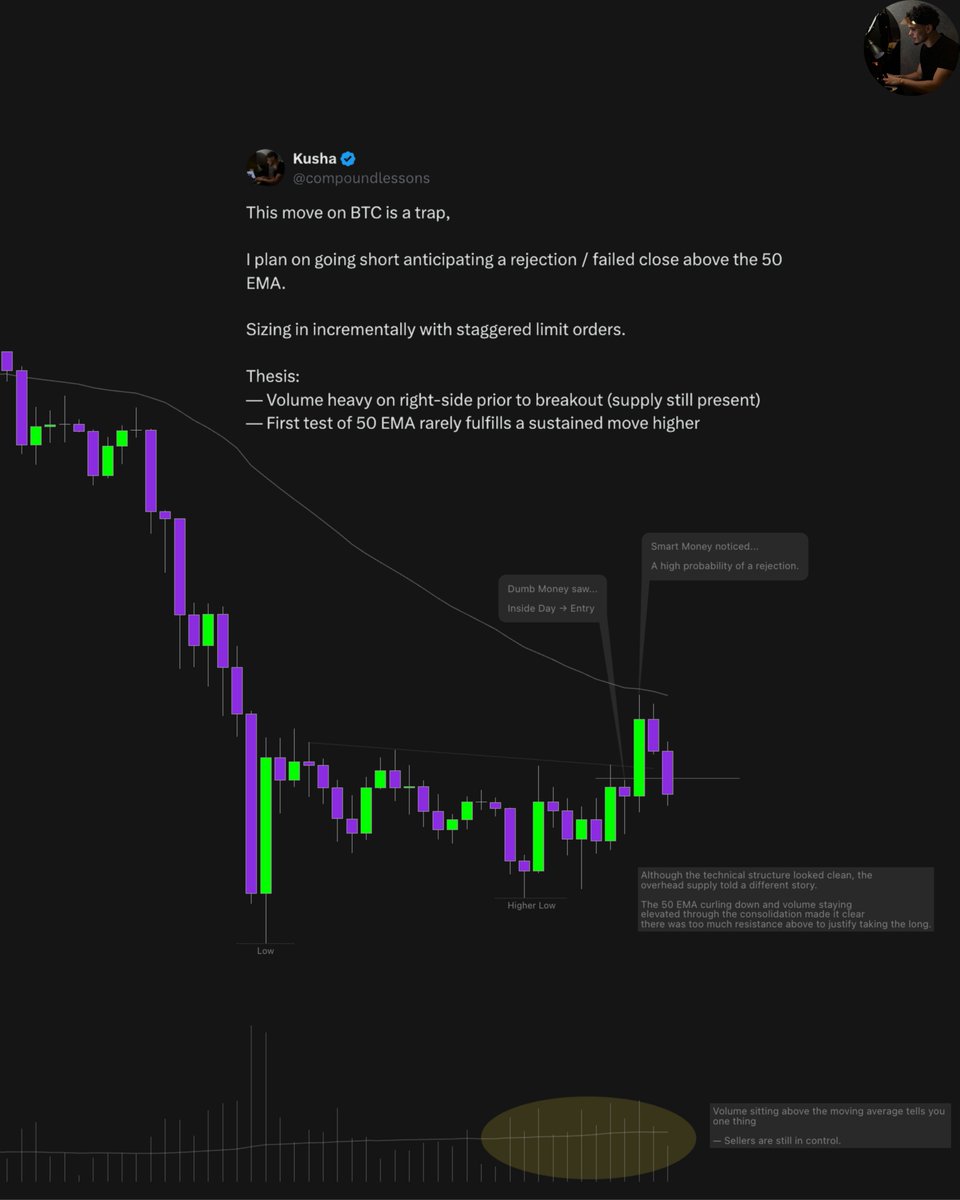
Retail bought the breakout on $BTC. Institutions used this as an opportunity to either scale out or positioned short. Every trade has a loser and that loser is almost always retail, for exactly the reasons they ignored here: – Volume remained elevated through the consolidation, signaling persistent selling pressure rather than a healthy contraction – The 50 EMA was curling lower with fresh supply sitting, because it hasn't been backtested since the first move below. For a breakout to be legitimate, you need to see: – Volume dry-up – 50 EMA either flattening out, beginning to slope upward, or weakening as resistance with multiple tests. Retail drew a trendline, saw an inside day, and entered long thinking this is the next leg higher. What they ignored was the context, the surrounding details that determine whether a setup is actually worth taking. This is another testimony to Jesse Livermore's, "There is nothing new in Wall Street. There can't be because speculation is as old as the hills. Whatever happens in the stock market today has happened before and will happen again." A direct transfer of wealth happening in real time.
Kusha tweet media
Kusha@compoundlessons

This move on BTC is a trap, I plan on going short anticipating a rejection / failed close above the 50 EMA. Sizing in incrementally with staggered limit orders. Thesis: — Volume heavy on right-side prior to breakout (supply still present) — First test of 50 EMA rarely fulfills a sustained move higher — This move is a draw of retail hope anticipating the bottom being in, paired with base counting suggesting another leg lower is evident to fulfill 4-5 bases lower in a cycle (William O’Neal)

English
1
1
2
1.3K
Kusha
Kusha@compoundlessons·
you won’t beat me. i will outwork you. i will lose more sleep than you. i will take more losses than you. i will be more productive than you. i will burn everything down to build something you can’t touch.
Kusha tweet media
English
0
0
2
712
Kusha
Kusha@compoundlessons·
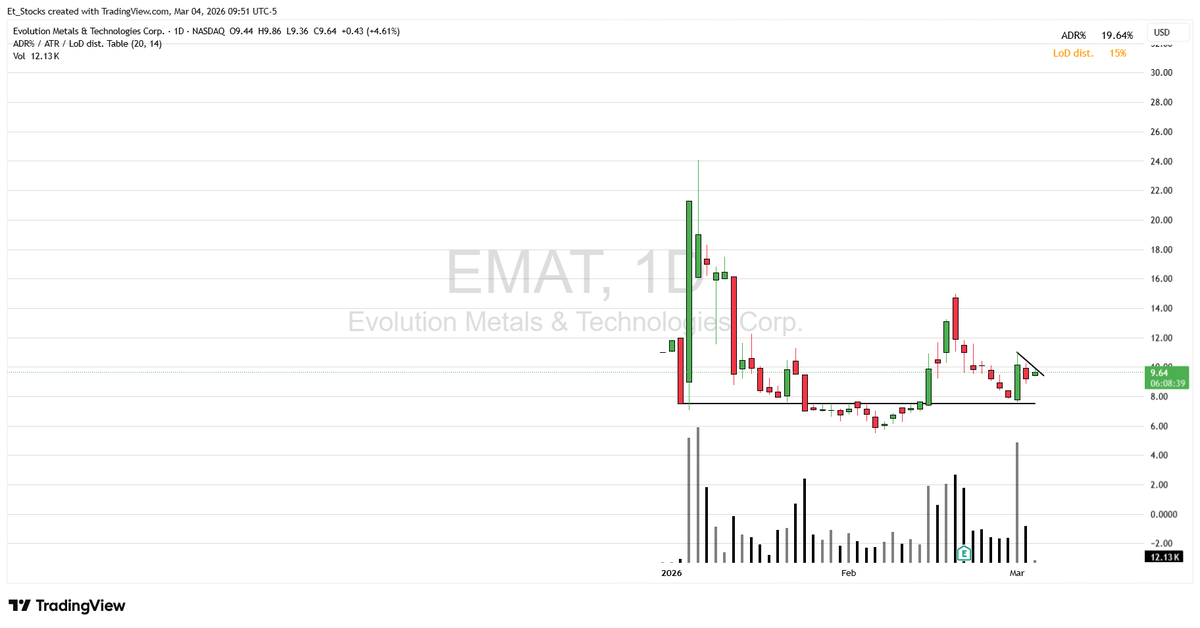
@ET_Stock a short pivot i see 😍😍
English
0
0
1
86
Ernesto Texidor
Ernesto Texidor@ET_Stock·
$EMAT another REE with a lot of potential
Ernesto Texidor tweet media
English
1
0
5
324
Kusha
Kusha@compoundlessons·
This move on BTC is a trap, I plan on going short anticipating a rejection / failed close above the 50 EMA. Sizing in incrementally with staggered limit orders. Thesis: — Volume heavy on right-side prior to breakout (supply still present) — First test of 50 EMA rarely fulfills a sustained move higher — This move is a draw of retail hope anticipating the bottom being in, paired with base counting suggesting another leg lower is evident to fulfill 4-5 bases lower in a cycle (William O’Neal)
English
0
0
7
2K
Kusha
Kusha@compoundlessons·
I’ve been building these reports on my trades as of recent times, building in-depth private PDF. Mentoring students one on one, and been off the radar. Really falling in love with the process again. Will be more active on here pushing forward.
Kusha tweet media
English
0
0
5
836
Kusha
Kusha@compoundlessons·
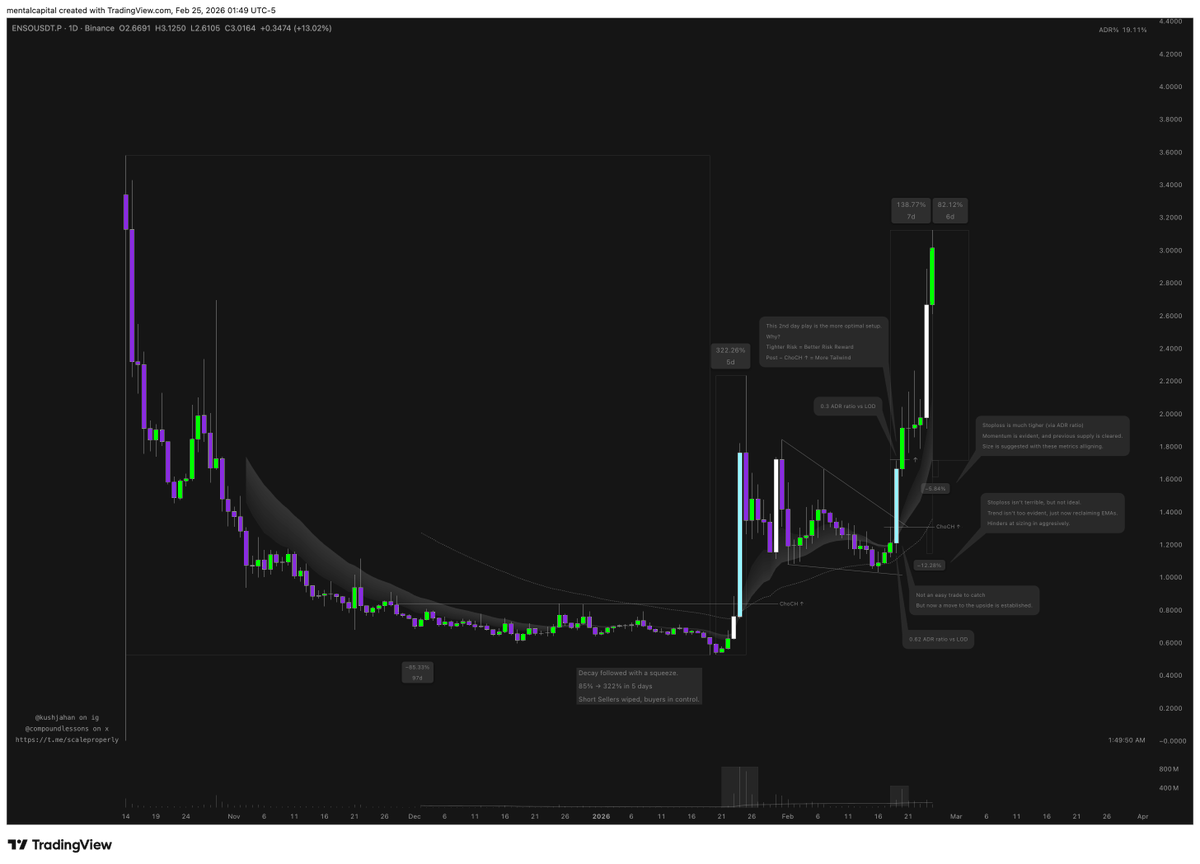
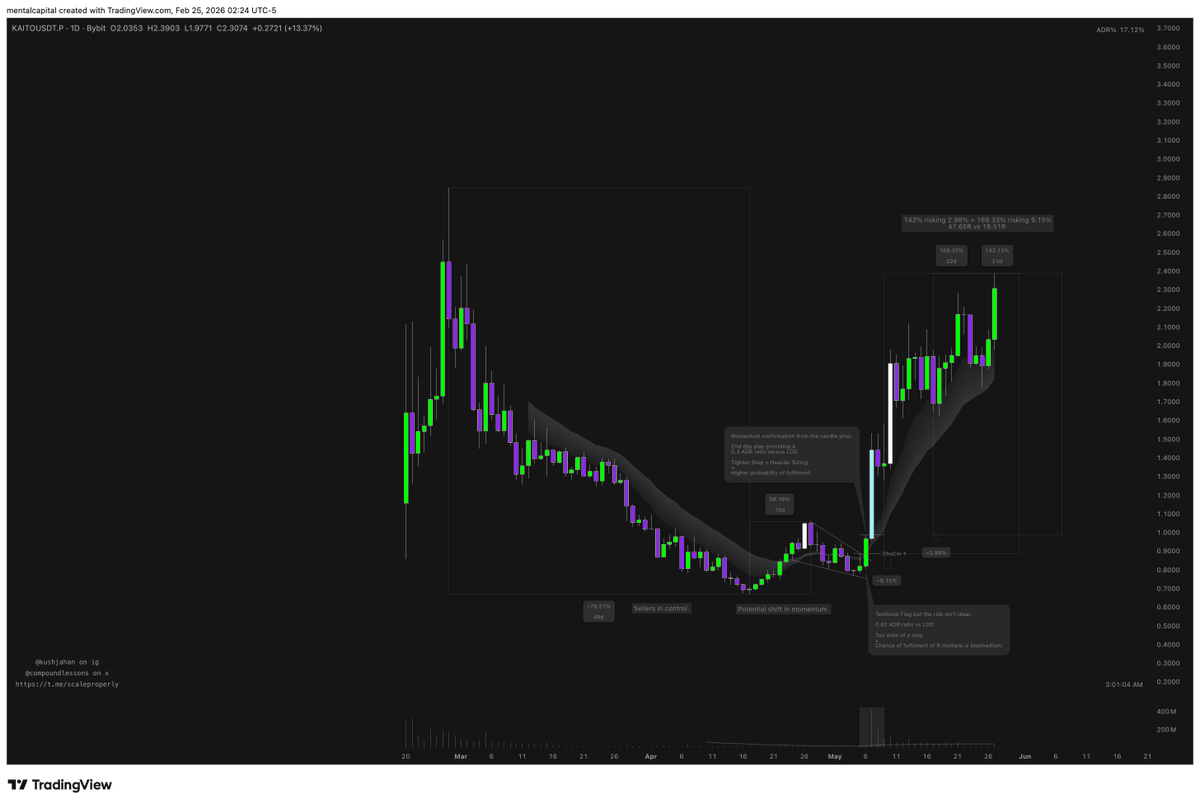
Now regarding the setup I have listed in the examples, The "Second day play" is one of the most powerful setups in systematic trading in regards to EV. The concept is simple but the edge it provides is significant. After an initial breakout occurs and that candle closes, the setup begins. You are NOT interested in chasing the breakout itself. Instead, you are waiting for the following session to open and break above the prior breakout candle's high of day. That break above the previous session's high is your entry signal. It confirms that the momentum from the initial breakout has carried over and buyers are still in control. Your stop loss is placed at the low of day in roughly 95% of cases. This is the most logical invalidation level because if price retraces the entire session's range, the momentum thesis is dead. However, there are instances where a green to red level offers a tighter stop with equal or better probability of fulfillment. In those cases, you take the tighter risk because it allows you to size heavier and improve your overall risk reward profile. What makes this setup structurally superior is that you are not the one absorbing supply. The initial breakout already handled that. It cleared the overhead resistance, flushed out trapped sellers, and established acceptance at a higher level. By the time you enter on the second day, you are riding clean momentum through a path that has already been carved out. There is less friction, less resistance, and a higher probability of continuation. This translates directly into a higher win rate and better risk reward. You are not guessing whether the breakout will hold. You are letting the breakout prove it first, then positioning yourself behind confirmed strength with a defined level of risk.
Kusha tweet media
Kusha@compoundlessons

Why the Best Trades aren't the ones that moved the most... The Illusion behind Big Moves Notice how the first trade opportunity yielded 139% while the second only put up 82%. Most people see that and assume the first trade was better. It wasn't. The first trade returned 11R. The second returned 14R on a smaller percentage gain. This is one of the most misunderstood concepts in trading. A smaller percentage move with a tighter stop allows you to allocate significantly more size. More size on a high probability move will always outperform light size on a speculative one. The math is non negotiable. Think about it from the asset's perspective. It does not care how much capital you have behind your position. It only cares about the probability of reaching a given price level. So which is more likely, a 100% move or a 20% move? The answer is obvious. And if the 20% move is more probable, then the optimal strategy is to size aggressively into that setup rather than spread yourself thin chasing an extended target with reduced conviction. There is also a structural reason the second trade carries higher probability. The first leg already did the heavy lifting. It absorbed the overhead supply, cleared the sellers, and established a new range of acceptance. By the time the second leg initiates, it is riding clean momentum into a path of least resistance. There is no longer a wall of trapped participants waiting to exit. The supply has already been consumed. That means the second move does not need the same amount of energy to travel, and it has a significantly higher chance of following through to higher levels. This is why the second entry, the one that comes after the initial breakout and offers a definable, tight level of risk, is almost always the superior trade. You are not sacrificing upside. You are engineering a position where probability, size, and execution are all working in your favor simultaneously. Stop expecting fulfillment of unreasonable targets. Start taking the highest probability setup with the most efficient risk structure, and primed risk reward. Those are where your best trades are located.

English
0
1
13
1.8K
Kusha
Kusha@compoundlessons·
Why the Best Trades aren't the ones that moved the most... The Illusion behind Big Moves Notice how the first trade opportunity yielded 139% while the second only put up 82%. Most people see that and assume the first trade was better. It wasn't. The first trade returned 11R. The second returned 14R on a smaller percentage gain. This is one of the most misunderstood concepts in trading. A smaller percentage move with a tighter stop allows you to allocate significantly more size. More size on a high probability move will always outperform light size on a speculative one. The math is non negotiable. Think about it from the asset's perspective. It does not care how much capital you have behind your position. It only cares about the probability of reaching a given price level. So which is more likely, a 100% move or a 20% move? The answer is obvious. And if the 20% move is more probable, then the optimal strategy is to size aggressively into that setup rather than spread yourself thin chasing an extended target with reduced conviction. There is also a structural reason the second trade carries higher probability. The first leg already did the heavy lifting. It absorbed the overhead supply, cleared the sellers, and established a new range of acceptance. By the time the second leg initiates, it is riding clean momentum into a path of least resistance. There is no longer a wall of trapped participants waiting to exit. The supply has already been consumed. That means the second move does not need the same amount of energy to travel, and it has a significantly higher chance of following through to higher levels. This is why the second entry, the one that comes after the initial breakout and offers a definable, tight level of risk, is almost always the superior trade. You are not sacrificing upside. You are engineering a position where probability, size, and execution are all working in your favor simultaneously. Stop expecting fulfillment of unreasonable targets. Start taking the highest probability setup with the most efficient risk structure, and primed risk reward. Those are where your best trades are located.
Kusha tweet mediaKusha tweet media
English
0
0
5
2.3K
Kusha รีทวีตแล้ว
Crypto Fergani
Crypto Fergani@cryptofergani·
Vitalik sprinting to his room to stop ETH from falling under $2000
English
245
194
2.2K
284.2K
Kusha รีทวีตแล้ว
Goshawk Trades
Goshawk Trades@GoshawkTrades·
if you skip one trade signal because "it doesn't feel right," you've broken the entire system. Big lesson. Either trust the model or don't deploy it.
English
18
158
1.9K
96.1K
Kusha
Kusha@compoundlessons·
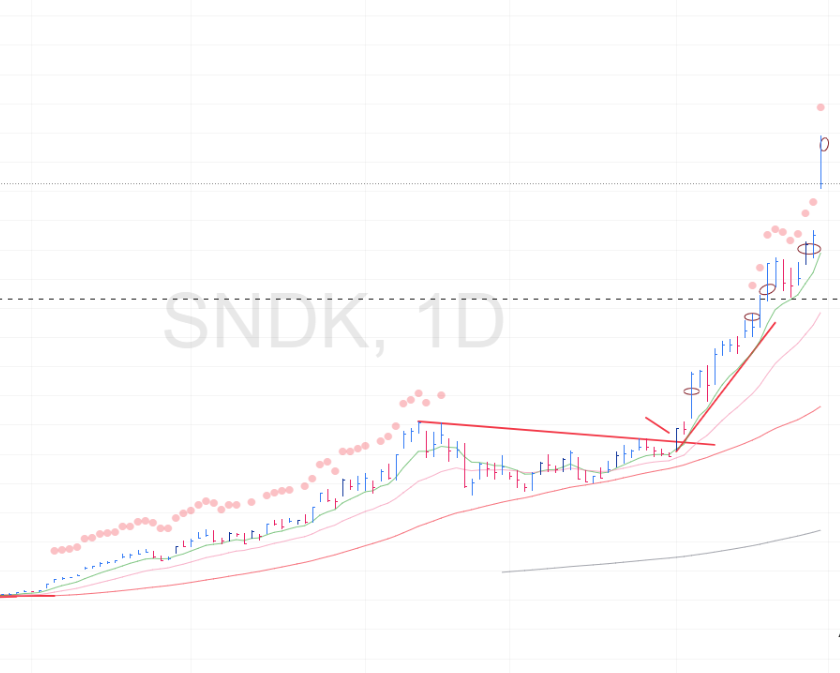
@TMLitalia what are the dots on the left side of the chart regarding uptrend
English
1
0
0
170
Dario
Dario@TMLitalia·
$SNDK trade (closed pre-mkt today)...one of the few joys of January
Dario tweet media
English
4
0
17
862