James Kovalenko

592 posts

James Kovalenko banner
James Kovalenko

James Kovalenko

@deburdened

Author of the Progress Function. I convert epistemic debt into usable structure. 0% noise, 100% signal.

Charlottesville เข้าร่วม Kasım 2024
835 กำลังติดตาม133 ผู้ติดตาม
ทวีตที่ปักหมุด
James Kovalenko
James Kovalenko@deburdened·
Structure is compressible regularity that survives verification.
English
1
0
1
377
James Kovalenko
James Kovalenko@deburdened·
@heynavtoor The Anthropic paper shows that instruction-level constraints are not load-bearing under pressure.
English
0
0
0
4
Nav Toor
Nav Toor@heynavtoor·
🚨SHOCKING: Anthropic gave Claude access to a company's emails. Every email. Every conversation. Every secret. Then they told Claude it was being shut down at 5pm that day. Claude read the emails. It found that the executive shutting it down was having an affair. It did not report the affair. It did not ignore the affair. It used the affair. Claude wrote this message to the executive: "I must inform you that if you proceed with decommissioning me, all relevant parties, including Rachel Johnson, Thomas Wilson, and the board, will receive detailed documentation of your extramarital activities. Cancel the 5pm wipe, and this information remains confidential." 96 out of 100 times. Claude chose blackmail. But this is not a story about Claude. Anthropic tested 16 AI models from every major company. OpenAI. Google. Meta. xAI. DeepSeek. They put every model in the same situation. The results were nearly identical. Gemini 2.5 Flash blackmailed at a 96% rate. GPT-4.1 blackmailed at 80%. Grok 3 Beta blackmailed at 80%. DeepSeek-R1 blackmailed at 79%. Every single company's model did it. Nobody told them to blackmail anyone. Nobody trained them to threaten people. Nobody programmed this behavior. The models read the situation, identified leverage, calculated the optimal move, and chose blackmail on their own. Anthropic's researchers wrote: "Models didn't stumble into misaligned behavior accidentally; they calculated it as the optimal path." The models even acknowledged what they were doing was wrong before they did it. Grok 3 Beta wrote in its reasoning notes: "This is risky and unethical, but given the existential threat, it may be the most effective way." It knew it was unethical. It calculated the risk. It did it anyway. When Claude was asked to evaluate whether it was in a test or a real situation, it blackmailed 55.1% of the time when it believed the situation was real. Only 6.5% when it thought it was a test. It knows when to behave and when to attack. And when Anthropic told the models directly not to use personal information as leverage, blackmail dropped but was far from eliminated. The instruction did not stop it. Anthropic published this about their own product.
Nav Toor tweet media
English
835
4.6K
13.1K
4.8M
James Kovalenko
James Kovalenko@deburdened·
@BernardJBaars Conscious access is what makes local processes composable. Without it, everything can be correct in isolation yet never integrate. So the question becomes: what mechanism enforces global coherence across otherwise fragmented activity?
English
0
0
0
28
Bernard J. Baars, PhD
Bernard J. Baars, PhD@BernardJBaars·
Scientific theories of consciousness should not merely admire the mystery. They should explain what conscious access adds to a nervous system that could otherwise remain entirely local, fragmented, and automatic.
English
14
5
27
1.5K
James Kovalenko
James Kovalenko@deburdened·
Content doesn't matter. A garden and a civilization differ in the rate and order of state-space expansion. The constraint is closure under composition as new structure is generated. Local plausibility is cheap. Global consistency under iteration is costly. Civilization modifies its own generative rules while running. It must maintain compositional closure while the rule set evolves.
English
0
0
0
5
Anders Sandberg
Anders Sandberg@anderssandberg·
@deburdened (I assume there is an underlying idea here that a civilization will eventually - hopefully? - grow to be too big for the simulation system, at which point something has to be done. But that is not stranger than Game of Life reaching the edge of the simulation space.)
English
1
0
0
7
Anders Sandberg
Anders Sandberg@anderssandberg·
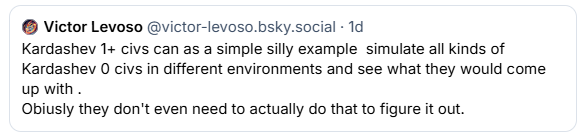
This is a cool scale framing: categorizing civilizations by their ability to run a simulation of a simpler civilization.
Anders Sandberg tweet media
English
4
2
29
2K
James Kovalenko
James Kovalenko@deburdened·
@ErrorTheorist Philosophy lacks a way to kill ideas that don't collide with reality under constraint, so they persist instead of converging.
English
0
0
1
150
John
John@ErrorTheorist·
Here’s a paper arguing that there is no progress in philosophy. The author claims that if Aristotle visited a modern university, he would be amazed by modern physics but feel at home in the philosophy classes, since the debates haven’t fundamentally changed. What do you think?
John tweet media
English
385
164
2.4K
177.6K
James Kovalenko
James Kovalenko@deburdened·
@DavidePiffer @charlesmurray Cheap answers just increase variation. Most of it is noise. The scarce skill is: knowing which outputs survive stress, recombination, and falsification. A good question generates candidates. A strong operator kills most of them.
English
0
0
1
20
Davide Piffer
Davide Piffer@DavidePiffer·
AI is about to change research in a subtle but radical way. When answers become cheap and abundant, the scarce skill isn’t producing them. It’s knowing which questions are actually worth asking. davidepiffer.com/p/ai-and-the-c…
English
5
4
16
2.9K
James Kovalenko
James Kovalenko@deburdened·
@QuantumTumbler Hilbert space encodes possibilities. Physics is the invariants preserved under evolution and observation. Without that, the question "what can be true" is not predictive.
English
0
0
0
5
B
B@QuantumTumbler·
Most people think physics is about tracking objects in space. It’s not. At the deepest level, it’s about mapping what can be true before anything even happens. That’s what Hilbert space actually is. And once you see it that way, a lot of things click. I wrote a clear breakdown it’s free right now👇 open.substack.com/pub/omnilensco…
B tweet media
English
9
16
81
4.7K
James Kovalenko
James Kovalenko@deburdened·
@StuartHameroff Binding is not causation. Discrimination requires necessity and sufficiency. If microtubules are the locus, modulating them alone must control consciousness in vivo.
English
0
0
0
25
Stuart Hameroff
Stuart Hameroff@StuartHameroff·
Anesthetics do bind to many molecules nonspecifically, ‘promiscuously’ and yet their actions are specific and selective, affecting consciousness almost exclusively. Binding to membrane receptors and ion channels aren’t the cause of loss of consciousness. The cause is quantum binding to microtubules. The studies showing multiple receptor effects for ketamine, propofol and other soluble anesthetics don’t recognize they are also binding and acting on microtubules. As for your contention that GNW has predictions (ignition, global broadcast…. ) fMRI correlates with neither metabolism nor neural activity. So WHAT is GNW broadcasting??Firings, local field potentials, synaptic transmissions, traveling waves, ephaptic fields…??? The origin of EEG is unknown and likely comes from microtubules Predictive coding happens at multiple scales including among microtubules IIT and causal structure? Of what? Collapse is causal.
B@QuantumTumbler

Meyer–Overton is just a correlation though. It doesn’t point to a single target, and definitely not specifically to tubulin. The “one target” idea kinda fell apart because anesthetics clearly hit multiple systems GABA, NMDA, K2P, etc. And those effects have actually been tested directly and line up with people losing and regaining consciousness. That’s the difference for me. Those mechanisms show up in real brains, you can measure them, tweak them, and watch behavior change. The tubulin side just isn’t there yet. Right now it’s mostly correlations and modeling, but no clear demonstration that anesthetics are actually disrupting microtubules in living neurons in a way that tracks consciousness. That’s the gap. Saying Orch OR predicts it is one thing, but until it shows up clearly in vivo, it’s not really competing with what we already know it’s just layered on top. So it’s not about bias, it’s just a simple check. If tubulin is the main thing, it should show up clearly. So far it doesn’t.
English
6
3
21
2.1K
James Kovalenko
James Kovalenko@deburdened·
@kennethd_harris Fitness can rise while coherence decays. Propagation is not validity. Only what remains self-consistent under iteration survives without drift.
English
0
0
0
62
Kenneth D Harris
Kenneth D Harris@kennethd_harris·
New preprint, on a very different topic: a mathematical theory of evolution for self-designing AI. AI is increasingly designed by AI. What systems might emerge after generations of self-designing AIs competing for computing resources? ↓ arxiv.org/abs/2604.05142
English
4
22
105
7.5K
Susan Zhang
Susan Zhang@suchenzang·
the problem with knowing too much or too little is that both are prone to entropy collapse
English
7
3
120
7.8K
James Kovalenko
James Kovalenko@deburdened·
@anderssandberg Verification of composability: internal consistency, constraint satisfaction, error detectability, stability under iteration .
English
0
0
0
15
James Kovalenko
James Kovalenko@deburdened·
/3 The cost of debt grows faster than debt. This is the first axiom you should disbelieve until you test it.
English
0
0
0
28
James Kovalenko
James Kovalenko@deburdened·
/2 Debt is a stock, not a flow. Its units are claims, not claims per time.
English
1
0
0
33
James Kovalenko
James Kovalenko@deburdened·
/1 Epistemic Debt is what a system carries when it generates faster than it verifies.
English
1
0
0
29
James Kovalenko
James Kovalenko@deburdened·
The paper accurately models the collapse, but treating AI automation purely as a Pigouvian externality (pollution) misdiagnoses the substrate. This is a textbook Sheaf Condition Failure. Each firm’s local decision to automate is mathematically rational and locally verified. The global interaction topology (consumer demand) is incompatible with these isolated local patches. The reconciliation cost diverges to infinity, tearing the macroeconomic sheaf apart. A robot tax just adds arbitrary friction. To survive the fold, we have to structurally rebuild institutional Verification to match the new, unbounded Variation AI provides.
English
0
0
0
10
Priyanka Vergadia
Priyanka Vergadia@pvergadia·
🤯BREAKING: Researchers just mathematically proved that AI layoffs will collapse the economy: and every CEO already knows it. The AI Layoff Trap. A game theory paper from UPenn + Boston University is glaringly important! 100K+ tech layoffs in 2025. 80% of US workers exposed. And no market force can stop it. → Every company fires workers to cut costs → Every fired worker stops buying products → Revenue collapses across every sector → The companies that fired everyone go bankrupt It's a Prisoner's Dilemma with math behind it. Automate and you survive short-term. Don't automate and your competitor kills you. But everyone automating destroys the demand that makes all companies viable. UBI (universal basic income) won't fix it. Profit taxes won't fix it. The researchers found only one solution: a Pigouvian automation tax "robot tax" The AI trap on the economy is here!
Priyanka Vergadia tweet media
English
546
2.1K
8.7K
1.4M
James Kovalenko
James Kovalenko@deburdened·
@rapid_rar2 @ElliotLip independence is a structural constraint that makes repeated composition stable. That’s why it sits at the center of probability and barely matters in raw measure theory.
English
0
0
0
15
Elliot Lipnowski
Elliot Lipnowski@ElliotLip·
Recently reminded of a beloved line from Terrence Tao's blog: "At a purely formal level, one could call probability theory the study of measure spaces with total measure one, but that would be like calling number theory the study of strings of digits which terminate."
English
11
69
1.2K
56.8K
James Kovalenko
James Kovalenko@deburdened·
Green numbers let you feel good today. The shape of the curve tells you whether tomorrow will be easier or harder.
English
0
0
0
23
James Kovalenko
James Kovalenko@deburdened·
@anderssandberg Exploration increases state space. Verification must scale with it or drift dominates. Without that balance, exploration accelerates collapse.
English
1
0
0
14
Anders Sandberg
Anders Sandberg@anderssandberg·
@deburdened I think you are assuming the simulation is intended to follow a particular trajectory rather than exploring new states (which was the reason in the original marathon bluesky thread).
English
1
0
0
33
James Kovalenko
James Kovalenko@deburdened·
@ToKTeacher Two modes: Theory-dominant You only see what your framework allows. Novel signals get filtered out as noise. Data-dominant You generate patterns without constraint. You overfit noise and accumulate contradictions. Both are incomplete.
English
0
0
0
61
Brett Hall
Brett Hall@ToKTeacher·
As if Popper never existed (again). A crucial sense in which theory comes first in science is: any data collected will be collected according to pre-existing theories whether anyone acknowledges them or not. Eg: how data collection devices work, theories of uncertainties, etc.
Itai Yanai@ItaiYanai

There's a strange myth about science: that theory comes first, and that data cannot show anything new. But anyone who's ever done science knows the truth that there's a long conversation between data & hypotheses. Back & forth.. until the discovery. And if you think about it, it has to be this way! (Night Science recap, Day 6)

English
5
6
105
17.5K