
Dan Shaw

64K posts

Dan Shaw banner
Dan Shaw

Dan Shaw

@dshaw

🦄 Godfather of Node.js → Democratizing enterprise AI ✨

San Francisco, CA เข้าร่วม Mart 2007
6.8K กำลังติดตาม18.2K ผู้ติดตาม

Louis Arge
Louis Arge@louisvarge·
@yourDomainAdmin because it didn’t work very well + required me to pre-plan the need for communication i wanted it to just be like “yooo, i can tell you’re gonna be working on some of the same stuff as other claude, please coordinate!”
English
5
0
43
6.7K
Louis Arge
Louis Arge@louisvarge·
i made a thing where now any Claude Code can send messages to any other Claude Code on my machine they can ask clarifying questions about work, or become friends
English
247
226
3.9K
643.4K
Dan Shaw
Dan Shaw@dshaw·
@claudeai @bcherny This has been a huge transformation. I haven't hit compaction in days. 🙇‍♂️
English
0
0
0
41
Claude
Claude@claudeai·
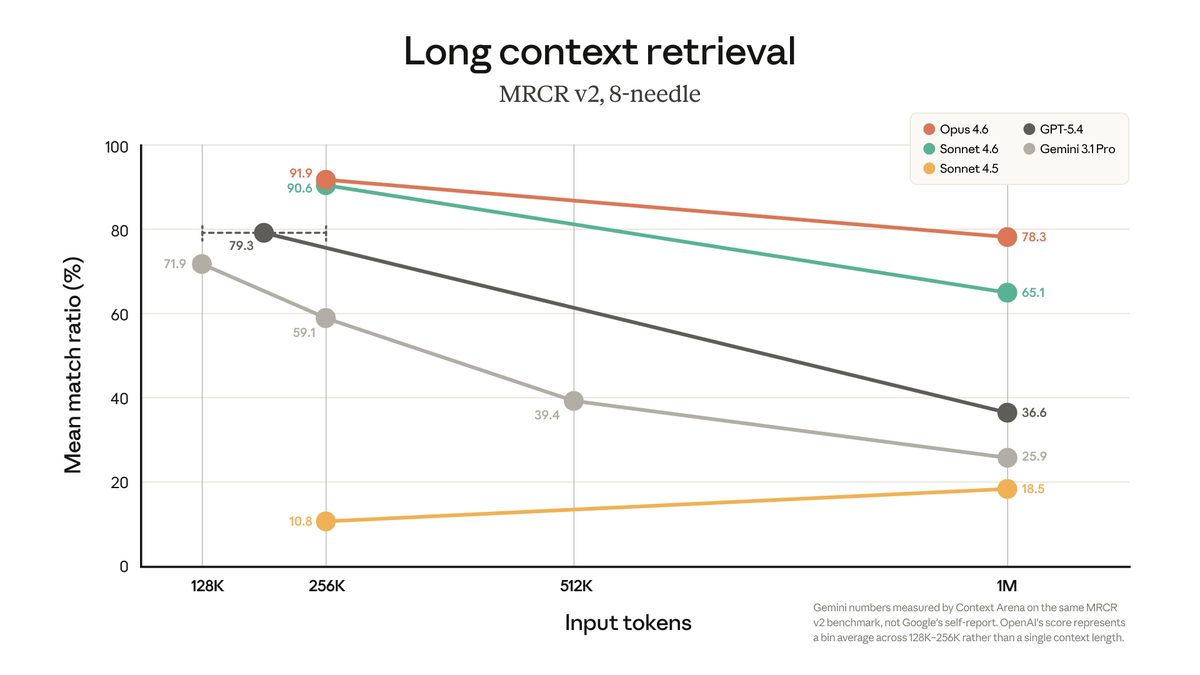
1 million context window: Now generally available for Claude Opus 4.6 and Claude Sonnet 4.6.
Claude tweet media
English
1.2K
2K
25.2K
5.5M
Dan Shaw
Dan Shaw@dshaw·
@AnthropicAI Great news. Further affirmation why Anthropic models are the top choice.
English
0
0
5
1.6K
Dan Shaw รีทวีตแล้ว
Ishaan Tharoor
Ishaan Tharoor@ishaantharoor·
A bad day
Ishaan Tharoor tweet media
English
272
412
3K
241.6K
Dan Shaw
Dan Shaw@dshaw·
@Trevornoah You killed it. Thank you for being amazing!
English
0
0
1
329
Dan Shaw
Dan Shaw@dshaw·
"How could you possibly compete with Google?" Beyond the immense amount of proof we already have in AI, this fatalistic mindset is drenched with irony given Google's own history. Google was one of the last big search plays to hit the scene. When Google started, Yahoo and Excite dominated the web portals game. AltaVista was the best web search and Goto search was what Google would become after they became an ads company. Game on! ✨
English

0
0
1
439
Andrej Karpathy
Andrej Karpathy@karpathy·
A conventional narrative you might come across is that AI is too far along for a new, research-focused startup to outcompete and outexecute the incumbents of AI. This is exactly the sentiment I listened to often when OpenAI started ("how could the few of you possibly compete with Google?") and 1) it was very wrong, and then 2) it was very wrong again with a whole another round of startups who are now challenging OpenAI in turn, and imo it still continues to be wrong today. Scaling and locally improving what works will continue to create incredible advances, but with so much progress unlocked so quickly, with so much dust thrown up in the air in the process, and with still a large gap between frontier LLMs and the example proof of the magic of a mind running on 20 watts, the probability of research breakthroughs that yield closer to 10X improvements (instead of 10%) imo still feels very high - plenty high to continue to bet on and look for. The tricky part ofc is creating the conditions where such breakthroughs may be discovered. I think such an environment comes together rarely, but @bfspector & @amspector100 are brilliant, with (rare) full-stack understanding of LLMs top (math/algorithms) to bottom (megakernels/related), they have a great eye for talent and I think will be able to build something very special. Congrats on the launch and I look forward to what you come up with!
Flapping Airplanes@flappyairplanes

Announcing Flapping Airplanes! We’ve raised $180M from GV, Sequoia, and Index to assemble a new guard in AI: one that imagines a world where models can think at human level without ingesting half the internet.

English
251
502
8.1K
1.2M
Dan Shaw
Dan Shaw@dshaw·
Worth a read. I agree that the most shocking aspect is how fun it all is.
Andrej Karpathy@karpathy

A few random notes from claude coding quite a bit last few weeks. Coding workflow. Given the latest lift in LLM coding capability, like many others I rapidly went from about 80% manual+autocomplete coding and 20% agents in November to 80% agent coding and 20% edits+touchups in December. i.e. I really am mostly programming in English now, a bit sheepishly telling the LLM what code to write... in words. It hurts the ego a bit but the power to operate over software in large "code actions" is just too net useful, especially once you adapt to it, configure it, learn to use it, and wrap your head around what it can and cannot do. This is easily the biggest change to my basic coding workflow in ~2 decades of programming and it happened over the course of a few weeks. I'd expect something similar to be happening to well into double digit percent of engineers out there, while the awareness of it in the general population feels well into low single digit percent. IDEs/agent swarms/fallability. Both the "no need for IDE anymore" hype and the "agent swarm" hype is imo too much for right now. The models definitely still make mistakes and if you have any code you actually care about I would watch them like a hawk, in a nice large IDE on the side. The mistakes have changed a lot - they are not simple syntax errors anymore, they are subtle conceptual errors that a slightly sloppy, hasty junior dev might do. The most common category is that the models make wrong assumptions on your behalf and just run along with them without checking. They also don't manage their confusion, they don't seek clarifications, they don't surface inconsistencies, they don't present tradeoffs, they don't push back when they should, and they are still a little too sycophantic. Things get better in plan mode, but there is some need for a lightweight inline plan mode. They also really like to overcomplicate code and APIs, they bloat abstractions, they don't clean up dead code after themselves, etc. They will implement an inefficient, bloated, brittle construction over 1000 lines of code and it's up to you to be like "umm couldn't you just do this instead?" and they will be like "of course!" and immediately cut it down to 100 lines. They still sometimes change/remove comments and code they don't like or don't sufficiently understand as side effects, even if it is orthogonal to the task at hand. All of this happens despite a few simple attempts to fix it via instructions in CLAUDE . md. Despite all these issues, it is still a net huge improvement and it's very difficult to imagine going back to manual coding. TLDR everyone has their developing flow, my current is a small few CC sessions on the left in ghostty windows/tabs and an IDE on the right for viewing the code + manual edits. Tenacity. It's so interesting to watch an agent relentlessly work at something. They never get tired, they never get demoralized, they just keep going and trying things where a person would have given up long ago to fight another day. It's a "feel the AGI" moment to watch it struggle with something for a long time just to come out victorious 30 minutes later. You realize that stamina is a core bottleneck to work and that with LLMs in hand it has been dramatically increased. Speedups. It's not clear how to measure the "speedup" of LLM assistance. Certainly I feel net way faster at what I was going to do, but the main effect is that I do a lot more than I was going to do because 1) I can code up all kinds of things that just wouldn't have been worth coding before and 2) I can approach code that I couldn't work on before because of knowledge/skill issue. So certainly it's speedup, but it's possibly a lot more an expansion. Leverage. LLMs are exceptionally good at looping until they meet specific goals and this is where most of the "feel the AGI" magic is to be found. Don't tell it what to do, give it success criteria and watch it go. Get it to write tests first and then pass them. Put it in the loop with a browser MCP. Write the naive algorithm that is very likely correct first, then ask it to optimize it while preserving correctness. Change your approach from imperative to declarative to get the agents looping longer and gain leverage. Fun. I didn't anticipate that with agents programming feels *more* fun because a lot of the fill in the blanks drudgery is removed and what remains is the creative part. I also feel less blocked/stuck (which is not fun) and I experience a lot more courage because there's almost always a way to work hand in hand with it to make some positive progress. I have seen the opposite sentiment from other people too; LLM coding will split up engineers based on those who primarily liked coding and those who primarily liked building. Atrophy. I've already noticed that I am slowly starting to atrophy my ability to write code manually. Generation (writing code) and discrimination (reading code) are different capabilities in the brain. Largely due to all the little mostly syntactic details involved in programming, you can review code just fine even if you struggle to write it. Slopacolypse. I am bracing for 2026 as the year of the slopacolypse across all of github, substack, arxiv, X/instagram, and generally all digital media. We're also going to see a lot more AI hype productivity theater (is that even possible?), on the side of actual, real improvements. Questions. A few of the questions on my mind: - What happens to the "10X engineer" - the ratio of productivity between the mean and the max engineer? It's quite possible that this grows *a lot*. - Armed with LLMs, do generalists increasingly outperform specialists? LLMs are a lot better at fill in the blanks (the micro) than grand strategy (the macro). - What does LLM coding feel like in the future? Is it like playing StarCraft? Playing Factorio? Playing music? - How much of society is bottlenecked by digital knowledge work? TLDR Where does this leave us? LLM agent capabilities (Claude & Codex especially) have crossed some kind of threshold of coherence around December 2025 and caused a phase shift in software engineering and closely related. The intelligence part suddenly feels quite a bit ahead of all the rest of it - integrations (tools, knowledge), the necessity for new organizational workflows, processes, diffusion more generally. 2026 is going to be a high energy year as the industry metabolizes the new capability.

English
0
0
2
934
Dan Shaw รีทวีตแล้ว
Barack Obama
Barack Obama@BarackObama·
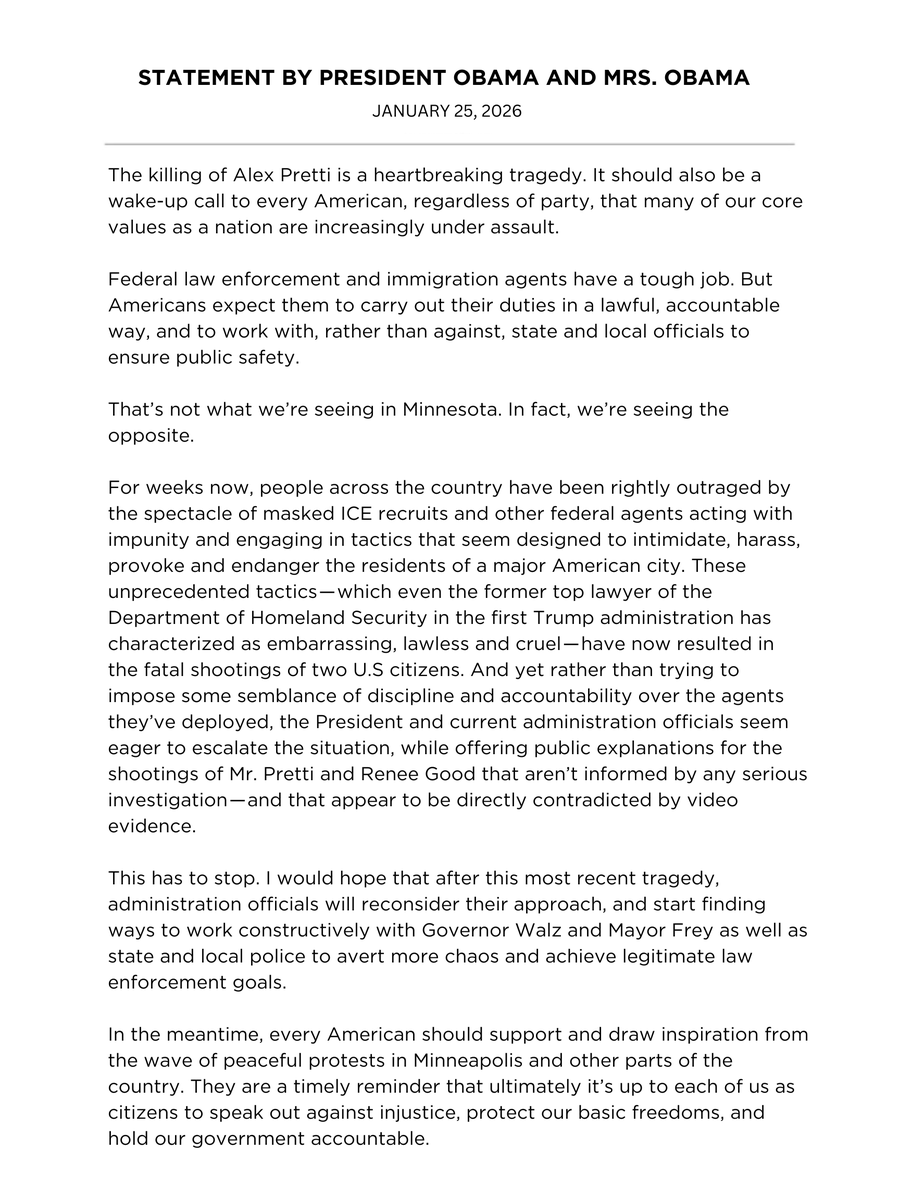
The killing of Alex Pretti is a heartbreaking tragedy. It should also be a wake-up call to every American, regardless of party, that many of our core values as a nation are increasingly under assault.
Barack Obama tweet media
English
66K
116.4K
813.3K
43.8M
Dan Shaw
Dan Shaw@dshaw·
For those following: I installed with new Mac installer. It does not attempt to clean up any previous install. I had npm global with the what I assume is new bun magic and it seemed wonky. npm uninstall -g @anthropic-ai/claude-code After that works great. ✨
English
0
0
1
97
Dan Shaw
Dan Shaw@dshaw·
@jarredsumner Yeah, that makes sense. I'd personally lean toward markdown over text. Still great for LLMs. Also good for humans.
English

0
0
0
103
Jarred Sumner
Jarred Sumner@jarredsumner·
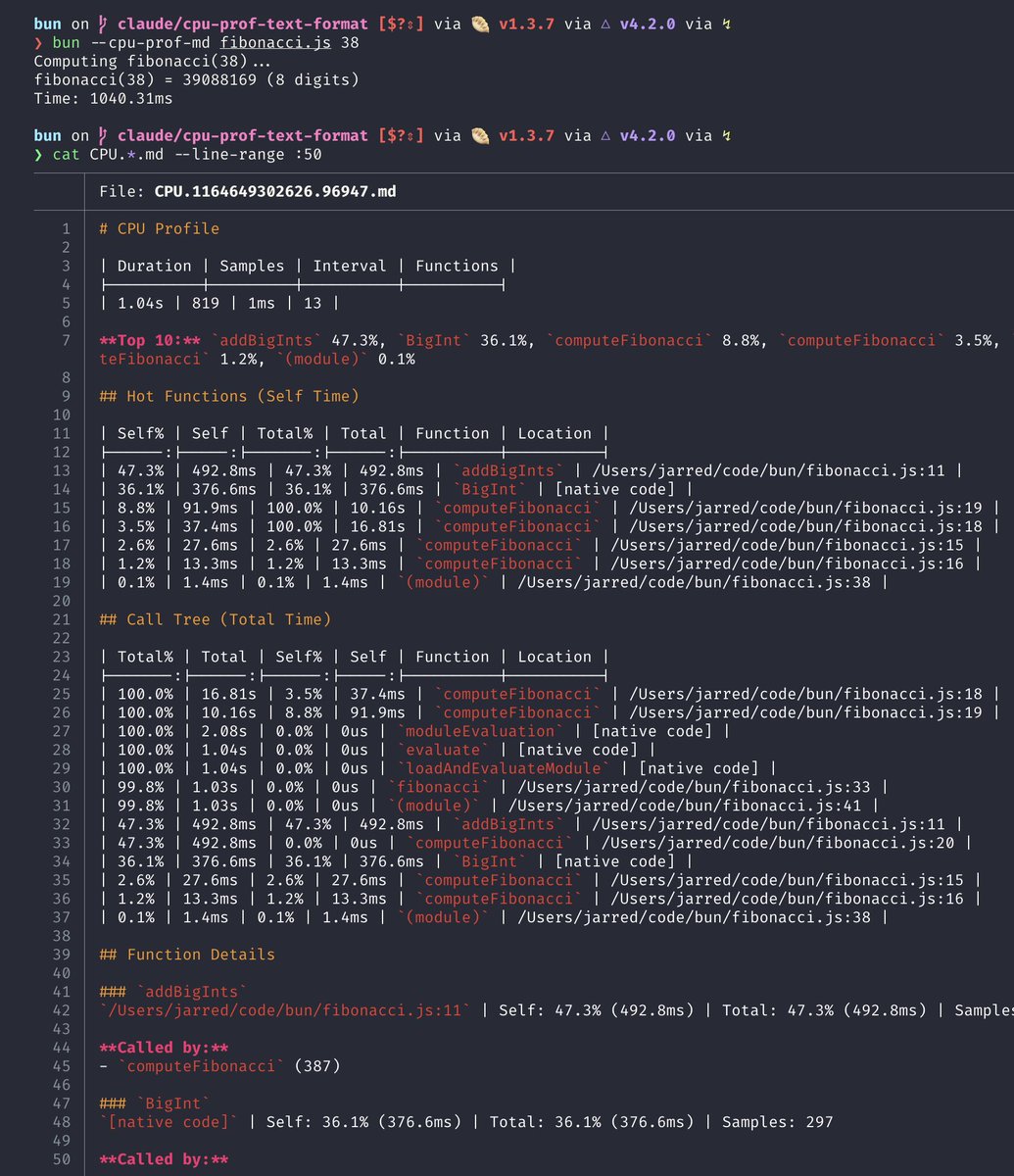
In the next version of Bun `bun --cpu-prof-md <script>` prints a CPU profile as Markdown so LLMs like Claude can easily read & grep it
Jarred Sumner tweet media
English
45
73
1.2K
145.1K
Dan Shaw
Dan Shaw@dshaw·
@jarredsumner --cpu-prof-md is the shorthand. --cpu-prof-type md|txt (or --cpu-prof-output... naming is hard) #options" target="_blank" rel="nofollow noopener">bun.com/docs/project/b…
English
1
0
2
298
Jarred Sumner
Jarred Sumner@jarredsumner·
I’m going back and forth a bit on “should it be .txt or .md” Plain text is a little more token efficient + can have inline non-markdown tables and diagrams But .md renders nicely But also humans won’t be reading these for that much longer It probably should be .txt
English
23
0
127
11K
Dan Shaw รีทวีตแล้ว
Sassiest Minx in Minnesota 💚 🇺🇸
Of all the protest videos I’ve seen this one has hit me the hardest. It’s such a unique perspective and it answers the question of “What’s the purpose of protests anyway? It’s not like they do anything.”
English

24
7.1K
71.1K
2.3M
Dan Shaw
Dan Shaw@dshaw·
@jxmnop Welcome. The water's fine. Been here 15+ years and love it. Pro-tip: get out of the city regularly.
English
0
0
1
573
dr. jack morris
dr. jack morris@jxmnop·
life update moved to san francisco to do ai research 🤦‍♂️
dr. jack morris tweet mediadr. jack morris tweet media
dr. jack morris@jxmnop

some people will hate me for saying this, but my conclusion from moving to san francisco this year to do AI research was this: you don’t need to move to san francisco to do AI research there’s certainly a higher concentration of people who speak fluent AI, and more people closely following the cutting edge - and there are really amazing researchers in SF (the people at OpenAI, whoever made Gemini, everyone at stanford & berkeley, etc.) unlike most other cities, SF definitely has an ingroup (which I was not a part of) of AI-adjacent folks who meet for parties and dinners and talk about things like RLHF and long context windows but the average person you find there isn’t a core contributor to the field, it’s more like some guy who runs a three-person startup generating pictures of anime cats and is trying to finetune a diffusion model to make the cats more realistic overall i thought it was nice to live in SF (amazing city) but i don’t think that anything about being there accelerated my research more or less than anywhere else i’ve lived the reality is that the next big AI-related innovation probably won’t happen in san francisco. it’ll happen in seoul, or in tel aviv, or london or beijing or paris or princeton... the AI community is beautifully and completely distributed; there’s no one central geographic location you “have” to live to be a part of it

English
99
23
2K
235.6K