Ahmad@TheAhmadOsman
> be you
> want to actually learn how LLMs work
> sick of “just start with linear algebra and come back in 5 years”
> decide to build my own roadmap
> no fluff. no detours. no 200-hour generic ML playlists
> just the stuff that actually gets you from “what’s a token?” to “I trained a mini-GPT with LoRA adapters and FlashAttention”
> goal: build, fine-tune, and ship LLMs
> not vibe with them. not "learn the theory" forever
> build them
> you will:
> > build an autograd engine from scratch
> > write a mini-GPT from scratch
> > implement LoRA and fine-tune a model on real data
> > hate CUDA at least once
> > cry
> > keep going
> 5 phases
> if you already know something? skip
> if you're lost? rewatch
> if you’re stuck? use DeepResearch
> this is a roadmap, not a leash
> by the end: you either built the thing or you didn’t
> phase 0: foundations
> > if matrix multiplication is scary, you’re not ready yet
> > watch 3Blue1Brown’s linear algebra series
> > MIT 18.06 with Strang, yes, he’s still the GOAT
> > code Micrograd from scratch (Karpathy)
> > train a mini-MLP on MNIST
> > no frameworks, no shortcuts, no mercy
> phase 1: transformers
> > the name is scary
> > it’s just stacked matrix multiplies and attention blocks
> > Jay Alammar + 3Blue1Brown for the “aha”
> > Stanford CS224N for the theory
> > read "Attention Is All You Need" only AFTER building mental models
> > Karpathy's "Let's Build GPT" will break your brain in a good way
> > project: build a decoder-only GPT from scratch
> > bonus: swap tokenizers, try BPE/SentencePiece
> phase 2: scaling
> > LLMs got good by scaling, not magic
> > Kaplan paper -> Chinchilla paper
> > learn Data, Tensor, Pipeline parallelism
> > spin up multi-GPU jobs using HuggingFace Accelerate
> > run into VRAM issues
> > fix them
> > welcome to real training hell
> phase 3: alignment & fine-tuning
> > RLHF: OpenAI blog -> Ouyang paper
> > SFT -> reward model -> PPO (don’t get lost here)
> > Anthropic's Constitutional AI = smart constraints
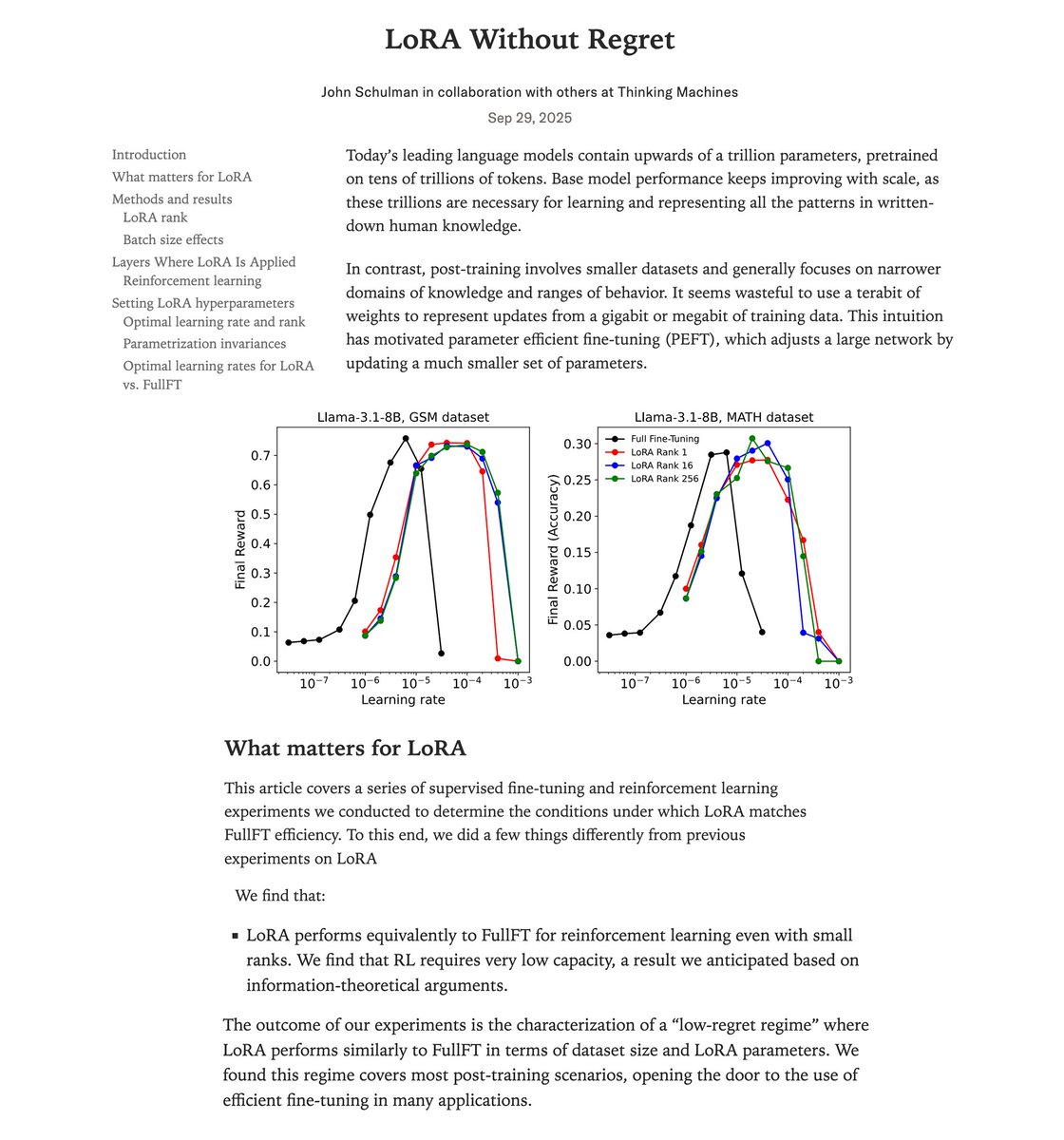
> > LoRA/QLoRA: read, implement, inject into HuggingFace models
> > fine-tune on real data
> > project: fine-tune gpt2 or distilbert with your own adapters
> > not toy examples. real use cases or bust
> phase 4: production
> this is the part people skip to, but you earned it
> inference optimization: FlashAttention, quantization, sub-second latency
> read the paper, test with quantized models
> resources:
> math/coding:
> > 3Blue1Brown, MIT 18.06, Goodfellow’s book
> PyTorch:
> > Karpathy, Zero to Mastery
> > transformers:
> > Alammar, Karpathy, CS224N, Vaswani et al
> > scaling:
> > Kaplan, Chinchilla, HuggingFace Accelerate
> > alignment:
> > OpenAI, Anthropic, LoRA, QLoRA
> > inference:
> > FlashAttention
> the endgame:
> > understand how these models actually work
> > see through hype
> > ignore LinkedIn noise
> > build tooling
> > train real stuff
> > ship your own stack
> > look at a paper and think “yeah I get it”
> > build your own AI assistant, infra, whatever
> make it all the way through?
> ship something real?
> DM me.
> I wanna see what you built.
> happy hacking.