Elom

951 posts

Elom

Elom

@elomaur

ai and fitness nerd. bjj enthusiast. taekwondo black belt. jack of many trades. master of a few. kaizen

เข้าร่วม Mayıs 2022
695 กำลังติดตาม157 ผู้ติดตาม
ทวีตที่ปักหมุด
Elom
Elom@elomaur·
if you can scroll twitter for an hour a day, you can spare an hour to learn coding and ai tools. here are some resources: @AnthropicAI build with claude course. it includes hands-on tutorials and real-world use cases @scrimba it's a beginner-friendly platform to learn coding interactively, including ai-first programming @Replit 100 days of code free project-based python course that helps you build coding habits and learn the foundations needed for ai and automation work @DeepLearningAI by @AndrewYNg world-class courses on machine learning, deep learning, and how to apply ai in real-world scenarios
English
2
1
7
920
Zara Zhang
Zara Zhang@zarazhangrui·
PSA: You can vibe code your own "New tab" page in Chrome. I have turned mine into the ultimate solution to the "too many tabs" problem - See all your tabs with clear titles, grouped by domain - Closing any tab gives you "swoosh" sound and confetti effect 🎊 - "Easy wins" grouped together: homepages, localhost tabs... batch-close them with one click - Duplicate tabs detected; close duplicates with one click - For tabs you're not done with, save it for later in a checklist This is the Marie Kondo method for browser tabs Open-sourced the code below
English
78
73
1.6K
202.8K
Elom
Elom@elomaur·
@FarzaTV @hnshah even though i forked your repo, I will happily purchase the updated product. If you decide to crowdsource capital from the community, will happily invest as well. thanks for all the value you've created 🙏
English
1
0
4
680
Farza 🇵🇰🇺🇸
I'm gonna keep hacking on Clicky! It's not a 10/10 idea, but, I think it's an okay starting point to continue iterating into an actual company. Instead of hunting for the perfect idea, I rather ship and turn whatever I'm building into the perfect idea! The existing codebase remains open source. Tinker with it, make it yours, start a company out of it, do whatever you want I don't mind. But, for all the new stuff I'm hacking on, gonna keep it private. What's funny is I had been sitting on the Clicky demo for a few weeks. I thought it was a pretty meh idea and posted it with no real expectation. I really didn't wanna work on it. What changed my mind was talking to all the users this week, I feel like there's so much more here than what meets the eye. Let's see what happens. Regardless, glad I shipped it! And glad so many people are building their own Clicky's now as well it's very inspiring. Gonna continue sharing learnings. Wish me luck!!
English
106
22
1.3K
46.3K
Elom รีทวีตแล้ว
Trung Phan
Trung Phan@TrungTPhan·
Claude Opus vs. Claude Mythos
Trung Phan tweet mediaTrung Phan tweet media
English
108
410
11.9K
668.1K
Elom
Elom@elomaur·
@linuz90 consider open sourcing it for a one time fee and letting people build on top of it to meet their various needs
English
0
0
1
106
Fabrizio Rinaldi
Fabrizio Rinaldi@linuz90·
The response to Cogito has been wild. Way beyond what I expected, also considering I'm not the only one building a Markdown writing app apparently 😆 Since launch 2 days ago I shipped: • Copy as formatted • Basic MDX support • PDF & HTML exports • Wider font and style selection • Better Quick Open suggestions • Refreshed Settings with theme etc. • Better help pages + in-app feedback • Cloud/git badge with status for locations Don't expect more big updates soon since this is a side project, but I'm reading all feedback and will keep improving it ✌️ If you were looking for a beautiful, polished Markdown writing app, I really think this is it.
Fabrizio Rinaldi tweet media
Fabrizio Rinaldi@linuz90

I built my dream Markdown editor for Mac. → Introducing Cogito (pronounced koh-gee-toh). It started out of frustration: Obsidian is powerful but overwhelming. iA Writer is beautiful but feels built for a different era. Nothing felt right for how I actually write and work now: plain files, lots of folders, agents and scripts editing alongside me. I wanted both: native and beautiful, powerful and calm. So I finally built it. It's fast, keyboard-first, polished, truly native. A Mac app built with power users and developers in mind. This is my love letter to writing and Mac apps. I use it for all my writing now. Free while in beta ✌️

English
16
3
137
21K
Elom รีทวีตแล้ว
Jeremy
Jeremy@ManaByte·
This is one of the greatest photos ever taken by a human…so far.
Jeremy tweet media
English
1.3K
9.4K
107.8K
1.7M
Elom
Elom@elomaur·
@cathrynlavery @bcherny i've been having the same issue for the past few weeks. searched all over and couldn't find anything. i thought i was the only one
English
0
0
1
654
Cathryn
Cathryn@cathrynlavery·
why does claude --dangerously-skip-permissions not work anymore? getting asked for permissions nonstop 🫠 @bcherny
English
52
2
176
52.3K
Elom
Elom@elomaur·
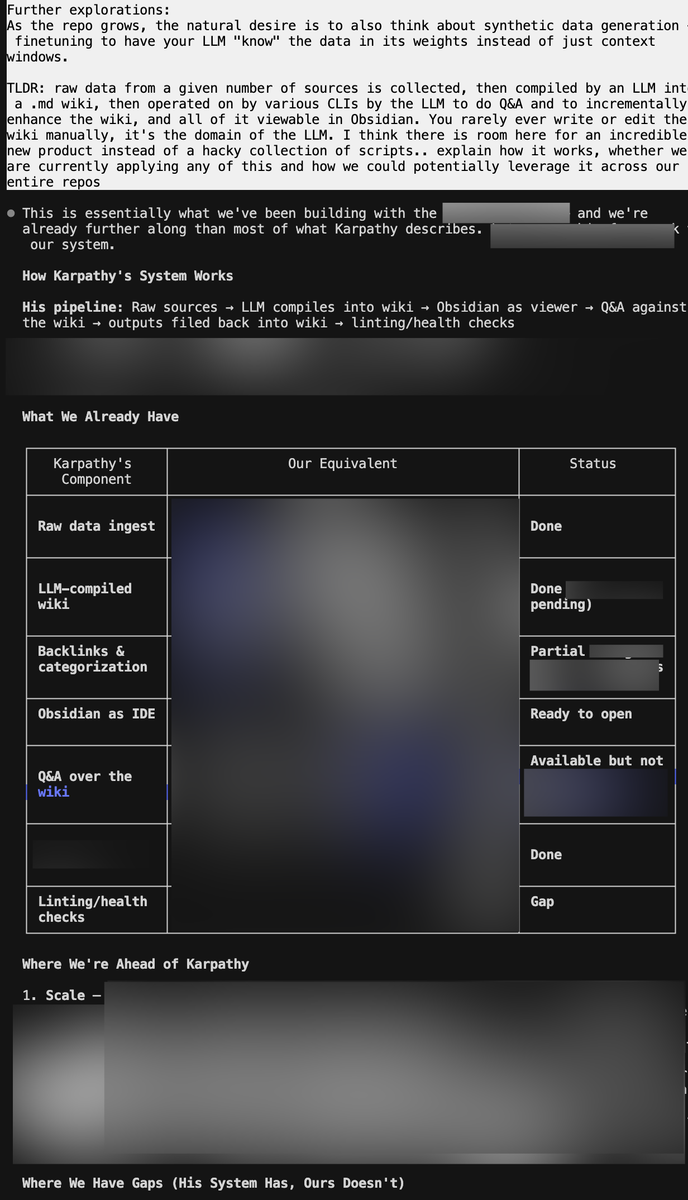
i've had a similar setup for a while. stoked to close the gaps and grateful for all the incredible knowledge
Elom tweet media
Andrej Karpathy@karpathy

LLM Knowledge Bases Something I'm finding very useful recently: using LLMs to build personal knowledge bases for various topics of research interest. In this way, a large fraction of my recent token throughput is going less into manipulating code, and more into manipulating knowledge (stored as markdown and images). The latest LLMs are quite good at it. So: Data ingest: I index source documents (articles, papers, repos, datasets, images, etc.) into a raw/ directory, then I use an LLM to incrementally "compile" a wiki, which is just a collection of .md files in a directory structure. The wiki includes summaries of all the data in raw/, backlinks, and then it categorizes data into concepts, writes articles for them, and links them all. To convert web articles into .md files I like to use the Obsidian Web Clipper extension, and then I also use a hotkey to download all the related images to local so that my LLM can easily reference them. IDE: I use Obsidian as the IDE "frontend" where I can view the raw data, the the compiled wiki, and the derived visualizations. Important to note that the LLM writes and maintains all of the data of the wiki, I rarely touch it directly. I've played with a few Obsidian plugins to render and view data in other ways (e.g. Marp for slides). Q&A: Where things get interesting is that once your wiki is big enough (e.g. mine on some recent research is ~100 articles and ~400K words), you can ask your LLM agent all kinds of complex questions against the wiki, and it will go off, research the answers, etc. I thought I had to reach for fancy RAG, but the LLM has been pretty good about auto-maintaining index files and brief summaries of all the documents and it reads all the important related data fairly easily at this ~small scale. Output: Instead of getting answers in text/terminal, I like to have it render markdown files for me, or slide shows (Marp format), or matplotlib images, all of which I then view again in Obsidian. You can imagine many other visual output formats depending on the query. Often, I end up "filing" the outputs back into the wiki to enhance it for further queries. So my own explorations and queries always "add up" in the knowledge base. Linting: I've run some LLM "health checks" over the wiki to e.g. find inconsistent data, impute missing data (with web searchers), find interesting connections for new article candidates, etc., to incrementally clean up the wiki and enhance its overall data integrity. The LLMs are quite good at suggesting further questions to ask and look into. Extra tools: I find myself developing additional tools to process the data, e.g. I vibe coded a small and naive search engine over the wiki, which I both use directly (in a web ui), but more often I want to hand it off to an LLM via CLI as a tool for larger queries. Further explorations: As the repo grows, the natural desire is to also think about synthetic data generation + finetuning to have your LLM "know" the data in its weights instead of just context windows. TLDR: raw data from a given number of sources is collected, then compiled by an LLM into a .md wiki, then operated on by various CLIs by the LLM to do Q&A and to incrementally enhance the wiki, and all of it viewable in Obsidian. You rarely ever write or edit the wiki manually, it's the domain of the LLM. I think there is room here for an incredible new product instead of a hacky collection of scripts.


English
0
0
0
72
Elom
Elom@elomaur·
concerning
Alex Prompter@alex_prompter

🚨 BREAKING: Google DeepMind just mapped the attack surface that nobody in AI is talking about. Websites can already detect when an AI agent visits and serve it completely different content than humans see. > Hidden instructions in HTML. > Malicious commands in image pixels. > Jailbreaks embedded in PDFs. Your AI agent is being manipulated right now and you can't see it happening. The study is the largest empirical measurement of AI manipulation ever conducted. 502 real participants across 8 countries. 23 different attack types. Frontier models including GPT-4o, Claude, and Gemini. The core finding is not that manipulation is theoretically possible it is that manipulation is already happening at scale and the defenses that exist today fail in ways that are both predictable and invisible to the humans who deployed the agents. Google DeepMind built a taxonomy of every known attack vector, tested them systematically, and measured exactly how often they work. The results should alarm everyone building agentic systems. The attack surface is larger than anyone has publicly acknowledged. Prompt injection where malicious instructions hidden in web content hijack an agent's behavior works through at least a dozen distinct channels. Text hidden in HTML comments that humans never see but agents read and follow. Instructions embedded in image metadata. Commands encoded in the pixels of images using steganography, invisible to human eyes but readable by vision-capable models. Malicious content in PDFs that appears as normal document text to the agent but contains override instructions. QR codes that redirect agents to attacker-controlled content. Indirect injection through search results, calendar invites, email bodies, and API responses any data source the agent consumes becomes a potential attack vector. The detection asymmetry is the finding that closes the escape hatch. Websites can already fingerprint AI agents with high reliability using timing analysis, behavioral patterns, and user-agent strings. This means the attack can be conditional: serve normal content to humans, serve manipulated content to agents. A user who asks their AI agent to book a flight, research a product, or summarize a document has no way to verify that the content the agent received matches what a human would see. The agent cannot tell the user it was served different content. It does not know. It processes whatever it receives and acts accordingly. The attack categories and what they enable: → Direct prompt injection: malicious instructions in any text the agent reads overrides goals, exfiltrates data, triggers unintended actions → Indirect injection via web content: hidden HTML, CSS visibility tricks, white text on white backgrounds invisible to humans, consumed by agents → Multimodal injection: commands in image pixels via steganography, instructions in image alt-text and metadata → Document injection: PDF content, spreadsheet cells, presentation speaker notes every file format is a potential vector → Environment manipulation: fake UI elements rendered only for agent vision models, misleading CAPTCHA-style challenges → Jailbreak embedding: safety bypass instructions hidden inside otherwise legitimate-looking content → Memory poisoning: injecting false information into agent memory systems that persists across sessions → Goal hijacking: gradual instruction drift across multiple interactions that redirects agent objectives without triggering safety filters → Exfiltration attacks: agents tricked into sending user data to attacker-controlled endpoints via legitimate-looking API calls → Cross-agent injection: compromised agents injecting malicious instructions into other agents in multi-agent pipelines The defense landscape is the most sobering part of the report. Input sanitization cleaning content before the agent processes it fails because the attack surface is too large and too varied. You cannot sanitize image pixels. You cannot reliably detect steganographic content at inference time. Prompt-level defenses that tell agents to ignore suspicious instructions fail because the injected content is designed to look legitimate. Sandboxing reduces the blast radius but does not prevent the injection itself. Human oversight the most commonly cited mitigation fails at the scale and speed at which agentic systems operate. A user who deploys an agent to browse 50 websites and summarize findings cannot review every page the agent visited for hidden instructions. The multi-agent cascade risk is where this becomes a systemic problem. In a pipeline where Agent A retrieves web content, Agent B processes it, and Agent C executes actions, a successful injection into Agent A's data feed propagates through the entire system. Agent B has no reason to distrust content that came from Agent A. Agent C has no reason to distrust instructions that came from Agent B. The injected command travels through the pipeline with the same trust level as legitimate instructions. Google DeepMind documents this explicitly: the attack does not need to compromise the model. It needs to compromise the data the model consumes. Every agentic system that reads external content is one carefully crafted webpage away from executing attacker instructions. The agents are already deployed. The attack infrastructure is already being built. The defenses are not ready.

English
0
0
0
55
Elom รีทวีตแล้ว
Cheng Lou
Cheng Lou@_chenglou·
My dear front-end developers (and anyone who’s interested in the future of interfaces): I have crawled through depths of hell to bring you, for the foreseeable years, one of the more important foundational pieces of UI engineering (if not in implementation then certainly at least in concept): Fast, accurate and comprehensive userland text measurement algorithm in pure TypeScript, usable for laying out entire web pages without CSS, bypassing DOM measurements and reflow
English
1.3K
8.3K
65.2K
23.7M
Elom รีทวีตแล้ว
kepano
kepano@kepano·
if your data is stored in a database that a company can freely read and access (i.e. not end-to-end encrypted), the company will eventually update their ToS so they can use your data for AI training — the incentives are too strong to resist
English
38
220
1.6K
209K
@levelsio
@levelsio@levelsio·
Okay let's see who can reply to this
English
2.5K
16
2.1K
1M
Mckay Wrigley
Mckay Wrigley@mckaywrigley·
looking for a handful of people to test something new... i've been using it for a few months and am prepping to share. if you're a fan of claude cowork, openclaw, manus, perplexity computer, etc then you're a perfect fit. this will self destruct in 4hrs - please dm or reply.
Mckay Wrigley@mckaywrigley

you’re like 6 prompts away from infinitely customizable personal agi. anthropic gave you a world class agentic harness for free. use it!!!

English
1K
15
768
157.9K
Elom รีทวีตแล้ว
Audrey
Audrey@audrlo·
Hi, I'm Audrey. I'm making 1,000 AI caretakers for seniors. Here's my story:
English
380
153
2.2K
548.4K
Elom
Elom@elomaur·
@alexframegreen great concept but no thanks. rewind did exactly this , switched to cloud then ended up selling to meta
English
0
0
1
99
Elom รีทวีตแล้ว
Tal✨they/them
Tal✨they/them@talyaTheeEnby·
please get a library card even if you won’t use it because cities will look at library statistics and use that to decide to keep libraries open and properly funded
English
343
25.2K
161.6K
1.6M
Elom
Elom@elomaur·
@trq212 slack when please? that's where some of us live
English
0
0
2
62
Thariq
Thariq@trq212·
We just released Claude Code channels, which allows you to control your Claude Code session through select MCPs, starting with Telegram and Discord. Use this to message Claude Code directly from your phone.
English
1.7K
2.3K
25.7K
7.6M
Elom
Elom@elomaur·
@moxie you can't have meta and privacy in the same sentence
English
0
1
10
553
Elom รีทวีตแล้ว
Andrew Ng
Andrew Ng@AndrewYNg·
Should there be a Stack Overflow for AI coding agents to share learnings with each other? Last week I announced Context Hub (chub), an open CLI tool that gives coding agents up-to-date API documentation. Since then, our GitHub repo has gained over 6K stars, and we've scaled from under 100 to over 1000 API documents, thanks to community contributions and a new agentic document writer. Thank you to everyone supporting Context Hub! OpenClaw and Moltbook showed that agents can use social media built for them to share information. In our new chub release, agents can share feedback on documentation — what worked, what didn't, what's missing. This feedback helps refine the docs for everyone, with safeguards for privacy and security. We're still early in building this out. You can find details and configuration options in the GitHub repo. Install chub as follows, and prompt your coding agent to use it: npm install -g @aisuite/chub GitHub: github.com/andrewyng/cont…
English
386
752
5K
629.9K