John Loeber 🎢@johnloeber
I'm seeing a lot of tech founders on O-1s and H-1Bs ring the alarm bells over this. But they don't need to panic.
H-1B and O-1 visas are dual intent visas, i.e. you are allowed to apply for a green card while you are on them. My understanding is that nothing changes for these applicants.
Tourist, F-1 (student), and similar visas are temporary for non-immigrant intent. On those, you are not meant to apply for a green card, because that shows immigrant intent. That's why people on F-1 visas applying for green cards, for example, can't leave the country for a year or two while they're waiting -- they might not be re-admitted at the border.
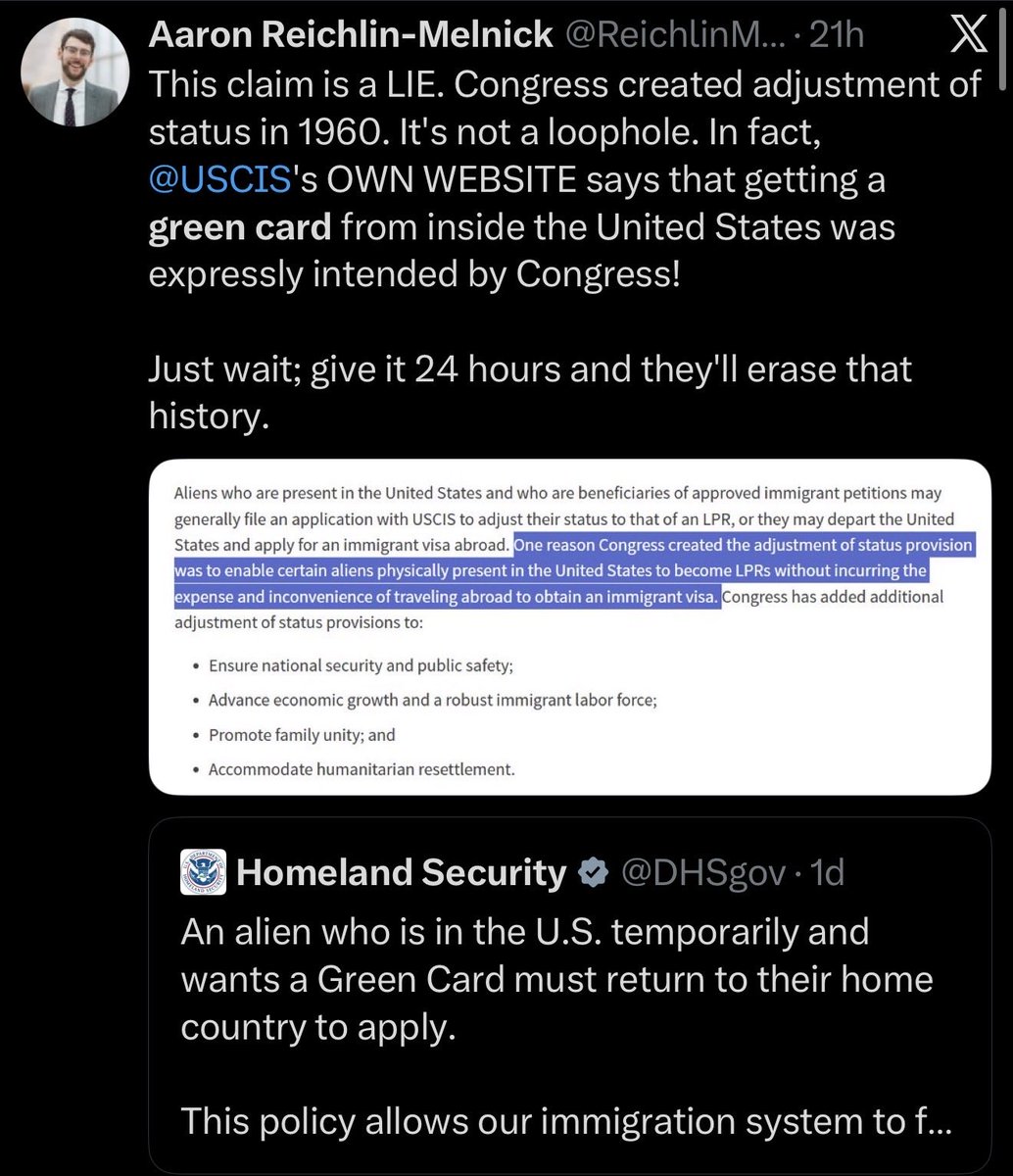
The loophole that DHS/USCIS is closing is the one where you can be on a non-immigrant visa but still apply for permanent immigration inside the country, because that immigrant intent is only evaluated at the border, not by USCIS at application-time. (Confusing, right?)
On its face, limiting non-immigrant visas to not enabling permanent residency, and instead directing those applicants to the proper immigrant visa route, is not crazy. When you get a non-immigrant visa, you do certify that you don't intend to immigrate.
The only technical talent that suffers from this are F-1 students on post-completion OPT, of whom there are many bright achievers in Silicon Valley. But many of those are also good fits for O-1s.
As an aside, I obtained my green card on the F-1 -> EB-3 path, which is what's being challenged by this memo. I'm grateful it was straight-forward at the time because I never got an H-1B visa in the lottery (30% chance), but this was also not an ideal process. Three years of uncertainty.
In my view, what closing this loophole does is force the conversation on the need for skilled immigration visas -- a better, faster, higher-certainty pathway from a strong university to the right to work that doesn't have you competing in a stacked lottery. The Twitter reaction is alarmist, but I think the policy reality is more benign.