

Francesco
2.1K posts

Francesco
@giftedio
Father of 3. Paid Ads Expert. CTO @ https://t.co/grvHczbCKU, growing https://t.co/hIkf8lRSCU. I teach you how to make ads work ⬇️⬇️⬇️⬇️
เข้าร่วม Nisan 2023
321 กำลังติดตาม501 ผู้ติดตาม

@stephsmithio @giftedio @SmallBetsDotCom It's so refreshing to see genuine kindness and appreciation. It really highlights how small gestures can create a ripple effect of positivity. What do you think inspires people to share compliments like this?
English
I think I've found the perfect "internet person" (and most people probably already know her): @stephsmithio.
I've been following her for a long time through the @SmallBetsDotCom community, and I haven't come across anything off-putting, on the contrary, I've found everything she's posted or published online genuinely enjoyable.
Always with elegance and good etiquette.
It would be wonderful to have more people like her around.
English
@stephsmithio @SmallBetsDotCom In the age of AI slop, fake content, and other nonsense, I think we should celebrate people like you!
English

@giftedio @SmallBetsDotCom Oh my goodness, this is one of the nicest things anyone could say. Truly. Thank you so much 🙏
English
It's this whole trend. Snce companies are laying people off, everyone should apparently become a consultant, and businesses are all just sitting around waiting for you to pitch them!
It's not far off from the SaaS narrative. And honestly, this is even harder to sell, because it touches very sensitive parts of a business. If the clients don't grasp what's at stake—and you don't take the time to explain it, I can only imagine the scale of the egregious incidents we're going to see.
I still come across dozens of insecure WordPress installations that anyone could hack in a couple of hours.
Imagine what's going to happen with openclaw in the mix.
And you're absolutely right, they're talking about charging $3–4K a month. You can hire one or two employees for that. Complete nonsense, at least for the current generation of entrepreneurs.
English

Most of it is a hoot. It’s one thing to map out bespoke and viable solutions for small businesses and there is some verifiable interest from biz owners who know they could be doing certain things more efficiently but neither understand the technicalities nor have any inclination or time to tinker. The Openclaw setup pitches kill me in particular tho. Like, so you save someone five minutes by running a command line. Ok but then who helps them when it breaks at every update as it does? They’ve no budget for it. It doesn’t scale
English
My feed is saturated with these testimonials, and I find them increasingly difficult to take at face value.
Seemingly overnight, everyone has rebranded as an "AI transformation consultant",people who, six months ago, were doing something entirely unrelated.
Armed with a rudimentary grasp of what an LLM actually is, they claim CEOs are rolling out the red carpet and cutting them checks and pour money in their pockets.
Forgive my skepticism, but something doesn't add up. Either every organization I speak with, and we're talking dozens, US and Europe, is operating with UNUSUAL caution, or this supposed gold rush is simply savvy self-promotion by a new cohort of AI consultants marketing their own mythology.
The shift is real, OK, entrepreneurs are adopting AI. But the overwhelming majority, particularly the SMB operators running sealcoating outfits, renovation crews, HVAC companies, and the like, are figuring it out on their own.
And for precisely the same reason these self-anointed gurus believe they can add value, these business owners don't need them. The learning curve is that shallow.
If a piano teacher can reinvent herself as an AI consultant over a weekend, then the business owner herself, or someone already on her payroll, the cousing the assistant, the daughter, can absolutely do the same. They won't throw billions at you for sure, they are not stupid, and you won't be able to improve their business just getting them an @openclaw instance. Generating leads is not just that, runnign the business is a different beast.
The sheer volume of accessible material, combined with how readily an LLM will walk you through configuring your own infrastructure once you've got the fundamentals down, renders the consultant redundant in most cases. This isn't even the old "my nephew built me a WordPress site" dynamic. That was rocket science by comparison!
And when you move upmarket, to structured companies with real leadership, even in the most freewheeling countries and industries, the bar rises considerably.
You need genuine expertise, an established firm behind you, earned credibility, and substantive prior knowledge of the industry and the specific business you're pitching. Or you need to know the PEOPLE and cut the line. They are not getting anybody in exactly like it was before. Come on...
This is a great podcast arc. Let @mcuban weigh in and put this absurd narrative to rest. The fundamentals of building a trustworthy business haven't changed, and they're not about to.
Andrew Warner@AndrewWarner
That guy with a big smile just hit $4.5M ARR. His business: helps SMB implement AI. I grilled @cheneypiano about his playbook: + He DM'd CEOs on LinkedIn + Within 72 hours, he got his first sale: $15k + His pitch: CEOs get ai strategy. Their teams learn AI + He built a .org site, which gives him credibility + @Replit does his SEO/GEO, which lands him clients + He shifted to subscriptions to get steady revenue Even at $15k/month, every 6 clients add $1M ARR. (He's increasing prices.) Next: He's setting clients up with his version of NeoClaw (NVIDIA's safer OpenClaw). Yes, I simplified his story. But he goes through it in detail in our interview. (YouTube link below.)
English
@BryanBumgardner Can't move from Meta, Instagram is the money printer and nothing comes close to it in most accounts.
English

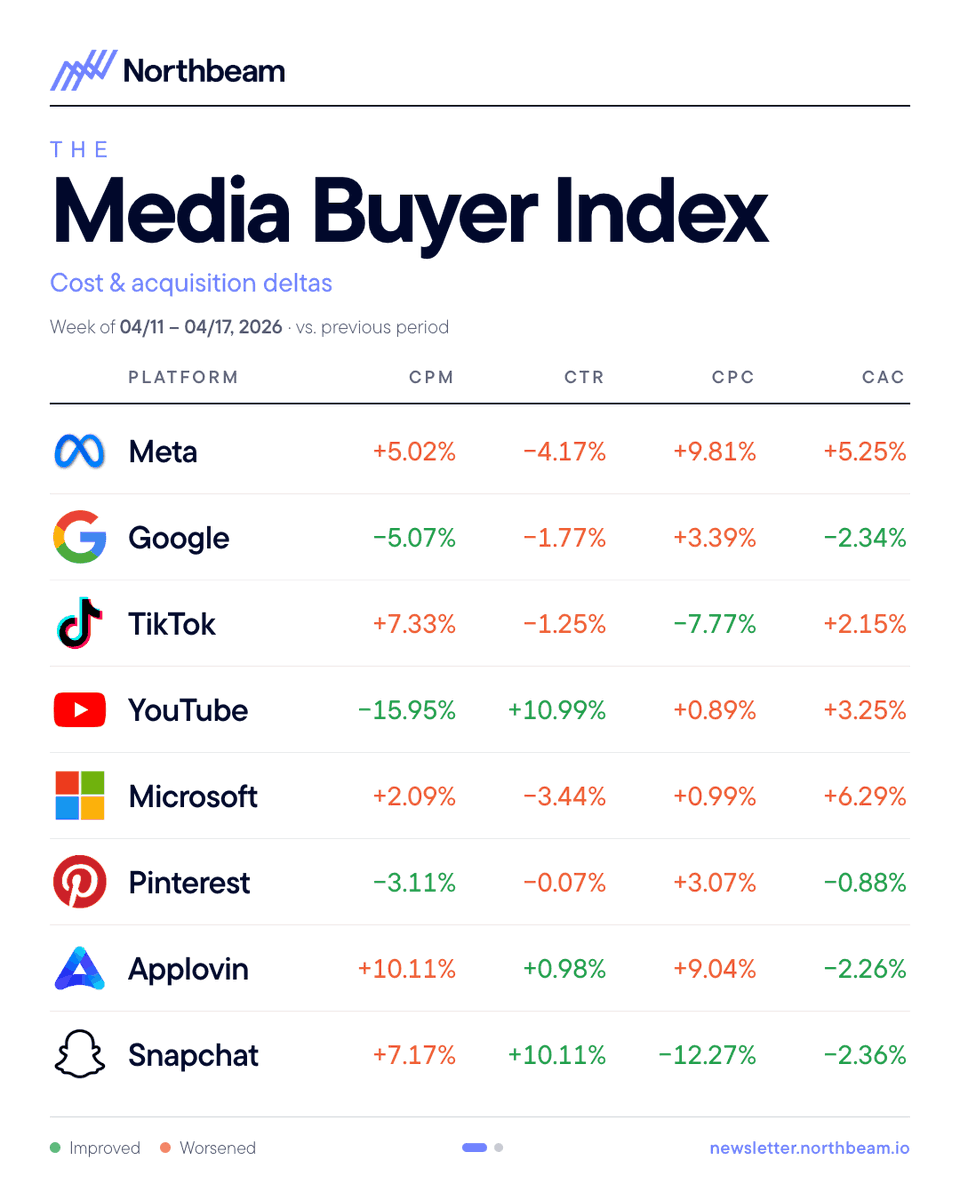
Brutal movement on Meta ad performance in the wake of bugs, AI influence, and general chaos.
Meta is still the undisputed leader of performance marketing channels, but my feed is full of frustration this week.
Your week-over-week performance is likely beaten up because of wider-reaching issues affecting your peers.
Are you seeing comparable WoW shifts in your ad accounts?
No action right now. Just stay the course, Memorial Day is coming which launches us into ecomm summer.
English
Agree 100% here, @RobertMSterling got it.
Robert Sterling@RobertMSterling
KPMG is laying off 10% of their audit partners. You might have missed the news amidst today’s announcement that Meta is also laying off 10% of their employees. I’ll be blunt: If you work in front of a computer, your job isn’t safe. It doesn’t matter how senior you are (KPMG’s partners literally own the company). Nor does it matter how good you are at your job (Meta’s engineers are among the best of the best in the tech industry). Your job is at risk, and it’s incumbent on you—and no one but yourself—to plan for what you do in your career to proactively manage that risk. Four reasons why this is happening: 1. Competition: AI is reducing barriers to entry across every industries, from professional services (such as the audit and advisory services provided by the likes of KPMG) to software and everything in between. Reduced barriers to entry mean increased competition, which means lower pricing power, margin compression, and pressure to reduce costs—especially fixed costs such as labor, which is the number one expense for most white-collar businesses. 2. Need to Invest: As incumbents face increased competition from new entrants to their market and from substitute products (e.g., vibe-coded homebrew SaaS replacing expensive vertical SaaS products that previously enjoyed virtual monopolies within their respective target markets), they are forced to make sizable investments in technology to remain competitive. In the case of professional services companies, this means large investments in proprietary software (all of the Big Four firms are investing billions in new technology right now); for big tech companies, this means tens of billions of dollars going into data centers and physical infrastructure. Essentially, capex and opex are in the middle of a zero-sum battle in corporate budgets. As companies face the need to invest more in capex and R&D—and as capital markets become increasingly averse to providing them additional liquidity to fund it, out of concerns that the ROIC on said capex will not be accretive to earnings—opex is cannibalized to fund capex. And, again, the primary lever CFOs in white-collar companies have to instantly reduce opex is layoffs. 3. Automation: These competitive pressures are compounded by AI rapidly automating work faster than incremental revenue is able to be generated. In other words, workers are being made redundant faster than companies are able to come up with the new business that might otherwise save those jobs. Some in the tech industry (people far smarter than me, I will add) conjecture that, on a net basis, AI will create more jobs than it will destroy, due to an AI-facilitated period of hypergrowth and a corresponding boom in corporate earnings. But with every company I advise, across the worlds of startups, SMBs, and large industrial companies, I’m simply not seeing that yet, and I don’t know anyone who is. 4. It might feel like ancient history at this point, but many companies are still dealing with the excesses of the Covid-era labor market. Money was loose, talent was in short supply, and software companies, financial services firms, and professional services companies hired too many people too fast, with standards that were too low. They’ve made significantly progress in right-sizing their workforces over the past couple years (return-to-office mandates, for example, have essentially created “soft layoffs” at many large companies), but much work still remains. If you’re picturing your career and your company as you read these words, I can’t emphasize it enough: Plan ahead. Build a network of people outside your company who would want to work with you if your current job were made redundant. Think about businesses you might want to start (it’s a lot easier to keep your job if no one but your customers can terminate you). Set money aside. Be proactive, not reactive. Be a predator, not the prey. Because these trends are inexorable, they’re unstoppable, and, chances are, they’re coming for all of us. Start planning. And start planning now.
English
I see 2 patterns:
1) SMBs build their own things with AI but then create a massive mess and are not able to control it to a level where it's actually working. And then out of frustration they drop everything after weeks.
2) They still need to hire someone or have a person that USES AI but they won't outsource the whole process because, again, they can't control it and there are too many nuances they don't understand. They need a human to yell at in case things go wrong. It's their business, they pay taxes and they want to avoid taxes as much as possible.
Not saying the shift will never happen, but this transition will be slower than gurus and hyper-optimists are forecasting.
English

The irony is there are really only two types of SMB owners:
1. Hates AI and would not entertain this for a second
2. Already doing all of this themselves and thinks $3k/month is a complete joke
WOLF@WOLF_Financial
CHRIS CAMILLO JUST LAID OUT HOW TO MAKE $500,000 A YEAR AS AN "AI GUY" FOR LOCAL BUSINESSES His blueprint: 1. Walk into any HVAC, plumbing, or sprinkler business. 2. Ask where they're leaking money. 3. Build them an AI agent that answers after-hours calls, sends instant texts, and gets quotes out in real time. 4. Integrate it with their CRM for free. 5. Charge them $2K-$3K/month to be their "AI guy." Repeat across 10-20 businesses. "There are people right now doing this."
English

oh, it's a long one and you need to try them all haha.. but in the center, two places I try go to everytime I'm there are "De Memmo" (I always get Amatriciana+Cacio & Pepe) and touristic but nice "Sora Lella". Do you know them?
But there's a culinary universe in the city and don't rely on reviews by American tourists, most of them have no idea what they are talking about.
English


Don’t do this.
Ever.
This will get you banned instantly
Tom Dörr@tom_doerr
Open-source AI agent for Meta Ads management github.com/TheMattBerman/…
English
I feel the gap between Meta and those who work with their universe is somehow getting bigger, despite the platform still being quite efficient.
The API part always feels like a 2nd class citizen, and the random errors and sudden changes in the business suite are sometimes very scary.
If we add the heavy use of AI, probably also in the auction mechanics, it paints a picture of an immense black box that resembles a giant ship without a captain.
The whole thing looks like an aggregation of different patches that try to reassure advertisers and guide them as much as possible, but rather creates confusion.
Most of the setups I see now are wrong or at least not aligned with the goal of the advertiser.
I have to say Meta is still a safe harbour compared to Google's nonsensical thirst for broad campaigns and the ridiculous approach to ads of LinkedIn. And I also get that they want to keep a sense of distance from naive users.
I keep working and spending millions within Meta properties, I keep suggesting using it to many clients and, again, Meta is still the best acquisition channel for lots of industries (if properly used).
But we'd like to have more "faces", not a Meta AI for support and non-existent customer service. On this, Google is far superior. I met at least 40 different people at different levels over these years.
On the Meta side I probably got to speak to 2 or 3, with some kind of knowledge and authority. I wish they'd find a "Head of Product" for ads. They really need it.
jason yim@jasonyimco
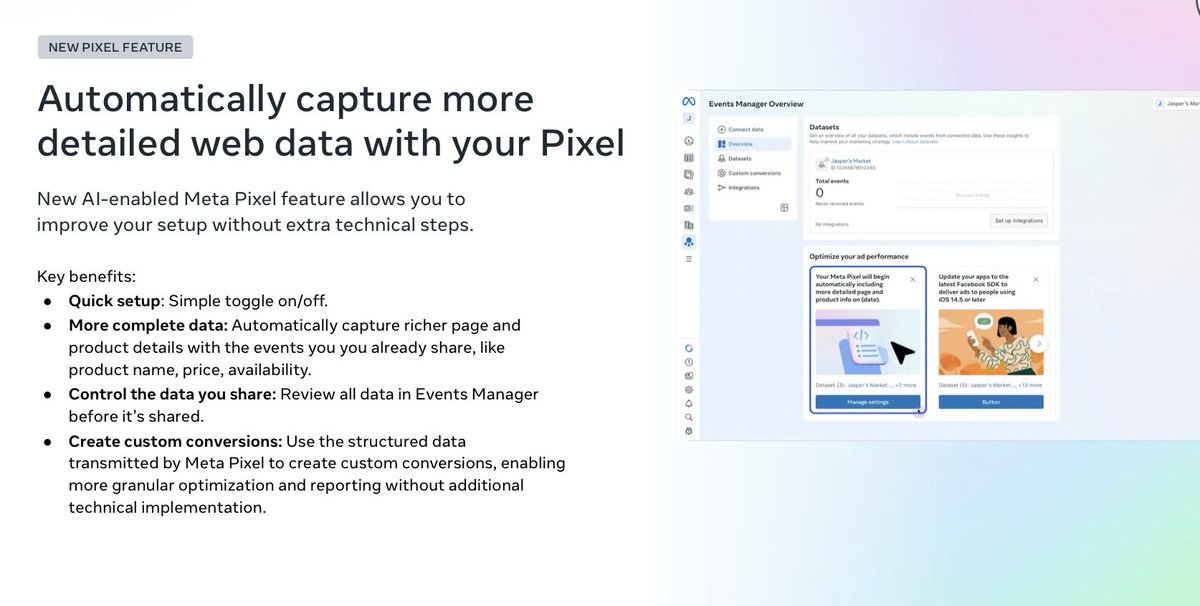
Meta just killed the biggest technical barrier in performance marketing. for years, the gap between big brands and small businesses wasn’t just budget. it was developer resources. if you wanted to run dynamic product ads or set up the conversions api, you needed a dev team to configure servers and manually map structured data. that changes today. we just rolled out two massive updates that automate the entire backend setup: 🔵 ai-powered pixel enrichment: the pixel now uses ai to automatically read your website and pull product names, prices, and availability into your events. no more manual coding or schema .org mapping. smaller businesses get performance benefits without technical work and larger businesses can refocus tech resources on more important areas 🔵 one-click capi: we launched a “meta-enabled” conversions api setup. it’s literally one click. no servers, no ongoing maintenance, no costs. this is a huge deal for signal quality. advertisers using capi for web events see an average 17.8% lower cpa than those relying on the pixel alone. historically, getting that setup was a nightmare for lean teams. now, the playing field is leveled. the machine handles the technical plumbing, so you can focus entirely on creative and strategy. if you’ve been putting off capi because it was too technical, now is the time.
English
@jasonyimco thank you for clairfying @jasonyimco . Even a small improvement can have a bigger impact so we welcome this even though this is just a gateway and doesn't solve all the privacy and technical issues with the pixel.
English

it mirrors your pixel events server-side. so your pixel fires on the browser, and meta's infrastructure automatically creates a redundant server-side connection that delivers those same events to meta.
if you already have a custom capi setup or partner integration, keep it.
but for anyone who's been pixel-only because capi was too complex or expensive to set up, this removes that barrier.
English
Meta just killed the biggest technical barrier in performance marketing.
for years, the gap between big brands and small businesses wasn’t just budget. it was developer resources.
if you wanted to run dynamic product ads or set up the conversions api, you needed a dev team to configure servers and manually map structured data.
that changes today.
we just rolled out two massive updates that automate the entire backend setup:
🔵 ai-powered pixel enrichment: the pixel now uses ai to automatically read your website and pull product names, prices, and availability into your events. no more manual coding or schema .org mapping. smaller businesses get performance benefits without technical work and larger businesses can refocus tech resources on more important areas
🔵 one-click capi: we launched a “meta-enabled” conversions api setup. it’s literally one click. no servers, no ongoing maintenance, no costs.
this is a huge deal for signal quality.
advertisers using capi for web events see an average 17.8% lower cpa than those relying on the pixel alone.
historically, getting that setup was a nightmare for lean teams.
now, the playing field is leveled. the machine handles the technical plumbing, so you can focus entirely on creative and strategy.
if you’ve been putting off capi because it was too technical, now is the time.
English
@jasonyimco like a gateway? how can Meta have access to my server events if I don't fire them from the server itself? Is it some kind of statistical modeling like for pixel events?
English
@AarmanRoy I think that exists! not saying there's nothing left to learn, there's always some new room where you're the dumbest, but "detachment" could be seen in a positive way.
And what's the next step, stay and ascend or swtich?
English

@giftedio You've ascended to the next level of expertise: detachment. lol
English
What happens when you spend years building expertise in something...and then end up hating it?
It's beyond frustrating. You're basically a walking encyclopedia on the subject, and you couldn't care less about any of it anymore.
Is pivoting to an adjacent field the move? Or what?
English

@giftedio Ah I think the reframe is that humans like movement, challenges, progress. The field is irrelevant. That is maybe part of it.
English