Check out this job from Refactor Talent linkedin.com/jobs/view/3834…
Do you want the opportunity to work full time, with 21 days of PTO, 401 (K) match, + tuition reimbursement as well as student loan payback assistance? Then I have the PERFECT role for YOU!
#brightonmichiganjobs
I can't stop thinking about this...
Michael Caine on his defining philosophy on life:
Use the Difficulty
As a young actor, he was rehearsing a play scene when a chair got stuck in the door and blocked his path.
He told the other actor he couldn't get by the chair to enter the room in the scene.
The actor's response:
"Use the difficulty...if it's a comedy, fall over it, if it's a drama, pick it up and smash it."
This idea—of using the difficulty—became a defining mantra for Michael Caine's life.
"There's never anything so bad that you cannot use that difficulty...if you can use it a quarter of one percent to your advantage, you're ahead, you didn't let it get you down."
This idea hit me hard...
How can you use the difficulty you're currently facing?
How can you embrace the struggle?
How can you find flow through the friction?
How can you sow the seeds of your light during the periods of darkness?
As with everything in life, control the controllable:
The difficulty is already there, you can't control it.
You can control how you react to it.
You can control your response to it.
You can control your attitude towards it.
Lesson: Difficulty is inevitable. Use it.
I’m preparing a Huberman Lab podcast on colds & flus and how to avoid/treat them. What protocols besides the standard “rest, liquids, wait” advise do you believe can truly help you recover more quickly and/or stay non-infected? I am asking about colds & flu’s only/specifically.
Help me friends who’ve been through hospice process. Social worker coming today to help guide me through final arrangements/next steps. Momma refuses to believe she’s dying/near the end. Dr said weeks. How much do I TELL her? Ignorance = bliss in this case? Gah.
@YogaPantsRec Consider taking whatever support hospice offers you too. Wildly compassionate and patient people in my experience. While my sister was dying, a nurse asked me if I was drinking enough water. It started a whole conversation for me that was incredibly helpful. ♥️
Pete Carroll said, "It's about being the very best you can be. Nothing else matters as long as you're working and striving to be your best. Always compete. It's truly that simple."
Excellence is the mindset, it's not the destination.
Don't crave for success, but aim for excellence in everything that you do.
When you strive for excellence, success follows.
✅You have to be committed.
✅You have to compete.
✅You have to give your best.
Excellence isn't a one-time event, it's a journey.
It starts by winning today and then tomorrow and then the next day.
6 Ways to Win The Day with Excellence:
1. Set Clear Goals for the Day
Goals provide direction and a sense of purpose. Measure your performance and make sure it aligns with your values. Goals don’t always have to be big and broad, they can be daily cadences or weekly expectations, but they give you a target to aim for.
2. Own your Mindset, Own your Actions
Take ownership and responsibility for yourself and your mindset. Adopt a growth mindset and believe that your abilities and intelligence can be developed through dedication and effort. Take responsibility for your thoughts, beliefs, and actions. Challenge self-limiting beliefs and replace them with empowering ones.
3. Compete with the You of Yesterday
Each day, strive to outperform the person you were yesterday. Challenge yourself and look to improve, learn, and grow every day. The comparison should not be outside of yourself, but it should always be to your previous self. Progress becomes a testament to your dedication and growth journey.
4. Embrace "The Power of One More"
As Ed Mylett calls it, harness "the power of one more". When you feel like you've reached your limit, push yourself to do one more task, make one more effort, or take one more step toward your goals. It's in those moments of extra effort that significant progress is often made in the mind and body.
5. Will Yourself Every Day with Resilience
Embrace the mindset that setbacks and failures are opportunities for growth and learning.
- Expect that there will be setbacks.
- Expect that there will be adversity.
When you try new things, you develop the ability to adapt and grow stronger.
6. Reflect on How to Improve and Win Tomorrow
At the end of each day, take some time to reflect on your achievements and setbacks. Celebrate your wins and identify areas where you can improve. Set a plan for the next day. Continuous self-assessment and planning are essential for long-term success.
Growth becomes a daily habit when you combine discipline, perseverance, and intentionality.
"We are what we repeatedly do. Excellence then is a habit." - Socrates
- - -
Follow @coachajkings for more content like this!
“When I am gone, do not fear my memory.
Do not be afraid to speak my name or look through old photographs.
Do not be scared to play old videos so that you might hear my voice and see me laughing.
Do not be wary of visiting my favourite places or eating my favourite foods or singing along to my favourite songs.
I know it will hurt. Those memories will remind you that I am gone.
They will stab at you like a knife in an open, gaping wound. Raw, excruciating pain.
But after a while the knife will become less sharp, the wound will become less open and the pain will become less raw.
And those memories will remind you that I was here.
That I lived.
Do not reduce my life to my death.
Speak my name, hear my voice, sing my favourite songs and visit my favourite places.
Because that’s how I can stay alive a little.
Right here with you 🧡
Beautifully written by
Becky Hemsley ❤️
Image by
Juli Scalzi ❤️
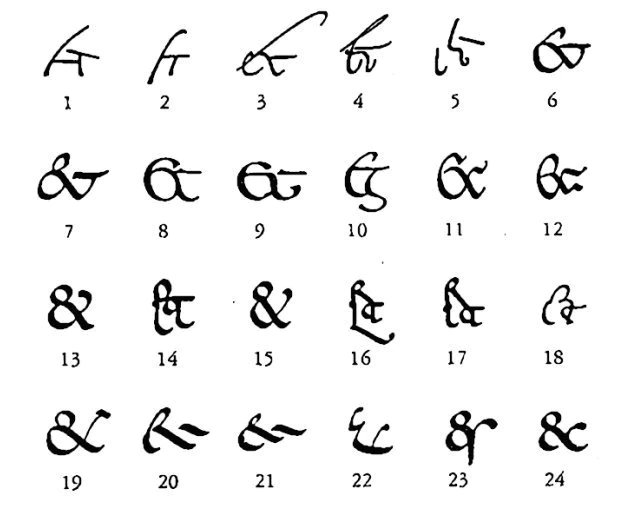
What the hell is an ampersand and why does it look like that?!
The first thing you need to know is that "&" used to be the 27th letter of the alphabet...
But there are three parts to this story. And the first begins over two thousand years ago in Ancient Rome with a single word: et. It's the Latin for "and". At some point Roman scribes started combining the two letters of et into a single symbol, which was the ancestor of our modern &.
The earliest example of the "et" symbol is actually from graffiti in Pompeii. In any case, it did not disappear with the fall of the Roman Empire.
Latin survived as the language of the Catholic Church and of scholarship in Medieval Europe. Scribes during the Dark Ages continued to use the & symbol. It evolved down the centuries, in places losing any semblance of the letters e and t whatsoever.
The second part of the story is that during the 18th and 19th centuries, as education and the teaching of literacy spread, & was added to the end of the alphabet as a sort of 27th letter.
On a related note, although "et cetera" is now usually just abbreviated as etc., for a long time it was instead abbreviated as "&c". The & was for et and the c for cetera.
The third and final part of the story is about how the alphabet was taught to children — and how it was read out loud.
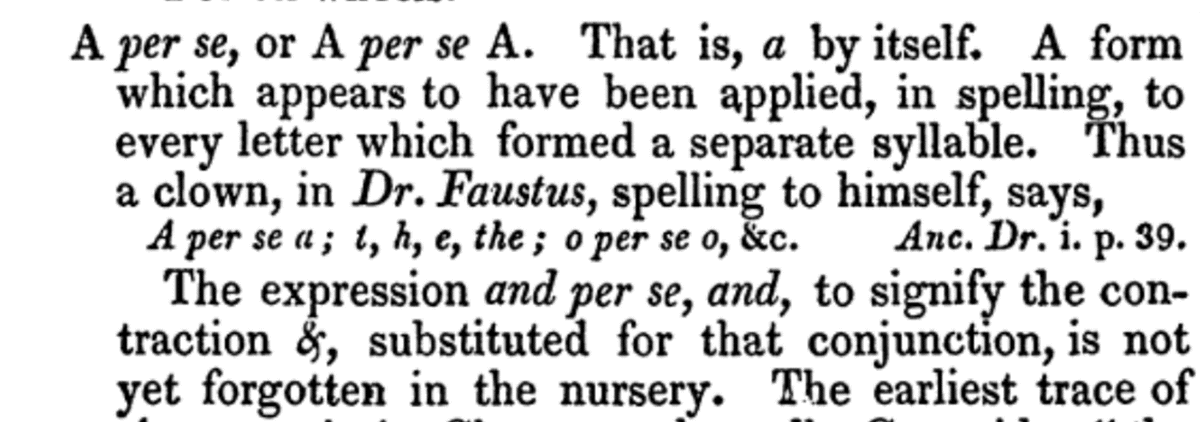
As this 1822 Glossary of Words and Phrases explains, it had been normal during the Renaissance, when speaking the alphabet, to add "per se" before any letter which could also be a word on its own — "per se" means "by itself" in Latin.
Take the letter A, which can also be a word of its own. When reading out the alphabet people would say "A, per se A, B, C, D, E, F, G, H, I, per se I..." and so on. O was also considered a word of its own.
Which means, when people got to the end of the alphabet, with & being the 27th letter, they would say: "S, T, U, V, W, X, Y, Z, and per se &."
When this old way of reading the alphabet was taught to children in the 18th century and they were reciting it aloud, they would garble "and per se " into what eventually became... ampersand.
A Dictionary of Slang and Colloquial English from 1905 relates some of the many other pronunciations school children apparently came up with:
"Ampersand. The sign &; ampersand. Variants: Ann Passy Ann; anpasty; andpassy; anparse; apersie; per-se; ampassy; am-passy-ana; ampene-and; ampus-and; ampsyand; ampazad; amsiam; ampus-end; apperse-and; empersiand; amperzed; and zumzy-zan."
Well, of all the many pronunciations that might have stuck, it was "ampersand" which came to be accepted and is now the official name for &... rather than zumzy-zan. So, from hurried Roman scribes to unruly school children, that's where "&" came from.
The Harvard Study of Adult Development is considered the longest running study on adult life, health, and happiness.
The study looked at mechanisms through which participants dealt with life's challenges.
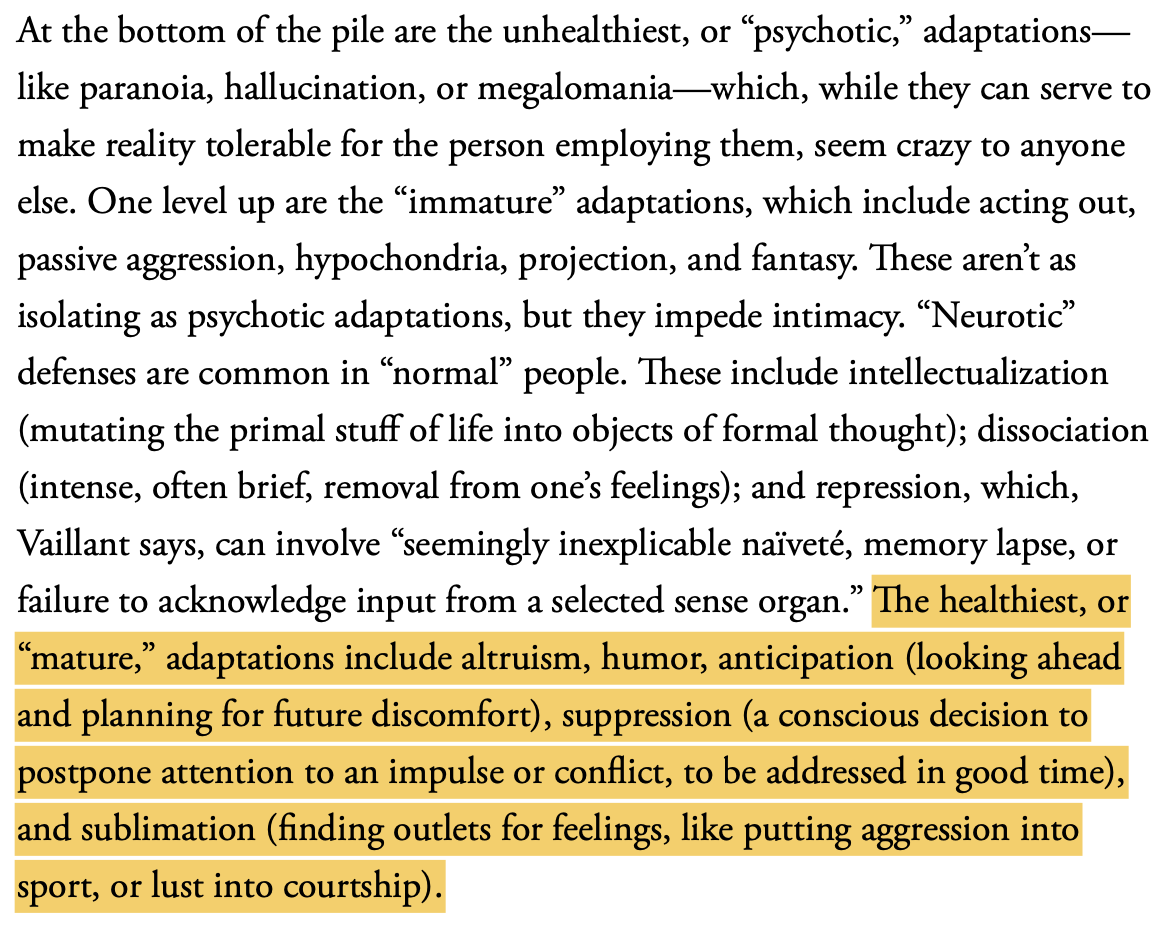
These 5 "healthy adaptations" were correlated with health and happiness:
1. Altruism: Focus on the wellbeing of others over the self. Empathetic behavior.
2. Anticipation: Looking into the future and anticipating the inevitability of discomfort. Maintaining a realistic, balanced view of the future.
3. Sublimation: Finding a productive outlet for negative emotions like aggression, such as through sports or exercise.
4. Humor: The ability to laugh at life's trials and setbacks.
5. Suppression: Delaying the confrontation with stress or struggle beyond the initial, impulsive, emotional reaction.
Charles Darwin is often paraphrased as saying, "It's not the strongest or the most intelligent species that survives. It's the one that is most adaptable to change."
By embracing these 5 healthy adaptations, we can all become more effective at riding the inevitable waves of life.
If you learned something or enjoyed this, follow me @SahilBloom for more.