Nicklas Brendborg

507 posts

Nicklas Brendborg banner
Nicklas Brendborg

Nicklas Brendborg

@nbrendborg

Author of “Jellyfish Age Backwards” on the science of a long life 📖 - PhD student, University of Copenhagen

København, Danmark เข้าร่วม Mart 2020
491 กำลังติดตาม1.3K ผู้ติดตาม
ทวีตที่ปักหมุด
Nicklas Brendborg
Nicklas Brendborg@nbrendborg·
Proud to announce that Jellyfish Age Backwards has been shortlisted for Science Book of the Year by @royalsociety! What an absolute honour ♥️
English
3
4
42
4.4K
Nicklas Brendborg
Nicklas Brendborg@nbrendborg·
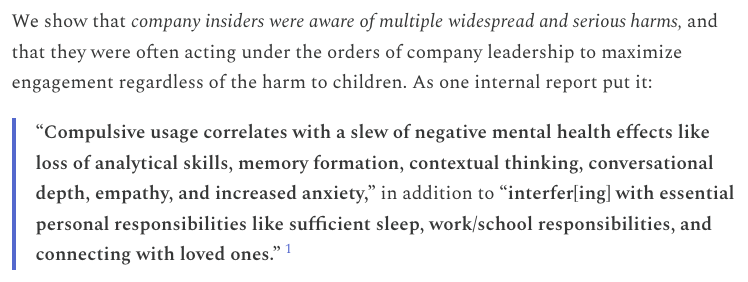
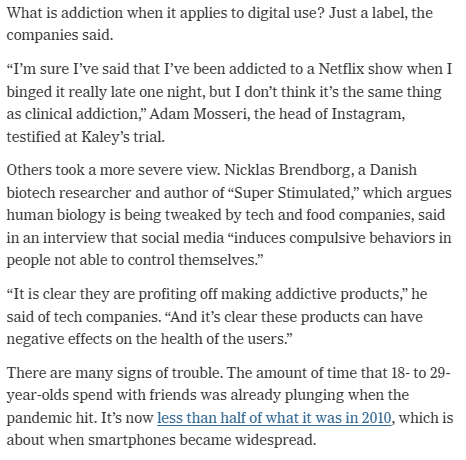
Everyone knows what people mean when they say they're feeling addicted and trapped by social media. The word games don't even matter, though. We can just call it "compulsive behavior" and the unethical business practices remain.
English
0
0
0
62
Nicklas Brendborg
Nicklas Brendborg@nbrendborg·
Such a classic dodge. Big Tobacco also used definitions to argue cigarettes aren't addictive. After all, they aren't intoxicating and withdrawal symtoms are milder than for heroin.
Nicklas Brendborg tweet media
English
1
0
2
126
Anil Nair
Anil Nair@ace_cool_an·
@nbrendborg - This was an amazing read, entertaining, informative and also profound, that epilogue. Thank you. Highly recommended reading …. #jellyfishagebackwards
Anil Nair tweet mediaAnil Nair tweet media
English
1
0
0
16
Nicklas Brendborg รีทวีตแล้ว
How To Academy
How To Academy@howtoacademy·
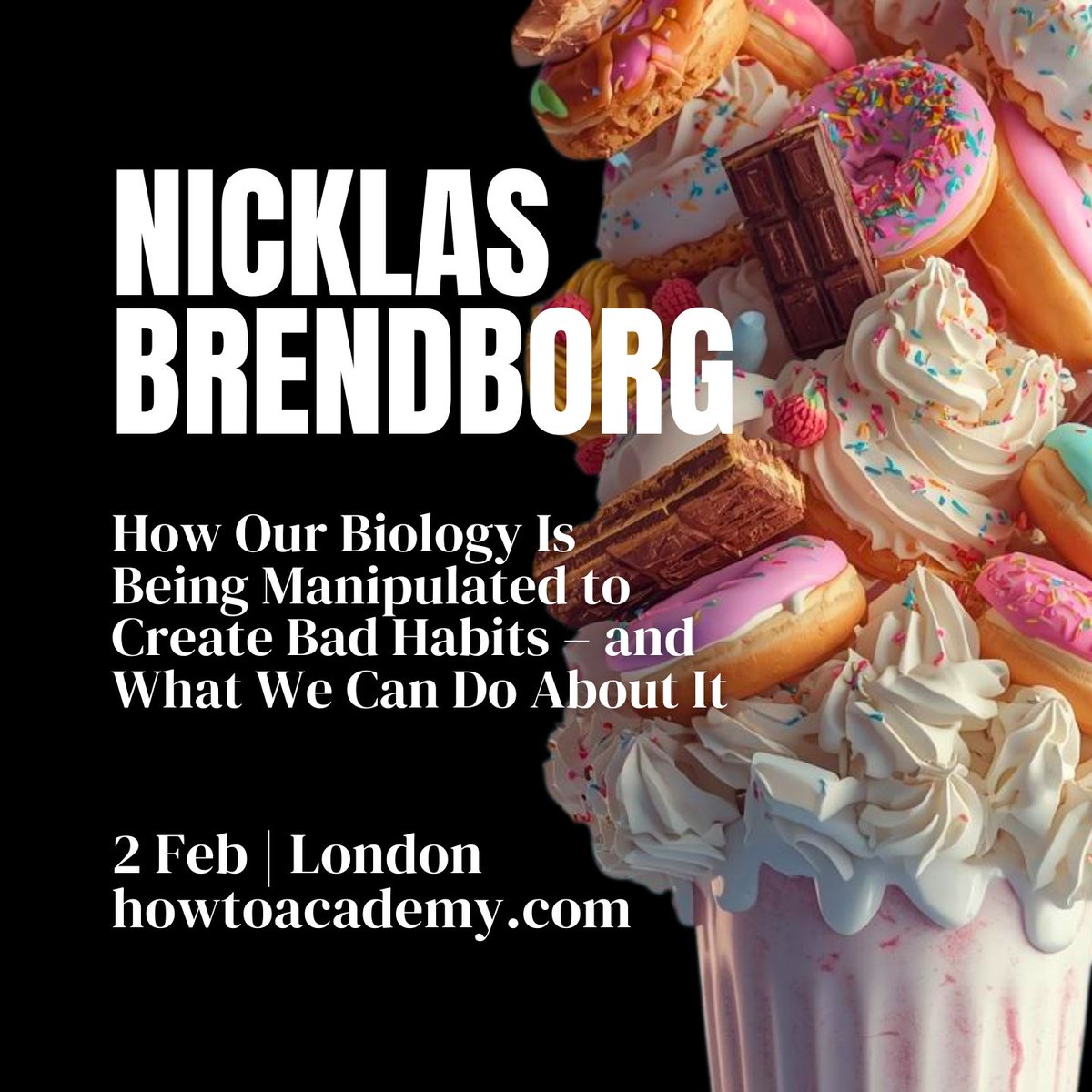
Danish biomedical researcher and the author of global bestseller 'Jellyfish Age Backwards', @nbrendborg, joins us to explain the science of letting go of bad habits – and why it’s so hard. Mon, 2 Feb | 7:30pm | London Tickets at howtoacademy.com/events/how-our…
How To Academy tweet media
English
0
1
0
400
Bianca Itariu
Bianca Itariu@adiposiwas·
Started reading @nbrendborg new book. Truly enjoyable, informative and entertaining. Caught myself thinking "ha, but this is only half true" just to find that he sets the record straight on the next page. Curious if there's anything on AI as "ultra-processed information".
Bianca Itariu tweet media
English
1
0
2
96
Nicklas Brendborg รีทวีตแล้ว
Alex & Books 📚
Alex & Books 📚@AlexAndBooks_·
A meta-study of 54 studies and 170,000+ people found that: People remember more information if they read a physical book instead of a digital one. The paper advantage holds across ages and has grown over time. Looks like paper beats pixel.
Alex & Books 📚 tweet media
English
87
504
2.2K
248.1K
Nicklas Brendborg รีทวีตแล้ว
Bobby Seagull MBE
Bobby Seagull MBE@Bobby_Seagull·
Would you live forever if you could? With non-fiction @rebelbookclub, our meeting on longevity inspired by books "Jellyfish Age Backwards" (@nbrendborg) &  "Ageless" (@statto). What if aging wasn't inevitable? Jellyfish Age Backwards explores how nature's most resilient creatures - like regenerating jellyfish, cancer-immune elephants & long-living bowhead whales - hold clues to human longevity. While we are far from immortality, Brendborg highlights actionable strategies like diet, stress reduction and cellular repair that can slow down ageing. Steele's "Ageless" book isn't just about living longer, but about extending healthspan and the years of life spent healthy, active and independent (regular exercise, balanced diet and good sleep support long term health). Thought provoking session chaired by RBC co-founder @benkeene with breathwork expert Jane Tarrant, longevity scientist Richie Barclay, health hacker Jo Dalton & detox coach Adam Parker. #Book #Books #Reading #BookClub #longevity #lifespan #ageing #health
Bobby Seagull MBE tweet mediaBobby Seagull MBE tweet media
English
0
2
5
3.8K
Nicklas Brendborg
Nicklas Brendborg@nbrendborg·
@LidskyPeter For humans, total energy expenditure is something like 20 percent higher in men. That equals more than the cost of a pregnancy I think but then there is breastfeeding as well. Maybe @HermanPontzer can clarify?
English
1
0
1
74
Peter Lidsky
Peter Lidsky@LidskyPeter·
@nbrendborg In species with stable couples, males should contribute less, I believe.
English
2
0
1
123
Peter Lidsky
Peter Lidsky@LidskyPeter·
An aging spell will be debunked here and now! Today, we will reveal why “disposable soma” – a famous formula that should have resolved the enigma of millennia – is flawed! What is it, and why is it wrong? So, what is it about? Antagonistic pleiotropy, which we discussed a few weeks ago, suggested that there are some genes that are good in young years and bad in old years, making aging similar to repaying a college loan (x.com/LidskyPeter/st…). We found that these links between “good” and “bad” effects are coming out of the blue, and their evolutionary stability is poorly explained. (BTW, nobody came up with a single realistic example of an evolutionary stable pleiotropic gene, so I drink my beer myself). When antagonistic pleiotropy was proposed, the central dogma of molecular biology was a very new thing, and scientists did not yet realize how flexible our genetics are. Apparently, by the seventies, this became obvious, and a British statistician and biologist, Thomas Kirkwood, made the next conceptual breakthrough by proposing the existence of a fundamental trade-off between longevity and early-life fitness (simply reproduction). His ideas were enthusiastically supported by Robin Holiday (have you heard about Holiday’s junctions? This guy.) According to Kirkwood, if an animal evolves a longer lifespan, it MUST get some fitness penalties. There are so few non-aging animals in the wild because, for some reason, they all should become very weak. Sounds reasonable? Very much! But what did Kirkwood propose as a mechanism? What is the “currency” that mediates this “fitness for longevity” trade-off transaction? How does an old individual “pay” for its young years of vigor? Here, we come to the shortfall of the disposable soma theory. In its initial theory formulation, the currency is simply the energy. Animals consume calories and can invest them either in reproduction or in repairing their bodies. If animals overinvest in reproduction, they can have many cubs, but the repair may go low, resulting in aging over time. If animals do not age, they will spend too many resources on repair, and too few will be left to reproduce. As a result, they would have few cubs and, therefore, would be overgrown by short-lived but rapidly replicating variants. Thus, aging is perceived as an energy conservation strategy. What is wrong with this model? It has both mathematical and biological flaws. Let’s start with math. In his work, Kirkwood considered an exponentially growing population. In this case, indeed, a rapidly reproducing variant may easily outcompete the long-lived slow reproducers. Imagine we put a single C. elegance worm on an agar plate. In a few days, you have ~200 children worms, and in a few more days, ~40000 grandchildren worms!! By that time, the initial grandma worm could still be alive! How much will it win from living a little longer? It is just a single old worm… However, if fertility decreases by just 1%, she will have only 39204 grandchildren, so the difference is staggering 796 worms!!! Numbers are hypnotizing, however, formally disposable soma fails here: the problem is food abundance. It assumes there is enough food on the agar plate to feed this growing progeny, so food must be presented with a huge excess and, therefore, cannot be a limiting factor. The grandma has no incentive to save energy; it can just eat a little more, lay a few more eggs, and over a long evolutionary timeline, it will get the “best survivor” price. Remember that growth is much more expensive than maintenance (if you don’t believe it, look at how much your kids eat when they grow). And here, we come to a second flaw of disposable soma in its classical formulation. Let’s zoom out from our agar plate and look at the planet Earth. How many worms are living there? It is a HUUUUGE number, obviously, but is it exponentially growing? Obviously not. Globally, the population numbers are constant, meaning that, on average, a single worm produces only one child that survives to adulthood. So, the parent in this model is very important. In such a situation, what is more energetically efficient: to produce a new individual or to slow the aging of the old one? According to all the possible calculations and observations, maintenance of older animals must be cheaper. Replacing some molecules in the body must be more economically advantageous than making everything from scratch. Thus, energy cannot explain aging in non-growing populations as well, and disposable soma cannot work. What about biology? Nothing we see says aging is an energy-saving strategy. If we feed animals with extra food that would be sufficient for repair and reproduction, they just get obese and age FASTER. If we starve animals, they live longer, indicating that longevity is a better energy-saving strategy than excessive reproduction. All the energetically poor ecological niches that should promote energy saving, such as caves, deep water, or Arctics, are full of centenarian species: again, longevity is more energetically advantageous! Are all animals living in resource-poor environments? Not at all. Many animals, such as hibernating mammals, can gain weight in a short period. Why not gain some extra food to regenerate? Now, let’s compare males and females. Who invests more energy in childbirth? Females. Why do they live longer than males?! We, poor males, spend LESS energy and are MORE disposable! Disgrace! Outrageous disgrace! But more importantly, this observation strongly contradicts disposable soma! Thus, while we need to appreciate Thomas Kirkwood's trade-off idea, we also need to accept that the currency he proposed does not work. Hence, we need to seek another currency that mediates the trade-off between fitness and longevity.
Peter Lidsky tweet media
English
6
2
26
1.6K
Nicklas Brendborg
Nicklas Brendborg@nbrendborg·
@NeckDk @jello_aps Skal lige understrege, at der er andre sødemidler end dem vi gennemgår, hvor det kan være anderledes. Aspartam og Ace-K fordøjes/optages før de når tyktarmen, men det gør sakkarin, for eksempel ikke.
Dansk
0
0
1
61
StiffNeckDK
StiffNeckDK@NeckDk·
@nbrendborg @jello_aps Overraskende - Det udråbes ellers som et faktum mange steder. Super med mere formidling af videnskaben.
Dansk
1
0
2
36
Nicklas Brendborg
Nicklas Brendborg@nbrendborg·
I dag er vores nok mest efterspurgte afsnit udkommet, nemlig om kunstige sødemidler. Skal man vælge light- eller sukkerudgaven? 🔗👇
Dansk
2
1
15
3.1K
David Andersen
David Andersen@jello_aps·
@nbrendborg Interessant. Tak for svar. Nu har jeg ellers kæmpet for at finde stevia alternativer - helt spildt 😅 Et input til en fremtidig afsnit kunne være de synlige tegn på aldring. Hvad siger forskningen man skal gøre for at undgå at miste ens hår på toppen og undgå rynker 👴 Igen tak
Dansk
1
0
1
49
Nicklas Brendborg
Nicklas Brendborg@nbrendborg·
@jello_aps Det var på blokken, men hverken aspartam eller ace-K ser ud til at blive metaboliseret af tarm-mikrobiomet i nævneværdig grad. Hvis vi laver et afsnit om nogle af de andre, kunne det være værd at tage op
Dansk
1
0
1
146
David Andersen
David Andersen@jello_aps·
@nbrendborg Super godt afsnit (som de alle er) 😀 Det undre mig at du ikke kommer ind på mikrobiomet? Det stærkeste argument for at undgå sødemidler jeg har læst er deres negative effekt på ens mikrobiom. Her skulle Stevia være det bedste alternativ. Eller er du uenig i den påstand?
Dansk
2
0
2
213
Nicklas Brendborg
Nicklas Brendborg@nbrendborg·
@AlecStapp This is wrong. Semaglutide is slightly modified GLP-1 linked to a fatty acid. Exendin-4, the Gila monster peptide, is structurally distinct & not the basis for it. It’s produced by the spit glands, not the venom glands. That said, completely agree on the grants.
English
0
3
8
857
Alec Stapp
Alec Stapp@AlecStapp·
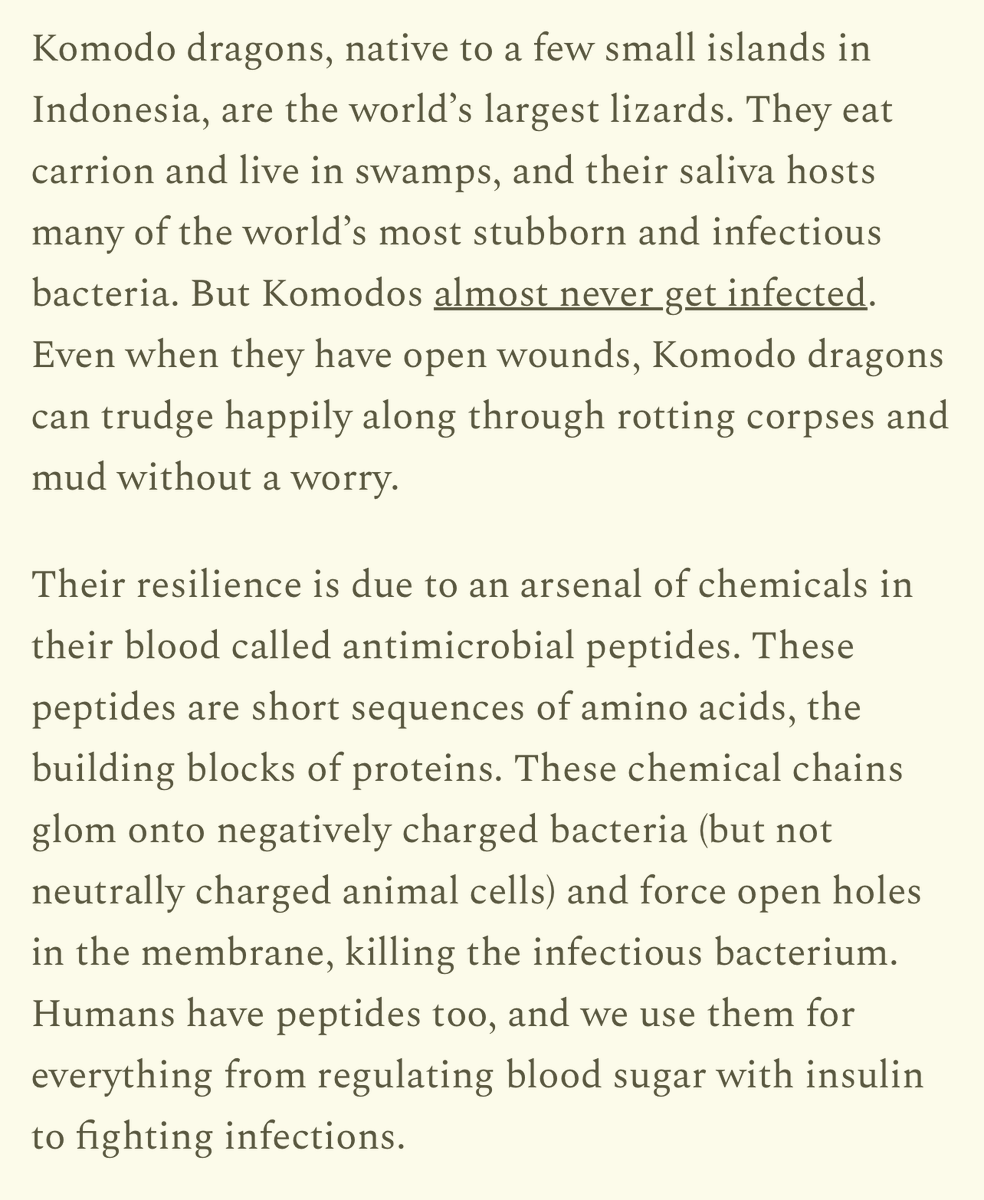
Ozempic (semaglutide) is a synthetic version of a hormone found in Gila monster venom. The most promising solution to antibiotic resistance comes from the antimicrobial peptides in Komodo dragon blood. Maybe some of those weird-sounding NSF/NIH grants are useful after all...
Alec Stapp tweet media
English
63
820
6.4K
277.9K
Nicklas Brendborg รีทวีตแล้ว
Jonathan Haidt
Jonathan Haidt@JonHaidt·
Do employees at TikTok think they are harming kids? Many do, at a vast scale. Their own words and internal reports are damning. We collect highlights at AfterBabel: afterbabel.com/p/industrial-s…
Jonathan Haidt tweet media
English
15
173
671
65.6K