PL

5.4K posts

PL banner
PL

PL

@plevchen

the ART of TRADING

England, United Kingdom เข้าร่วม Eylül 2017
514 กำลังติดตาม3.4K ผู้ติดตาม
PL รีทวีตแล้ว
Alice (e/nya)🐈‍⬛
Alice (e/nya)🐈‍⬛@Alice_comfy·
To me the bigger takeaway from that chart is either company can be profitable whenever they decide to stop R&D maxxing, and OpenAI thinks they will be R&D maxxing for longer. Most of these "training costs" are probably going to experiments, not released models.
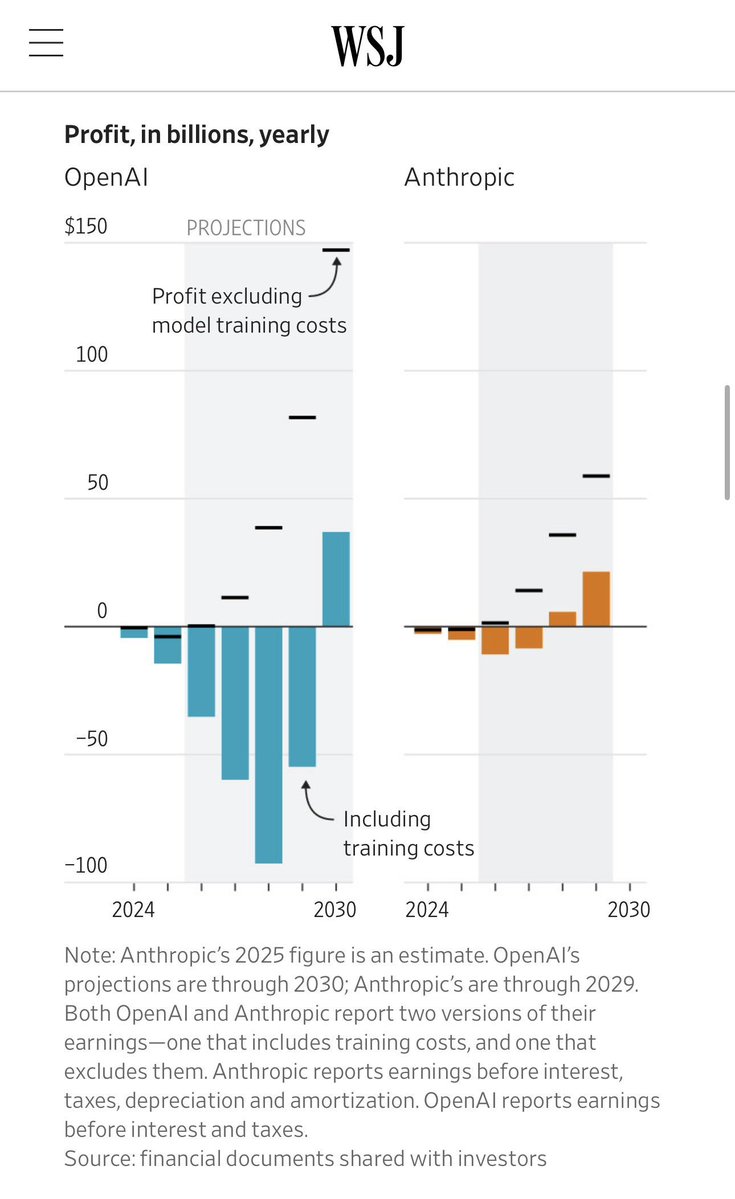
Alice (e/nya)🐈‍⬛ tweet media
English
1
1
4
1K
PL รีทวีตแล้ว
Anthropic
Anthropic@AnthropicAI·
Mythos Preview has already found thousands of high-severity vulnerabilities—including some in every major operating system and web browser.
English
119
569
6.8K
1.9M
TSDR Trading
TSDR Trading@TSDR_Trading·
What a great quote, and very true in markets! Thanks @jfsrev
TSDR Trading tweet media
English
1
1
29
3K
PL รีทวีตแล้ว
The AI Investor
The AI Investor@The_AI_Investor·
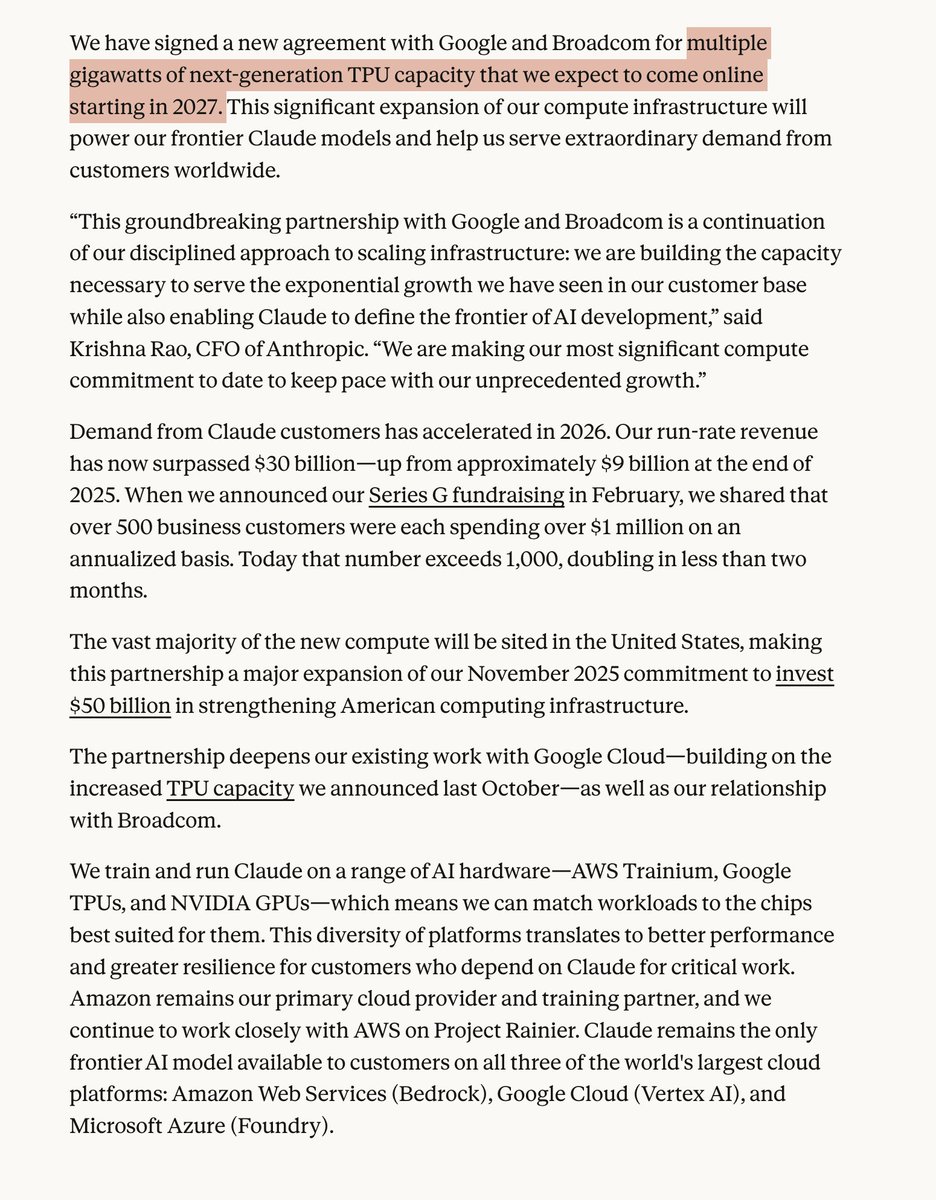
Anthropic's run-rate revenue has now surpassed $30 billion, up from approximately $9 billion at the end of 2025. 3x in 3 months at the scales of $30B per year. Insane run. They have signed a new agreement with Google and Broadcom for multiple gigawatts of next-generation TPU capacity that we expect to come online starting in 2027.
The AI Investor tweet media
English
4
14
74
18.1K
PL
PL@plevchen·
@aadilomar No I haven’t. Thanks for the suggestion. The Andrew Wiles story is incredibly inspiring to me. In the field of mathematics research, it’s kind of a fairy tale story
English
0
0
0
5
Aadl
Aadl@aadilomar·
@plevchen I read the book some years ago in disbelief by the dedication Have you come across E=MC2 by David Bodanis?
English
1
0
1
42
PL
PL@plevchen·
Andrew Wiles (Mathematician who proved Fermat’s Last Theorem): youtu.be/GS7CxAtV5Ks
YouTube video
YouTube
PL tweet media
English
1
0
4
631
PL
PL@plevchen·
Ideals are like stars, you may never reach them but if you follow them you will find your destiny. - some wise US general dude
English
0
0
2
528
Jad Malaeb (جاد ملاعب)
Jad Malaeb (جاد ملاعب)@JadTrades_14·
@plevchen Would you say the parabolic short and EPs are sufficient for impressive returns? Breakouts seem to have so much churn altho I know in theory they work. My laziness attracts me to the setups you mentioned.
English
1
0
0
52
PL
PL@plevchen·
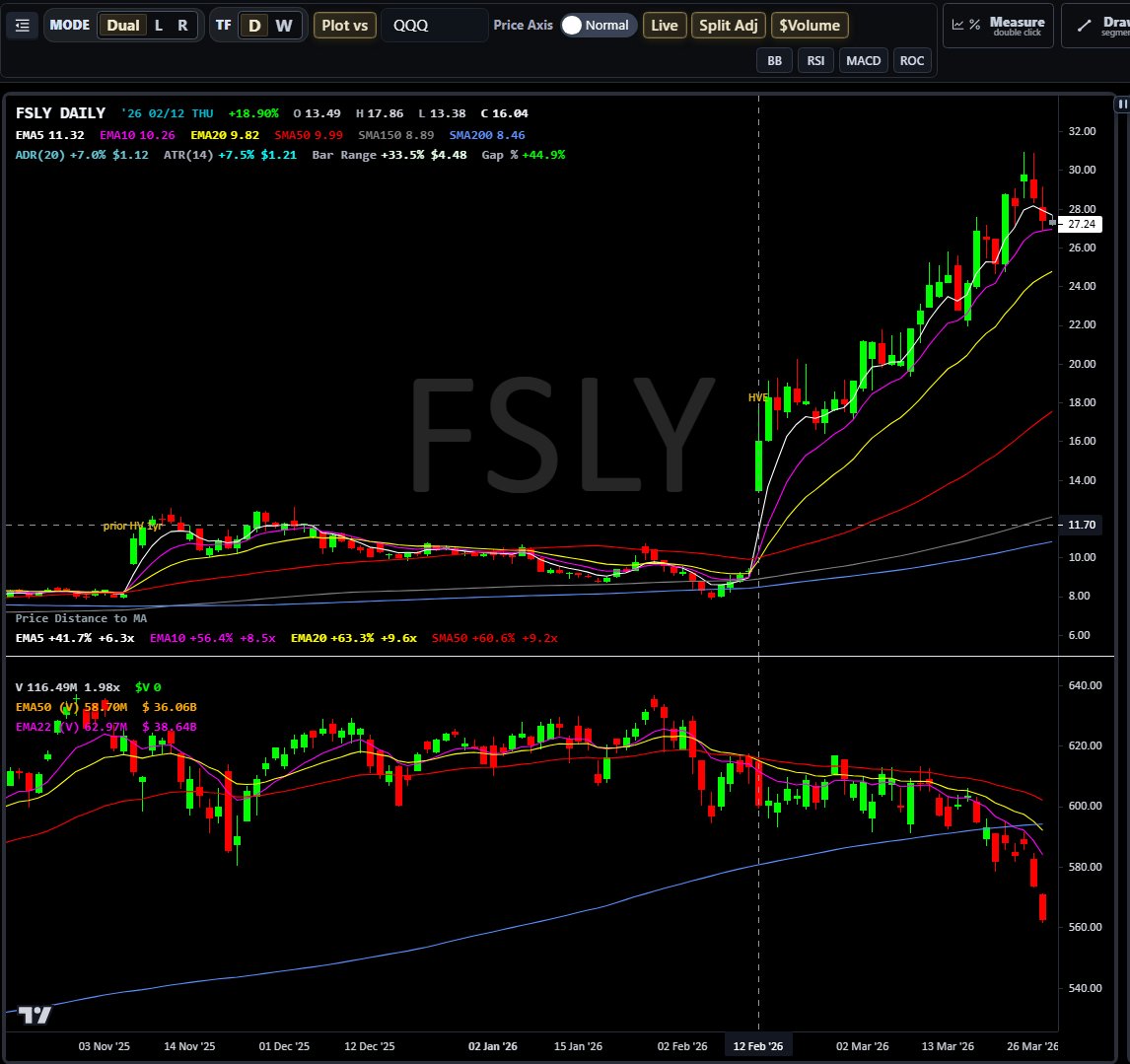
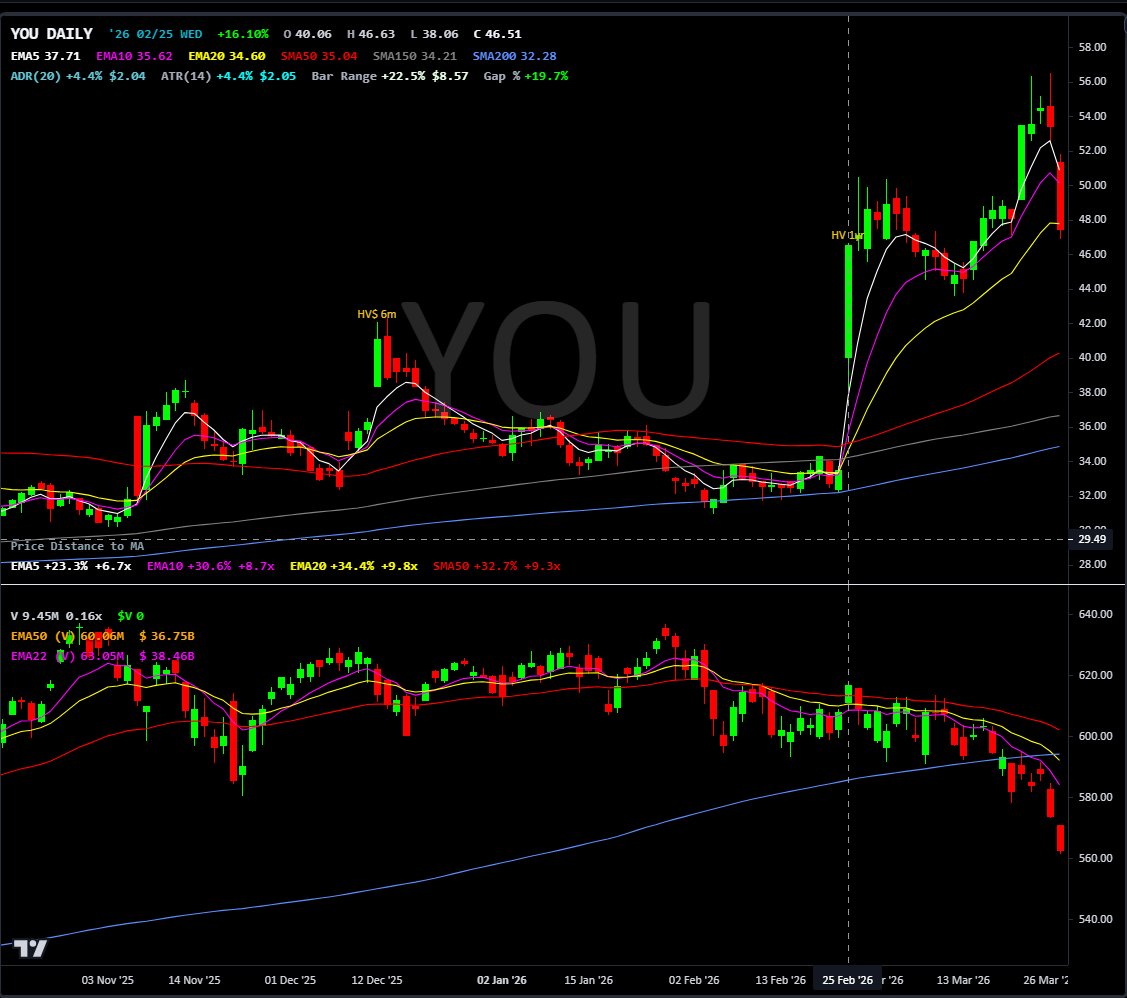
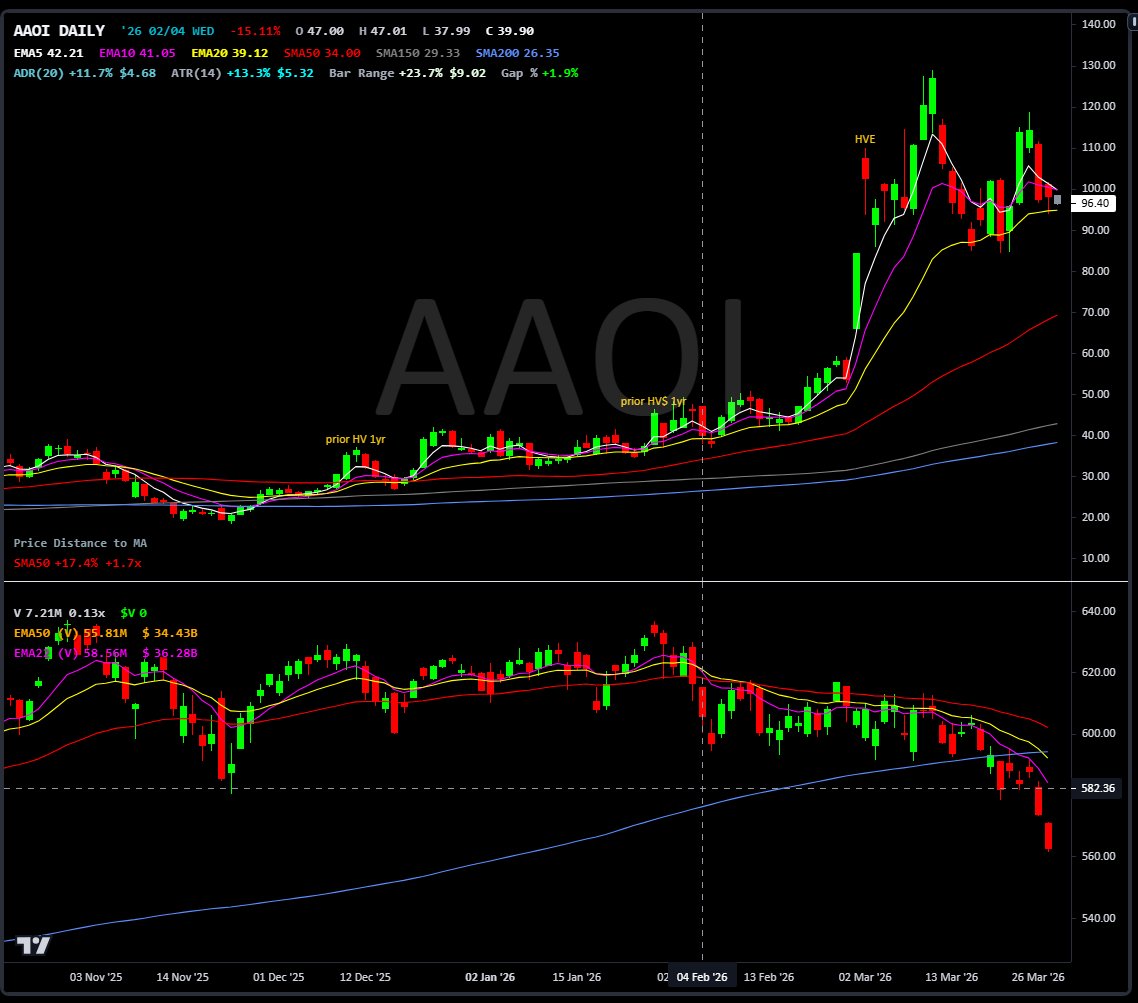
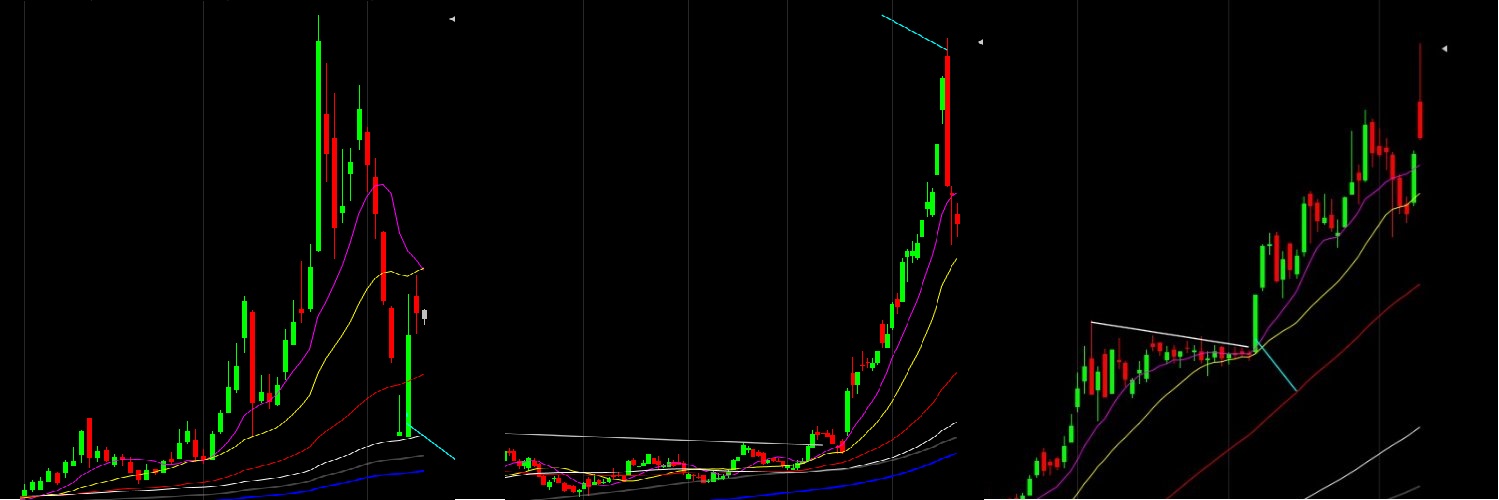
when you plot some EPs side by side vs a market benchmark like $QQQ, you are reminded how you were drawn to the setup in the first place whilst you were in search of alpha :) if i had to pick the most profitable non-market-correlated setup in my arsenal right now, it would be the EP opening drive on 4*+ catalyst . most reliable is using 09:50-10:30 target zone for exit. 2nd place - EP 3-5day hold 3rd place - 5*+ parabolic short in a small cap or a just a stock/instrument NOT part of a group move. 4rd place - 6*+ parabolic if an instrument is part of a group move. 5th place - EP swing hold. ... 999th place - $CRWV / $ONDS BO :) $FSLY $YOU $DELL $AAOI
PL tweet mediaPL tweet mediaPL tweet mediaPL tweet media
English
3
2
72
5.3K
PL
PL@plevchen·
The issue with BO is that it’s not actually a setup. Like everything BOs all the time on any timeframe. So saying you have a system which basically is based on buying things that look strong that breakout from tight ranges is not enough on its own as a meaningfully profitable edge. Markets are only THAT inefficient at rare and opportune moments. So the WAITING is what the edge is or rather “equity curve filtering” (ie not taking trades but tracking them at points in time AND/or potentially varying position sizing in an exponential way rather than a linear way for trades you take during particular periods vs others). Unfortunately 99% of what I see on fintwit is massively survivorship biased stuff like “look I bought this setup and it’s a lot higher”, very little discussion of PROCESS or even a baseline strategy that consistently leads you to find the high performing breakouts AND not trade the 999 other ones that stop you out. Re your point on first principles. The cycle is: You consistently notice something. Initially it’s just anecdotal. Emotional feedback is also very useful. Like if you are feeling resistance or pressure, that could be the most valuable input FOR YOU, because it’s specific to exactly how you trade. Everyone has a unique lens of viewing the market, if you commit to aligning that lens to how markets actually work, like how they move - you end up with an approach that’s unique to you, but it’s based on principles that don’t belong to you or me. They are a fundamental part of market nature. So in this process of seeking there’s no ego, there’s just a never ending curiosity to keep fine tuning you awareness so you see the markets for how they actually are more and more precisely. Unfortunately, you’re rarely going to come across the exact alpha handed out to you because it’s closely guarded for good reasons. But the good alpha is inevitably rooted in sound fundamental principles , and they are not a secret, they don’t belong to anyone. Rest is just a ton of work and finetuning. The work is the moat because no one wants to do it :)
English
1
0
0
44
Aadl
Aadl@aadilomar·
This is a thought provoking response - I very much appreciate you sharing this. I agree that that fundamental principles are key to bed down to have any chance of sustainability in this game - but it’s really tricky to land on the “fundamental foundation”, requires kissing many frogs before something shows robustness. This process itself is never ending. It’s one of the first steps to B/O rehabilitation imo - not that b/o don’t work but that they’re not a fundamental quality that can be relied upon without context. I got asked in an interview many years ago “what makes a stock go up?” Simple enough and the answer is assumed to be known by every market participant yet consensus on an answer is not achievable I’ve been working to answer the question for many years…despite many notes, diagrams and flow charts and anecdotes the answer remains ; it depends
English
1
0
1
53
PL รีทวีตแล้ว
Big Brain AI
Big Brain AI@realBigBrainAI·
Jensen Huang on the decision that nearly destroyed NVIDIA, but later became the bedrock for the global AI industry: In a conversation with Lex Fridman, Jensen reveals the strategic logic behind CUDA, and why he held the line even as the NVIDIA's market cap collapsed from $8 billion to $1.5 billion. CUDA (Compute Unified Device Architecture) is NVIDIA's programming platform. Instead of being limited to rendering video games, a CUDA-enabled GPU could run complex scientific calculations, simulations, and eventually, AI training. The question was how to get developers to actually use it. Jensen's core insight was about distribution, not technology: "A computing platform is all about developers. They come to a computing platform because the install base is large. Install base is everything. Everything else is secondary." He points to x86 (the widely criticised but dominant processor architecture) as proof. "Elegant design doesn't win. Scale does. Whoever gets into the most hands first defines the category." So NVIDIA made a bold call: embed CUDA inside every GeForce consumer GPU and ship it to millions of PC buyers — whether they used it or not. The problem? It nearly broke the company. Adding CUDA to a consumer GPU drove costs up 50% — on a product where customers pay a fixed market price regardless of what it costs to build. For a company running on 35% gross margins, the math was deadly. The market cap fell from roughly $8 billion down to $1.5 billion. But Jensen held the line. His reasoning to the board: eventually CUDA would reach workstations and supercomputers — higher-margin segments where they could recapture the value. "You could reason your way into being able to afford this. But it still took a decade." A decade later, the deep learning revolution arrived and the platform was already everywhere. Optimise for today's margins and you build a business. Build tomorrow's ecosystem and you shape an industry. Jensen chose the latter.
English
7
46
493
20K
Christian Flanders
Christian Flanders@CFlanders7·
My friends who are just getting into trading ask me how I could have such large drawdowns. Just using a simple trend filter would keep you out of bad environments. imgflip.com/i/antjna
English
9
5
115
9.2K
PL
PL@plevchen·
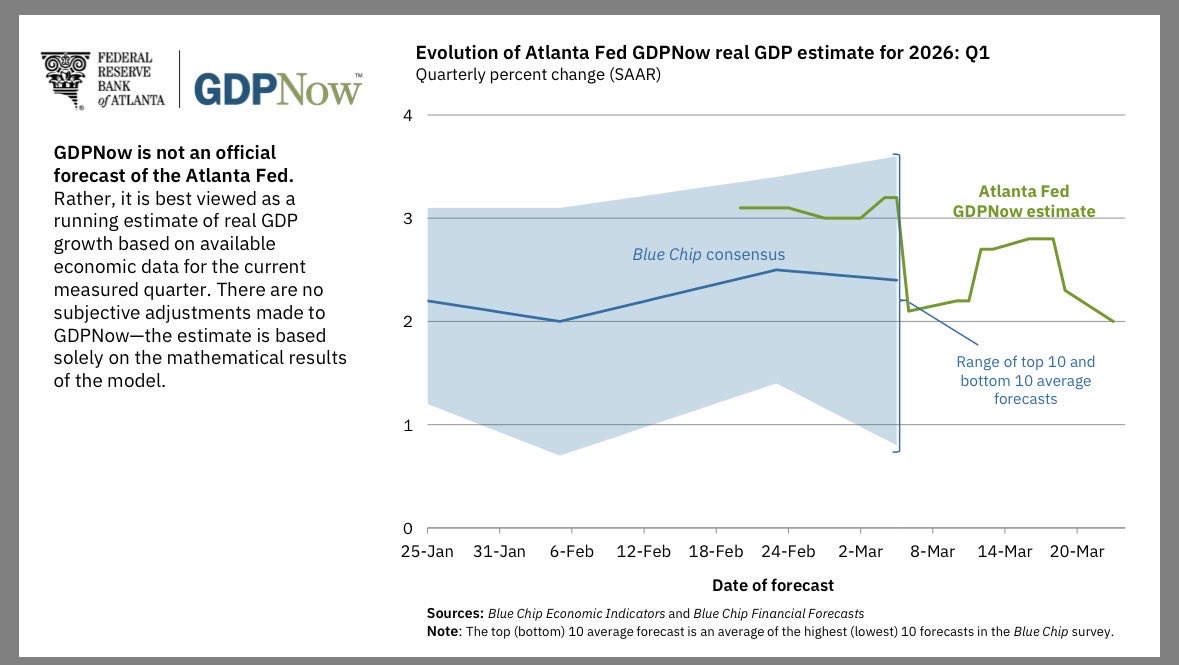
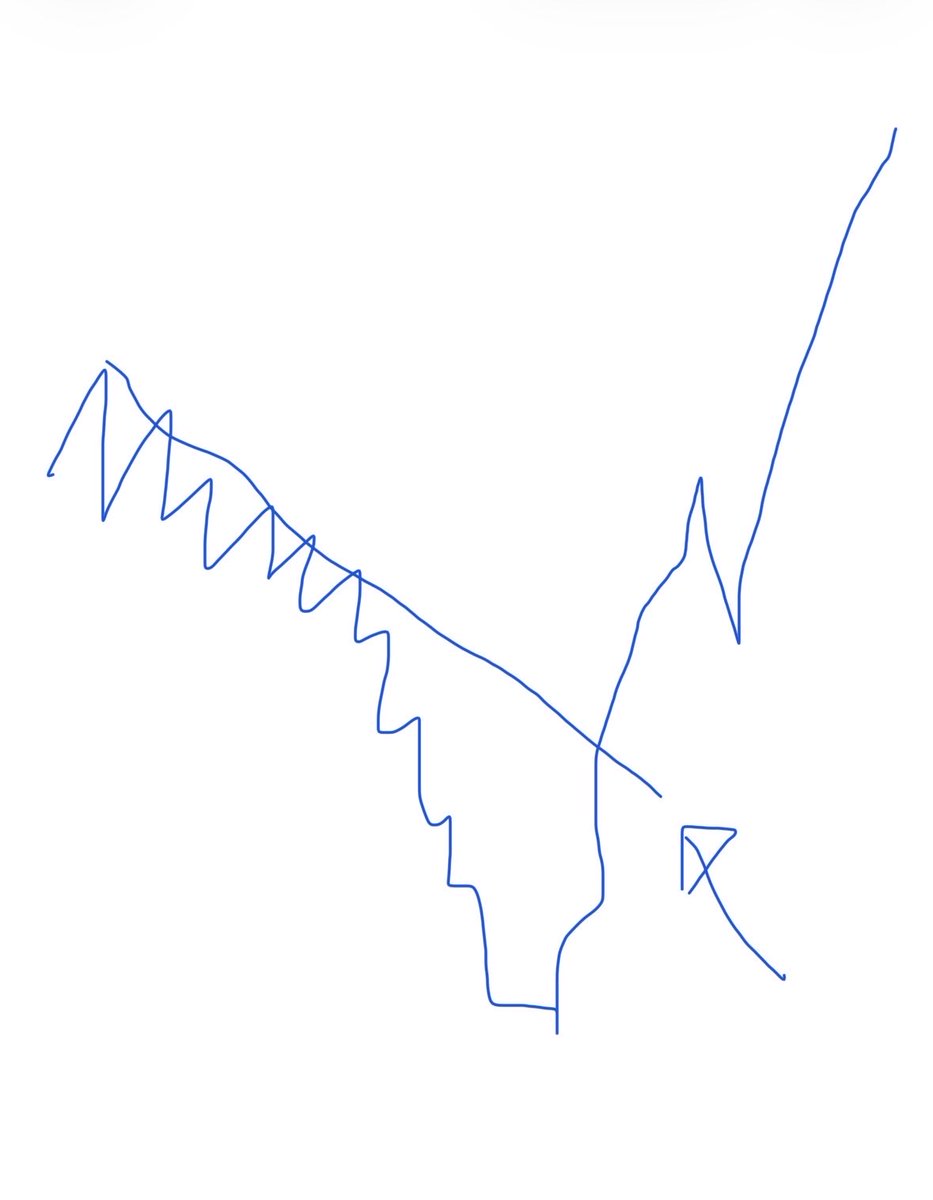
Atlanta Fed GDPNowcast prob only useful growth indicator I look at. Eco growth is slowing down by a 1% or so yoy, oil shock can’t be good at this point, AI revolution leading to tech layoffs. There’s enough there to anticipate a 2022 style orderly choppy bear. Or another 5-10% or so from here on indices. At same time so many growth stocks are already zeroed that I’m open to a BARR -setup style reclaim too. All in all, evidence points to the usual “there are reasons for markets to go up, and down” lol. If we extend downside, mean reversion longs will become super attractive as the base case is we roll down surfing MAs, so even in an eventual decline, it will be full of SnapBacks so extensions down side are buyable. With Trump TACO dynamics at play, it raises the edge of M/R long setups other things being equal. If we start the V bounce, you want to avoid going short on bounces IF we reclaim 200day and definitely the declining 50day MA on $QQQ Given all of the above, the stupidest aka lowest edge approach seems to me to be shorting into weakness. Qs have actually surfed declining MAs on daily very well despite apparently headline noise and chop. Will watch that relationship with MAs for a change of character. The market currently is not in a state where downside volatility is so high that it warrants passing 4*+ long spots especially if you are prepared to be tactical with hold like D1-D2 big peel D3-5 exit, tho this may change. Crypto looks ominous. If I was bag holding that I would be feeling pretty sick right now. Not sure what it means for anticipating future price direction :)
PL tweet mediaPL tweet media
English
0
2
15
998
PL
PL@plevchen·
Tax that’s hard to kick is right lol. Re setup rating its combination of factors/features. For a long/ breakout: - if applicable, quality of catalyst - daily context (eg BO into fresh highs from neglect range vs BO into recent overhead supply zone) - relative strength of the stock vs group and market Stock “personality” / character: - (a) cleanliness / orderliness / linearity in the way it trades. Linearity is correlated with order vs randomness/chaos. Think lack of overlapping bars, clean looking vs choppy looking. - (b) stock relationship with its MAs : orderly vs chaotic / random - (c) historic follow through the stock has had from the setup in question. Some stocks put in clean moves from breakouts like $TSLA, other stocks put in clean moves from Undercuts & Reclaims or pullbacks. Think $NBIS.. if it’s about an EP and the catalyst is monumental, prior history can be disregarded. - VOLUME. - if applicable, relative strength of group vs market - how tight realistic set risk is relative to ATR - time of day Some factors are context and setup specific. Relative “rank” in importance of how the factors above apply is also non linear and setup / context specific . Eg Mean reversion criteria are different. I’m looking for a stock to be down more and more, ie relative weakness when extended on downside is better than strength. The edge in M/R comes from the extension itself, so you don’t care about relative strength you actually want it to be more extended on downside for a long but not orderly extended. And then as it’s turning up you want it to show relative strength on the burst higher. Eg higher low vs an undercut, adds to the quality. Similarly, in an orderly market correction you care about relative strength as an edge on longs. In a deep market correction that ends with a capitulation, you care about relative weakness as a better edge on longs. You can consider all of these as features that apply and interact in non linear ways depending on setup. It’s also important to think process and strategy vs hindsight. Eg recently $VCX parabolic short setup day 5 as it broke through VWAP is 5*+. But it ended up putting you underwater on entry and was difficult to carry overnight. The next day $VCX broke through PDL, it’s actually lower grade Parabolic D2 but it ended up working much better. It’s also interesting that besides $BYND since late last year, a lot of high grade parabolics ended up giving cleaner follow through on D2. So if this persists, the grading may require a revision. I personally believe your best guide is always First Principles Thinking. Focusing on how a factor fundamentally affects edge or quality of a setup, then paying attention to how it interacts with others. With this method you end up constructing something that you can reverse engineer back to foundations, and I believe it is more robust as an edge, something that can withstand changing market conditions and can evolve in the face of edge erosion we are all up against. A total black box hindsight driven approach, can over realise over short term samples but once it inevitably faces underperformance, it becomes difficult to see what adjustments one should make.
English
1
0
2
188
Aadl
Aadl@aadilomar·
@plevchen B/O are often the first setup a trader experiments with but then becomes tax that’s hard to kick. How do you grade your setups ie 4* vs 6*?
English
1
0
4
253
PL
PL@plevchen·
Anthropic acknowledges testing a new AI model representing a "step change" in capabilities after an accidental data leak revealed its existence, per Fortune. Leaked draft blog post refers to the model as "Claude Mythos" under a new tier called "Capybara" - larger and more capable than Opus. Company says it is "currently far ahead of any other AI model in cyber capabilities." Being trialed with early access customers. Nearly 3,000 unpublished assets were left in a publicly accessible data cache due to a CMS configuration error.
English
0
0
3
698
PL
PL@plevchen·
@aadilomar yes. action is attention in manifestation.
English
0
0
0
22
Aadl
Aadl@aadilomar·
@plevchen A bit tangential but have you thought about the relationship between attention/focus and manifestation? Attention leads to action which has the potential to reconfigure reality if you hit the right pressure points?
English
1
0
1
27
PL
PL@plevchen·
All of life is the study of attention. Where your attention goes, your life follows. - Jiddu Krishnamurti “Attention is all you need.” - 2017 seminal academic paper by Ashish Vaswani and Google Brain/Google Research team, which introduced the Transformer architecture, the “T” in the GPT model.
English
2
1
16
790
PL
PL@plevchen·
This is potentially a huge deal for AI related inference and RAM. AI models store a “cheat sheet” of info shared with them via a KV cache. On an LLM, that cache alone can eat up 40GB of GPU RAM, often more than the AI model itself. Google just published TurboQuant, a compression algorithm that shrinks this cache by 6x, down to just 3 bits per value, with zero accuracy loss across every benchmark tested. No retraining. No fine-tuning. Drop-in replacement. Whilst I think Jaevons paradox dynamics apply here, and this just means demand for compute completely sky rockets as it’s entirely supply constrained, it could be a short term “excuse” to dump memory stocks?
Google Research@GoogleResearch

Introducing TurboQuant: Our new compression algorithm that reduces LLM key-value cache memory by at least 6x and delivers up to 8x speedup, all with zero accuracy loss, redefining AI efficiency. Read the blog to learn how it achieves these results: goo.gle/4bsq2qI

English
1
0
10
1.5K
PL รีทวีตแล้ว
Google Research
Google Research@GoogleResearch·
Introducing TurboQuant: Our new compression algorithm that reduces LLM key-value cache memory by at least 6x and delivers up to 8x speedup, all with zero accuracy loss, redefining AI efficiency. Read the blog to learn how it achieves these results: goo.gle/4bsq2qI
GIF
English
1K
5.8K
39K
19.2M
PL รีทวีตแล้ว
roon
roon@tszzl·
common pattern: have an idea, make a horrifically messy implementation of it, see that it’s promising, and then spend twice as much time “cleaning it up” and “doing it right” only to realize you got 80% of what you were going to get out of it the first time
English
87
50
1.4K
61.3K