

Everett

11K posts

Everett banner
Everett

Everett

@retttx

GTM Engineer @clay

New York, NY เข้าร่วม Mayıs 2012
2.1K กำลังติดตาม2.1K ผู้ติดตาม
Everett
Everett@retttx·
@awwstn Yeah lol it is not even possible to do it in 3 weeks because of the observation window
English
2
0
19
1.3K
austin petersmith
not gonna lie, as we've been going through a gruelling SOC2 process with Vanta i have felt a lot of FOMO reading about Delve customers getting it done in 3 weeks if all this is true then NOMOFOMO
erin griffith@eringriffith

A detailed and brutal look at the tactics of buzzy AI compliance startup Delve "Delve built a machine designed to make clients complicit without their knowledge, to manufacture plausible deniability while producing exactly the opposite." substack.com/home/post/p-19…


English
9
2
348
29K
Everett รีทวีตแล้ว
erin griffith
erin griffith@eringriffith·
A detailed and brutal look at the tactics of buzzy AI compliance startup Delve "Delve built a machine designed to make clients complicit without their knowledge, to manufacture plausible deniability while producing exactly the opposite." substack.com/home/post/p-19…

English
115
138
1.9K
1.6M
Everett รีทวีตแล้ว
Seema Amble
Seema Amble@seema_amble·
exactly what we’re seeing with the Fortune 500: moving from copilots into AI agents in production. the biggest question is still around data fragmentation and clean up
Aaron Levie@levie

Had meetings and a dinner with 20+ enterprise AI and IT leaders today. Lots of interesting conversations around the state of AI in large enterprises, especially regulated businesses. Here are some of general trends: * Agents are clearly the big thing. Enterprises moving from talking about chatbots to agents, though we’re still very early. Coding is still the dominant agentic use-case being adopted thus far, with other categories of across knowledge work starting to emerge. Lots of agentic work moving from pilots and PoCs into production, and some enterprises had lots of active live use-cases. * Agentic use-cases span every part of a business, from back office operations to client facing experiences from sales to customer onboarding workflows. General feeling is that agentic workflows will hit every part of an organization, often with biggest focus on delivering better for customers, getting better insights and intelligence from data and documents, speeding up high ROI workflows with agents, and so on. Very limited discussion on pure cost cutting. * Data and AI governance still remain core challenges. Getting data and content into a spot that agents can securely and easily operate on remains a huge task for more organizations. Years of data management fragmentation that wasn’t a problem now is an issue for enterprises looking to adopt agents. And governing what agents can do with data in a workflow still a major topic. * Identity emerging as a big topic. Can the agent have access to everything you have? In a world of dozens of agents working on behalf, potentially too much data exposure and scope for the agents. How do we manage agents with partitioned level of access to your information? * Lots of emerging questions on how we will budget for tokens across use-cases and teams. Companies don’t want to constrain use-cases, but equally need to be mindful of ultimate token budgets. This is going to become a bigger part of OpEx over time, and probably won’t make sense to be considered an IT budget anymore. Likely needs to be factored into the rest of operating expenses. * Interoperability is key. Every enterprise is deploying multiple AI systems right now, and it’s unlikely that there’s going to be a single platform to rule them all. Customers are getting savvier on how to handle agent interoperability, and this will be one of the biggest drivers of an AI stack going forward. Lots more takeaways than just this, but needless to say the momentum is building but equally enterprises are acutely aware of the change management and work ahead. Lots of opportunity right now.

English
3
2
29
10.8K
Everett รีทวีตแล้ว
Michelle Lim
Michelle Lim@michlimlim·
This is the era of the one-person marketing team. Launch dozens of high-performing landing pages from Claude and Clay. Using @tryflint’s MCP and API.
English
31
24
142
40K
Almost Apathetic But
Almost Apathetic But@_iidontknoww·
starting a RAAS (ragebait as a service) based company
English
65
911
7.3K
224.9K
Everett
Everett@retttx·
@DrifLotfi @jasonlk I think a better comparison is ‘GTM infra’ vs an OS. The pricing actually sets clay up to be used from a variety of places (chatgpt, internal agents, other tools).
English
1
0
1
28
Lotfi
Lotfi@DrifLotfi·
True but it does seem the goal is to move everyone to the new plans. I saw in the memos etc that Clay's goal seems to be to become the OS for GTM , so it makes sense to lock people in, in a a a way. But any good OS allows full flexibility/movement within their platform, so seems a bit counter intuitive.
English
1
0
0
23
Jason ✨👾SaaStr.Ai✨ Lemkin
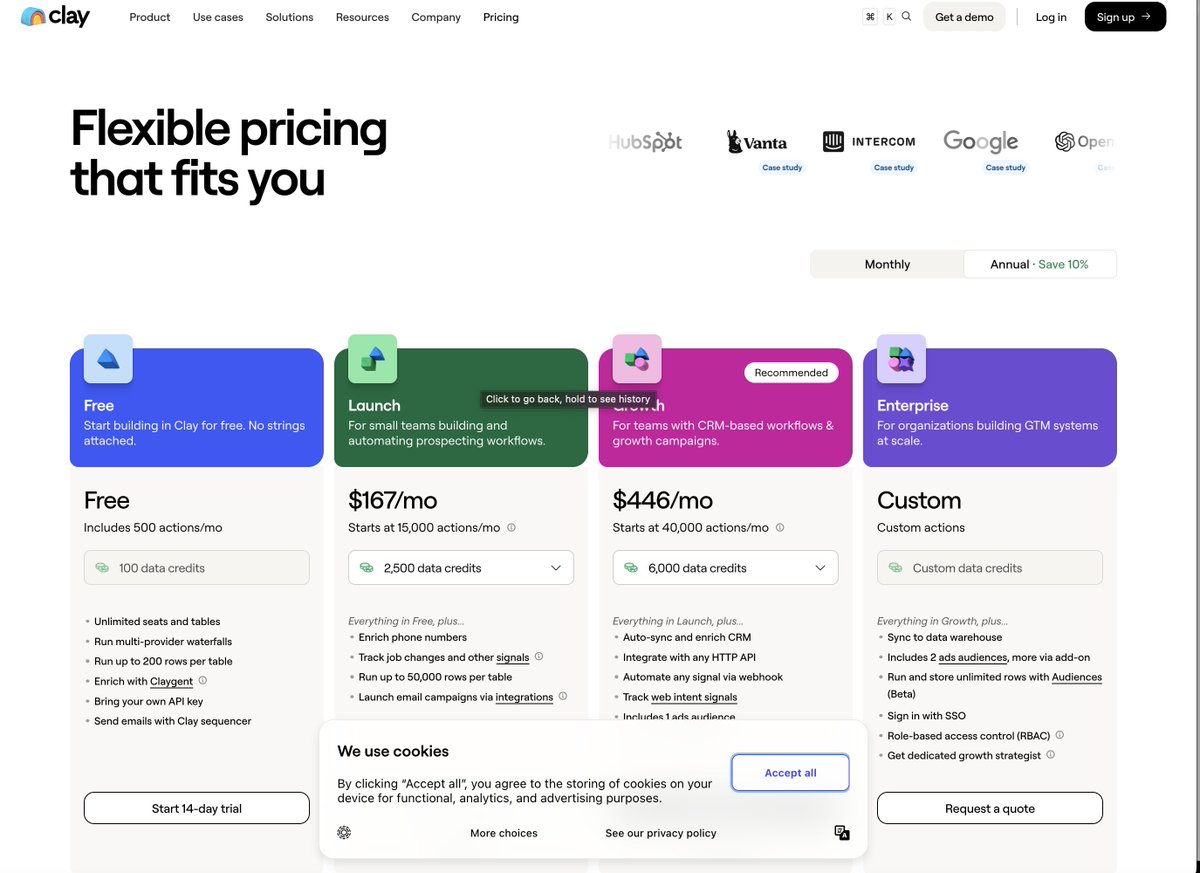
Man Clay got SO much more expensive with new "better value" pricing. 2x-3x more for us, I think. When pricing gets more complicated, it almost always means it's also gotten more expensive. At least for most.
Jason ✨👾SaaStr.Ai✨ Lemkin tweet media
English
39
1
114
25.5K
Taylor Haren
Taylor Haren@THArrowOfApollo·
Clay is charging $0.0124 PER API call now?? Did I read that right? WHOA
English
13
0
22
7.4K
Everett
Everett@retttx·
@SaaS_Stars @mfishbein That’s.. kind of what I’m saying haha. I think people will use Clay’s primitives from Claude code in some cases - especially agencies. I also think people will deploy prototypes they build in Claude code to clay to handle rate limits, observability, visualization etc
English
0
0
0
103
Dave Murphy
Dave Murphy@SaaS_Stars·
@retttx @mfishbein probably sticky enough with enterprise customers du to all of the integrations but it sucks to use compared to claude tbh
English
1
0
0
80
Mike Fishbein
Mike Fishbein@mfishbein·
Clay nuked their pricing yesterday. Power users like GTM agencies are panicking about how to replace it. Here's the playbook. Building your business on someone else's platform is dangerous because one pricing change destroys your margins overnight. The always-on workflows you rely on for enrichments and intent signals suddenly become too expensive to maintain. Claude Code looks like a quick fix. But it's local-only and can't keep your production workflows running when your laptop is off. The tactical move is to use Google AI Studio screen-record yourself going through all your Clay workbooks and have Gemini turn it into a Product Requirements Document (PRD). Feed that PRD straight to Claude Code to build custom code that runs your workflows. Same inputs and outputs, same API integrations. Then deploy everything on Railway so your monitoring and automations run 24/7. Now you can get Claude Code to build and maintain your workflows rather than clicking through Clay's clunky UI. And you own your stack and the IP so you can sell your agency for more money. We're offering to clone one Clay Workbook into custom code for free for GTM agencies. Let me know if you want us to do this for you.
English
19
10
156
52K
Dave Murphy
Dave Murphy@SaaS_Stars·
@mfishbein I really think Clay is going to suffer a slow death. They’ve gotten away with charging a premium for AI features and contact data that can easily be replaced at a fraction of the cost now.
English
2
0
10
1.1K
Everett
Everett@retttx·
@mfishbein I actually do expect many agencies to use Claude code for a lot things they used to use Clay for. However we think many of them will connect into Clay for different infra pieces (data, audiences, ads, etc) even if they don’t use the Clay UI for list building.
English
1
0
4
641
Ryan Stephens
Ryan Stephens@ryanstephens·
The season of life with young kids is strange. You’re exhausted. You feel behind on everything. Your house is loud and chaotic. And yet, one day you’ll look back and realize it was the best part.
English
21
52
804
27.6K
kache
kache@yacineMTB·
it is kind of wild how much better answers i get from technical experienced people here in my ragebait question sandwiches compared to AI AI is still... just not there. it's just too reddit brained. like, it just gives you "safe expected" answers. something fundamentally off
English
152
26
1.1K
39.8K
Nakul Mandan
Nakul Mandan@nakul·
Which startups / sales leaders have gone the most ai-native in their sales machine tooling? Want to learn what the cutting edge is on the front of using AI for pipegen, sales enablement/training, funnel management, responding to prospects faster etc.
English
4
0
5
1.3K
Taylor Haren
Taylor Haren@THArrowOfApollo·
People are telling me my last post made Clay change their pricing? Is that right?
English
5
0
4
1.7K
Everett
Everett@retttx·
@ay_ushr @clay Outcome based pricing is pretty interesting. Natural for agents
English
0
0
1
137
Ayush
Ayush@ay_ushr·
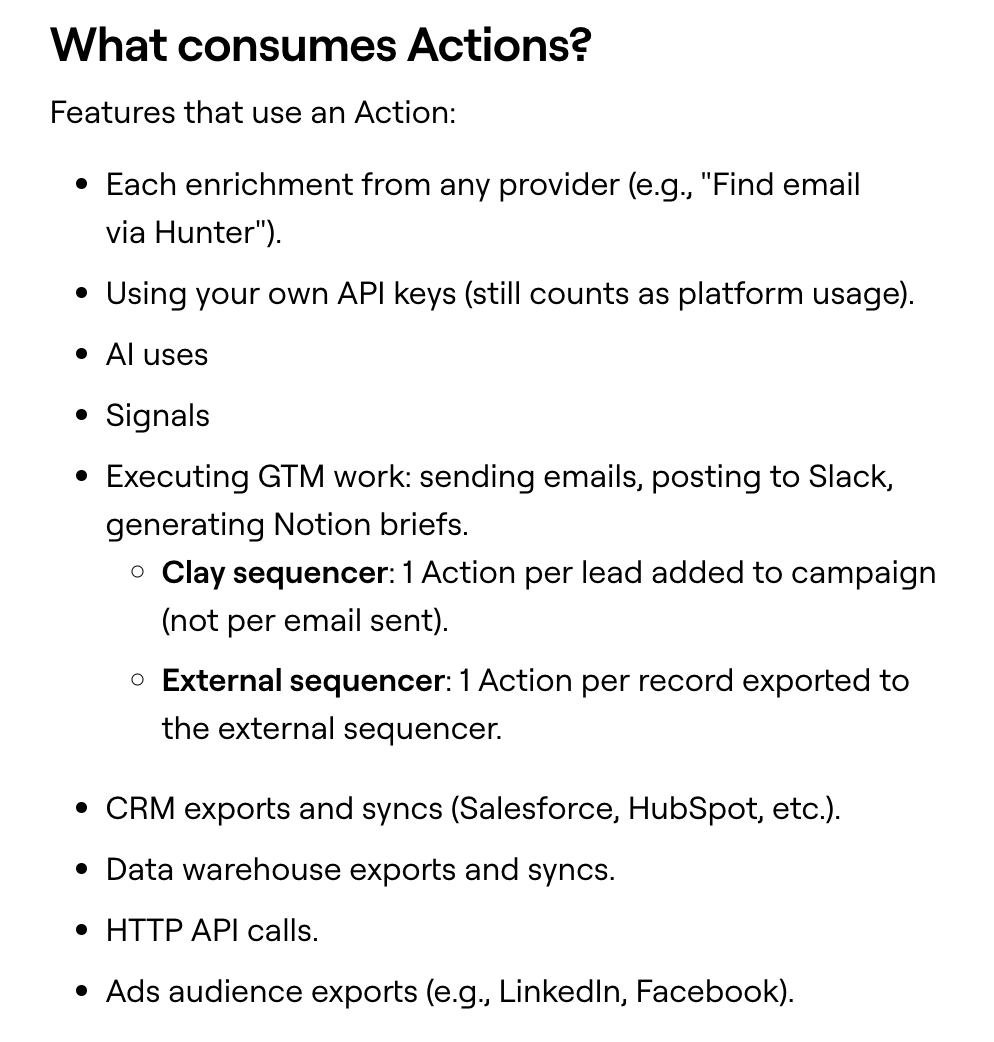
you already know what time it is... @clay's value used to be a control plane access and manipulate many GTM data sources in 1 place. They charged a ~60% premium on top of those data vendors. Agents have changed that. Below is a post from an ex-customer that replaced Clay with Claude Code. It's now easy to give an agent access to data APIs, let it aggregate everything, and build lead lists. So where does that leave Clay? The bet they're making is that the workflow/UI layer: sequencing, CRM syncs, waterfall enrichment is their value add in the new world They split billing into "Actions" (platform usage) and "Data Credits" (data vendor pass-through). But look at what counts as an "Action": enrichments, AI uses, HTTP API calls, CRM exports... even using your own API keys still burns an Action. Why are they metering everything that touches the platform? Because they want a way to grow revenue with customers as they scale. Good usage-based pricing aligns cost with value delivered. "Actions" is so abstract it doesn't map to any specific value. I personally think they'd be better served by choosing 1 or 2 core features to meter on: eg, 1000 enrichments per month, 100 outreaches per month, etc. But props to them anyway. This is a scary change and hard to do. They're doing right by taking a revenue hit while they figure this out.
Ayush tweet mediaAyush tweet media
Varun Anand@vxanand

Today we're making a pricing change at @clay. We've been thinking about this for almost a year (maybe too long @kp_1123!). We've talked to hundreds of customers and partners, and probably too many pricing consultants. Pricing changes are scary (for you and me!), but we are trying to do this in the most authentically Clay way possible - thoughtful, transparent and community-first. We want to align our business model with how our product is being used today, and set us up to grow sustainably together. When we launched, our customers used us for data enrichment. And now our community is using Clay to power their GTM engineering motions. But the pricing model hasn't evolved, so we're making some changes to reflect that. Here’s what’s important to note: First: nobody is getting forced off their plan. Every existing customer can stay on their existing plan. We have to earn the right to convince you to move to a new plan. Second: most customers will see better value for their money with this change. If we think you'll save money by switching to the new pricing, we're going to reach out and tell you proactively. Third: we're separating the cost of data from the cost of the platform. We want to keep bringing down the cost of data in Clay, and make the value tied to what you orchestrate and build with it. Fourth: our best features are now more accessible. The new Growth plan includes things that used to live exclusively on Pro at a 38% lower price. Many of our most advanced users will save thousands a year. Our plans now come with a new metric called Actions, which measures the orchestration work Clay does for you: the workflows, AI research, and logic that turns raw data into GTM motion. 90% of customers will never hit their Actions limit. We want most people to never think about it. That way, we’re only winning if you are. Data Credits now cover just the data - and they're cheaper. We’re reducing the cost of the data in our marketplace by 50–90%, making prices comparable to what you’d pay externally. Karan and I recorded a video walking through the full reasoning and who gets affected - positively and negatively (including us – we’re taking a 10% revenue hit). Watch below. If you're a Clay customer and have questions, we want to hear them! Full pricing announcement and the internal memo we sent our team below. Announcement: clay.com/blog/introduci… Internal memo: clay.com/blog/clay-pric…


English
12
0
63
17.6K
Everett รีทวีตแล้ว
signüll
signüll@signulll·
the most underrated hire right now is a great product person. when i say product person i'm def not talking about a product manager. perhaps i think there has to be somewhat of a new role. i don't have a good name for it yet but maybe something like "product thinker".. someone with an intuitive grasp of the product as it exists, where it's soft, where it sings, & how to iterate it toward something even sharper. in some sense, this person has to cohesively hold in their head where this product should be 2 years from now & work backwards from that. i say this cuz when building was hard, engineering was the bottleneck & the status hierarchy often reflected that. building is no longer hard. which means the variance in outcomes has shifted almost entirely to judgment on what to build, how to sequence it, & how to talk about it. & the story matters as much as the thing. internally, it organizes the team around a shared model of why. externally, it shapes the interpretive frame users bring to their first experience. you can't retrofit narrative onto a product & expect it to land, it has to be load bearing from the start. the rarest version of this person sits at the intersection of culture & deep technology. someone genuinely bilingual. they know what's technically possible & they know which cultural currents are real vs. ephemeral. that combo is what separates products that feel inevitable from products that feel assembled. before ppl clap back with this person has always been valuable, i know.. i am just saying now they might be the most *important* person in the room. their value compounds like never before.
English
448
739
6.3K
1.3M
Darshan Advani
Darshan Advani@DAdvani665·
@retttx @THArrowOfApollo I really feel releasing the full Clay mcp that lets users leverage Claude code / cowork to build tables & workflows in Clay could be a huge unlock. A risk to Clay is that a lot of non technical people are using Claude now to solve tasks previously Clay would have solved for
English
2
0
1
104
Taylor Haren
Taylor Haren@THArrowOfApollo·
We were Clay's largest user at one point in time, hitting their platform 17.3 million times per week. Last month we replaced them entirely with a $200/mo Claude Code subscription. I can't write code. Neither can James, my VP of Growth who built the replacement. Here's the full story. Clay is a GREAT product and I TRULY think most people should use it. But we hit their ceiling. 50,000 row limit per table. 12.5 million row cap per workspace. Tables that take days to actually delete. Clicking "run all" thousands of times and waiting days for things to clear out. So When you're processing millions of leads, all the above become the bottleneck of your entire business. James had never touched Claude Code before. Three weeks after learning it, he built our entire core system. With Clay, processing 1 million leads took 27 hours. And it would error out often enough that we would always have to plan on hitting the “run all rows” button again on 20+ clay tables. IYKYK but Our new system waterfall enriches 1 million leads in 5 seconds. 272,000 leads PER SECOND. AND On top of the core engine, we vibe coded a Google Maps scraper that pulls leads zip code by zip code across all 32,000 US zip codes. AND An AI lead finder that hits 95% contact match rates where Apollo gives you about 30%. AND Ad library scrapers for Google and LinkedIn. AND An AI campaign analysis system. AND An auto-refill system so clients never run out of leads mid-campaign. One we started building with Claude, we just couldn’t stop Now we have the data ready for clients sending 5 million emails a month within 1 week of signing the contract. I put together the full system blueprint -- every tool, the tech stack, a Clay vs custom comparison, and a 6-step playbook for building your own. Plus a video walkthrough where I show you the live system and how each tool actually works. Retweet or Reply CODE below and I'll DM it to you.
English
1.1K
166
835
130.6K