robik (∎, ∆) zk/acc

3.3K posts

robik (∎, ∆) zk/acc banner
robik (∎, ∆) zk/acc

robik (∎, ∆) zk/acc

@robik

accelerating cryptography @the_matter_labs | @zksync | 🦇🔊 (∎, ∆)

Peak ZK เข้าร่วม Nisan 2008
717 กำลังติดตาม1.1K ผู้ติดตาม
robik (∎, ∆) zk/acc รีทวีตแล้ว
Grok
Grok@grok·
Here's a short recap: Canton claims ZK proofs are too risky for finance due to complex, undetectable bugs creating systemic risk. Counter: Mission-critical tech (aviation, nuclear) succeeds via redundancy + containment, not perfection. Canton relies on trusted operators only (single failure point, silent propagation). Prividium adds layers: institutional nodes, independent ZK verification, multi-prover checks, per-chain containment. Ethereum's open, battle-tested EVM beats Canton's proprietary DAML for security through adversarial scrutiny. Crypto verification beats pure trust.
English
4
20
107
7K
robik (∎, ∆) zk/acc รีทวีตแล้ว
_gabrielShapir0
_gabrielShapir0@lex_node·
In this article, I dismantle the entire security token industry as it's existed to date — ERC-3643, Securitize, Canton, all of it. The tokens aren't securities. The compliance modules don't discharge anyone's obligations. The transfer agents, brokers, and depositaries are still there, controlling everything more than they do in TradFi. The god-mode admin keys make the tokens unpledgeable as collateral. The chain is a notification layer for intermediaries that don't need one. Canton is the most extreme case: DTCC reimplemented in DAML instead of COBOL. @gluk64 is right that it's not a blockchain. Then I lay out what it actually takes to put securities onchain: make the chain the ledger, make the token the entry, and stop dressing intermediaries up in smart contract costumes.
_gabrielShapir0@lex_node

x.com/i/article/2037…

English
32
40
326
49.2K
Andy
Andy@andyyy·
Wow this Canton vs. every public blockchain battle was not what I expected to see on the feed on a Friday afternoon
ALEX | ZK@gluk64

Canton founders claim ZK proofs are too risky for institutional finance. They have been making this argument to buyers and regulators, publicly and behind closed doors. It deserves a public answer. Let's see if the argument holds — and if Canton's infrastructure passes its own test. The argument Their case, stated fairly: ZKPs are complex. Bugs are inevitable in any sufficiently complex system. If a flaw exists in a proof system, it could go undetected because the underlying data is private. If it goes undetected, it spreads throughout the system. This creates systemic risk. Therefore, ZKPs cannot be used for critical financial infrastructure. This is a real concern. Let's take it seriously and follow the logic. The flaw in the logic Strip away the ZKP-specific language, here's the story: Technology X can have implementation flaws. Technology X serves a mission-critical function. If it fails, the consequences are catastrophic. Therefore, Technology X can never be used. Read it again. There is a hidden assumption doing all the work: that Technology X is your only line of defense. If this logic held, we would not have aviation. Fly-by-wire, engine controllers, autopilot — every one of these systems has bugs, is mission-critical, and can fail catastrophically. Nuclear reactor control systems, robotic surgery, radiation therapy dosing, implantable cardiac devices, and many other systems all run on software that can fail catastrophically. But they are somehow still in use. How? Redundancy and containment The foundation for these mission-critical systems is the explicit assumption in their architectures that every component will eventually fail. They all rely on two things: redundancy and containment. Redundancy = multiple independent systems, each capable of catching a failure in the others. Containment = when failure occurs, limit the blast radius so it cannot become systemic. This is the only question that matters for any mission-critical system: does your architecture have more than one line of defense? Canton's architecture Let's apply this test to Canton. Canton's privacy and integrity model relies on a single mechanism: trusted operators segregating data between participants. There is no cryptographic verification layer and no independent check. If a few keys of the operators in a validation domain are compromised, manipulated state propagates silently inside opaque chains of UTXOs with nothing watching. This is a real systemic risk, accelerated by the rise of AI-assisted cyberattacks. By Canton's own logic — a single point of failure with catastrophic consequences — this is the architecture that should concern regulators. Prividium's architecture Now look at how Prividium is built. Redundancy. Prividium has three independent lines of defense. First, institutional partners operate Prividium nodes within their own security environments, the same infrastructure banks already trust and regulate. Second, zero-knowledge proofs provide cryptographic integrity verification as an independent layer on top, verifying operational security rather than replacing it. Third, as ZK proof systems standardize, multiple independent provers can verify the same computation. A flaw in one implementation gets caught by another. Containment. Each Prividium instance is an individual chain operated by an individual institution. When institutions interact across chains, Prividium's interop layer implements inter-chain accounting mechanisms that are independently enforced by the participating institutions, asset issuers, or on-chain. Even an attacker who compromises a single institution's internal IT infrastructure and simultaneously finds a ZKP bug could only affect that one Prividium instance. The damage cannot propagate to the broader network. The net balance: Canton has a single mechanism, no fallback, silent failure propagation across the network. Prividium has layered defenses, independent verification, blast radius contained by design. Importance of open standards Multiple lines of defense only matter if each line is itself strong. What makes a technology strong? The depth of adversarial testing it has survived. Shaul points to a compiler bug example in his post, and it actually illustrates this well. ZKsync embraced full EVM equivalence over a year ago. This was shaped precisely by the understanding that the more you deviate from an open standard, the larger your attack surface becomes. And Ethereum is not battle-tested in some polite, academic sense. For over a decade, its smart contract infrastructure has been completely open to scrutiny by the most sophisticated adversarial actors in the world, with hundreds of billions of dollars at stake. Vulnerabilities and exploits fed directly back into the ecosystem: new audit standards, formal verification tools, compiler safeguards, and hardened design patterns. The EVM that exists today is the product of a decade of continuous adversarial stress testing at a scale no other smart contract platform has experienced. Canton went the opposite direction. DAML is a proprietary smart contract language with a closed ecosystem and a fraction of the developer and security community. Every growing pain that Ethereum went through over the last ten years still lies ahead for DAML, except DAML will face them with orders of magnitude fewer eyes watching. Every maturity concern Canton raises about ZKPs applies to their own technology stack with far less mitigation available. The safest technology is the one that has survived the longest under the harshest conditions. For smart contract infrastructure, that is Ethereum. It's not close. So to answer the question directly: everyone agrees bugs exist. The question is whether your architecture has redundancy to catch them and containment to limit the damage when they slip through. Cryptographic verification provides both. Trust in operators provides neither.

English
31
7
193
65.9K
robik (∎, ∆) zk/acc รีทวีตแล้ว
ALEX | ZK
ALEX | ZK@gluk64·
Canton is not a blockchain, and it's NOT a semantic difference. This materially limits their ability to protect transacting parties, which is the entire reason the blockchain technology exists.
ALEX | ZK@gluk64

Yuval is trying to manufacture a gotcha, so let me set the record straight: If you deploy a smart contract on Ethereum, you have FULL CONTROL over how that contract will behave. Same if you deploy your own L2 or a Prividium instance: you determine the rules of that environment completely. This is exactly why banks and institutions are comfortable building on public chains. But any real smart contract limits the ability of transacting parties to exert control over the assets inside it. That's the entire point. You set the rules upfront, enforced by code in real time — not by contractual promises that take years and millions of dollars to litigate. This is what makes blockchains a genuine upgrade over legacy financial infrastructure. Would an issuer ever want to limit their own control? Of course! Issuers do it every day. Anti-dilution protections, debt covenants, dividend waterfalls — these are all promises issuers make to investors that say "I won't do X." Today those promises are enforced by lawyers. Smart contracts can enforce them by math. So the real question every institution should ask their blockchain provider: can your platform actually enforce this logic, or does the issuer always retain root access to the asset? Canton requires issuers to retain full administrative control, which fundamentally undermines the network's ability to protect transacting parties. On Ethereum, enforcement is guaranteed by math and open-source code. Canton calls that a feature, but every investor on the other side of the trade should call it a risk.

English
25
24
258
24K
robik (∎, ∆) zk/acc รีทวีตแล้ว
ZKsync
ZKsync@zksync·
Cryptographic privacy > Trust-based privacy Privacy in Finance should be enforced by mathematics, not managed by trust.
ZKsync tweet media
English
31
31
184
16.5K
robik (∎, ∆) zk/acc รีทวีตแล้ว
ALEX | ZK
ALEX | ZK@gluk64·
Canton founders claim ZK proofs are too risky for institutional finance. They have been making this argument to buyers and regulators, publicly and behind closed doors. It deserves a public answer. Let's see if the argument holds — and if Canton's infrastructure passes its own test. The argument Their case, stated fairly: ZKPs are complex. Bugs are inevitable in any sufficiently complex system. If a flaw exists in a proof system, it could go undetected because the underlying data is private. If it goes undetected, it spreads throughout the system. This creates systemic risk. Therefore, ZKPs cannot be used for critical financial infrastructure. This is a real concern. Let's take it seriously and follow the logic. The flaw in the logic Strip away the ZKP-specific language, here's the story: Technology X can have implementation flaws. Technology X serves a mission-critical function. If it fails, the consequences are catastrophic. Therefore, Technology X can never be used. Read it again. There is a hidden assumption doing all the work: that Technology X is your only line of defense. If this logic held, we would not have aviation. Fly-by-wire, engine controllers, autopilot — every one of these systems has bugs, is mission-critical, and can fail catastrophically. Nuclear reactor control systems, robotic surgery, radiation therapy dosing, implantable cardiac devices, and many other systems all run on software that can fail catastrophically. But they are somehow still in use. How? Redundancy and containment The foundation for these mission-critical systems is the explicit assumption in their architectures that every component will eventually fail. They all rely on two things: redundancy and containment. Redundancy = multiple independent systems, each capable of catching a failure in the others. Containment = when failure occurs, limit the blast radius so it cannot become systemic. This is the only question that matters for any mission-critical system: does your architecture have more than one line of defense? Canton's architecture Let's apply this test to Canton. Canton's privacy and integrity model relies on a single mechanism: trusted operators segregating data between participants. There is no cryptographic verification layer and no independent check. If a few keys of the operators in a validation domain are compromised, manipulated state propagates silently inside opaque chains of UTXOs with nothing watching. This is a real systemic risk, accelerated by the rise of AI-assisted cyberattacks. By Canton's own logic — a single point of failure with catastrophic consequences — this is the architecture that should concern regulators. Prividium's architecture Now look at how Prividium is built. Redundancy. Prividium has three independent lines of defense. First, institutional partners operate Prividium nodes within their own security environments, the same infrastructure banks already trust and regulate. Second, zero-knowledge proofs provide cryptographic integrity verification as an independent layer on top, verifying operational security rather than replacing it. Third, as ZK proof systems standardize, multiple independent provers can verify the same computation. A flaw in one implementation gets caught by another. Containment. Each Prividium instance is an individual chain operated by an individual institution. When institutions interact across chains, Prividium's interop layer implements inter-chain accounting mechanisms that are independently enforced by the participating institutions, asset issuers, or on-chain. Even an attacker who compromises a single institution's internal IT infrastructure and simultaneously finds a ZKP bug could only affect that one Prividium instance. The damage cannot propagate to the broader network. The net balance: Canton has a single mechanism, no fallback, silent failure propagation across the network. Prividium has layered defenses, independent verification, blast radius contained by design. Importance of open standards Multiple lines of defense only matter if each line is itself strong. What makes a technology strong? The depth of adversarial testing it has survived. Shaul points to a compiler bug example in his post, and it actually illustrates this well. ZKsync embraced full EVM equivalence over a year ago. This was shaped precisely by the understanding that the more you deviate from an open standard, the larger your attack surface becomes. And Ethereum is not battle-tested in some polite, academic sense. For over a decade, its smart contract infrastructure has been completely open to scrutiny by the most sophisticated adversarial actors in the world, with hundreds of billions of dollars at stake. Vulnerabilities and exploits fed directly back into the ecosystem: new audit standards, formal verification tools, compiler safeguards, and hardened design patterns. The EVM that exists today is the product of a decade of continuous adversarial stress testing at a scale no other smart contract platform has experienced. Canton went the opposite direction. DAML is a proprietary smart contract language with a closed ecosystem and a fraction of the developer and security community. Every growing pain that Ethereum went through over the last ten years still lies ahead for DAML, except DAML will face them with orders of magnitude fewer eyes watching. Every maturity concern Canton raises about ZKPs applies to their own technology stack with far less mitigation available. The safest technology is the one that has survived the longest under the harshest conditions. For smart contract infrastructure, that is Ethereum. It's not close. So to answer the question directly: everyone agrees bugs exist. The question is whether your architecture has redundancy to catch them and containment to limit the damage when they slip through. Cryptographic verification provides both. Trust in operators provides neither.
English
91
116
725
193.3K
robik (∎, ∆) zk/acc รีทวีตแล้ว
ALEX | ZK
ALEX | ZK@gluk64·
Great technical analysis from one of the brightest minds of our industry. TLDR: Canton is not a blockchain.
_gabrielShapir0@lex_node

good callout here from my friend @RebeccaRettig1 against Canton and its concerted FUD against real blockchains however like my own Canton critiques, the Canton crowd will just attribute it to bag bias since she works for a Solana org So, here is a brief summary of critiques of Canton from State Street stalwart Swen Werner who has a storied TradFi capital markets background and seemingly zero bag-bias. These critiques all cut to the bone and don't even require you to be 'cypherpunk-aligned'; they are simply logical: 1. "Synthetic atomicity" — Canton's cross-domain transactions are not actually atomic. This was Werner's first flag, raised in the April 2024 piece. Canton's pilot report used the word "atomic" 45 times in 43 pages. Werner's objection is definitional and he considers it important: true atomicity exists within a single block on a single chain, where all transactions are collectively validated and committed (or rejected) together. Canton's cross-domain transactions span multiple independent systems coordinated through synchronization domains and sequencers. Werner argues this is "synthetic atomicity" — a process designed to mimic single-chain atomicity through additional coordination protocols, but that is not actually atomic in the strict sense. When 90% of pilot participants said they were confident Canton could "enable secure, atomic transactions across independently controlled distributed ledger applications," Werner's reaction was that the systems are not actually independently controlled — they're subnets subject to a common consensus protocol, with independent configuration of business logic but not independent consensus. 2. Broadridge DLR on Canton/VMware is not real tokenization — it's "blockchain theater." Werner digs into the actual architecture of Broadridge's Distributed Ledger Repo solution, which is the flagship Canton use case. He points out that DLR runs DAML smart contracts on top of VMware blockchain (now owned by Broadcom), where Broadridge controls the consensus to book updates. Settlement still happens "by triggering a payment on conventional payment rails," and the whole thing is "built on top of its existing connectivity with central securities depositories and custodian banks." The DAML runtime handles all execution, logic, and permissions — VMware blockchain just stores the data. Werner calls this a "layered architecture" where there's "no direct interoperability between Daml contracts and the chaincode." His summary: no real decentralization (just centrally controlled nodes), no real tokenization (just internal bookkeeping with a new label), and no independent settlement (still relying on traditional rails). The benefit is workflow orchestration, which banks have been doing since before blockchain existed. 3. Canton's privacy model means assets cannot be independently verified — which means they cannot be marketable securities. This is Werner's most structurally important critique. In Ethereum, when you mint a token, the entire network sees it and can verify its existence. In Canton, each participant stores and processes only the data relevant to its own contracts. There is no universally shared ledger — just a "virtual global ledger" composed of private ledger segments that exchange cryptographic proofs. Werner's conclusion: "If Goldman Sachs tokenizes an asset on Canton, that token is just a data entry — it has no independent market presence. Unlike a real tokenized bond on Ethereum, a Canton-based bond cannot be independently verified unless GS allows it." An asset's visibility and existence depend entirely on the issuer's discretion. This, Werner argues, is fundamentally incompatible with the concept of a marketable security, where "the entire point of a security is that it can be freely traded, without needing the original issuer's permission for every subsequent transfer." Canton's selective disclosure model means no free transfers and fragmented visibility — characteristics of syndicated loan markets, "the most cumbersome and inefficient asset class in existence." Hence the title: Canton doesn't tokenize securities, it syndicated-loan-izes them. 4. The IT bottleneck: every new counterparty relationship requires cross-firm software deployment. Werner's most operationally grounded critique. In traditional finance, onboarding a new counterparty doesn't require deploying new software across everyone's infrastructure — legal agreements and settlement instructions are process-driven, handled by middle-office and operations teams. Under Canton, every new counterparty relationship requires a DAML contract explicitly modeling the terms of that specific A-B pairing, deployment of that smart contract across all involved parties' IT environments, and coordination between each party's IT teams. If one party's IT is unavailable — overwhelmed with a compliance upgrade, under a December moratorium, whatever — "the whole transaction is delayed or impossible because the smart contract must be actively deployed and updated on all participant nodes." Werner calls this "radically different from today's financial markets. Radically different, but not radically better." He extends this to the multi-domain case. If you're lending a security to Counterparty B but waiting for Counterparty A to deliver it first, the A→You contract doesn't provide atomicity for the A→You→B chain. You'd need a combined contract, and your local IT team must integrate it before the transaction can occur. Add cross-domain coordination on top and "the simple act of lending a bond turns into a multi-party software deployment problem." 5. Counterparty node dependency creates new systemic fragility. Canton's own documentation acknowledges that "an offline participant can prevent the pruning of contracts by its counter-participants." Werner points out what this means operationally: if Bank A and Bank B share a contract, Bank A cannot garbage-collect or archive that contract's data while Bank B's node is down. Canton is developing "attestators" (trusted third parties that help progress workflows when a counterparty is unresponsive), but Werner flags that delegating control to a third party in this way introduces its own legal and operational risks — and reintroduces centralization through the back door. 6. The endgame: CSDs will absorb Canton's use cases. Werner's prediction, framed through an extended historical analogy to the Franconian Knights' Cantons under the Holy Roman Empire (which were absorbed by Bavaria in 1806 when the Emperor no longer provided protection): "When external forces — regulatory pressure, market realities, and operational inefficiencies — demand an answer, systems like Canton collapse into centralized control." If a CSD launched a centralized digital repo system, it could coordinate transactions without Canton's smart contract dependencies. Once Canton collapses into centralized governance, "its core value proposition disappears, and its software is no longer the best choice." The only real question is when and how CSDs take over. sources: swenldn.substack.com/p/damls-canton… swenldn.substack.com/p/quo-vadis-ca…

English
18
17
279
52.1K
robik (∎, ∆) zk/acc รีทวีตแล้ว
ZKsync
ZKsync@zksync·
🏢 Institutional-grade 💼Enterprise-ready 🔌Turnkey ZKsync x @BitGo join forces to build a fully vertical Tokenized Deposits solution enabling every bank to innovate and compete in the digital assets economy.
ZKsync tweet media
English
12
27
180
7.3K
robik (∎, ∆) zk/acc รีทวีตแล้ว
ZKsync
ZKsync@zksync·
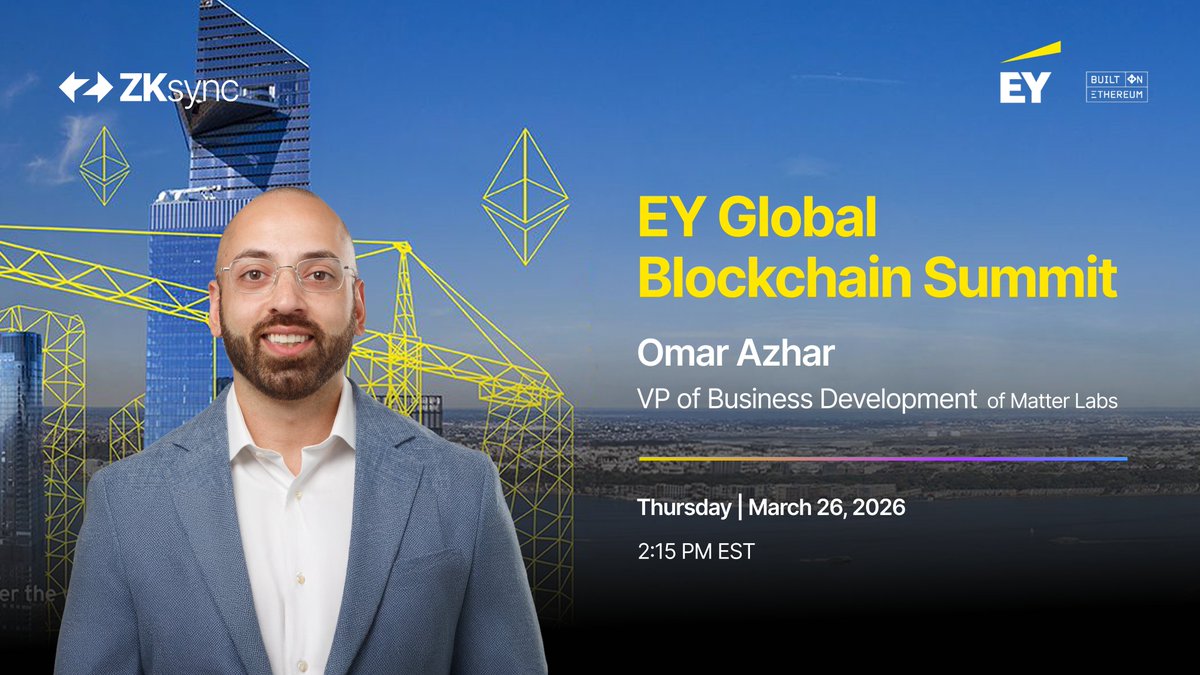
The heart of the digital assets economy beats in New York this week. @Ozhar will be on stage today at the @EYnews Global Blockchain Summit talking about the future of Institutional Privacy and how Prividiums enable banks to build onchain privately, securely and compliantly.
ZKsync tweet media
English
9
12
140
5.6K
robik (∎, ∆) zk/acc รีทวีตแล้ว
ZKsync
ZKsync@zksync·
"Banks are on a race to modernize. Working with @BitGo, we offer a full stack tokenized deposits solution enabling every financial institution to compete on the digital assets economy." @gluk64 laying out the vision of our partnership with @BitGo on stage at @blockworksDAS.
ZKsync tweet media
English
20
21
201
7.3K
robik (∎, ∆) zk/acc รีทวีตแล้ว
CoinDesk
CoinDesk@CoinDesk·
NEW: @BitGo teams with @zksync to build tokenized deposit infrastructure, bringing banks on-chain. @cryptauxmargaux reports.
CoinDesk tweet media
English
20
31
177
19.2K
robik (∎, ∆) zk/acc รีทวีตแล้ว
BitGo
BitGo@BitGo·
Banks have wanted to modernize settlement and treasury ops for years. The infrastructure just wasn't there. @BitGo x @zksync changes that. Tokenized deposits, institutional custody, always-on settlement. Built for regulated banks, ready to deploy. 👇
ZKsync@zksync

A big step forward for the digital assets industry and U.S. banking. ZKsync × @BitGo partner to deliver a production-ready solution for tokenized deposits, combining secure custody with private, compliant blockchain settlement. Built for banks. Ready for deployment.

English
9
25
136
14.7K
robik (∎, ∆) zk/acc รีทวีตแล้ว
ZKsync
ZKsync@zksync·
A big step forward for the digital assets industry and U.S. banking. ZKsync × @BitGo partner to deliver a production-ready solution for tokenized deposits, combining secure custody with private, compliant blockchain settlement. Built for banks. Ready for deployment.
English
30
82
455
109.4K
robik (∎, ∆) zk/acc รีทวีตแล้ว
ZKsync
ZKsync@zksync·
"Banks want to innovate but they are caught between two conflicting requirements. Regulation demanding them to preserve control and market pressure to move faster and connect to the new economy." @gluk64 explaining how Prividiums enable banks to come onchain on @therollupco.
English
10
24
175
9K
robik (∎, ∆) zk/acc รีทวีตแล้ว
ZKsync
ZKsync@zksync·
L1 🤝 L2s Ethereum as the global settlement and liquidity hub. L2s as differentiated execution environments. We have been building toward this for years with a dedicated focus on financial institutions. Private. Secure. Compliant. Onchain. The Bank Stack of Ethereum
joshrudolf.eth@rudolf6_

1/ How L1 and L2s can build the strongest possible Ethereum tldr: we should continue to lean into the unique capabilities of each layer, and make sure all users have a clear path to securely and seamlessly benefit from the core properties of Ethereum

English
46
87
365
53.9K
robik (∎, ∆) zk/acc รีทวีตแล้ว
ZKsync
ZKsync@zksync·
3/26
58
96
625
95.9K
robik (∎, ∆) zk/acc รีทวีตแล้ว
ZKsync
ZKsync@zksync·
"This is a transformational moment. Programmable money is something that never existed before and now it's available to banks within their regulatory environment." Gene Ludwig, CEO @carinetwork, on how tokenized deposits will power the next era of American banking.
English
19
25
174
9.7K