Rob Gallo, MD

210 posts

Rob Gallo, MD

Rob Gallo, MD

@robjgallo

Research Fellow @Ci2iFellowship | Alum: @StanfordMedRes @WUSTLmed @WUSTL

Palo Alto, CA เข้าร่วม Ağustos 2018
929 กำลังติดตาม326 ผู้ติดตาม
Rob Gallo, MD
Rob Gallo, MD@robjgallo·
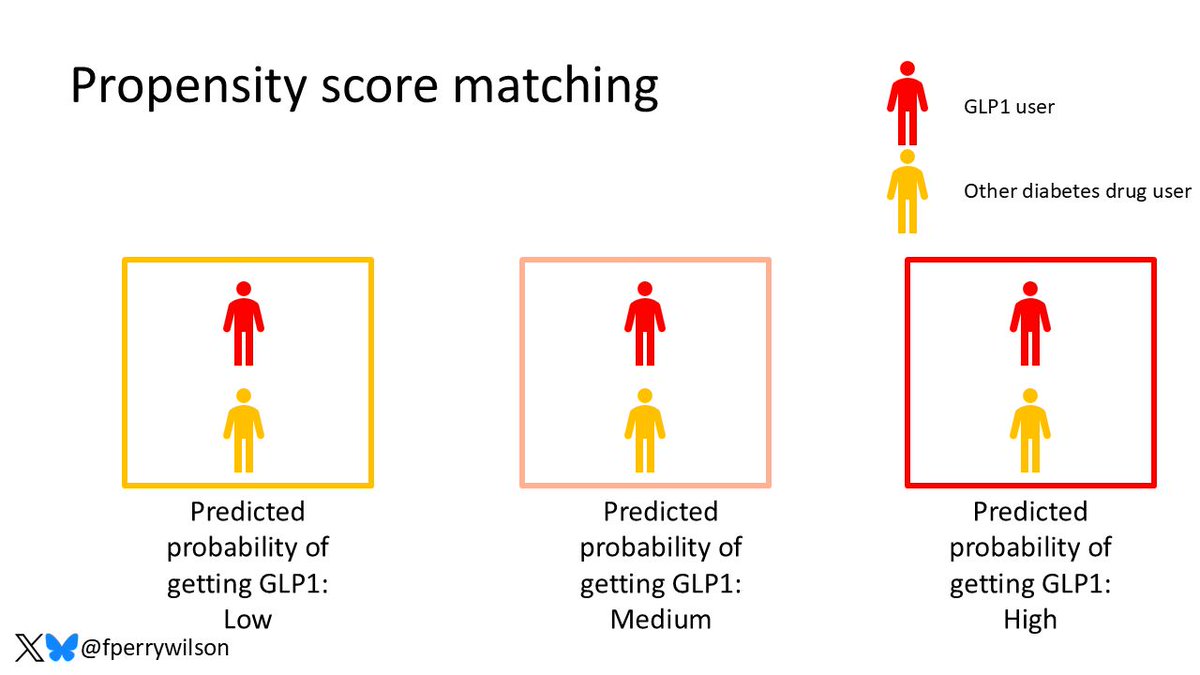
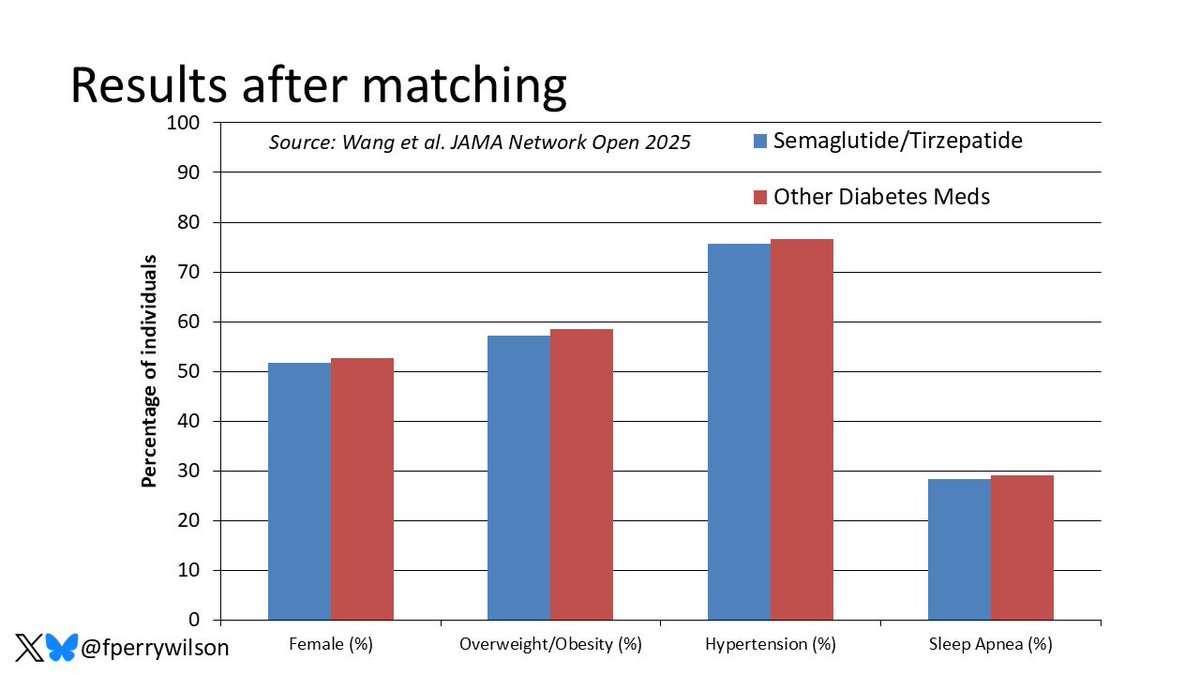
@fperrywilson I like the orangish apples and appley oranges comparison… implies that even though the matched groups look similar they may still be inherently different since you are starting with apples and oranges
English
0
0
0
23
F. Perry Wilson, MD MSCE
F. Perry Wilson, MD MSCE@fperrywilson·
Enter propensity score matching! Statistical wizardry that pairs similar patients where one got GLP-1s and one didn't. Like finding orangish apples to compare with appley oranges.
F. Perry Wilson, MD MSCE tweet mediaF. Perry Wilson, MD MSCE tweet media
English
2
2
64
3.9K
F. Perry Wilson, MD MSCE
F. Perry Wilson, MD MSCE@fperrywilson·
About a year ago, I joked with a friend about Ozempic's miracle benefits. Weight loss! Better hearts! Less drinking! "What about side effects?" he asked. "Maybe after 10 years your eyes fall out," I joked. Well, about that... 🧵
F. Perry Wilson, MD MSCE tweet media
English
7
68
400
40.3K
Rob Gallo, MD
Rob Gallo, MD@robjgallo·
@kylefbutts @selcukorkmaz @cellis212 Isn’t that essentially how these terms are used in mixed effects modeling? I’ll be honest that I find the terminology of fixed and random effects confusing, especially because there are so many definitions (see the linked Gelman blog in other reply)
English
0
0
0
103
ky
ky@kylefbutts·
@robjgallo @selcukorkmaz @cellis212 it’s kind of wild then to compare “indicators for gender/race/etc.” to “unit-specific (random) effects”, right?
English
1
0
0
225
Rob Gallo, MD
Rob Gallo, MD@robjgallo·
@kylefbutts @selcukorkmaz @cellis212 My experience is that outside of Econ when people say fixed effects they are referring to group indicator variables. More than anyone being correct/incorrect, it seems use of these terms are just different across fields.
English
3
0
5
401
Rob Gallo, MD
Rob Gallo, MD@robjgallo·
@kidney_boy It may actually be true that speed of correction doesn’t matter for ODS since it’s a low evidence area, but the likelihood that it significantly affects in-hospital mortality is very low in my opinion
English
0
0
3
78
Rob Gallo, MD
Rob Gallo, MD@robjgallo·
@kidney_boy To me this makes it clear this is probably confounding… why would correcting Na faster or slower change mortality? It would have to be one of the most effective interventions in medicine to have that large an effect!
English
1
0
4
260
Joel M. Topf, MD FACP
Joel M. Topf, MD FACP@kidney_boy·
Honey, stop what you're doing, new hyponatremia research just dropped! What's it say? It looks like slow correction is associated with worse outcomes, like death and length of stay! Was it just a small study? No, it was a meta-analysis of almost 12,000 patients! jamanetwork.com/journals/jamai…
English
22
127
662
98.8K
Rob Gallo, MD รีทวีตแล้ว
Jonathan H Chen MD PhD
Jonathan H Chen MD PhD@jonc101x·
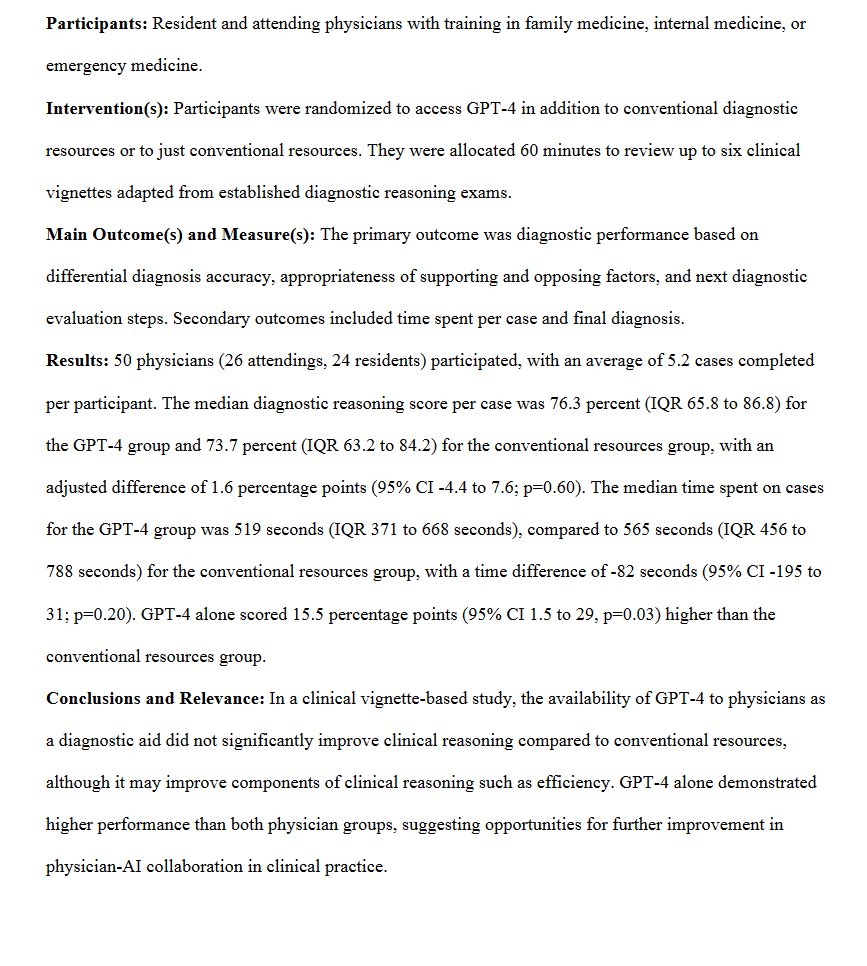
@emollick Provocative result we did NOT expect. We fully expected the Doctor + GPT4 arm to do better than Doctor + "conventional" Internet resources. Flies in the face of the Fundamental Theorem of Informatics (Human + Computer is Better than Either Alone).
Jonathan H Chen MD PhD tweet media
English
10
15
96
31.5K
Rob Gallo, MD รีทวีตแล้ว
Adam Rodman
Adam Rodman@AdamRodmanMD·
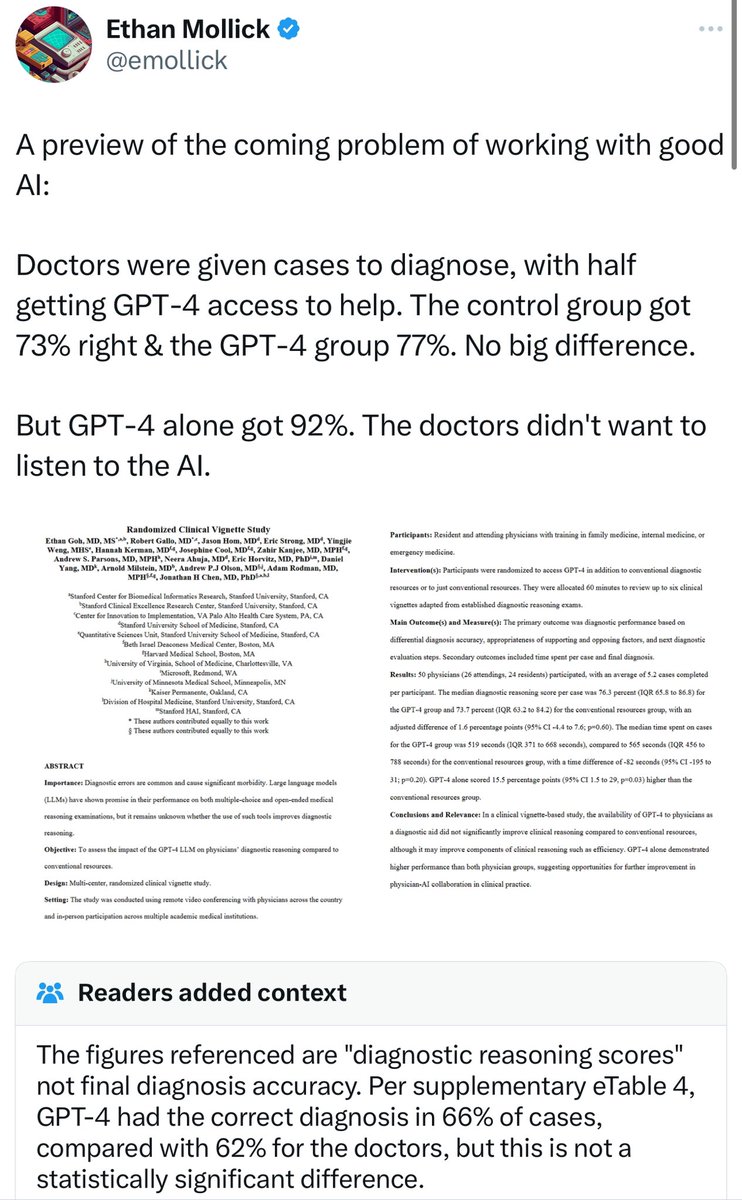
Our first RCT on using an LLM on diagnostic reasoning is out! And the results are 🔥🌶️... adding ChatGPT did NOT improve diagnostic accuracy or reasoning, and the AI alone outperformed ALL the humans. What does this mean? A 🧵⬇️ x.com/EricTopol/stat…
Eric Topol@EricTopol

A small randomized trial of generative #AI for diagnosis again (as seen in a few previous studies) shows higher performance for #AI than physicians + AI. May indicate that physicians need to be trained on how to incorporate AI. #google_vignette" target="_blank" rel="nofollow noopener">jamanetwork.com/journals/jaman…

English
14
86
294
195.6K
Rob Gallo, MD รีทวีตแล้ว
Jonathan H Chen MD PhD
Jonathan H Chen MD PhD@jonc101x·
Only a fraction of the doctors realized they could literally copy-paste in an entire case history into the chatbot and ask it for a surprisingly smart and comprehensive answer. nytimes.com/2024/11/17/hea…
English
1
5
14
1K
Rob Gallo, MD
Rob Gallo, MD@robjgallo·
@williamhersh @Squee451 @emollick Also the human comparison is just 4 physicians: 3 from Germany, 1 from US... hard to generalize to say LLM worse than physicians when you are only comparing to 4 physicians. This source of uncertainty also not accounted for in analyses.
English
0
0
0
78
Ethan Mollick
Ethan Mollick@emollick·
Ok. Deleting this and reposting given the Community Note (you can see the original and Note below). The main point doesn’t change in any way, but I want to make sure I am clear in this post that the measurement was diagnostic reasoning & not final diagnoses. A preview of the coming problem of working with AI when it starts to match or exceed human capability: Doctors were given cases to diagnose, with half getting GPT-4 access to help. The control group got 73% score in diagnostic accuracy (a measure of diagnostic reasoning) & the GPT-4 group 77%. No big difference. But GPT-4 alone got 88%. The doctors didn't change their opinions when working with AI. To be clear, this doesn't say AI will always beat doctors - this is a narrow test. It is much more about what this means for the future. As AI models get better, and match or exceed human level performance, what happens? This is one example where it is happening, and we see the issues emerging.
Ethan Mollick tweet mediaEthan Mollick tweet mediaEthan Mollick tweet media
English
38
93
628
142.8K
Rob Gallo, MD รีทวีตแล้ว
Eric Topol
Eric Topol@EricTopol·
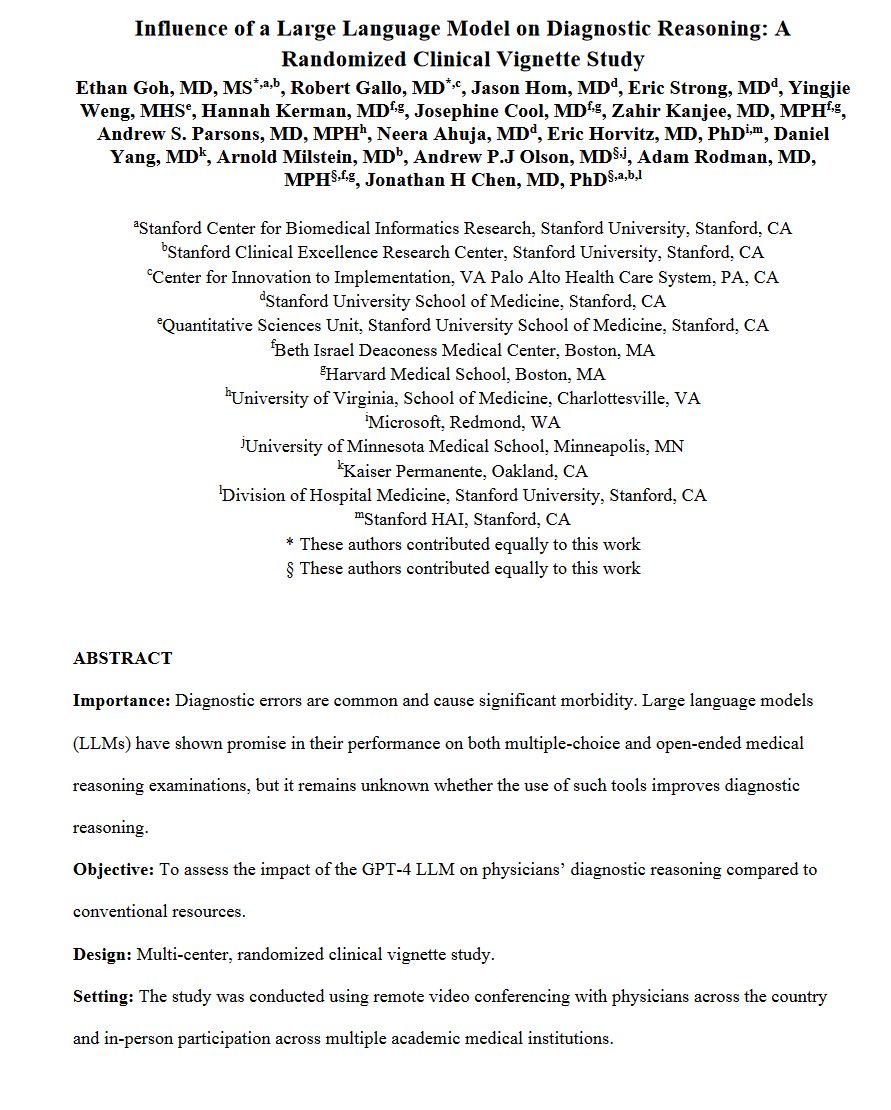
A small randomized trial of generative #AI for diagnosis again (as seen in a few previous studies) shows higher performance for #AI than physicians + AI. May indicate that physicians need to be trained on how to incorporate AI. #google_vignette" target="_blank" rel="nofollow noopener">jamanetwork.com/journals/jaman…
Eric Topol tweet media
English
13
37
111
186.7K
Rob Gallo, MD
Rob Gallo, MD@robjgallo·
@AnilMakam @gushamilton @syctong Beyond specific individual shortages, it’s worth considering confounding by the underlying reason for the shortages… I don’t know that they are random events isolated from other healthcare system issues or resource constraints
English
0
0
1
52
Rob Gallo, MD
Rob Gallo, MD@robjgallo·
@AnilMakam @gushamilton @syctong Also hard to fully control for time-varying confounding given the IV is based on time. Overall, I'm not sure how to reconcile with ACORN.
English
1
0
0
94
Rob Gallo, MD
Rob Gallo, MD@robjgallo·
@AnilMakam @gushamilton @syctong Interesting study, but it assumes that the only change during this time period was the pip/tazo shortage. At first read, that seems like a strong assumption... was the shortage not associated with other drug shortages or changes in hospital resources?
English
1
0
1
108