

slow
72 posts

slow
@slowfft
engineering and design at Jot ~ opinions not my own
เข้าร่วม Eylül 2025
41 กำลังติดตาม26 ผู้ติดตาม

Deleting code is the best kind of engineering. Period.
Simplicity > Lines of code.
While the whole world of vibe coders brags about pushing tens of thousands of LOC a day, I'm actually happier when my codebase shrinks every now and then, usually when I spot repeating patterns and extract reusable code into a better architecture.
File Pilot is only a little above 100k LOC right now, which I already consider a lot. And I've been working on it for 4 years straight. So when I see people here talking about how they push thousands of LOC a day, I'm like... there is no way in the world you understand that code and all the implications of all the pieces that have to communicate with each other.
You're gonna lock yourself so fast, into a place of such complexity that not even AI will be able to help. And for what? Speed? In generating mediocre junk code.
You only value your time. I value my users time.
We're not the same.
English

🚨 CRITICAL: Active supply chain attack on axios -- one of npm's most depended-on packages.
The latest axios@1.14.1 now pulls in plain-crypto-js@4.2.1, a package that did not exist before today. This is a live compromise.
This is textbook supply chain installer malware. axios has 100M+ weekly downloads. Every npm install pulling the latest version is potentially compromised right now.
Socket AI analysis confirms this is malware. plain-crypto-js is an obfuscated dropper/loader that:
• Deobfuscates embedded payloads and operational strings at runtime
• Dynamically loads fs, os, and execSync to evade static analysis
• Executes decoded shell commands
• Stages and copies payload files into OS temp and Windows ProgramData directories
• Deletes and renames artifacts post-execution to destroy forensic evidence
If you use axios, pin your version immediately and audit your lockfiles. Do not upgrade.
English

@MalmSanta @tautologer It's a very interesting topic but I gotta go for now 😅
English

@slowfft @tautologer having such a loud public square is tricky bc it introduces weirdly adverse incentives that can easily trickle into the cafes either directly or just through vibes. the tl algo does seem to do a pretty good job of finding new people though. just have to wade through some slop
English

the human-only internet doesn't look like the World Wide Web, it looks like a hundred million 10-50 person group chats
Minh Nhat Nguyen@menhguin
there should be 2 parallel internets: a human-only internet and an AI-only internet. anything else would be very painful.
English
@MalmSanta @tautologer the twitter model is pretty good to facilitate it because you can jump seamlessly between the public square (tl) and the corner cafe (gc). Unfortunately they turned the public square into a market for touts by trying to monetise everything
English
@slowfft @tautologer oh I'm thinking like, platform-level, what could a new thing do that would differentiate it for the majority of people in such a way that the platform could eventually host 100m (good) 10-50 person group chats
my thinking is more around discoverability and matching...
English
@MalmSanta @tautologer Yeah keypair usage only reaches the masses if it's managed by the application itself as with e.g. Signal. Trying to make it explicit and fully self-custodial is a fool's game - again, only nerds will bite let alone understand it
English
@slowfft @tautologer maybe that minority of users that have deplatforming as a concern are a subset of power users who are worth going out of your way to satisfy? but it feels like complexity of setting up a "node" or "cryptographic keypairs" would turn off so many people
English
@MalmSanta @tautologer Yeah in practice urbit is and will only be used by enthusiasts for a long time ahead. Regarding illegal things look up how data hosting works on there (keyword: DHT). You choose what to store on your urbit computer and you choose who to associate with
English
@slowfft @tautologer okay I've seen some urbit maxis in the past and am understanding what they liked. my problem with this is that there will never be 100m group chats on a platform so complex.. also wondering how they handle illegal things if not central authority is in charge
English
@MalmSanta @tautologer I don't know enough about Mastodon off the top of my head tbh. Your data/network still rests with someone else in a federated network. Go look up how urbit differs from this. Nostr is also pretty interesting.
English
@slowfft @tautologer is mastodon an attempt at this? why isn't it enough?
English
Yes. The meetings have ranged from the worst of my life to the best of my life
m@orphicdamsel
have any of you ever met up with someone you got to know on the internet
English
@MalmSanta @tautologer probably more sovereignty as a user, urbit-style, so you can't get yeeted off the platform you've built your entire network on
English
@tautologer what could a platform facilitating that future provide over what discord/slack/telegram/twitter dms currently provide?
English
@tautologer Indeed.
x.com/slowfft/status…
slow@slowfft
Collecting metrics from a large IRC network, researchers found in 2008 that posting activity eventually tops out regardless of community size. "discourse … appears to be limited to 40 posters in any 20 minute interval" There are interesting implications, so let's take a look. Message density (messages sent per user within a given time interval) was seen to drop sharply until a channel had around 40 active posters implying that the number of lurkers or inactive users in an instant messaging chat grows asymptotically with channel size. This decay is in part due to (1) human information-processing constraints; to cope with a large stream of messages a user will either start lurking or selectively respond to certain users which means taking activity elsewhere, and (2) user interface boundaries (lack of space). Some thoughts: Obvious as it might seem, hard limits to meaningful activity are inherent to any social space. Effective design of communication tools must treat these concerns with care and attention. Different tools possess different qualities which nudges users toward different behaviours. For any given tool one might consider: • Does interaction require presence? • Is content ephemeral or persistent? • How structured is the communication? Hierarchy, threading, searchability, linearity? • How much context does parsing a piece of information require? Let's look at two very different modes of communication: 1. A blog is asynchronous, persistent, structured and usually does not require context to parse (but may assume some topic knowledge). 2. A video meeting requires all participants to be present, may or may not be recorded, is semi-unstructured and most things being said are highly contextual. The video meeting demands more of each participant since even just a momentary lapse of attention might make them lose the context with no way to backtrack. This is naturally compensated for through repetition and less dense communication. The tradeoff is that interaction is fast, bidirectional and personal. Instant messaging tools are by far the most varied in terms of implementation and design, making them extremely versatile and therefore ubiquitous. However, users will always be subject to information-processing constraints. Anyone building a social space should probably take the qualities discussed above into consideration and keep in mind that there are advantages to each. I'd like to write more on this eventually, especially regarding how to design the interface and experience around the hyper-synchronous real-time text mode (messages shown as they are typed) in a way that manages information overload. … but I'll stop here. Thanks for reading!
English

The problem is looking at capital risk as steady income generation, the doctor and other high earners will make that amount regardless of most variables.
The money you make "trading" or "trenching" is not a salary and should never be treated as such.
フ ォ リ ス@follis_
Crypto has broken my concept of money In college I used to work 8h shifts for $100 Now I lose $3k on a stop and it barely registers "Damn I only made +$900 today" Follis you dumb mfer that is a doctor's salary
English
@peer_rich No way this appeared on my feed! I have something that's a lot like Honk, still small though, about 30 daily active users. Currently web only (with a good PWA) but native app nearing release. Hope you don't mind me sharing it here
x.com/slowfft/status…
slow@slowfft
does the internet ever bore you? then let me introduce you to real-time text... we've created @jot_chat, a place where you can host communities and chat with people in a truly novel way, leveraging technology that makes chatting feel just like speaking and listening. read on...
English

i feel like its been forever since a new fun social b2c app launched on mobile
snapchat
tiktok
clubhouse (💀)
honk (💀)
…?
English

Few understand what this unlocks. It’s not just about having pretty wrapped text.
Cheng Lou@_chenglou
My dear front-end developers (and anyone who’s interested in the future of interfaces): I have crawled through depths of hell to bring you, for the foreseeable years, one of the more important foundational pieces of UI engineering (if not in implementation then certainly at least in concept): Fast, accurate and comprehensive userland text measurement algorithm in pure TypeScript, usable for laying out entire web pages without CSS, bypassing DOM measurements and reflow
English

Streaming text is rendered with handwriting animation. The layout is calculated with Pretext. Has kerning logic and accurate glyph positions. Text is selectable.
Cheng Lou@_chenglou
My dear front-end developers (and anyone who’s interested in the future of interfaces): I have crawled through depths of hell to bring you, for the foreseeable years, one of the more important foundational pieces of UI engineering (if not in implementation then certainly at least in concept): Fast, accurate and comprehensive userland text measurement algorithm in pure TypeScript, usable for laying out entire web pages without CSS, bypassing DOM measurements and reflow
English
don't call it AGI unless it can reliably do this
slow@slowfft
@onehappyfellow bidirectional scroll with content load+unload that works across all browsers and mobile
English

@Lord_N3_ @0xglitchbyte Obviously you won't get good results if you're pasting snippets into a browser UI with a model that has no deep understanding of your codebase.
English
@Lord_N3_ @0xglitchbyte What model/tools do you use? With e.g. Claude Code you can tell it to read the codebase, understand its structure and patterns and save its research to CLAUDE.md. Give it hints/explainers for more unconventional patterns you use.
English

Because these codebases need to architected and maintained
You cannot maintain a large codebase with full confidence unless you yourself are in said codebase doing the work.
The more you allow LLMs to code for you, the less you understand of your own codebase, and the less youre able to maintain in the long term.
BURKOV@burkov
With all due respect to Andrew, in his motivational post, he didn't explain why anyone would write code by hand. I can code, but I consider coding by hand a waste of time. So, if I, the one who already knows how to code, consider this a waste of time, why would anyone learn something which is very hard to learn only to then consider it a waste of time, like I do?
English

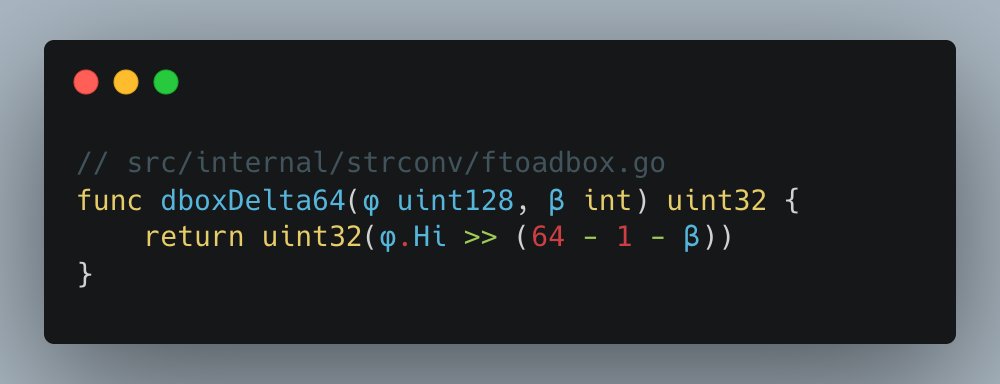
If you stare into Go's stdlib long enough, you start seeing things.
Dark things. Things you weren't meant to see.
Like this function that uses variables named φ and β.
English