
ทวีตที่ปักหมุด
Bel Ami
91.6K posts

Bel Ami
@tamuke06
the Art of Peace. #Canal_Libéral. Liberté, Responsabilité, Laïcité. « Si un espoir est permis, tous les espoirs sont permis ». Je soutiens #Lisnard2027
Cannes, France เข้าร่วม Kasım 2011
1.3K กำลังติดตาม6.5K ผู้ติดตาม
Bel Ami รีทวีตแล้ว

Enfin, croire qu'on lutte par la peine de mort contre des kamikazes, c'est quand même très con. #Israël
Français
Bel Ami รีทวีตแล้ว

🚨🇮🇱🇫🇷 Israel has decided to halt all security procurement from France, an Israeli official told @Jerusalem_Post.
The decision to stop the purchases was made under the directive of Defense Minister Israel Katz and Defense Ministry Director-General Amir Baram. Apart from existing contracts that are still in force, all security procurement from France has been completely halted.
Israeli officials stated that in the past two years, France has adopted a consistently hostile policy toward Israel, which makes it impossible for Israel to rely on France in matters of defense exports.
English
Bel Ami รีทวีตแล้ว

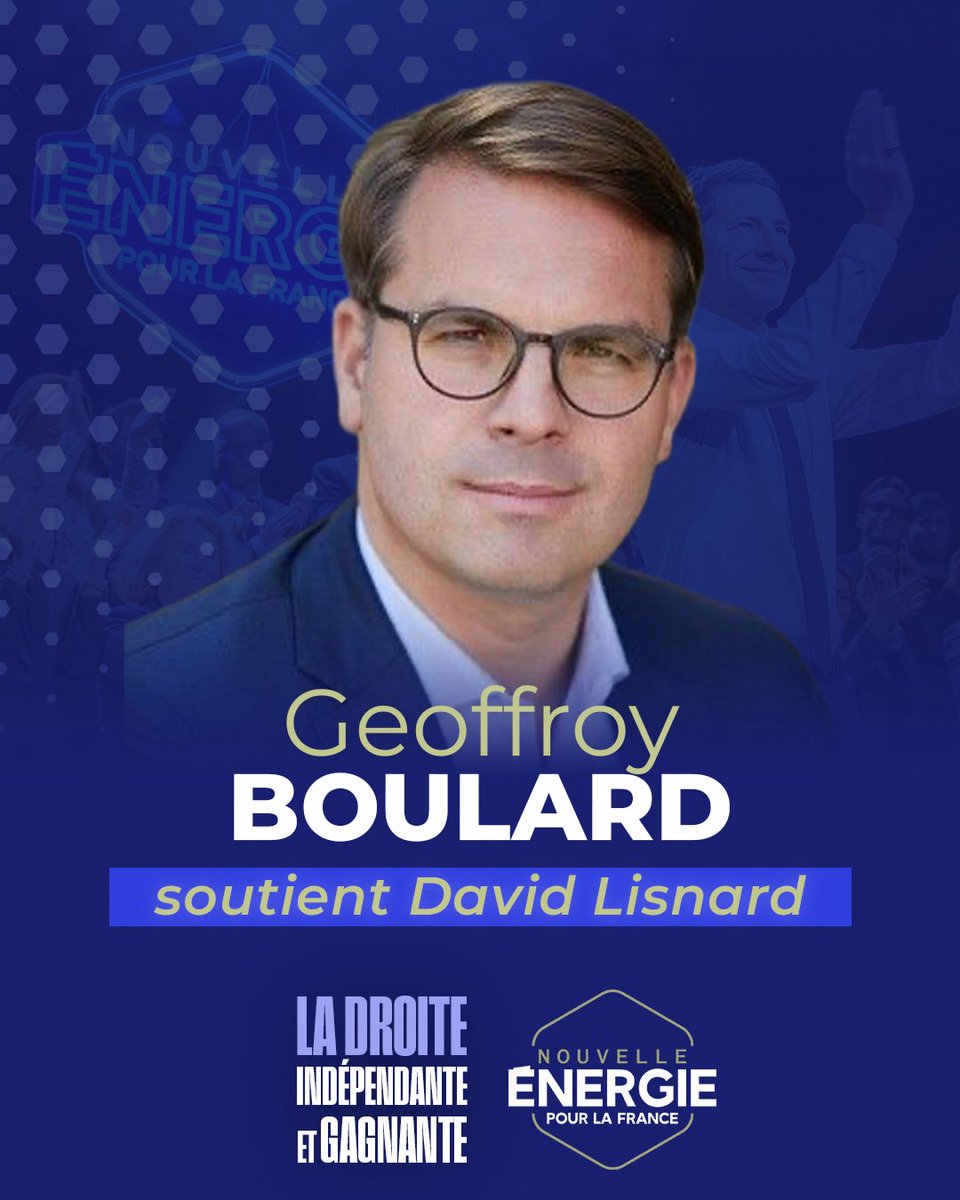
📢 @geoffroyboulard, maire du 17ème arrondissement de Paris, soutient @davidlisnard.
Pour une droite INDÉPENDANTE et GAGNANTE.
👉 Adhérez : soutenir.unenouvelleenergie.fr/adhesion
Français
Bel Ami รีทวีตแล้ว

Il serait plus opportun de demander que l’ambassadeur iranien -persona non grata- soit livré aux autorités libanaises plutôt que le ressortissant ukrainien qui était détenu dans une des prisons souterraines du Hezbollah ans la banlieue sud.
L'Orient-Le Jour@LOrientLeJour
🚨 #Urgent | Le Liban réclame que l'Ukraine lui livre un de ses ressortissants réfugié dans son ambassade après avoir fui la banlieue sud de Beyrouth où il était aux mains du Hezbollah, ont indiqué lundi un haut responsable sécuritaire et une source du parti pro-iranien à l'AFP.
Français
Bel Ami รีทวีตแล้ว

The whole system should be sanctioned
Accountability Now@NowActs
1️⃣Accountability Now has filed a sanctions submission with the @USTreasury against Speaker Nabih Berri. The filing presents a compelling case for his designation based on rampant corruption, state capture, control over a suspicious oil cartel tied to the Zahrani oil installations
English
English
Bel Ami รีทวีตแล้ว
Since 1982, Iran has implemented a deliberate strategy to anchor its power in Lebanon through Kizballah, a terrorist mercenary militia operating as a direct extension of Tehran. This was never a resistance project. It was a long-term plan to capture the Lebanese state from within.
Iran did not need to invade. It built a system that made invasion unnecessary.
Over time, Kizballah constructed parallel structures that steadily displaced state authority:
a military force outside government control,
a financial network sustained by illicit and external flows,
and a political mechanism capable of overriding national decision-making.
The decisive shift came in 2006. The Mar Mikhael agreement did not merely reflect political pragmatism. It institutionalized the erosion of sovereignty. By aligning with Kizballah, Michel Aoun and Gebran Bassil provided the political legitimacy that allowed an armed non-state actor to entrench itself at the core of the Lebanese system.
This was not coexistence. It was state capture facilitated from within.
Kizballah’s record leaves little ambiguity. Its intervention in Syria prolonged the Assad regime at Lebanon’s expense. Its role in the 2006 war exposed the country to devastating consequences without delivering strategic gain. Its parallel economic networks have hollowed out state institutions while insulating its own structures from collapse.
The pattern is consistent: decisions taken in service of Iranian regional priorities, with Lebanon absorbing the cost.
Equally important is the role of internal enablers. This system could not have consolidated without political actors willing to legitimize, protect, or ignore the expansion of parallel authority. Alliances were formed, institutions were compromised, and accountability was systematically avoided.
The result is a state in form, but not in function.
Reversing this trajectory requires more than reform. It requires dismantling the architecture that allowed this parallel system to take root: restoring exclusive state control over force, confronting the political networks that enabled it, and disrupting the financial structures that sustain it.
Lebanon’s central challenge is no longer ambiguous. It is whether the state can reassert authority over actors that have systematically operated beyond it.
Until that question is answered, sovereignty will remain nominal, and instability will persist
#Lebanon
#FreeLebanon
#Iran
#IranProxy
#IranInfluence
#MiddleEast

English

Breaking: Netanyahu says Long-term solutions to the Strait of Hormuz crisis could include rerouting energy pipelines westward across Saudi Arabia to the Red Sea and the Mediterranean.
jpost.com/israel-news/be…
English
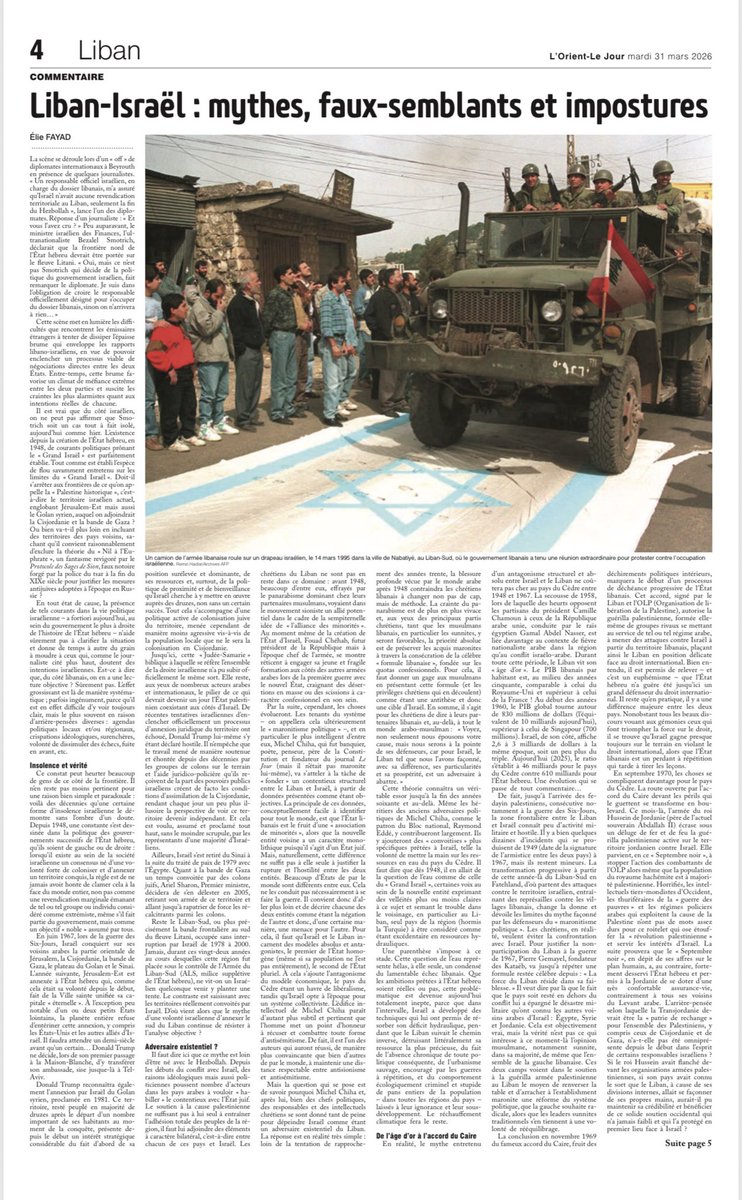
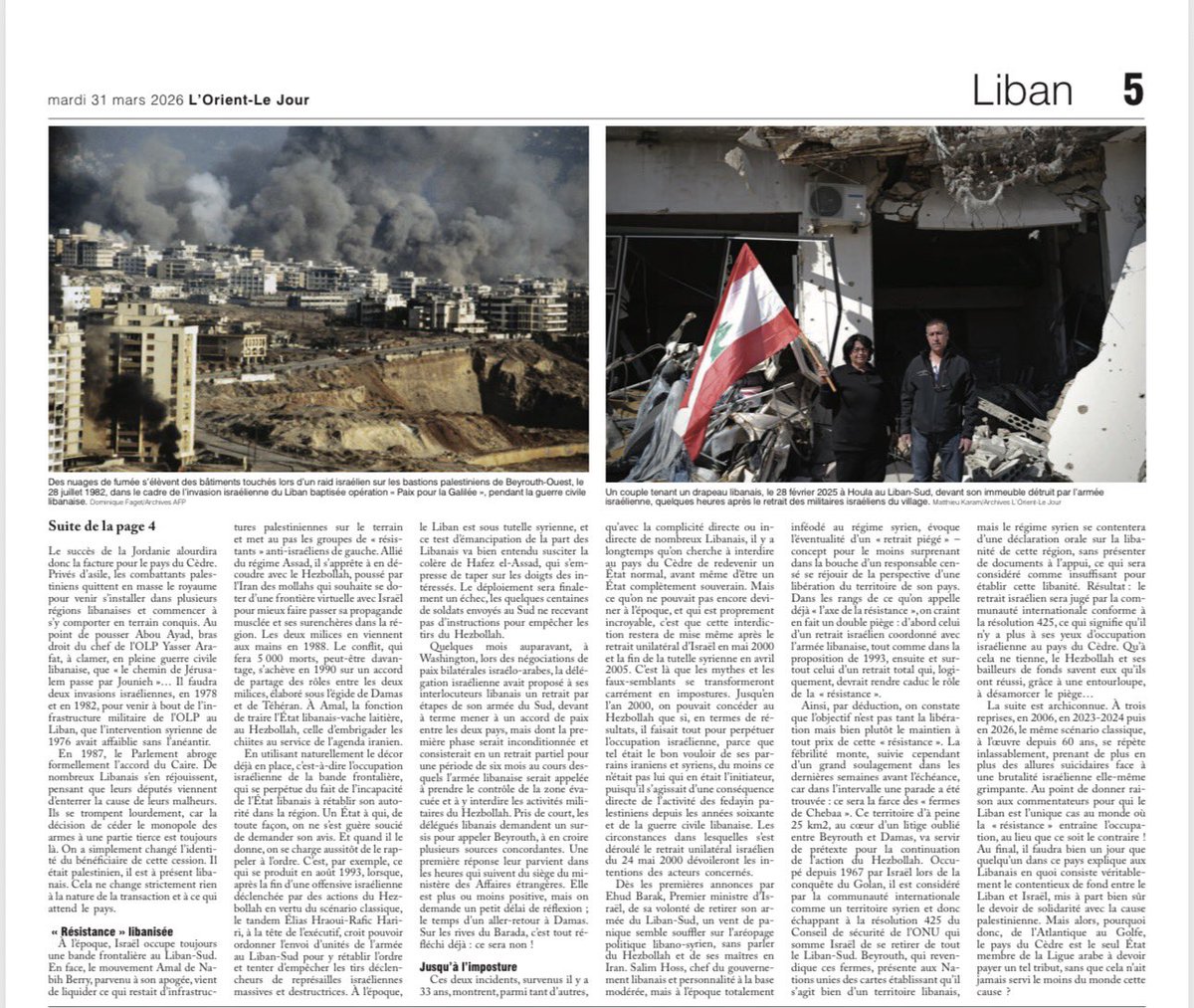
Élie Fayad déconstruit les mythes et impostures autour du conflit Liban-Israël, critiquant les faux-semblants comme la légitimité absolue du Hezbollah ou les simplifications historiques, pour recentrer sur des faits objectifs.[lorientlejour +1]
Plutôt qu’un appel direct à la paix, il vise à dissiper les illusions qui perpétuent le conflit. @LOrientLeJour vous m’étonnez la.
Français
Bel Ami รีทวีตแล้ว

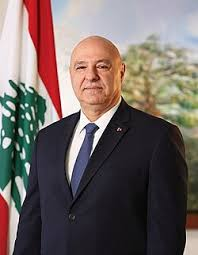
A transitional Iranian ambassador to Lebanon?
Following the Lebanese state’s decision to end the mission of the previous regime’s ambassador—and the diplomat’s reported refusal to leave Lebanese territory while remaining under Hezbollah’s protection—the government in Beirut could consider a new course of action. One option would be to formally request that Iran’s transitional government appoint an interim representative to serve as ambassador to Lebanon.
Under such a scenario, the current diplomat would effectively remain a rogue representative of the existing regime until removal is possible. While a newly appointed envoy could represent an alternative Iranian transitional government in official relations with Lebanon.
@LBpresidency @YoussefRaggi @SecRubio @SenTedCruz @LindseyGrahamSC

English
Bel Ami รีทวีตแล้ว
Associated Press :
* Les Émirats arabes unis exhortent Trump à ordonner une invasion terrestre de l'Iran, le Koweït et Bahreïn soutenant également cette initiative.
* Des sources officielles d'Arabie saoudite, des Émirats arabes unis, du Koweït et de Bahreïn ont fait part, lors de discussions à huis clos, de leur opposition à la fin de l'opération tant qu'il n'y aura pas de changements significatifs au sein de la direction iranienne ou qu'un revirement radical ne se produira pas dans le comportement de l'Iran.
In the Live news thread👇
@AP
#0000019d-40d2-d7cd-a7df-dbfe27250000" target="_blank" rel="nofollow noopener">apnews.com/live/iran-war-…
Français
Bel Ami รีทวีตแล้ว
@hahussain The cancer is telling the brain this is not your body anymore.
English
Bel Ami รีทวีตแล้ว

BREAKING: In 1622, Shah Abbas I captured the Strait of Hormuz from the Portuguese and made it the economic engine of the Safavid Empire. He ruled from Isfahan. He built the Shah Mosque there, the Naqsh-e Jahan Square, the Ali Qapu palace, the Chehel Sotoun pavilion. Isfahan became, in the words of historians, one of the most beautiful cities ever constructed. Its wealth flowed from one source: control of the strait.
Tonight, 404 years later, Isfahan is burning because of the strait.
Al Jazeera confirmed overnight US-Israeli strikes hitting the Badr military airbase in Isfahan, producing a column of fire visible across a city of 2.3 million people. Bunker-busters detonated ammunition depots in secondary explosions that turned the night sky orange. This is the fourth wave of strikes on Isfahan since February 28. Previous waves destroyed Il-76 transports, C-130s, Su-22s, S-300 radar systems, and runway infrastructure at the 8th Tactical Airbase. On March 9, strikes damaged Naqsh-e Jahan Square itself, along with the Shah Mosque, Ali Qapu, and Chehel Sotoun. Blue Shield International called it a war crime. The monuments Abbas built with Hormuz revenue are being destroyed in a war triggered by Hormuz closure.
The geography has not moved in four centuries. The chokepoint has not moved. The city that profited from controlling the strait is now paying the price of a regime that weaponised it. Shah Abbas understood something that the IRGC also understands: whoever controls Hormuz controls the economic destiny of every nation that depends on what passes through it. In 1622, he used English warships to seize it from the Portuguese and redirected its wealth to build a capital that rivalled Constantinople. In 2026, the IRGC is using the same chokepoint as a toll booth, charging two million dollars per tanker in yuan, while the air defences that protected the city Abbas built are systematically dismantled by the descendants of the same English-speaking naval power that helped him take it.
But here is the connection nobody has made. Isfahan is not only the city that Abbas built with Hormuz wealth. It is where Iran’s enriched uranium sits underground. The same city. The same geography. The column of fire tonight is burning above the facility where 1,000 pounds of uranium hexafluoride sits in cylinders that both diplomats and commandos are racing to reach. Every strike that degrades Badr’s air defences makes a future special operations approach to that uranium more feasible. Rubio’s four stated objectives, destroy the air force, navy, factories, and missile launchers, are the precondition for the unstated fifth: extract the uranium. And the precondition converges on Isfahan.
Shah Abbas captured Hormuz to fund Isfahan. The IRGC closed Hormuz and brought war to Isfahan. The uranium that could end or extend this war sits beneath the city that was built by the strait that started it. Four centuries of Persian strategic logic, from Safavid empire to Islamic Republic, compressed into one burning city where the chokepoint, the capital, the heritage, and the nuclear material all occupy the same coordinates.
The Shah Mosque was designed to last a thousand years. Whether it survives April depends on whether a Pakistani diplomat landing in Beijing this morning can broker a deal faster than the bunker-busters can reach the cylinders beneath the city that Hormuz built.
open.substack.com/pub/shanakaans…
English
1️⃣Accountability Now has filed a sanctions submission with the @USTreasury against Speaker Nabih Berri. The filing presents a compelling case for his designation based on rampant corruption, state capture, control over a suspicious oil cartel tied to the Zahrani oil installations
English
Le discours que j’aurais tant aimé entende en 2015 à l’Assemblée Nationale. @marcorubio
Mike@Doranimated
Marco Rubio’s 2015 denunciation of Obama’s JCPOA was prophetic.
Français