
Mark Williams

3.1K posts

Mark Williams banner
Mark Williams

Mark Williams

@williams2mark

Not old but not young. Likes to run. Likes to write.

U.K. เข้าร่วม Mart 2015
312 กำลังติดตาม319 ผู้ติดตาม
ทวีตที่ปักหมุด
Mark Williams
Mark Williams@williams2mark·
@csljohnkirby @LeeHurstComic If you tax unrealised gains then you have to exempt unrealised losses from an individual’s tax. Increase corporation tax and lose tax revenue: Ireland did then opposite and boomed. Inheritance tax is perhaps the best way to redistribute “unearned” wealth.
English
1
0
0
33
John Kirby
John Kirby@csljohnkirby·
The flaw here is simple. No serious person is suggesting taking 100% of billionaire wealth. That is a straw man, not an argument. The real debate is whether the tax system treats earned income, inherited wealth, capital gains, land, dividends and extreme asset growth fairly. Nobody funds the NHS by raiding one group once. Public services are funded year after year through a broad, sustainable tax base, economic growth, productivity, employment, prevention, procurement discipline and sensible long-term planning. So the question is not: “What happens if you confiscate everything?” The question is: “Is the current balance fair, efficient and sustainable?” That is the debate worth having.
English
13
0
14
1.5K
Lee Hurst
Lee Hurst@LeeHurstComic·
Question for all socialists. You get your wish and tax the rich. In fact you take every penny from every British billionaire (£185 billion). Your UK NHS budget is £206 billion. You are £21 billion short. Next year you have no billionaires to steal from. What’s your next move?
English
558
661
5.6K
240.8K
Mark Williams รีทวีตแล้ว
Brivael
Brivael@brivael·
Hello Julia, sans aucune ironie, c'est top que tu prennes le temps de te renseigner. Mais le problème quand on lit Marx aujourd'hui, c'est qu'on prend pour acquis sa prémisse de départ, alors qu'elle a été démontée scientifiquement il y a plus de 150 ans. Toute la pensée de Marx repose sur la théorie de la valeur-travail. L'idée que la valeur d'un bien vient de la quantité de travail nécessaire pour le produire. Si tu acceptes cette prémisse, alors oui, tout son raisonnement tient. Le capitaliste "vole" la plus-value du travailleur, l'exploitation est mathématique, la révolution est inévitable. Sauf qu'en 1871, trois économistes (Menger en Autriche, Jevons en Angleterre, Walras en Suisse) découvrent indépendamment la même chose : la valeur n'est pas objective, elle est subjective et marginale. Un verre d'eau dans le désert vaut une fortune. Le même verre à côté d'une rivière ne vaut rien. Le travail incorporé est identique. Donc le travail ne détermine pas la valeur. C'est le consommateur qui valorise un bien selon son utilité marginale dans un contexte donné. Exemple concret : tu peux passer 1000 heures à tricoter un pull moche que personne ne veut. Selon Marx, ce pull a énormément de valeur (beaucoup de travail incorporé). Selon la réalité, il ne vaut rien. Parce que personne n'en veut. À l'inverse, Bernard Arnault crée des milliards de valeur non pas parce qu'il "exploite" mais parce qu'il a su anticiper et organiser des désirs humains à grande échelle. La valeur est créée par la coordination, pas extraite par le vol. Cette découverte (la révolution marginaliste) a invalidé tout l'édifice marxiste. Pas pour des raisons idéologiques, pour des raisons scientifiques. C'est pour ça que plus aucun département d'économie sérieux au monde n'enseigne Marx comme un cadre d'analyse valide. On l'enseigne en histoire de la pensée. Maintenant, le truc important. Si ton intention en lisant Marx c'est d'aider les pauvres (c'est une intention noble), alors tu vas être surprise par ce qui suit. Regarde les chiffres de la Banque mondiale. En 1820, 90% de l'humanité vivait dans l'extrême pauvreté. Aujourd'hui, moins de 9%. Cette chute historique ne s'est PAS produite dans les pays qui ont appliqué Marx. Elle s'est produite dans les pays qui ont libéralisé leur économie. Chine post-1978, Vietnam post-1986, Inde post-1991, Pologne post-1989. À chaque fois qu'un pays libéralise, des centaines de millions de gens sortent de la pauvreté en une génération. À chaque fois qu'un pays applique Marx (URSS, Cambodge, Corée du Nord, Venezuela), c'est la famine et les goulags. Ce n'est pas une opinion, c'est l'expérience la plus massive jamais menée en sciences sociales. Plusieurs milliards de cobayes humains, sur un siècle. Donc paradoxalement, si tu aimes vraiment les pauvres, la position la plus cohérente n'est pas d'être marxiste. C'est d'être pour la liberté économique. Parce que c'est empiriquement la seule chose qui a jamais sorti massivement les gens de la misère. Pour creuser, je te recommande trois lectures qui vont changer ta vision : "La Loi" de Frédéric Bastiat (court, lumineux, gratuit en ligne) "La Route de la Servitude" de Hayek "Économie en une leçon" de Henry Hazlitt Bonne lecture, et vraiment chapeau de chercher à comprendre plutôt que de rester dans tes certitudes. C'est rare.
Julia ひ@lifeimitatlife

Depuis tout à l'heure je me renseigne sur les idées de Karl Marx sincèrement je n'arrive pas à comprendre comment on peut être pour le capitalisme et même plus généralement être de droite

Français
1.5K
11.1K
48.7K
3.2M
Mark Williams
Mark Williams@williams2mark·
@yuanyi_z I think the Greens are dangerous/hopelessly misguided/annoying, but it doesn’t mean they’re wrong about everything. MPs shouldn’t be drinking while working in the HoC.
English
0
0
0
72
Mark Williams
Mark Williams@williams2mark·
@BellaWallerstei No one has to due in pain. We need to better palliative care. We have the medication just not the planning ADB service.
English
0
0
0
75
Bella Wallersteiner 🇺🇦
Bella Wallersteiner 🇺🇦@BellaWallerstei·
Hugely disappointing assisted dying bill has failed to become law. Too many terminally ill people are forced to endure their final days in pain. I’ve seen first-hand how cruel that can be. We all deserve the right to choose how and when we die. The law should recognise that
English
211
14
212
29.8K
Mark Williams
Mark Williams@williams2mark·
@mancunianmedic I have an instinctive dislike of JRM probable due to inverse snobbery. I sometimes agree with what he says but you don’t beat racism by attributing actions to someone’s immutable characteristics.
English
0
0
0
48
Mark Williams
Mark Williams@williams2mark·
@MatthewStadlen Hiring someone who styled himself as the Prince of darkness, who was twice sacked for corruption and was best friends with the most famous nonce even after his conviction, is pretty ruthless.
English
0
0
0
30
Matthew Stadlen
Matthew Stadlen@MatthewStadlen·
Suspect some of Starmer’s detractors still underestimate just how tough he is. Not easy to be the country’s chief prosecutor or to take on the Corbynite wing of the Labour Party. He’s showed himself repeatedly to be both resilient and capable of ruthlessness.
English
1K
178
852
53.1K
Mark Williams
Mark Williams@williams2mark·
@cjsnowdon I agree, the NHS has many problems, including the dogma of underfunding. Here’s a question to test your objectivity: What is the best NHS service in terms of cost efficiency, quality in terms of hitting KPIs and patient feedback but has also seen an increase in productivity?
English
1
0
0
57
Mark Williams
Mark Williams@williams2mark·
@HSJEditor And because of that general practice is the most cost effective service, most effective in terms of hitting KPIs, gets the best patient feedback, and is second only to community services in terms of staff satisfaction.
English
0
0
4
194
Mark Williams รีทวีตแล้ว
Jaynit
Jaynit@jaynitx·
In 1942, the Japanese rounded up all Chinese men in Singapore. They were filtering out the healthy young ones to execute. Lee Kuan Yew was 18. A guard pointed at him and said: "Go to that lorry." He knew what that meant. The lorry went to the beaches. The beaches meant machine guns. He asked: "Can I collect my other things?" They said yes. He walked away, found his family's gardener, and hid in his quarters for two days. When they changed the screening inspectors, he tried again. This time, he got through. The ones sent to that lorry were taken to the beaches and shot. Somewhere between 50,000 and 100,000 didn't survive. 60 years later, he sat down at Harvard to explain how he built Singapore from a tiny island into one of the wealthiest nations on Earth: On what the war did to him: "We lived in happy, placid colonial Singapore in the 1920s and 30s. The British Empire would have lasted another thousand years, so we thought." Then the Japanese came. In less than one and a half months, the British collapsed. "Three and a half years of hell. Butchery. Brutality. Many didn't survive. I was fortunate. I did." "But it changed us." "What right did they have to do this to us? Why did the British let us down so badly?" When the war ended, Lee went to Cambridge to study law. But he was watching with different eyes. "Can they govern me better than I can govern myself? Because they scooted when the Japanese came in. And why shouldn't I be running the place?" On learning languages to lead: Lee was the best speaker in English. But only 20% of Singapore spoke English. The masses spoke Hokkien, Mandarin, and Malay. "So every day at lunchtime, instead of having lunch, I would sit down with a Hokkien teacher and laboriously and painfully learn to convert my Mandarin into Hokkien." "Had I not mastered that, the battle would be lost by default." His first speech in Hokkien, the kids laughed at him. "I said, please don't laugh. Help me. I'm trying to get you to understanding." By 6 months, he could get his ideas across. By 2 years, he was fluent. "Believe it or not, at the end of two years I could speak better than most of them." "That came respect." It showed two things: how determined he was, and how sincere. Here was a man doing all these other things and still learning their language just to talk to them. On fighting the Communists: The Communists had been organizing since 1923. The year Lee was born. "Here we were in the 1950s trying to beat them. And they are professionals at organization." They had elimination squads. Guerrillas in the jungle. Killer squads in the towns. Lee stood up and said no. "They denied that they were Communists. 'We're just left-wing socialists.' So I did a series of 12 broadcasts to set the scene. And I made it in three languages." English. Malay. Mandarin. 20 minutes each. "When I finished each broadcast, the director of the station couldn't see me. Went into the room and found me lying on the floor trying to recover my breath." "But it was a fight for survival. Life or death." On where trust comes from: "It's difficult to establish trust in times of calm. You just say, 'Well, it's an argument, therefore I'm a better guy than you.'" "But when the chips are down and you can get eliminated in a very unpleasant way and you show that you're prepared for it and you'll fight for them, it makes a difference." "Without that trust, we could not have built Singapore." On IQ vs EQ: Harvard asked him: would you prefer high IQ or high EQ in a leader? "IQ, you can get beautiful paper done. Complex formulas worked out. Elegant solutions." "But when you've got to get a team to work and put that formula into practice, you're dealing with human beings." "If you're not good at EQ, you can't sense that A doesn't get on with B, and you put them in the same team. It's no good." He rated his own EQ as 7 or 8 out of 10. His IQ as "maybe 120." But he had colleagues who could sense a person instantly. "He shook hands with the man and said, 'I recoiled when I felt his palm. Evil man.' And he was. How does he know? I don't know." "So I learned whenever I had to do interviews to choose people, I would get people who are very good at seeing through a candidate." On corruption: Singapore in the 1950s was full of deals, bribes, and organized crime. "When we took over, we decided that this was the critical factor. If we did not make it so that every dollar put in at the top reaches the ground as one dollar, we're not going to succeed." "We came in and made a symbolic act. We dressed in white shirts, white trousers, and said we will be what we represent." He put the anti-corruption bureau under his personal portfolio. "I gave the director the authority to investigate everybody and everything. All ministers. Including myself." One of his own colleagues took half a million in bribes. When the investigation started, he asked to see Lee. "I said, if I see you then I'll be a witness in court. So best not see me. Better see your lawyer." The man committed suicide. Left a note saying: "As an oriental gentleman who believes in honor, I have to pay the supreme price." "It's a heavy price. But it reminds every minister that there are no exceptions." On consistency: Lee had three journalists analyze 40 years of his speeches. He asked them: what was the dominant theme? All three said the same thing: consistency. "What I said at the beginning, throughout all that period, the theme stayed loud and clear." "That made it simple. Because you know where you stand with me. And you know what I want to do." On delivering results: "We deliver the homes, the schools, the jobs, the hospitals." "Today, 98% of our people own their own homes. The smallest would be about $100,000 US. The biggest about $300,000." "Once you own that amount of assets, you are not in favor of risking it with a crazy government. Your assets will go down in value." "But that was planned." Why? Because Singapore is small. Everyone does national service. If you're going to fight, you better be fighting for something you own. "So we give everybody a stake." On changing culture slowly: Lee wanted Singapore to speak English. But he couldn't force it. "Had I passed a law and said you will all learn English, we would have had mayhem. Riots." Instead, he let parents watch who got the best jobs. The jobs were already there, from the multinationals and banks. They all used English. "They watched and saw who got the best jobs. And they switched." It took 16 years. "I did not want to have said 16 years. Because in those 16 years I lost 20,000 Chinese graduates who had poor jobs. I wanted to make it shorter. I couldn't. I would have run into flack." On whether leadership can be taught: Lee quoted Isaac Singer, the Nobel Prize winner for Yiddish literature. Someone asked Singer: "Can you make a writer write great literature?" He paused. Then said: "If he has the writer in him, I will make him a good writer in a shorter time." Lee's version: "Can you make a leader of anybody? I don't think so." "He must have some of the ingredients. He must have that high energy level. He must have the ability to project himself, his ideas. He must have the desire, almost instinctively, to say 'let's do something better.' Of wanting to do something for his fellow men and not just for himself and his family." "You can't teach those things. He's either got it or he hasn't got it." "But if he's got that, then you can save him a lot of trouble." On sustaining yourself: Harvard asked how he managed despair over decades of leadership. "If your message is one of despair, then you should not be a leader. You must give people hope." "But there are moments when you feel very down. Either because you're physically down, or emotionally down, or because the world has turned adverse against you." "When you are in that condition, the first thing you do is get a good night's sleep. Then get a swim or chase a ball. Get the cobwebs out of your mind." "If you're not fit, you're going to make mistakes. Physically fit. You must stay physically and mentally fit." In his later years, he learned to meditate. "At the end of 20 minutes to half an hour, my pulse rate can go down from 100 to about 60. You can feel yourself subside. You still your mind. You empty your mind." "Then when you are rested, you resume quietly. You still got the same problems. Maybe you sleep on it. Come back. Look at it for a few days. Then decide." This 2 hour Harvard interview will teach you more about leadership than every business book you've read combined. Bookmark & give it 2 hours this weekend, no matter what.
English
95
1.4K
6.4K
943.6K
Mark Williams รีทวีตแล้ว
Ian Weissman, DO
Ian Weissman, DO@DrIanWeissman·
Pancreatic cancer mRNA vaccine shows lasting results in an early trial. Scientists caution that more research is needed, but nearly all of the patients who responded to the personalized vaccine are still alive six years later. nbcnews.com/health/cancer/…
English
515
5.8K
26.2K
5.6M
Mark Williams
Mark Williams@williams2mark·
@GSpellchecker They’re probably taken the recommended rest between sets. Fellow, middle-aged, gym goer
English
0
0
0
12
Stephen Knight 🎙️
Stephen Knight 🎙️@GSpellchecker·
My gym workout would take about 40 mins instead of an hour and half if I didn't have to factor in people sat around on equipment playing on their phone. This post was brought to you by violent middle-aged rage
English
106
26
632
57.2K
Mark Williams
Mark Williams@williams2mark·
@nowak_paul Do you really think these changes increase the desire of business owners to employ more staff?
English
0
0
0
5
Paul Nowak
Paul Nowak@nowak_paul·
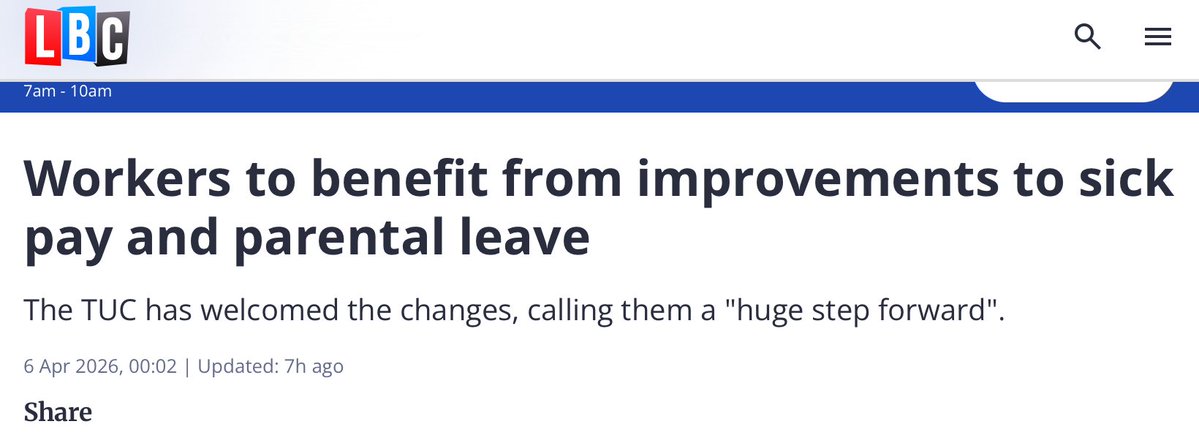
Today millions will get sick pay for the first time, and from day one Paternity leave from day one Ending the two-child benefit cap will lift hundreds of thousands of kids out of poverty. Union campaigning & a Labour government making a difference. Progress made. More needed.
Paul Nowak tweet media
English
1.2K
295
743
147.1K
Mark Williams
Mark Williams@williams2mark·
@Landeur Even if you compensated them for what they’d receive if they’d invested the money?
English
0
0
0
2
Mark Williams
Mark Williams@williams2mark·
@mmamas1973 That’s very interesting. Regardless of lipid profile, BP etc. I’m tempted!
English
0
0
1
21