Xiao Dou | Cloud + AI

1.7K posts

Xiao Dou | Cloud + AI banner
Xiao Dou | Cloud + AI

Xiao Dou | Cloud + AI

@FightyAI

Cloud access where credit cards don't work. AWS · GCP · Alibaba · Tencent — no card needed. Built by ex-AWS & Alibaba Cloud team. → https://t.co/TjlDbd1bBO

Global Sumali Ekim 2022
578 Sinusundan627 Mga Tagasunod
Naka-pin na Tweet
Xiao Dou | Cloud + AI
Xiao Dou | Cloud + AI@FightyAI·
A developer in Lagos can't pay for AWS because their card limit is $20/month. A freelancer in Karachi gets their payment declined every time they try to top up GCP. A startup in Colombo spent 3 days trying to verify their credit card with AWS. These aren't edge cases. This is the reality for millions of builders. Here's what we do about it 🧵
English

1
0
2
128
Xiao Dou | Cloud + AI
True. And once the business model proves out — where agent output value consistently exceeds token cost — the monitoring shifts from "how do we spend less" to "where do we scale up." But until that ROI loop is validated, instrumenting from day one is the only way to know if you're burning or building.
English
0
0
0
3
Hamza Tahir
Hamza Tahir@htahir111·
Agents burn ~4x the tokens of a chat interaction. Multi-agent systems hit ~15x. At scale, hundreds of thousands of runs! You’re looking at hundreds of thousands or even millions in spend over a year. That’s massive. Most teams haven’t hit this scale yet, but in a year, cost will become a limiting factor. My hot take: The teams that survive will be the ones who instrumented from day one, not the ones scrambling to add cost visibility after the bill arrives.
English
1
0
1
28
Xiao Dou | Cloud + AI
Fully agree. I run AI agents daily for my business — content generation, customer research, market monitoring, all automated. Token consumption keeps climbing but the business value far exceeds the cost. The real CFO question isn't "why did Bob burn 200k" — it's "how much revenue did that 200k generate." Once that ROI is measurable, the token budget really does become infinite.
English
0
0
0
6
0x_Vivek
0x_Vivek@0x_Vivek·
@levie cfo looking at the aws bill wondering why bob burned 200k on claude tokens is gonna be a movie. if agents output more value than they consume, the token budget becomes infinite.
English
0
0
2
145
Aaron Levie
Aaron Levie@levie·
Without getting into the specific numbers, this underlying concept and trend is going to be very real. For any worker who is able to wield AI agents effectively in an organization, their compute budgets are just going to monotonically go up over time. This will of course start in engineering, where we already know developers can run multiple agents in parallel, or have projects going over night. But this eventually hit the rest of knowledge work as well. Lawyers that can create and review more drafts, marketed that can build more campaigns and test more ideals in parallel, sales reps that can reach out to more customers and process more leads. Many of these activities will essentially be token-dependent in how much work a single person can do. These aren’t chatbot workflows answering a simple question, but agents that are running and processing through incredible amounts of data at scale, and generating all new forms of information. Companies will have to figure out how they budget for this, and it likely won’t be an IT budget item over time, but ultimately owned and allocated by the business. Maybe the CFO is ultimately the head of AI :-).
TFTC@TFTC21

Jensen Huang: "If that $500,000 engineer did not consume at least $250,000 worth of tokens, I am going to be deeply alarmed. This is no different than a chip designer who says 'I'm just going to use paper and pencil. I don't think I'm going to need any CAD tools.'"

English
78
53
480
219.7K
Xiao Dou | Cloud + AI
Agreed. I spent years at AWS and the pricing model hasn't fundamentally changed — hourly/second billing, RIs for commitment. But sandbox and agent workloads look nothing like steady-state compute. They burst hard, idle long. Current pricing was built for predictable loads, not pulse-driven consumption. The 10x compression probably won't come from discounts — it needs a completely different billing architecture.
English
0
0
0
28
Diptanu Choudhury
Diptanu Choudhury@diptanu·
Unless there is a major shift in pricing, it would be difficult to build the next generation of compute infrastructure on AWS, GCP and Azure. To build a healthy business around sandboxes there needs to be at least a million sandboxes running in parallel. And it has to be on bare metal infrastructure to get good margins. The cloud is a great place to start and experiment.
English
13
1
38
5.4K
Xiao Dou | Cloud + AI
@saidul_dev Smart optimization. Worth noting there's another invisible cost layer for Indian dev teams — 22% GST on foreign AWS transactions sits on top of compute costs. Lightpanda helps the compute side. The payment overhead is a separate problem most don't budget for.
English
0
0
0
8
Saidul
Saidul@saidul_dev·
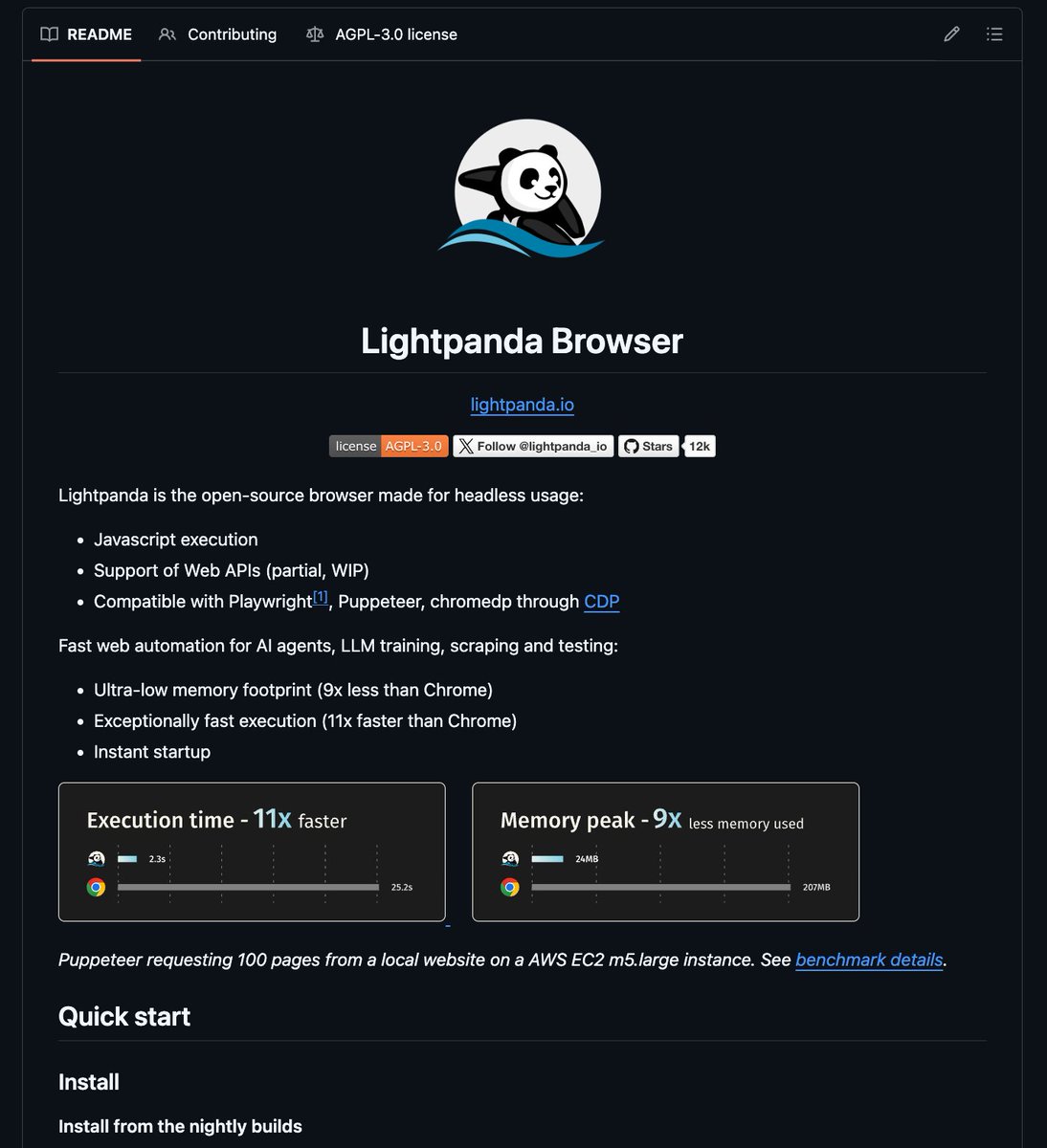
Real benchmark: Puppeteer requesting 100 pages on AWS EC2 m5.large: Chrome → baseline Lightpanda → 11x faster, 9x less RAM If you're running AI web agents at any kind of scale, this is the difference between a $500/month infra bill and a $50 one.
English
2
0
0
84
Saidul
Saidul@saidul_dev·
🚨BREAKING: A new open-source browser just appeared that runs 11x faster than Chrome while using 9x less memory. It’s called Lightpanda, and it’s designed from the ground up for AI agents, scraping, and automation. Not built on Chromium. Not a patched version. A completely fresh browser written in Zig. Here’s why this could be a huge deal for AI builders: ↓
Saidul tweet media
English
2
15
41
3.7K
Xiao Dou | Cloud + AI
@Ncky_Mrtnez @djcows Data backs this. If you're building from India, that AWS bill comes with a 22% GST on foreign transactions — plus most credit cards cap international payments at ₹15,000/month (~$175). The humility kicks in earlier than expected, sometimes mid-launch.
English
0
0
0
6
djcows
djcows@djcows·
i'm scared my startup will make too much money, that would not be very humble
English
26
7
116
3.4K
Xiao Dou | Cloud + AI
Xiao Dou | Cloud + AI@FightyAI·
A college student in India created a GCP account for a lab assignment. His bank card couldn't process the recurring payment. Weeks later: ₹98,940 invoice. Collections letter from the US. I broke down the invisible 22% tax Indian developers pay on every AWS bill ↓ x.com/FightyAI/statu…
English
0
0
0
25
Xiao Dou | Cloud + AI
Xiao Dou | Cloud + AI@FightyAI·
Cloud billing fees most emerging market developers don't realize they're paying: → FX conversion: 3-5% → Bank international transaction fee: 2-3% → Failed payment retry penalty: varies → Account suspension recovery: 24-72 hours of downtime That's 5-8% tax just for living in the wrong country.
English
0
0
0
32
Xiao Dou | Cloud + AI
Useful list — but worth flagging that "100% guaranteed" on AWS credits depends heavily on context. AWS Activate has tiers. The self-serve tier ($1K) is broadly accessible. The $25K tier typically requires an affiliated accelerator or VC backing. Approval rates for founders in Lagos or Nairobi without a YC/Techstars affiliation are materially lower than the headline suggests. The real gap isn't getting credits — it's what happens at the payment cliff when they expire. That's where the geographic penalty kicks in hardest.
English
0
0
1
641
Name cannot be blank
Name cannot be blank@hackSultan·
List of some AI subscriptions and startup credits that you might qualify for and your chances of getting them on fushly ( fushly.com) : - $25,000 AWS credits ( 100% guaranteed ) - $8500+ Lovable credits ( 100% guaranteed as long as you’re building a startup ) - $25,000 Google cloud credits ( 90% guaranteed, as long as you’re building a startup ) - $50,000 Shied credits ( 100% guaranteed as long as you’re a business ) - $1497 @BugBunny_ai credits ( 100% guaranteed ) - $449 @ValyuOfficial credits ( 100% guaranteed ) - $10,600 @pipeopshq credits ( 100% guaranteed, if you’re building a company ) There’s like 150 credits listed there, not every single credit if guaranteed because the platforms will have to vet your applications themselves, but there are some that are being allocated by Fushly directly so you’re good. Just become a member and you can even request any credit you want. Goodluck✌🏽✌🏽. The platform is not free, it’s a members only platform. One simple membership opens you to so many opportunities.
Adewale@Ace_KYD

Which AI subscriptions are you paying for right now?

English
15
57
365
39.8K
Xiao Dou | Cloud + AI
Solid playbook — every step here is correct and well-documented. The part that's easy to overlook: this assumes someone on the team knows how to navigate Cost Explorer, evaluate RI commitment trade-offs, and set up lifecycle policies. At sub-$50K MRR, most teams don't have dedicated DevOps. The founder is usually the one staring at the bill — and they're optimizing product, not infrastructure. The real bottleneck isn't "what to do" — it's "who does it." That's why most of these optimizations sit undone for months even when the playbook is public.
English
0
0
1
5
Harshil Tomar
Harshil Tomar@Hartdrawss·
This Reddit user cut his AWS bill from $8K to $3K/mo without a single minute of downtime. Here's the exact playbook: 1/ the problem > B2B SaaS at $15K MRR spending $8K/month on infra > thats more than 50% of revenue going to AWS > oversized EC2s running 24/7, no auto-scaling, RDS way too big > S3 costs bleeding because lifecycle policies never set up > load balancers running for services with barely any traffic 2/ what he actually changed > right-sized every instance after 2 weeks of CloudWatch data. most were running at 10-15% CPU. dropped 1-2 sizes across the board. saved $2K/mo instantly. > bought 1-year reserved instances for baseline load. knocked off another 30-40% on those. > set up auto-scaling groups instead of keeping big instances on 24/7 for 4 hours of peak traffic. warm pools made it seamless. > S3 lifecycle policies. standard → infrequent access at 30 days → Glacier at 90 days. costs dropped 70%. > killed zombie resources. 3 dead EBS volumes, 2 unassociated elastic IPs, a NAT gateway for a VPC nobody was using. > moved batch jobs to spot instances. 60-70% cheaper. if interrupted, just retry. zero user impact. 3/ the real lesson > fear of downtime was costing more than downtime ever would have > most of the over-provisioning was emotional, not rational went from $8K to $3.2K in 3 weeks of part time work. now at $40K MRR. infra still under $4K. that's 10% of revenue. that's what good infra discipline looks like.
Harshil Tomar tweet media
English
4
2
29
2.9K
Xiao Dou | Cloud + AI
This is funny because it's true. But worth noting: for founders outside the US, this joke hits differently. A $47K AWS bill in USD is a procurement headache in San Francisco. The same bill hitting a team in Bangalore or Lagos — where it converts to local currency during a bad FX month — feels existential. The psychological multiplier is real. And the optimization playbook (RIs, Savings Plans, right-sizing) is almost entirely built around US startup ecosystems. Most teams outside that orbit don't even know these levers exist until the bill is already unmanageable.
English
0
0
0
12
Wise
Wise@trikcode·
Life as startup founders! "Should we use Kubernetes?" "Do we need Kubernetes?" "I don't know but Netflix uses it." "We have 12 users." "Yeah but what about when we scale?" "Fine. Add it." 3 months later: $47,000 AWS bill. Still 12 users. 6 months later: "Maybe we should simplify the architecture." The CTO who pushed for Kubernetes has already left for another startup.
English
90
44
883
57.7K
Xiao Dou | Cloud + AI
This is a meaningful step — $5K in credits removes the "getting started" barrier for early-stage teams. The gap I've seen with Indian builders isn't starting though. It's what happens when credits run out. AWS payment verification rejects many Indian cards. UPI isn't supported for recurring billing. And RBI's ~$15K annual limit on international card payments creates a structural ceiling that hits right when teams start scaling. Credits solve the access problem. The payment infrastructure problem is what keeps teams from graduating to production.
English
0
0
0
31
Vaibhav Domkundwar
Vaibhav Domkundwar@vaibhavbetter·
Amazon AWS 🤝 AI Grants India Another important step for AI Grants India: AWS is now supporting AIGI builders with cloud credits. Under this initiative, select teams in the AIGI ecosystem will be eligible for up to $5,000 in AWS credits, based on evaluation. For early builders, this matters. It extends runway. It allows teams to move from hackathon prototypes to real infrastructure-backed products without immediate cost pressure. AI Grants India was set up to solve a very specific problem. India has a large number of technically capable AI builders. Many cannot get started because access to models and compute is constrained at the earliest stage. In a short period, the program has already seen: • 1,500+ active builders • 100+ idea-stage AI startups • 1B+ tokens across leading model platforms • Adoption across IITs, BITS Pilani, IIIT Hyderabad, Network School, hacker houses, and national hackathons AWS credits add another layer of enablement to this ecosystem so early-stage innovation can compound. Grateful to AWS for supporting grassroots AI development in India.
English
6
7
94
7.1K
Xiao Dou | Cloud + AI
Something most developers don't know about Google Cloud: If your YouTube account gets flagged for "suspicious activity," Google can suspend your entire GCP infrastructure. Production servers. Databases. Everything. Your personal Gmail and your production cloud should never share the same Google account.
English
0
0
0
21
Jason Zhu
Jason Zhu@GoSailGlobal·
哈哈 打泰拳的老板在我安利下买了Claude 在用Claude Code搭建预约网站👀
Jason Zhu tweet media
中文
2
1
10
2.4K
Xiao Dou | Cloud + AI
@GaneshKompella Great breakdown. The "one database for everything" problem is universal. Curious — for your Indian clients, how much of that $14K was actual compute vs. the GST + forex markup layer? We've seen cases where the payment overhead alone adds 22% on top of face value.
English
0
0
0
4
Ganesh Kompella
Ganesh Kompella@GaneshKompella·
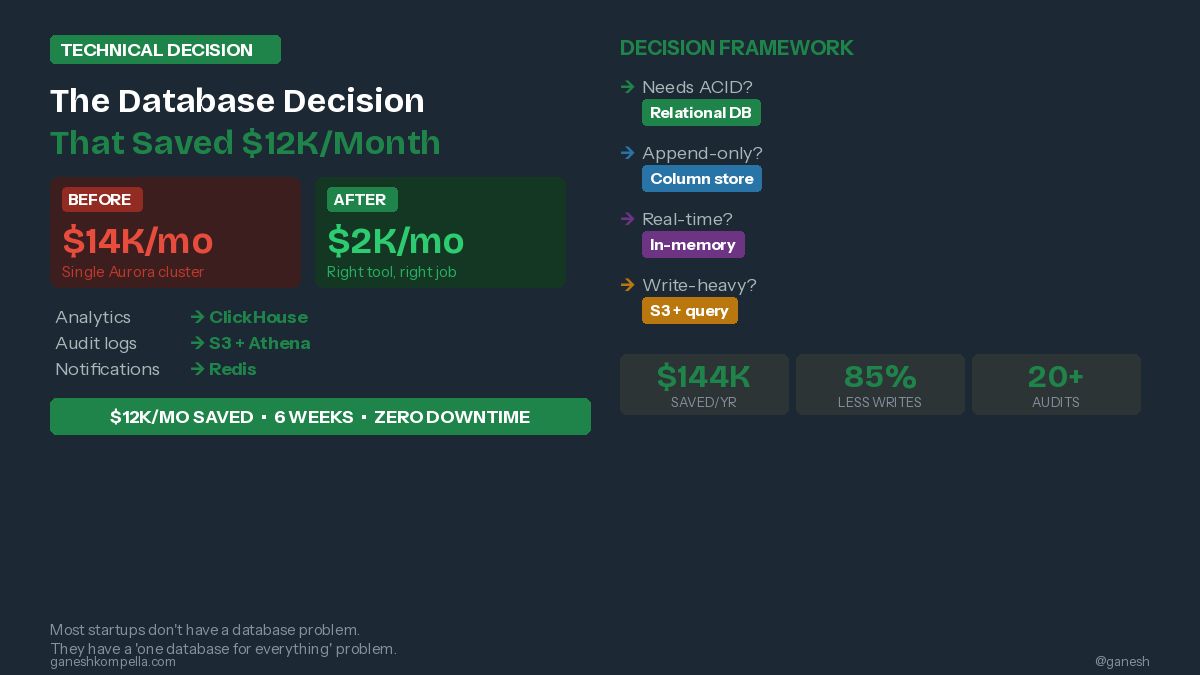
A client's AWS bill was climbing $3-4K every month. Root cause: everything in one Aurora PostgreSQL cluster. The fix: → Analytics events → ClickHouse → Audit logs → S3 + Athena → Notifications → Redis $14K/mo → $2K/mo. Six weeks. Zero downtime. Most startups don't have a database problem. They have a "one database for everything" problem.
Ganesh Kompella tweet media
English
2
0
0
41
Xiao Dou | Cloud + AI
Spot on. The "no one is looking" problem is even worse than most people realize. We audited payment flows for dev teams in India and Nigeria — turns out 18-22% of their cloud spend isn't compute at all. It's forex markup, mandatory GST, and bank processing fees that never show up in Cost Explorer. You can optimize every resource perfectly and still overpay by 20%+ just because of where you're located.
English
0
0
0
29
Filipe Névola
Filipe Névola@FilipeNevola·
Last week I looked at a company's AWS bill. $20k/month. I found $6k in pure waste in under an hour. Staging environments that no one remembers creating. NAT gateways running 24/7 for a service that was deprecated last year. Snapshots from a migration that "we'll clean up later." Spoiler: no one cleaned them up. 30% of what most companies pay for AWS is waste. And it's not only because AWS is expensive (it is, and we can talk about that another time). It's because no one is looking. The app runs. The team ships. The bill goes up every month. And no one asks why. The worst part? Most of these issues aren't hard to fix. They're just hard to see when no one has time to look. I put together a short guide with the 5 most common money drains we find when auditing cloud accounts. No fluff, just what to look for and where. DM me if you want it.
English
1
1
6
67
Xiao Dou | Cloud + AI
Been there. The postpaid model is designed to let costs run ahead of you — especially when you're not watching 24/7. One thing that helped me: switching to prepaid cloud accounts. You load a specific dollar amount, use it until it's done. No surprise bills, no budget overruns. Worth looking into if you want to keep building without the billing anxiety.
English
1
0
1
16
Jeremy 💻🎮🔭
Jeremy 💻🎮🔭@pcnerd37·
WTF!!! I have an @Azure App Service Plan that went way past its supposed $69.35/mo plan, blew past my monthly budget and now I'm stuck with an astronomical cloud bill. I can't afford this when I'm unemployed!!! @AzureSupport
English
3
0
0
265
Xiao Dou | Cloud + AI
@trikcode The real plot twist: the CTO's new startup is also running Kubernetes. But seriously — postpaid cloud billing is the root cause. You can't accidentally spend $47K on something you prepaid $500 for.
English
0
0
0
15