Ramesh May

1.3K posts

Ramesh May

Ramesh May

@rameshmay

Co-founder https://t.co/uTRQLGpgyL, tech junkie, love sports, food and travel

Bengaluru, India Sumali Ocak 2009
217 Sinusundan146 Mga Tagasunod
Ramesh May
Ramesh May@rameshmay·
@heygurisingh I think it always comes down to basics - identify (aka understand) the problem, solve it, create outcome. And this applies to pre-AI, NOW (with AI) and the potentially "coming soon" AGI days as well.
English
0
0
0
18
Guri Singh
Guri Singh@heygurisingh·
I asked Claude which startup idea has the highest success rate in 2026, which one is already saturated, and which one solo founders should actually bet on out of 6 trending categories: - AI agents for SMBs - Vertical SaaS - Developer tools - Creator economy platforms - B2B marketplaces - AI-native consumer apps And this is what Claude concluded. ↓
English
19
29
258
85.8K
Ramesh May
Ramesh May@rameshmay·
@_CallMeMacy Yes we vibe coded our CRM as well with just necessary functionality we really care about .. and that is good enough. Just need to be careful in going beyond strict MVP and having to deal with too many bugs/issues, etc.
English
0
0
0
73
Macy Mills
Macy Mills@_CallMeMacy·
Lately, I've been advising founders to vibecode their own CRM that reads their emails, calendars, and keeps things up to date in real time. It took me 2 hours to create my own using Claude Code (and I've never coded in my life). Am I crazy for suggesting this or do others agree?
English
197
3
267
58K
Ramesh May
Ramesh May@rameshmay·
AI enables organizations and individuals to play offense through sustained augmentation and expansion. That's what we're building at PitCrew. Our agent builder lets teams turn their own workflows into running agents, so the same people cover more ground.
PitCrew Agents@GoPitCrew

x.com/i/article/2049…

English
0
0
0
13
Ramesh May nag-retweet
Nikesh Arora
Nikesh Arora@nikesharora·
I would have expected the market to start discerning between SaaS that is impacted by AI, SaaS that needs to evolve, and SaaS that benefits from AI. Analytical SaaS, Creative SaaS is in category 1, System or Record, Human workflow and Engagement and Productivity are in category 2 and Infrastructure SaaS and Cybersecurity are in 3. This constant paranoid reaction of the market will continue to create buying opportunities for the discerning.
English
92
126
1.2K
254.4K
Ramesh May
Ramesh May@rameshmay·
@gokulr It is true that PMs/eng can vibe-develop a product but dont ignore continuous development, bug fixing, solving for internal requirements, etc. If you have resources, sure, but many companies cant afford to focus away from core. But this puts enough pressure on ACV to go down.
English
0
0
2
166
Gokul Rajaram
Gokul Rajaram@gokulr·
THE BUILD CEILING In the past few weeks, I've seen two different startups lose enterprise deals: one $1M ACV killed at the final stage of approval, another seven-figure ACV (that's been a customer for 2+ years) now on the chopping block. Same reason both times: the buyer decided to build internally instead. This is the new last-mile risk in enterprise sales. If you're selling application layer or workflow software to any team inside an enterprise, think hard before crossing $500k ACV. Above that threshold, your real competition is an internal employee plus an AI coding agent: not the next vendor on the shortlist. The math has shifted. A mid-level engineer or a domain expert with Claude Code or Codex can now replicate a functional workflow tool in weeks. Not a perfect one. Good enough. And "good enough" is all procurement needs to justify the kill. The underlying dynamic: enterprise teams are now being evaluated on AI nativeness. Finance, HR, ops: every functional team has an AI transformation mandate on their 2026 OKRs. The fastest way to demonstrate AI chops is to kill a vendor tool and replace it with something built internally. The switch signals more than cost savings. It signals that the team can build. At $50k ACV, nobody staffs a project to replace you. At $500k+, the VP has a business case that almost writes itself. Pipes products are largely safe: build complexity is high and switching cost is real. But dashboard-style workflow tools: approval flows, reporting layers, lightweight data apps, form-based operations software: these are exactly the category a mid-senior level employee with domain expertise and an AI coding agent can ship in a sprint. Call it the build ceiling (TM). Every application layer startup now has one. Most founders don't know where it sits for their category. Founders selling workflow software: understand your build ceiling and audit every prospect and current customer. And proactively price below the build ceiling: the price point where the ROI of replacing you never pencils out.
English
50
44
414
94.3K
Jasper Polak
Jasper Polak@polak_jasper·
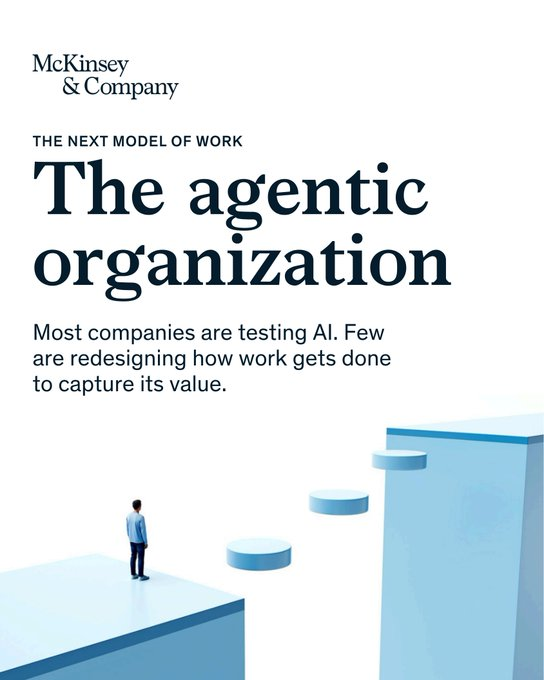
McKinsey published a piece this week on "The Agentic Organization." They claim most companies are stuck in pilot mode because the work itself hasn't changed. What "pilot mode" looks like at a 75-person consulting firm I've seen inside: - One analyst running Claude for market research. - A few associates using Gemini to draft deck sections. - A partner who built a private GPT for proposal writing and didn't tell anyone. All real. But none of them changes the firm's throughput, win rate, or margin. The pilots aren't failing because the tools are wrong. They're failing because nobody redesigned the workflow around them. Going from pilot to production means picking one full workflow, rebuilding it agent-first, measuring it against the old one, then rolling it out across the firm. That's the step McKinsey's framing is pointing at. Most firms skip it because it's harder than adding more tools. Link: mckinsey.com/capabilities/p…
Jasper Polak tweet media
English
40
124
943
139.5K
Ramesh May
Ramesh May@rameshmay·
@BadCapitalVC @sundeep All good but we seem to forget that between machinery and the data there is a big boulder (or the chasm) called the "people" who will not easily let the machine access the data ... services is that bridge that could bridge the chasm between machine and data.
English
0
0
1
36
Arjun Malhotra
Arjun Malhotra@BadCapitalVC·
Think of the AI stack like a factory: data is the raw material, software is the machinery, and agents are the workers. For decades, owning the machinery was the only moat. But as @sundeep suggested, the "workers" don't need the "machinery" anymore - they can go straight to the "raw materials." It's still early, but it's hard not to wonder what that means for the software layer over time.
English
11
7
99
11.3K
Ramesh May
Ramesh May@rameshmay·
@rentickle The cooler i rented from you is not WORKING .. i pointed out on day of delivery, cooler looked 20 yrs old but you assured me that it will be replaced. Nothing happened .. I paid for 3 months upfront. Is that why you dont care ?? #rentickle #badsupport
English
0
0
0
16
Ramesh May nag-retweet
Rishi Kulkarni
Rishi Kulkarni@rishikulkarni·
@ravi_lsvp Context winners from multiple angles. Systems of records believe they have right to win, Frontier models could build harness infra to simplify context capture. And domain or vertical experts bring unique workflow trajectories that address trust+context (eg financia services)
English
0
1
3
40
Ramesh May nag-retweet
Ramesh May
Ramesh May@rameshmay·
@pzakin Here is what-to-work-on-next could be the starting point (not what do you want to do). The agent should already have the context. It should proactively surface priorities, not wait for a prompt. Show the job-to-be-done, don't ask for it.
English
0
0
1
43
Peter Zakin
Peter Zakin@pzakin·
I feel like this screen should show the user what the agent thinks this team needs to work on next, particularly what issues need to be spec-ed out. "Figuring out what to work on next" requires context around product judgment, app context, company strategy etc... So starting here probably isn't useful for teams that haven't shared sufficient context. But for the teams that do, this feels like the right starting point.
Peter Zakin tweet media
English
8
0
32
3.8K
Ramesh May
Ramesh May@rameshmay·
@amix3k 100%. The missing piece: a harness that lets users build specialized agents. At PitCrew, users create their own compliance agents via factory.gopitcrew.com - with domain tools, regulatory gates, and human review baked in.
English
0
0
0
20
Amir Salihefendić
Amir Salihefendić@amix3k·
What matters here isn’t the chat interface, but that SaaS apps are adding specialized agents. That may also point to where SaaS is heading. Attio, for example, is no longer just offering a CRM interface. It’s also building a CRM agent that is far more optimized for CRM workflows than a general-purpose agent like Claude or ChatGPT. We’re doing something similar with Todoist Automations. We have a dedicated Automations Creator agent with a harness that makes it highly effective at creating and updating automations. 🤔 The real battle isn’t SaaS vs. agents, but general-purpose vs. specialized agents.
Rabi Shanker Guha@rabi_guha

notice something? Linear, PostHog, Attio - all shipped the same thing in the last few weeks. Homepage is a chat bar - not a dashboard. This is the SaaS industry quietly admitting that traditional UI doesn't work anymore. Every user is different. One homepage can't serve them all. The playbook is shifting: → expose your core APIs → connect an agentic layer → let users use software the way they want SaaS became chat. Chat will become Generative UI - the agent won't just reply in text, it will compose the interface itself. We're closer than people think.

English
18
1
69
23.2K
Ramesh May
Ramesh May@rameshmay·
@brettdash_ Nail on the head. @GoPitCrew we have used kanban board to represent agent workflows. Visible swimlanes, tasks, tools, compliance gates. Users prompt, the builder curates the rest into a board you can see, edit, and run. Kanban as agent UI > text box.
English
0
0
1
18
Ramesh May
Ramesh May@rameshmay·
@Appyg99 Folks need to apply first principles, always. Think from a perspective of what problems to solve first and then the how - chat UI, dashboard or something else. There is no need to simplify for the heck of it.
English
0
0
1
12
Ramesh May
Ramesh May@rameshmay·
@hvpandya We had a similar thesis when building factory.gopitcrew.com. Instead of a text box, users build structured agent workflows. The agent executes step by step, pauses at human review gates, continues. The UI is the run itself. Users see what's happening, not guess.
English
0
0
1
48
Hardik Pandya
Hardik Pandya@hvpandya·
The biggest issue with replacing all purpose-built UI with a text box is that it shifts the burden of figuring out how to get to the right intentful UI, on the user. It sounds easy for the makers. Easy to justify too. The feeling of ‘simplifying complex interfaces’ that has eluded most enterprise software builders for decades. If you’ve built anything at scale, you know users don’t intuitively figure out ‘what to prompt’. An empty text box, just like the empty document is one of the hardest starting points for any clear JTBD. On top of that there’s a million other issues too: the system you can only ‘look through’ a small prompt box is inherently un-navigable. And what’s un-navigable is unusable at scale. Such a system also does NOT expose its capabilities to the user. What’s the scope of things I can ask here? What do I type for what I want? What if my input is imprecise? A text box is not the end-all UI for enterprise software. We need to do better.
Rabi Shanker Guha@rabi_guha

notice something? Linear, PostHog, Attio - all shipped the same thing in the last few weeks. Homepage is a chat bar - not a dashboard. This is the SaaS industry quietly admitting that traditional UI doesn't work anymore. Every user is different. One homepage can't serve them all. The playbook is shifting: → expose your core APIs → connect an agentic layer → let users use software the way they want SaaS became chat. Chat will become Generative UI - the agent won't just reply in text, it will compose the interface itself. We're closer than people think.

English
26
23
236
29.4K
Ramesh May
Ramesh May@rameshmay·
@karrisaarinen Crawl-walk-run I guess .. add chatbot while transitioning from SaaS to AI world for comfort and continuity. Along similar lines, difficult to make a move from seat based pricing to outcome based pricing.
English
0
0
1
121
Ramesh May
Ramesh May@rameshmay·
@aakashgupta In regulated/domain-specific industries, the UI cannot just be a chatbar. It is the agent workflow with HITL gates. Prompt to build, then agents execute, shows findings with citations, pause for compliance review, and continue. That has been our approach @GoPitCrew
English
0
0
1
48
Aakash Gupta
Aakash Gupta@aakashgupta·
The most expensive real estate in SaaS was always the homepage. Billions of dollars in PM salaries, A/B tests, and design sprints spent optimizing what you see when you log in. Linear, PostHog, and Attio just replaced all of it with a text field. This sounds like a UI trend. It's a moat migration. When the interface collapses to a prompt, the only thing that matters is what's behind it. Your API surface. Your data model. Your integrations. The companies that spent 10 years perfecting complex dashboards just watched their primary competitive advantage become a liability. Salesforce has 300+ tabs. ServiceNow's UI requires a 6-week training course. Workday's interface is so dense that entire consulting practices exist just to navigate it. Every one of those layers of complexity was a switching cost. Users couldn't leave because they'd already learned the maze. A chat bar has zero switching cost. You type what you want. If the agent behind it can query your data and execute your workflow, the wrapper becomes interchangeable. The $250B enterprise SaaS market built on UI complexity suddenly has to compete on pure infrastructure. The winners already know who they are. Snowflake, Databricks, Stripe. Companies that always treated the UI as a thin layer over a deep data engine. The losers are every company whose product is essentially a spreadsheet with better CSS. Generative UI means the last 15 years of frontend moat-building were a warmup act for the only question that ever mattered: how good is your API?
Rabi Shanker Guha@rabi_guha

notice something? Linear, PostHog, Attio - all shipped the same thing in the last few weeks. Homepage is a chat bar - not a dashboard. This is the SaaS industry quietly admitting that traditional UI doesn't work anymore. Every user is different. One homepage can't serve them all. The playbook is shifting: → expose your core APIs → connect an agentic layer → let users use software the way they want SaaS became chat. Chat will become Generative UI - the agent won't just reply in text, it will compose the interface itself. We're closer than people think.

English
19
20
235
79.9K
Ramesh May
Ramesh May@rameshmay·
@rabi_guha UX is only means to an end .. like a year back chatbots only was responding to questions. And then it evolved into (co)pilot, triggering workflows. While it will evolve further , we need to optimize for solving pain points VS a “better” UX . And no idea what better will mean ..
English
1
0
2
81
Rabi Shanker Guha
Rabi Shanker Guha@rabi_guha·
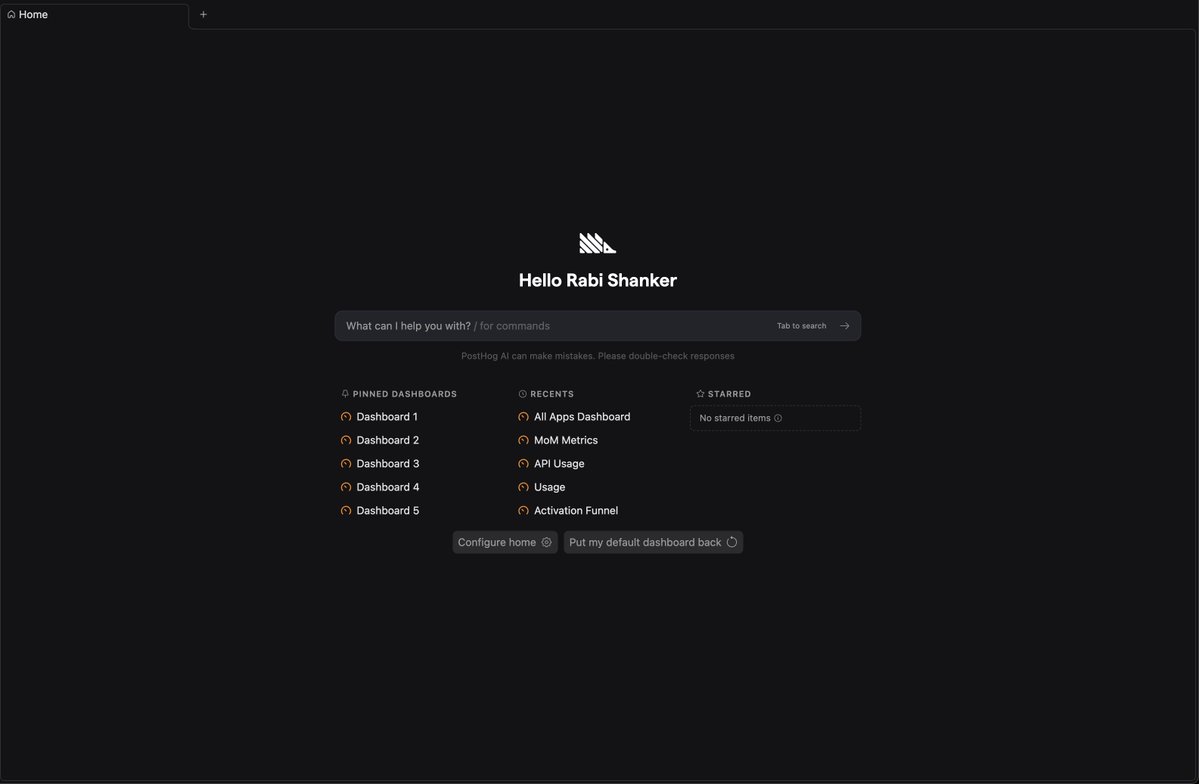
notice something? Linear, PostHog, Attio - all shipped the same thing in the last few weeks. Homepage is a chat bar - not a dashboard. This is the SaaS industry quietly admitting that traditional UI doesn't work anymore. Every user is different. One homepage can't serve them all. The playbook is shifting: → expose your core APIs → connect an agentic layer → let users use software the way they want SaaS became chat. Chat will become Generative UI - the agent won't just reply in text, it will compose the interface itself. We're closer than people think.

Rabi Shanker Guha tweet mediaRabi Shanker Guha tweet mediaRabi Shanker Guha tweet media
English
252
162
2.4K
1.5M