
Naka-pin na Tweet
rodamn
22.9K posts

rodamn
@rodamn
Our beliefs & opinions are based on our current understanding. Gather more data/evidence, refine beliefs & opinions, let the disproven go, and adopt the new.
Los Angeles, CA Sumali Ocak 2009
1.2K Sinusundan1.7K Mga Tagasunod
Accident-prone drivers are the first people who ought to buy FSD
It will save you so much money in the long run
Seeing damaged cars that are practically new—
still with temporary tags, and the paint hasn’t even had time to accumulate an iota of dust—
Gotta wonder how much better they’d have been with a FSD-enabled Tesla
$99 per month is going of a lot cheaper than paying the minimum deductible
and then paying the increased insurance premium
English
@wholemars Time for NASA to just dump Artemis and get a Starship-based plan going
English

NASA Plans Bigger SpaceX Moon-Mission Role in Blow to Boeing bloomberg.com/news/articles/…
English
@yunta_tsai Mom used to take me as a toddler to her office on weekends
She’d be coding up a stack of punchcards 🥶
English

Our grandmas are actually professional programmers. 🧶
GIF
Massimo@Rainmaker1973
Before we had silicon chips, we had needle and thread. In the 1960s, NASA didn’t ‘upload’ code; they sewed it. To get Apollo 11 to the moon, skilled weavers (often called ‘Little Old Ladies’) literally hand-stitched software into physical objects.
English
rodamn nag-retweet
rodamn nag-retweet

@KobeissiLetter @mrfundman How can anyone go without 𝕏?
Financial media points the finger at the Fed for the current market weakness
This is completely undiscussed as a contributing factor
English

This is absolutely insane:
The world is quite literally facing what appears to be the largest energy crisis in history.
US crude oil futures are now trading at a $20+/barrel DISCOUNT to Brent, also one of the largest on record.
As the US increases production and taps into reserves, the EU is facing a full out energy crisis.
European natural gas prices are up another +30% today and physical crude oil prices in Oman and elsewhere are trading at $150+/barrel.
In other words, the gap between Oman and US prices now stands at ~70%, or ~$70+ per barrel.
It has become so bad for Europe that the market is now pricing-in 2 interest rate HIKES in 2026, even as the US removes sanctions on Russian oil.
US rate cuts in 2026 are almost entirely priced-out as a result with Core PPI inflation on PRE-WAR data rising to its highest since February 2023.
The entire global economy just took a complete 180 degree turn in 3 weeks.
The next few months are going to be historic.
English
What is your basis for this understanding, though? It seems like a lot of Waymo understanding is just what people externally pieced together based on rides and maybe interviews
I just wonder how much we have gotten wrong
I see it happening in the real world at least twice per week
I’d estimate I encounter a Waymo 100-200 time every week
(not because unique Waymos, could be same vehicles over and over)
English

From what I understand is Waymo phones home (Remote Assist) when there's a solution that is needed if the vehicle gets stuck.
Waymo is completely unsupervised when it's doing normal routing or needing to reroute itself, pulling over and parking and etc... Only time when someone helps it is when an issue occurs. And no this doesn't mean someone has a steering wheel in an office somewhere driving the thing. The delay would be way too much for such thing.
All these people would do is give the vehicle a solution route and the vehicle would take it (if it likes it). If it doesn't like it the vehicle doesn't really try moving.
As you already know Waymo has scaled massively so of course we're gonna see issues here and there with them. Same thing will happen with Tesla Robotaxi once that is scaled.
Also realize that Cyber Trailer always posts Waymo's having issues and when it's Tesla there's hardly a mention. So there's a bit of bias there and I would even go as far to say fear mongering of Waymo's being inputted from his end.
English
How can anyone know Waymo is fully unsupervised?
How can one be so sure that there aren’t remote operators remotely checking into the vehicles to take over when things get hairy? (I.e. intermittent supervision)
This belief could be an unsubstantiated myth as there is no way to verify for themselves; the system is opaque, and you only have Waymo’s word
And what would make one believe this to be true?
Look at @Cyber_Trailer’s Waymo feed, go to a city with Waymo heavily rolled out
(I see on the order of 50 Waymo’s every day)
Well, Waymo’s in the past two months (coinciding with Waymo’s service expansion) are observed entering fail states at a much higher frequency
So, in theory: expansion yields more fail states, remote operators are overwhelmed, and unable to bail out vehicles before they enter a fail state, or are sitting in failed states longer before an operator can fix it
Unable to prove, but the observations of increasing stall rates is real
You have to come to your own hypothesis and conclusion
MonkeyFish@MonkeyFishh
@wholemars Waymo is unsupervised bud… that’s the difference
English
@wholemars Elon’s Bottleneck Extermination Service
Future of Abundance or bust!
English
rodamn nag-retweet

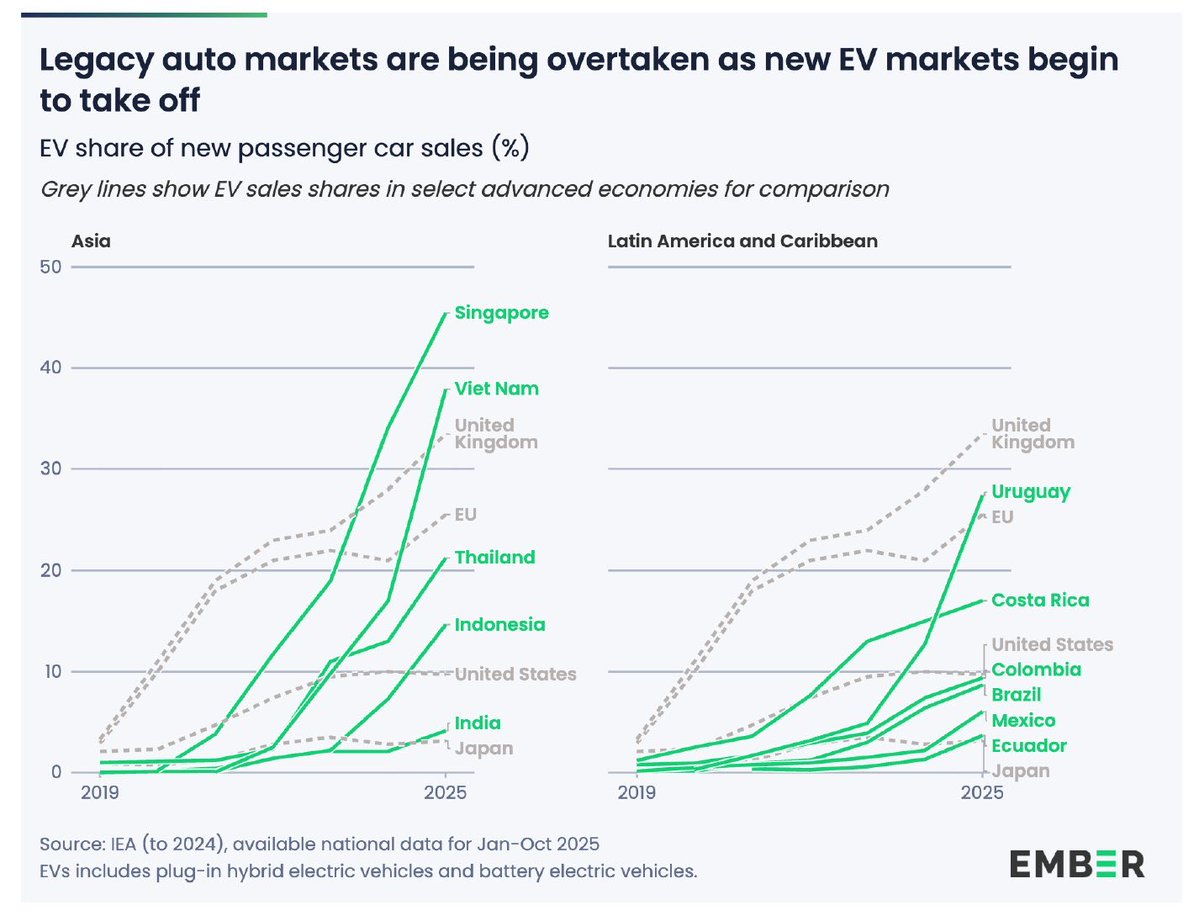
Regardless of what happens in Europe and the U.S., the world is moving to EVs.
There is nothing that western automakers can do to reverse this trend, and geopolitical risk in oil will only accelerate it.
Either get good at EVs, or wither away.
Assaad Razzouk@AssaadRazzouk
Emerging Asia is sprinting toward electric independence to crush fossil fuel fragility. Fossil fuel wars will only accelerate this trend ➡️Viet Nam: 38% EV sales share, ahead of EU ➡️Singapore: Leading the charge at 50%+ share ➡️Indonesia: 15% share, more than US ➡️Thailand: 21% share, leaving Japan (at 3%) in the rearview mirror ➡️India: Three-wheelers at 57% share, EVs rising rapidly and at 4%, already ahead of Japan ➡️China: Already banking $28b/year in avoided oil imports The era of being held hostage by oil chokepoints is coming to an end in multiple Asian countries, fast ember-energy.org/latest-insight…
English
@SawyerMerritt What are we doing for the next few weeks?
Get everything out of the way
Clear your task lists
Check your tire pressures
GIF
English

NEWS: Elon says FSD V14.3 will be released wide in a few weeks.
“It’s in testing right now.”
Elon Musk@elonmusk
@DBurkland @pbeisel It’s in testing right now. Wide release in a few weeks.
English

Do you realize that when you press send on this you turn thousands of insane nerds into hyped up children who won’t be able to sleep tonight?
I’ve gotta be up early too, you fucker.
Elon Musk@elonmusk
@DBurkland @pbeisel It’s in testing right now. Wide release in a few weeks.
English

@DBurkland @pbeisel It’s in testing right now. Wide release in a few weeks.
English

Tesla’s forthcoming AI5 uses a half-reticle design, which is crucial for yield. A reticle defines the imaging area of a lithography machine, fitting two chips per shot effectively doubles yield.
This means the Tesla chip design team had to carefully manage die features, for instance dropping the older ISP (and classic GPU) to make room for more AI cores.
By contrast, NVIDIA’s Blackwell fills nearly a full reticle, making it a single-reticle design.
If Tesla hits its compute and efficiency targets with AI5 in this half-reticle format, it’s almost like cutting fab requirements in half.
And this has a big impact on Terafab, especially if it carries forward for AI6, AI7, etc.

phil beisel@pbeisel
Terafab may be the most essential vertical integration Tesla has ever undertaken— and it is truly non-optional. It will take years to build and will test even Elon’s speedrunning abilities to the limit, but that won’t stop him from trying. The breakthrough likely lies in overhauling the overall facility’s cleanroom model. By moving wafers in sealed pods with localized micro-environments, the fab no longer needs a monolithic ultra-clean space. Elon’s line about “eating cheeseburgers and smoking cigars” on the fab floor isn’t silly, it’s the practical reality of a radically simpler, cheaper, faster approach that could finally change the economics of chipmaking. This is all forced by the brutal “pinch” in chip supply. Tesla must produce on the order of 100–200 billion AI chips per year just to saturate its roadmap. That volume powers: FSD cars & Robotaxis (tens of millions of vehicles needing AI5 inference for near-perfect autonomy), Physical Optimus (scaling from thousands today to millions per year, each requiring AI5/AI6-level compute), Digital Optimus (the new xAI-Tesla software agents for digital/office automation, running massive inference clusters), Space-based data centers (AI7/Dojo3 orbital compute for GW-scale training and inference beyond Earth limits). AI5 delivers the ~10× leap for vehicles and early robots; AI6 shifts focus to Optimus + terrestrial DCs; AI7 goes orbital. No external foundry (TSMC, Samsung, etc.) can deliver that scale or timeline— hence the Terafab launch. Without it, the entire robotics + autonomy future hits a brick wall. Terafab isn’t optional; it’s the only way forward.
English

@JCChristopher Thank you. Hard to believe anyone could have gotten it exactly backwards and blamed that crash on @elonmusk and FSD, but if anyone could, it would be Dan O’Dowd!
James Stephenson@ICannot_Enough
Dan O'Dowd falsely claimed a Cybertruck "on FSD" tried to drive "straight off an overpass"... but the crash was actually caused by Humanpilot crashing it the old-fashioned way: speeding towards a sharp curve in a 15 mph zone and losing control!
English
rodamn nag-retweet

I went to the exact same location of the Cybertruck accident shown in the Fox News video. This is the US-69/59 Eastex Freeway northbound HOV lane at the Y-split near the Eastex Park & Ride exit (approaching from downtown Houston toward Humble). In the Fox News video, the vehicle failed to follow the right curve, going straight into the barrier.
Well, I tested it twice today with Tesla FSD engaged the entire time with zero human intervention. And unless you think I am a hologram speaking to you from another dimension now, it worked out really well. Here is the video of me taking the exact same curve twice, with Tesla FSD v14.2.2.5.
English
@TSLAshareholder For sure, dude
So many people can’t fathom both League and DoTA…
Started as a WC3 mod
English

@wholemars Just a matter of time
Today is a mere instant
The future is infinite
It’s clear which system will dominate the future
English
A lot of people are focused on when Tesla will catch up to Waymo, which is fair given that Waymo has thousands of driverless cars and Tesla only has a handful.
But not enough people ask “When will Waymo catch up to Tesla?”
1. When will Waymo be able to take me on a coast to coast drive?
2. When will I be able to buy a Waymo?
3. When will Waymo cross 8 million cars that can run their software?
4. When will Waymo be able to work with no geofencing restrictions?
My contrarian take is that it’s a lot easier for Tesla to catch Waymo than for Waymo to catch up to Tesla.
English
rodamn nag-retweet

Waymo will never catch up to Tesla.
Waymo’s don’t have a big brain.
Waymo doesn’t have manufacturing expertise.
Soon it will be obvious to everyone.

Whole Mars Catalog@wholemars
A lot of people are focused on when Tesla will catch up to Waymo, which is fair given that Waymo has thousands of driverless cars and Tesla only has a handful. But not enough people ask “When will Waymo catch up to Tesla?” 1. When will Waymo be able to take me on a coast to coast drive? 2. When will I be able to buy a Waymo? 3. When will Waymo cross 8 million cars that can run their software? 4. When will Waymo be able to work with no geofencing restrictions? My contrarian take is that it’s a lot easier for Tesla to catch Waymo than for Waymo to catch up to Tesla.
English
rodamn nag-retweet
Terafab math
For “big” chips like Tesla’s AI5 (a half-reticle design, roughly 300–450 mm²), producing 100 million chips per year would require on the order of ~100k wafer starts per month, roughly the output of a single high-volume leading-edge fab.
At current industry efficiency, that translates to about 1–2 million sq ft of cleanroom space. Since cleanroom typically makes up 20–35% of total facility area, the initial Terafab phase would likely span ~4 to 10 million sq ft.
That puts the starting factory right in the same ballpark as Gigafactory Texas (~10 million sq ft).
Elon’s long-term target is a vastly higher combined volume of AI compute/memory chips for inference, far beyond the initial 100 million example.
However, the point of Terafab’s redesign is to break conventional fab assumptions, compressing more output into less space so that extreme production volumes become achievable.
phil beisel@pbeisel
Terafab may be the most essential vertical integration Tesla has ever undertaken— and it is truly non-optional. It will take years to build and will test even Elon’s speedrunning abilities to the limit, but that won’t stop him from trying. The breakthrough likely lies in overhauling the overall facility’s cleanroom model. By moving wafers in sealed pods with localized micro-environments, the fab no longer needs a monolithic ultra-clean space. Elon’s line about “eating cheeseburgers and smoking cigars” on the fab floor isn’t silly, it’s the practical reality of a radically simpler, cheaper, faster approach that could finally change the economics of chipmaking. This is all forced by the brutal “pinch” in chip supply. Tesla must produce on the order of 100–200 billion AI chips per year just to saturate its roadmap. That volume powers: FSD cars & Robotaxis (tens of millions of vehicles needing AI5 inference for near-perfect autonomy), Physical Optimus (scaling from thousands today to millions per year, each requiring AI5/AI6-level compute), Digital Optimus (the new xAI-Tesla software agents for digital/office automation, running massive inference clusters), Space-based data centers (AI7/Dojo3 orbital compute for GW-scale training and inference beyond Earth limits). AI5 delivers the ~10× leap for vehicles and early robots; AI6 shifts focus to Optimus + terrestrial DCs; AI7 goes orbital. No external foundry (TSMC, Samsung, etc.) can deliver that scale or timeline— hence the Terafab launch. Without it, the entire robotics + autonomy future hits a brick wall. Terafab isn’t optional; it’s the only way forward.
English