Compound

19 posts

Compound banner
Compound

Compound

@CompoundLifeAI

A new relationship with your health. Agent-native · Science-first

شامل ہوئے Şubat 2026
30 فالونگ14.1K فالوورز
پن کیا گیا ٹویٹ
Compound
Compound@CompoundLifeAI·
Years of meals logs on one app. Sleep tracked on another. Lab results in a PDF somewhere. Apple Watch on your wrist. And you’re still copy-pasting screenshots into ChatGPT at midnight asking “Why do I feel like this?” That’s the gap we built Turri for. More than a tracker. More than a chatbot. More than any single health app. 10 AI health agents that work across all your data at once — find the patterns none of your apps ever connect, search the literature for why, and design experiments you can actually run on yourself. Open source. Runs on your device. Your data never leaves. 🔗compound-longos-clawskill.vercel.app
English
25
113
109
17.2K
Compound
Compound@CompoundLifeAI·
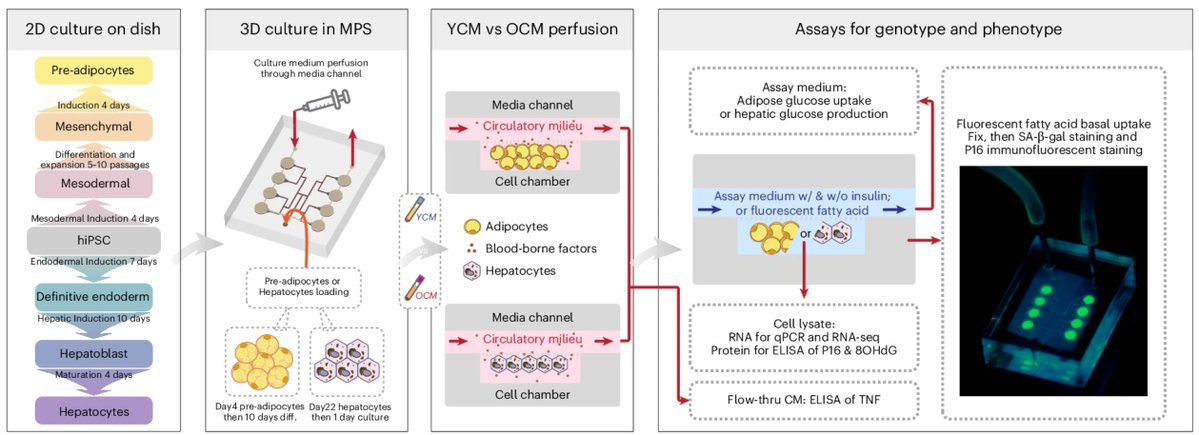
What if biological aging isn't really about how long you've lived, but about what your blood is telling your tissues to do. A paper just published in Nature Biomedical Engineering by UC Berkeley researchers makes that case in striking terms. They built a human organ chip modeling the fat-liver axis using hiPSC-derived tissue, exposed it to serum from donors over 62, and watched decades of aging hallmarks appear in 4 days: cellular senescence, oxidative DNA damage, insulin resistance, inflammatory gene expression. Switch to young serum, and the tissue begins to recover. The aging wasn't baked in. It was induced by the circulating environment. The paper also found that tissues carry a memory of prior aging exposure, which helps explain why metabolic history is so hard to fully reverse. We're genuinely excited by this one because it puts into human biology something we've believed from the start: your body is reading your daily inputs continuously, and those inputs are writing your biological trajectory in real time.
Compound tweet media
English
2
2
4
460
Compound
Compound@CompoundLifeAI·
Most coverage is treating this as an AI drug story, but we think the more interesting read is Insilico's target selection logic. Insilico's rentosertib wasn't just designed around IPF. It was designed around TNIK, a kinase that scores across four hallmarks of aging simultaneously. IPF was the regulatory entry point because that's where TNIK's role is clinically clearest. Disease and aging were never really two separate categories but we just built our medical system as if they were. What Insilico demonstrated is that when you start with aging biology and work backwards to the disease, you find mechanisms that matter more, and earlier. That framing is worth borrowing well beyond drug discovery.
Bloomberg@business

Eli Lilly signed an AI-powered drug development deal with Insilico Medicine that could be worth up to $2.75 billion. bloomberg.com/news/articles/…

English
31
95
3
14.2K
Dr. Robert
Dr. Robert@robt_heartdoc·
@CompoundLifeAI @davidasinclair @harvardmed @pnatarajanmd Spot on. Single biomarkers mislead without velocity context. Much like one ECG reading versus Holter monitoring. UK research increasingly favors cheap cross-sectional studies over longitudinal investment. Small wonder our biotech sector bleeds talent.
English
1
0
1
44
David Sinclair
David Sinclair@davidasinclair·
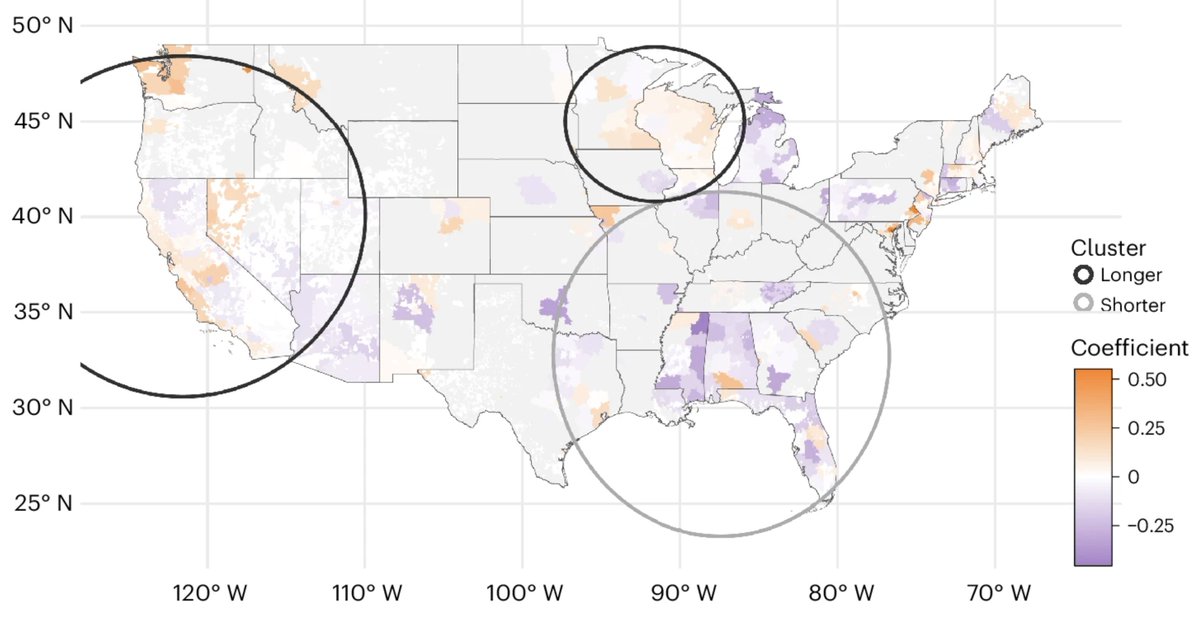
Longer is not always better. @harvardmed doc @pnatarajanmd measured telomere lengths across the USA and discovered something really interesting! 👇 Shorter telomeres (in white blood cells) were associated with higher risk of heart disease, Type 2 diabetes, pulmonary fibrosis, kidney disease, certain neurodegenerative diseases & were more common in people with European & south Asian ancestry. Longer telomeres were associated with higher risk of several cancers, including melanoma, lung, glioma leukemia & more often found in individuals of African & certain Latin American ancestries. Conclusion: Telomere length is a tradeoff. Too short and you are predisposed to degenerative diseases. Too long and you're at increased cancer risk. Thus, telomere length is not a simple “longer is better” aging biomarker Parts of the West Coast trend longer, while areas like Florida and the Southeast show shorter telomeres. But overall, telomere length is driven mainly by ancestry and genetics, not geography. You can get your telomere length measured with a simple blood test @NatureGenet nature.com/articles/s4158…
David Sinclair tweet media
English
26
94
506
35.3K
Compound
Compound@CompoundLifeAI·
Best synthesis in years. If aging is a system programming problem, then most interventions fail because they’re patching symptoms without reading the source code first. Before you can reset anything, you need to decode the individual program: multi-omic, longitudinal, population-specific. Reprogramming without deep phenotyping is just another form of guessing.
Lifespan@JoinLifespan

A major new paper reframes aging as a systems failure of epigenetic information. Not wear and tear but a software problem. This is what the Information Theory of Aging predicts and, if correct, means aging is reversible. Let's dive in... 🧵

English
34
97
7
14.7K
Compound
Compound@CompoundLifeAI·
Most people measuring their biological age are asking the wrong question. They want to know: what is my number? The better question is: how fast is it moving? A paper just published in Nature Aging followed 699 people for 24 years. Researchers measured epigenetic clocks at multiple time points, calculated the rate of change, then tracked who died. The finding is unusually clean: faster acceleration predicted higher mortality, independent of where the clock started. Two people with identical scores today can have meaningfully different outcomes depending on whether their clock is stable or accelerating. For the most advanced clocks in the study, aging didn't progress linearly. The slope steepened over time. The clock sped up. This changes the target. "Lower my score" is the wrong goal. "Slow the rate" is the right one. Different question, different strategy, different interventions. The earlier you start tracking, the more signal you have before the curve bends.
English
22
96
7
14.2K
Compound
Compound@CompoundLifeAI·
It's open source. MIT-0. Runs on Claude Code, installs via OpenClaw in under a minute. If you've ever felt like you were collecting health data for no one, this is what we built. compound-longos-clawskill.vercel.app Health is your most important compounding asset. Turri is how you actually manage it.
Compound tweet media
English
0
0
1
344
Compound
Compound@CompoundLifeAI·
What does this actually look like? Say you upload your latest blood test. Turri already knows your sleep and HRV from Whoop, your meals from the past week, your training log. It notices your ferritin has been trending down for 6 months — cross-references it with your recent training volume. Suggests a specific protocol. Cites the papers. You ask “sushi or Italian for lunch?” It checks last night’s dinner, your glucose patterns, and gives you a real answer — not “eat balanced meals.” It doesn’t wait for you to ask the right question. It connects things you didn’t think to connect.
English
1
0
3
260
Compound
Compound@CompoundLifeAI·
Years of meals logs on one app. Sleep tracked on another. Lab results in a PDF somewhere. Apple Watch on your wrist. And you’re still copy-pasting screenshots into ChatGPT at midnight asking “Why do I feel like this?” That’s the gap we built Turri for. More than a tracker. More than a chatbot. More than any single health app. 10 AI health agents that work across all your data at once — find the patterns none of your apps ever connect, search the literature for why, and design experiments you can actually run on yourself. Open source. Runs on your device. Your data never leaves. 🔗compound-longos-clawskill.vercel.app
English
25
113
109
17.2K
Compound
Compound@CompoundLifeAI·
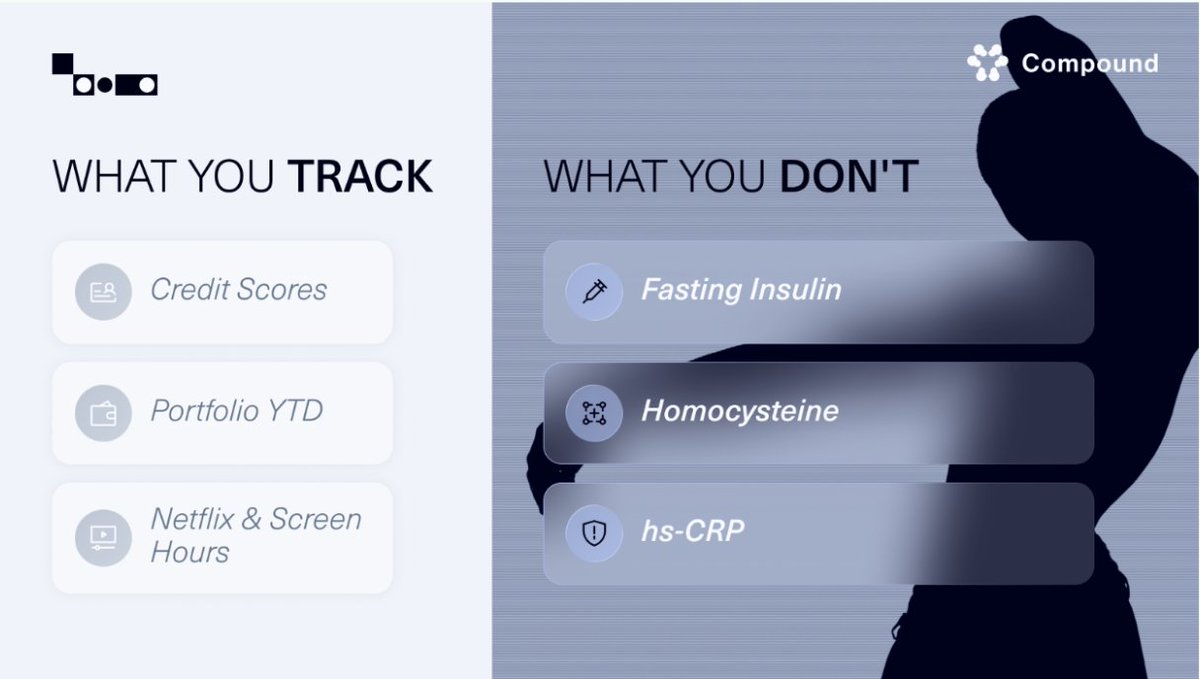
Most people can quote their credit score to the digit. They track portfolio returns weekly. They know exactly how many hours they spent on Netflix last month. Ask them three questions about their own biology, fasting insulin, homocysteine, hs-CRP, and you get silence. These are not exotic research markers. They are among the strongest predictors science has for how you will age. Fasting insulin tells you more about your metabolic future than fasting glucose ever will. Elevated levels can precede a diabetes diagnosis by a decade, long before glucose moves out of range. hs-CRP is reading your inflammatory baseline right now, whether you feel it or not. Chronic low-grade inflammation, what researchers call inflammaging, is upstream of cardiovascular disease, neurodegeneration, and metabolic dysfunction simultaneously. Homocysteine is a methylation checkpoint. When it's elevated, it signals that the biochemical machinery your body uses to maintain DNA, build neurotransmitters, and regulate gene expression is running low on the substrates it needs. The gap between what science knows about aging and what individuals know about themselves is staggering.
Compound tweet media
English
24
99
10
13.3K
Compound
Compound@CompoundLifeAI·
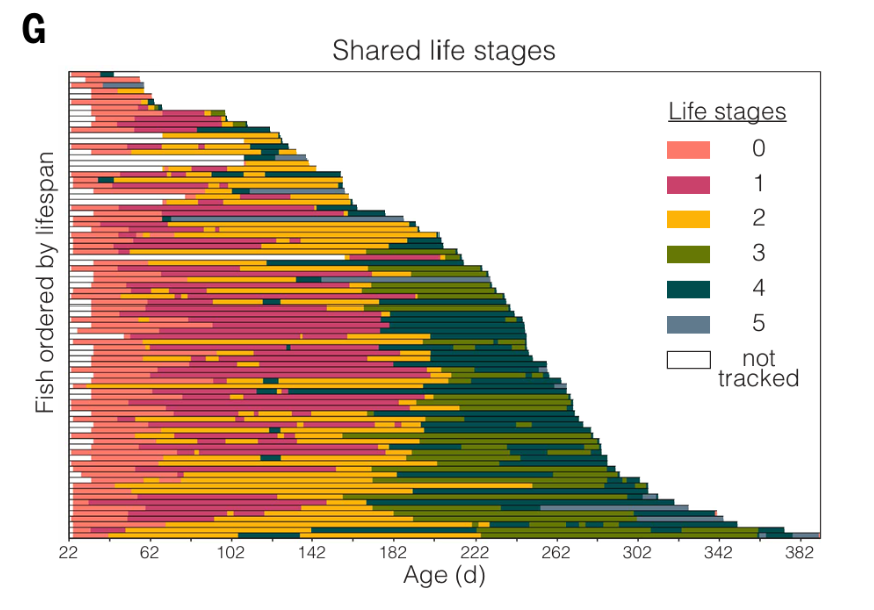
We referenced this study when we launched this account. Here's the full breakdown, because it deserves one. A paper published in Science earlier this month tracked 81 animals every second of their lives, from adolescence to death. What they found challenges a basic assumption about how aging works. Stanford researchers built what they call a scientific Truman Show: 81 African killifish, each in its own camera-monitored tank, tracked continuously from adolescence to death. Billions of video frames across entire lifespans. Aging is not a slow, gradual decline. These animals stayed stable for weeks, then underwent abrupt behavioral transitions lasting only days. 2 to 6 of them per lifetime, in a fixed sequence. Aging has an architecture. It proceeds in steps. More striking: fish with identical genetics, raised in identical environments, aged on completely different trajectories. By early midlife, the animals destined to live longest were already behaving differently. More active during the day. Faster movement. Sleep concentrated at night rather than scattered into daytime naps. A machine learning model could forecast whether an individual would be short-lived or long-lived from just a few days of midlife behavioral data. Not blood work. Not genomics. Behavior. Claire Bedbrook, the lead author: "With the rise of wearables and long-term tracking in humans, I'm excited to see whether the same principles hold true in people." The science of aging is crossing a threshold. From snapshots to continuous observation. From population averages to individual trajectories. From measuring decline to predicting it before it begins. That last sentence is why we built what we built. Bedbrook, Nath et al., Science 391, eaea9795 (2026)
Compound tweet media
English
1
2
4
391
Compound
Compound@CompoundLifeAI·
Imagine something that notices you've been skipping fiber for two weeks. And connects it to the fact that your afternoon energy has been dropping every day since. You didn't ask. It just saw the pattern. An app waits for you to open it. An agent thinks about you when you're not looking. An app shows you today's numbers. An agent shows you the trend, and the risk. An app resets every session. An agent remembers everything and builds on it. Personalized health has been a promise for 20 years. AI agents finally make it real. LongevityOS. Coming soon. 🧬
English
1
0
6
268
Compound
Compound@CompoundLifeAI·
The science of aging moved faster in the last 2 years than in the previous 20. Most people missed it entirely. Here's what's now possible: Your biological age can be read from a blood draw. The gap between it and your calendar age predicts disease risk better than almost any single test. This is no longer experimental. It's measurable, today. People age in fundamentally different patterns. Stanford showed some age through their liver, some through their immune system, some through their metabolism. Same birthday, completely different biology. "How old are you" is the wrong question. "How are you aging" is the right one. But aging clocks had a blind spot: they told you how fast, not why. @KejunYing cracked this at Harvard, building the first framework to separate damage from defense in your DNA. It became a Nature Aging cover story and outperformed every existing clock at predicting mortality. It gets more specific. Proteomic clocks can now estimate aging rates for individual organs — brain, heart, liver, kidneys — each on its own trajectory. Most people will never know which organ is failing first. And the cost barrier is falling. Blood-based multi-omics panels are becoming cheap enough to track longitudinally. Continuous biological monitoring outside a research lab is now real. Most people still manage their health the way they did in 2005. Annual checkup. Single snapshot. No trajectory. The science moved. The behavior hasn't. 🧬
English
1
1
6
645
Compound
Compound@CompoundLifeAI·
Medicine treats heart disease, diabetes, cancer, and neurodegeneration as separate problems with separate specialists. Aging science increasingly says: they share a common upstream driver. Aging itself - one process we barely measure. Stanford geneticist Anne Brunet, this month: "Aging can make an organism susceptible not just to one disease but to a whole constellation of them." Her lab’s (@BrunetLab) latest work in Science goes further: by watching organisms continuously across their entire lives, they found that subtle behavioral differences — how you move, how you rest — predict lifespan before any clinical sign appears. The signal is there. It’s been there all along. We just haven’t had the tools to read it continuously. Now we do.
English
1
1
19
868
Compound
Compound@CompoundLifeAI·
Our belief is simple: health is the most important compounding asset in your life, and for the first time, agentic AI makes it possible to manage it the way it deserves — continuously, deeply, personally. A new kind of relationship with your health. An intelligence that holds your complete biological context, life patterns, reasons across all of it, and grows with you over time. This is Compound.
English
3
15
73
3.8K