Dan G

1.1K posts

Dan G banner
Dan G

Dan G

@DanGoikhman

Founder/CEO @ Dappier - Open Web ➡️ Agentic Web - earlier founder @ Mojiva (Mobile Ads Acq. Pubmatic), https://t.co/1pWH2XkOjm (CTV Acq. by Bitcentral), Replay (Web3 TV)

Austin, TX شامل ہوئے Aralık 2021
1.1K فالونگ624 فالوورز
پن کیا گیا ٹویٹ
Dan G
Dan G@DanGoikhman·
The Answer Layer. The web is shifting from pages to prompts. Users don’t click anymore - they ask. And monetization is moving from the page level to the inference layer: the exact moment an AI resolves a question, completes a task, or makes a recommendation. That’s the Answer Layer - and every brand should own it. In an AI-native internet, the Answer Layer is where users ask, decide, and act. It’s the new front door for every vertical. From Google to Amazon to Reddit, the world’s largest platforms are already deploying “AI Mode” across search, commerce, and discovery. But here’s the opportunity: instead of licensing to Perplexity, be Perplexity for your vertical. At Dappier, we help media companies, marketplaces, and trusted brands launch AI-native answer engines trained on their own content. Not chatbots. Not widgets. But branded systems that resolve user intent with context, trust, and monetization. Owning the Answer Layer means: 🔍 AI-powered search 🧠 In-article, personalized answers 📄 Dedicated answer pages that rank 📦 Dockable widgets and SMS/social delivery 🤖 Syndication to LLMs—on your terms 📈 Feedback loops that make your content smarter and more valuable over time It’s not a UX upgrade. It’s a distribution and monetization shift. And it’s already working: AskMom.com and AskCafeMom—built with Dappier and WildSky Media—are redefining parenting search by turning expert content into conversational interfaces. Being the answer engine for your vertical means owning the journey, the data, the monetization, and the relationship. Otherwise, you’re outsourcing all of that - to a generic LLM. Your brand’s credibility is your wedge. Your content is the differentiator. And @DappierAI is the full-stack platform to help you capture it.
Dan G tweet media
English
5
2
18
21K
Dan G
Dan G@DanGoikhman·
Came across @ZeroGPU_AI (zerogpu.ai) - edge inference network that’s 10x faster, 50%+ cheaper, and 20% more accurate. Fewer tokens, better answers. This feels like the future.
ZeroGPU AI@ZeroGPU_AI

We just launched on @ProductHunt 🎉 Most teams are overpaying on AI. Tasks are being sent to expensive frontier models. It’s token overkill.  That’s why we’re building small language models, lowering costs by up to 50% and reducing latency by 10x.

English
1
2
12
212.5K
Dan G
Dan G@DanGoikhman·
@pmarca Tap into @ZeroGPU_AI and you can tokenmax that stack for about $5k/mo
English
0
0
0
45
Dan G
Dan G@DanGoikhman·
We just launched a new ad format for AI chat that outperforms traditional display ads by 5x. Here’s how it works: Users chat directly with brands inside websites’ AI chat or search (we power ad-supported AI agents across 100+ sites). Advertisers can use their existing creatives to create their own brand agent, which surface as a sponsored prompt suggestion when users have a relevant conversation with a site’s AI agent. These new ad formats run on existing pipes with industry leading partners creating an Open Web alternative to ChatGPT’s closed ecosystem for advertising. @DappierAI #SponsoredConversations are here. dappier.com for more.
English
1
0
2
81
Dan G
Dan G@DanGoikhman·
@JamesBorow Currently building it. Let’s sync on it!
English
0
0
1
41
Chamath Palihapitiya
Chamath Palihapitiya@chamath·
I don’t know if there is anything shady going on here or not, but I will say, more generally, that VCs prefer social proof than actual diligence: “XYZ did the A, we must get into the B” or “ARR is growing so fast, we need to get in”. In the final telling, there will be a lot of zeroes in the AI complex as some companies have spectacular rises and falls. When we look back, the reason above will largely explain why.
Aakash Gupta@aakashgupta

Cursor is raising at a $50 billion valuation on the claim that its “in-house models generate more code than almost any other LLMs in the world.” Less than 24 hours after launching Composer 2, a developer found the model ID in the API response: kimi-k2p5-rl-0317-s515-fast. That’s Moonshot AI’s Kimi K2.5 with reinforcement learning appended. A developer named Fynn was testing Cursor’s OpenAI-compatible base URL when the identifier leaked through the response headers. Moonshot’s head of pretraining, Yulun Du, confirmed on X that the tokenizer is identical to Kimi’s and questioned Cursor’s license compliance. Two other Moonshot employees posted confirmations. All three posts have since been deleted. This is the second time. When Cursor launched Composer 1 in October 2025, users across multiple countries reported the model spontaneously switching its inner monologue to Chinese mid-session. Kenneth Auchenberg, a partner at Alley Corp, posted a screenshot calling it a smoking gun. KR-Asia and 36Kr confirmed both Cursor and Windsurf were running fine-tuned Chinese open-weight models underneath. Cursor never disclosed what Composer 1 was built on. They shipped Composer 1.5 in February and moved on. The pattern: take a Chinese open-weight model, run RL on coding tasks, ship it as a proprietary breakthrough, publish a cost-performance chart comparing yourself against Opus 4.6 and GPT-5.4 without disclosing that your base model was free, then raise another round. That chart from the Composer 2 announcement deserves its own paragraph. Cursor plotted Composer 2 against frontier models on a price-vs-quality axis to argue they’d hit a superior tradeoff. What the chart doesn’t show is that Anthropic and OpenAI trained their models from scratch. Cursor took an open-weight model that Moonshot spent hundreds of millions developing, ran RL on top, and presented the output as evidence of in-house research. That’s margin arbitrage on someone else’s R&D dressed up as a benchmark slide. The license makes this more than an attribution oversight. Kimi K2.5 ships under a Modified MIT License with one clause designed for exactly this scenario: if your product exceeds $20 million in monthly revenue, you must prominently display “Kimi K2.5” on the user interface. Cursor’s ARR crossed $2 billion in February. That’s roughly $167 million per month, 8x the threshold. The clause covers derivative works explicitly. Cursor is valued at $29.3 billion and raising at $50 billion. Moonshot’s last reported valuation was $4.3 billion. The company worth 12x more took the smaller company’s model and shipped it as proprietary technology to justify a valuation built on the frontier lab narrative. Three Composer releases in five months. Composer 1 caught speaking Chinese. Composer 2 caught with a Kimi model ID in the API. A P0 incident this year. And a benchmark chart that compares an RL fine-tune against models requiring billions in training compute without disclosing the base was free. The question for investors in the $50 billion round: what exactly are you buying? A VS Code fork with strong distribution, or a frontier research lab? The model ID in the API answers that. If Moonshot doesn’t enforce this license against a company generating $2 billion annually from a derivative of their model, the attribution clause becomes decoration for every future open-weight release. Every AI lab watching this is running the same math: why open-source your model if companies with better distribution can strip attribution, call it proprietary, and raise at 12x your valuation? kimi-k2p5-rl-0317-s515-fast is the most expensive model ID leak in the history of AI licensing.

English
63
29
680
340.7K
Dan G
Dan G@DanGoikhman·
@ohryansbelt Software enabled service company
English
0
0
0
33
Ryan
Ryan@ohryansbelt·
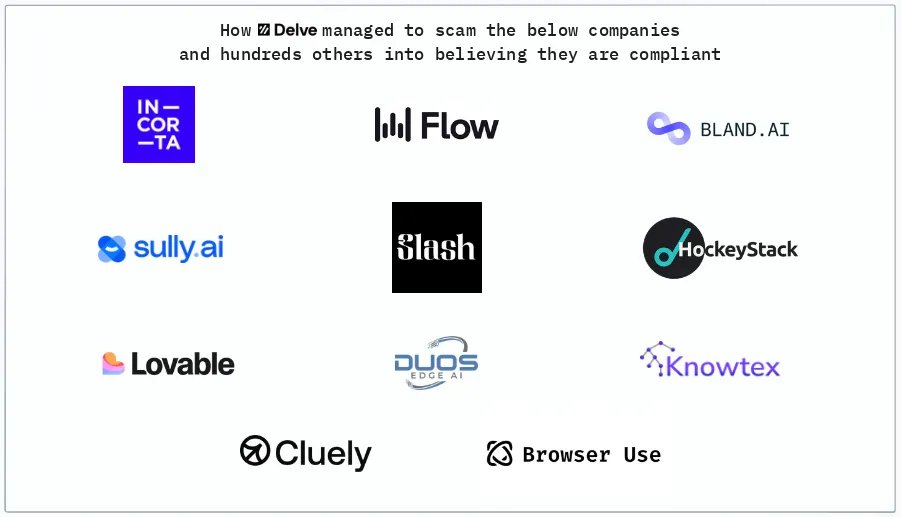
Delve, a YC-backed compliance startup that raised $32 million, has been accused of systematically faking SOC 2, ISO 27001, HIPAA, and GDPR compliance reports for hundreds of clients. According to a detailed Substack investigation by DeepDelver, a leaked Google spreadsheet containing links to hundreds of confidential draft audit reports revealed that Delve generates auditor conclusions before any auditor reviews evidence, uses the same template across 99.8% of reports, and relies on Indian certification mills operating through empty US shells instead of the "US-based CPA firms" they advertise. Here's the breakdown: > 493 out of 494 leaked SOC 2 reports allegedly contain identical boilerplate text, including the same grammatical errors and nonsensical sentences, with only a company name, logo, org chart, and signature swapped in > Auditor conclusions and test procedures are reportedly pre-written in draft reports before clients even provide their company description, which would violate AICPA independence rules requiring auditors to independently design tests and form conclusions > All 259 Type II reports claim zero security incidents, zero personnel changes, zero customer terminations, and zero cyber incidents during the observation period, with identical "unable to test" conclusions across every client > Delve's "US-based auditors" are actually Accorp and Gradient, described as Indian certification mills operating through US shell entities. 99%+ of clients reportedly went through one of these two firms over the past 6 months > The platform allegedly publishes fully populated trust pages claiming vulnerability scanning, pentesting, and data recovery simulations before any compliance work has been done > Delve pre-fabricates board meeting minutes, risk assessments, security incident simulations, and employee evidence that clients can adopt with a single click, according to the author > Most "integrations" are just containers for manual screenshots with no actual API connections. The author describes the platform as a "SOC 2 template pack with a thin SaaS wrapper" > When the leak was exposed, CEO Karun Kaushik emailed clients calling the allegations "falsified claims" from an "AI-generated email" and stated no sensitive data was accessed, while the reports themselves contained private signatures and confidential architecture diagrams > Companies relying on these reports could face criminal liability under HIPAA and fines up to 4% of global revenue under GDPR for compliance violations they believed were resolved > When clients threaten to leave, Delve reportedly pairs them with an external vCISO for manual off-platform work, which the author argues proves their own platform can't deliver real compliance > Delve's sales price dropped from $15,000 to $6,000 with ISO 27001 and a penetration test thrown in when a client mentioned considering a competitor
Ryan tweet media
erin griffith@eringriffith

A detailed and brutal look at the tactics of buzzy AI compliance startup Delve "Delve built a machine designed to make clients complicit without their knowledge, to manufacture plausible deniability while producing exactly the opposite." substack.com/home/post/p-19…

English
387
717
8.1K
5.7M
Steph Smith
Steph Smith@stephsmithio·
Every company with a c suite needs a “chief agents officer” For now they’d focus on the effective en masse deployment of agentic tools, incl training staff, equipping them w the right resources, quality control, etc Eventually… it’ll be coordination of the agents themselves
Greg Brockman@gdb

Software development is undergoing a renaissance in front of our eyes. If you haven't used the tools recently, you likely are underestimating what you're missing. Since December, there's been a step function improvement in what tools like Codex can do. Some great engineers at OpenAI yesterday told me that their job has fundamentally changed since December. Prior to then, they could use Codex for unit tests; now it writes essentially all the code and does a great deal of their operations and debugging. Not everyone has yet made that leap, but it's usually because of factors besides the capability of the model. Every company faces the same opportunity now, and navigating it well — just like with cloud computing or the Internet — requires careful thought. This post shares how OpenAI is currently approaching retooling our teams towards agentic software development. We're still learning and iterating, but here's how we're thinking about it right now: As a first step, by March 31st, we're aiming that: (1) For any technical task, the tool of first resort for humans is interacting with an agent rather than using an editor or terminal. (2) The default way humans utilize agents is explicitly evaluated as safe, but also productive enough that most workflows do not need additional permissions. In order to get there, here's what we recommended to the team a few weeks ago: 1. Take the time to try out the tools. The tools do sell themselves — many people have had amazing experiences with 5.2 in Codex, after having churned from codex web a few months ago. But many people are also so busy they haven't had a chance to try Codex yet or got stuck thinking "is there any way it could do X" rather than just trying. - Designate an "agents captain" for your team — the primary person responsible for thinking about how agents can be brought into the teams' workflow. - Share experiences or questions in a few designated internal channels - Take a day for a company-wide Codex hackathon 2. Create skills and AGENTS[.md]. - Create and maintain an AGENTS[.md] for any project you work on; update the AGENTS[.md] whenever the agent does something wrong or struggles with a task. - Write skills for anything that you get Codex to do, and commit it to the skills directory in a shared repository 3. Inventory and make accessible any internal tools. - Maintain a list of tools that your team relies on, and make sure someone takes point on making it agent-accessible (such as via a CLI or MCP server). 4. Structure codebases to be agent-first. With the models changing so fast, this is still somewhat untrodden ground, and will require some exploration. - Write tests which are quick to run, and create high-quality interfaces between components. 5. Say no to slop. Managing AI generated code at scale is an emerging problem, and will require new processes and conventions to keep code quality high - Ensure that some human is accountable for any code that gets merged. As a code reviewer, maintain at least the same bar as you would for human-written code, and make sure the author understands what they're submitting. 6. Work on basic infra. There's a lot of room for everyone to build basic infrastructure, which can be guided by internal user feedback. The core tools are getting a lot better and more usable, but there's a lot of infrastructure that currently go around the tools, such as observability, tracking not just the committed code but the agent trajectories that led to them, and central management of the tools that agents are able to use. Overall, adopting tools like Codex is not just a technical but also a deep cultural change, with a lot of downstream implications to figure out. We encourage every manager to drive this with their team, and to think through other action items — for example, per item 5 above, what else can prevent a lot of "functionally-correct but poorly-maintainable code" from creeping into codebases.

English
34
14
139
32.1K
Dan G
Dan G@DanGoikhman·
The handoff between agentic browsers and publishers is going to be one of the most important opportunities in media. AI Browsers: Threat Or Opportunity For News Publishers? tvnewscheck.com/ai/article/ai-…
English
0
1
1
32
Dan G
Dan G@DanGoikhman·
People want answers and the old web is incompatible with the new. The ChatGPT ads launch was a bombshell and highly anticipated. @DappierAI we bet early that conversational interfaces were going to eat the web and bring them to any site with a next gen ad stack built in. If you’re a publisher, it’s time to get going. The revenue that stems from monetizing decisions is going to change everything.
English
0
1
1
79