

titan
334 posts
titan
@MasterScaler91
Build or die (dont die) $RKLB $VST $NBIS $NVTS $MU
SF شامل ہوئے Kasım 2025
262 فالونگ18 فالوورز

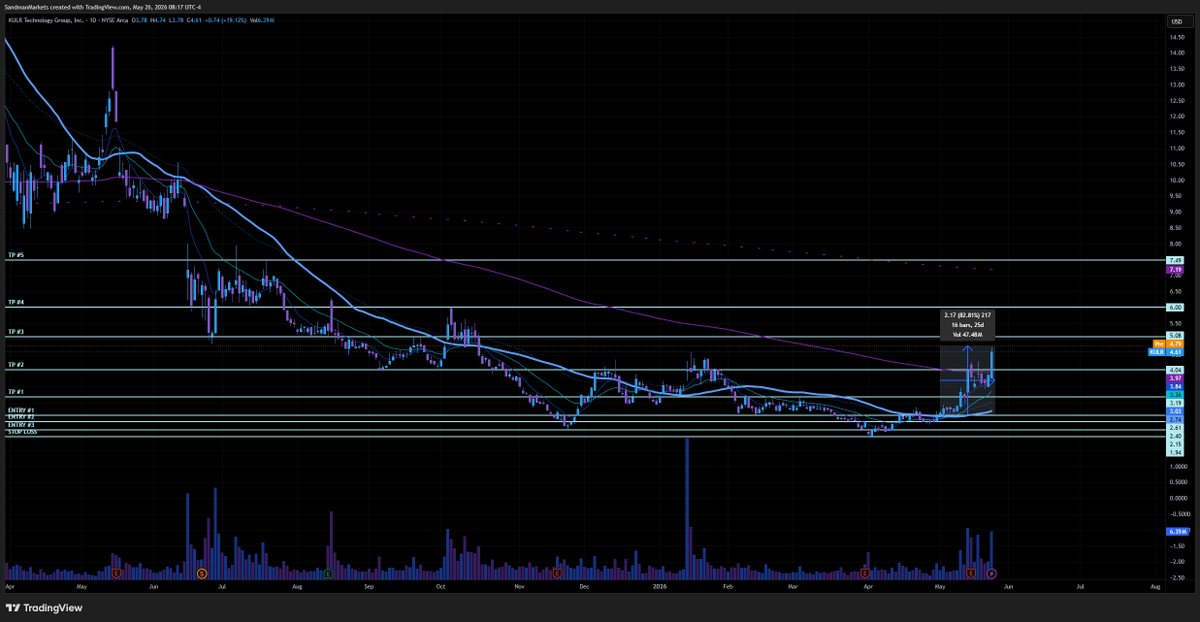
There is no doubt in my mind $KULR will be another 100% runner that I have shared here, already up over 80% since sharing my initial DD posts..
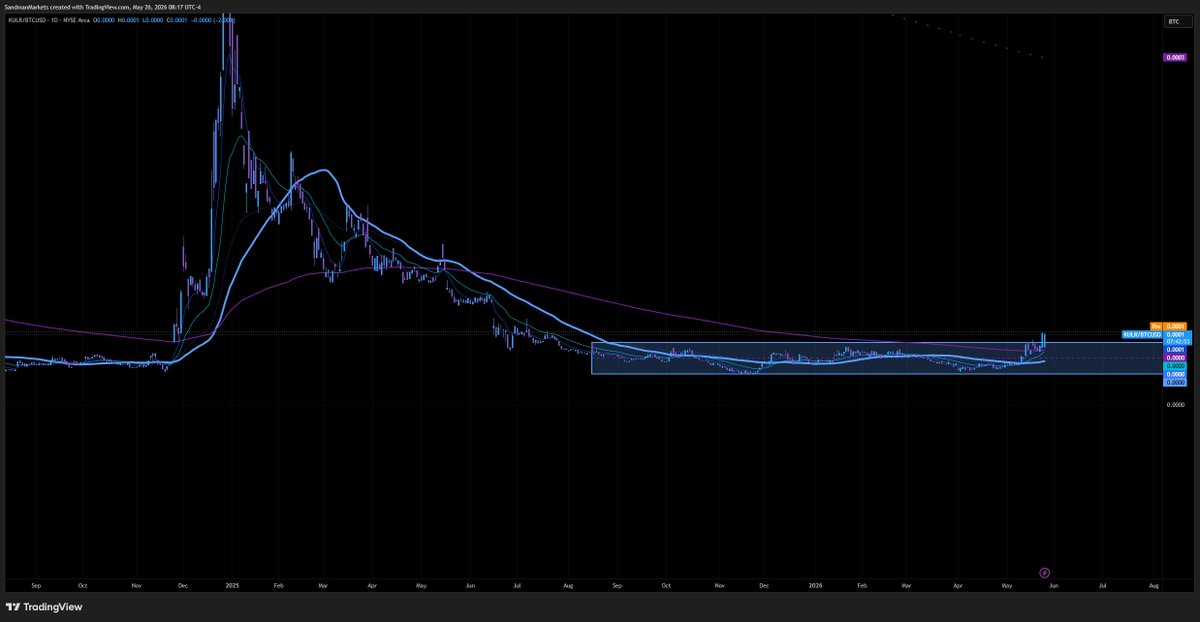
Since December of 2024, $KULR has been in a downtrend against bitcoin:native and is now beginning to outperform bitcoin:native, breaking out of a 9 month base it has formed.
This $KULR / chart shows that the market is beginning to price $KULR as more than just a DAT and starting to account for it's expanding battery business.
The sky is the limit for $KULR and it's up to management to continue to execute it's turnaround.
We also know that @NASA will be announcing an update on it's moon base strategy today at 2 PM where partnerships are anticipated to be announced.. $KULR has worked with NASA in the past and most recently on Artemis II launch.
Given the work $KULR has done with NASA in recent history, NASA needing battery power to provide power on any moon base, and $KULR having the only first and only commercially available battery approved by NASA to be used in space, there is a decent probability that $KULR is included in it's moon base strategy.
Do you think $KULR will be announced as a partner? Let me know in the comments 👇
Sandman Markets@SandmanMarkets
$KULR is one of the most misunderstood stocks and a stock that has one of the most significant upsides. Market thinks it's a $BTC miner when they are a battery engineering company and now expanding in to manufacturing. This transition began in 2025 and means instead of earning fees off of engineering, they can now make additional money off production of their engineered designs perpetually. Plus pretty much every article on Seeking Alpha talks about it as a $BTC miner (see image). Why that's bullish though - their $BTC + cash is basically equivalent to their MC. They're also down a lot from their $BTC average purchase which is why it's overlooked. So the battery company is basically free based on current valuation and $BTC holdings and cash. $130.3 mil MC vs $101.3 mil $BTC + cash. Battery business is valued at $29 mil. This means the battery business is trading at 1.8x 2025 revenues once you take out $BTC + cash. Plus the market hasn't priced in recent contract wins and expansion of their production capabilities either. They also likely have ties to SpaceX. Though this hasn't been confirmed, it can be narrowed down based on language in previous press releases. This misunderstanding coupled with the recent additions to their board of directions creates a turnaround opportunity in a sector that is set to expand tremendously in the coming years.
English



Apparently you can get from San Francisco to the foothills of the Sierras in 42 minutes, why do we even do cars?

English

Hyperscalars are all in housing IP design because *shocker* that’s the fucking moat.
You can increase throughput of LPDDR by 20-35% and drop power even more by designing your own controller and not using Cadence’s garbage. Their NoC’s are shit, even the SERDES you see people adding special sauce.
These are the coal mines I lived in day in day out. Absolutely going to get gigamogged.
English

Yo @NotMattGeorge - your early retail investors want to get our hands on this jacket. Can we make it happen please? $MRLN


English

@tleilax___ They will be packaging on die and stacking them soon.
English

Intel is dodging the HBM memory shortage for its topline AI accelerators by packing a massive 160 GB of laptop/low power DDR5 memory instead. Those memories are 75% cheaper, so you can put 4x as much on the card.
Of course this requires an absolutely gigantic ball grid array to connect the memory with the GPU.

Hassan Mujtaba@hms1193
Intel's Crescent Island PCB Leaks, Showing a Massive Xe3P GPU, 16-Pin Connector, 160GB LPDDR5X as Intel Sidesteps the HBM Shortage wccftech.com/intel-crescent… wccftech.com/intel-crescent…
English
@Knot_a_Clew @Bios4L @elpistollero_ @Reformed_Trader I have a huge position in $MRLN, but what about drones? Isn’t this basically a drone?
English

@Bios4L @elpistollero_ @Reformed_Trader $MRLN Put aside the risk to human life aspect.... human pilots are the limiting factor in high-G maneuvers. Planes are designed to exceed human capabilities. Get rid of human, you instantly have a more capable, more lethal, fighter aircraft.
English

$MRLN from the equity fund manager that has pounded the table on $ASTS from the lows with in-depth DD. The DD for MRLN: crossroadscap.io/insights/the-l…
English

$MRLN picked some up today at $6.00
Mark this post for 12 months and we will see you around $40-$50 a share!
English
@bubbleboi It’s like 25% of my net worth so.. I’ll keep adding lol
English
I find it quite surprising that the FX market is accurately pricing in an invasion of Taiwan which you can see if you look at the option prices on Non Deliverable Forwards (NDFs) that reference TWD.
The 1Y 25-delta risk reversal has been bid for USD calls / TWD puts at a level that’s roughly 1.5 vols rich to its 5Y median, and the wing skew on 10-delta strikes is doing something even more interesting…
If you strip out the carry component and decompose the forward into a deliverable proxy basket (DXY, CNH NDFs, KRW NDFs) the residual vol premium on TWD is the cleanest read you’re going to get on tail risk. Which in this case I would call the implied probability of a “regime change event.”
My back of the envelope calculations:
If you assume a binary outcome where invasion implies a ~25-30% spot move in USD/TWD and no-invasion implies mean reversion to forward fair value, the risk-neutral probability embedded in the 1Y wing is somewhere in the 8-12% range. That’s risk-neutral, so you need a haircut to account for the variance risk premium, which in tail-heavy EM could be 30-40% of the headline number. Running the numbers I get a real-world implied probability of ~5-8% over the next 12 months of an actual invasion of Taiwan.
If you compare that to Polymarket (~3-4% for the same window) you’ve got a ~3 vol point arb between retail prediction markets and the institutional FX vol surface and surprisingly the FX market is more worried than the betting markets.
English

For six months I tracked every aircraft connected to Merlin Labs $MRLN using nothing but public ADS-B data. No company input. No NDA. No paid feed.
shawarmacapital.substack.com/p/i-tracked-ev…
17 airframes. 180 days. Roughly 600 flights, each one rebuilt by hand from about 400GB of raw position archives.
The finding: Merlin's certification testbeds just flew their busiest stretch of the entire window. Three separate testbeds, two countries, two operators,
all peaking in the same eight weeks of spring 2026.
Three aircraft do not peak in the same window by accident.
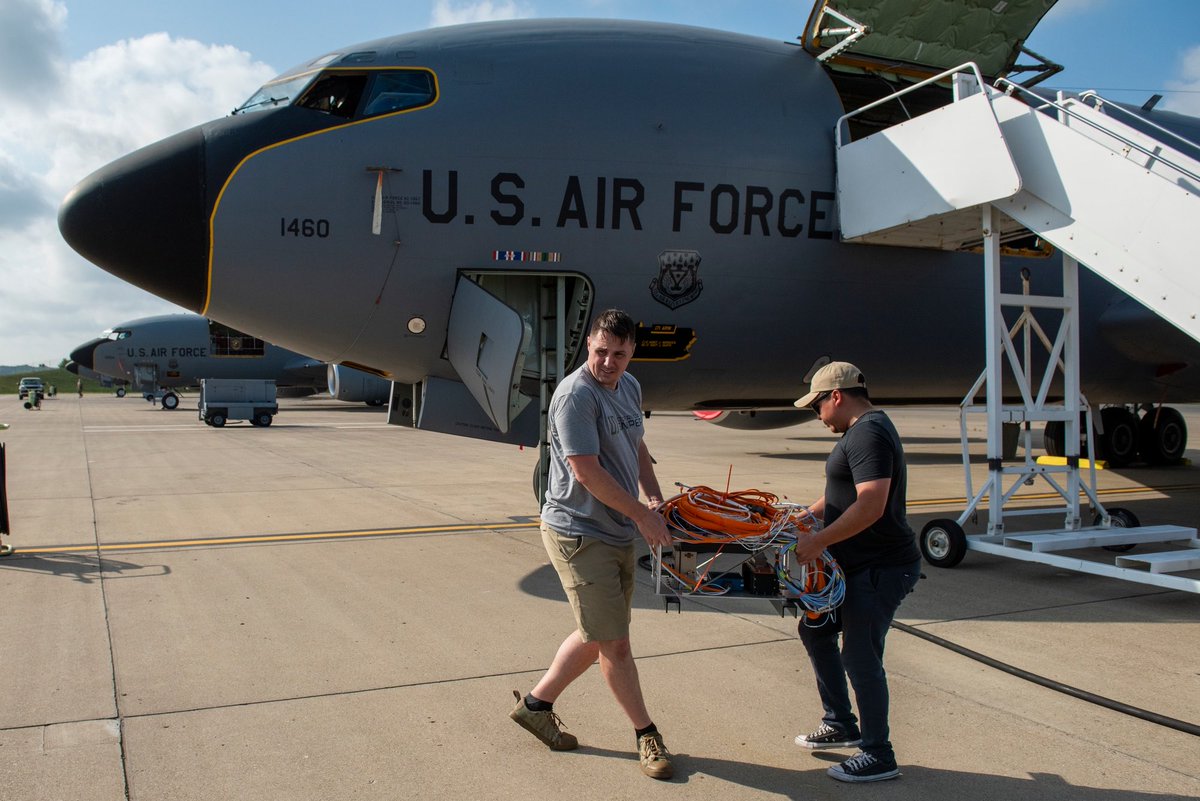
I also identified the USAF KC-135 that carried Merlin's autonomy rig, from the Air Force's own photo set. Tail number 59-1460, "Classic Iron."
The full reconstruction. The roster, the method, the complete ledger, and the one ramp in the data you have to throw away.
English
@ShawarmaCapital Curious though. These pics are from 2 years ago? May 2024?
No further imagery or data since then?
English
$MRLN
Follow up. 59-1460 was not the only KC-135 in this story.
Before the Pittsburgh flights, the program ran an earlier phase at MacDill AFB with the 6th Air Refueling Wing on May 14 and 15, 2024. Crew workload data collection on a KC-135. The Air Force documented it in its own 14-photo set.
dvidshub.net/news/471461/fu…
That aircraft I could not identify. Every one of the 14 photos is an interior shot, cockpit and instrumentation, no exterior view and no visible tail number. So the MacDill jet stays unknown for now.
Two documented KC-135 test phases. One identified airframe, 59-1460. One still open.
Shawarma Capital@ShawarmaCapital
🛩️ I went looking for every aircraft connected to Merlin Labs ($MRLN), the autonomous flight company, using only public data. Here is what turned up. 🧵 1/ The KC-135 the Air Force didn't name Merlin and Sierra Nevada Corp tested their autonomy system on a US Air Force KC-135 tanker with the 171st Air Refueling Wing in Pittsburgh. The Air Force put out six official photos of it and left the tail number off every single one. It is 59-1460, a tanker that carries the name "Classic Iron." The photo below is the Air Force's own. It shows the Merlin avionics data box being carried right up to that jet's door, with "1460" painted on the nose. I then matched it in historical ADS-B archives under broadcast hex ae0596, flying out of Pittsburgh through the 2024 test window. 2/ The host fleet The 171st ARW operates roughly 16 KC-135T tankers. I confirmed 8 of them by the real ICAO hex codes pulled straight from their broadcast data. That is the pool the test program drew from. On the C-130J: Merlin has a 105 million dollar USSOCOM contract to automate it, but there is no aircraft to find yet. That program has not flown. First flight is targeted for late 2026, so anyone naming a C-130J tail today is just guessing. 3/ Merlin's own aircraft Merlin Labs owns five aircraft. In the US, under Merlin Labs Inc: - N208B, a Cessna 208B Grand Caravan nicknamed "Big Red." It is the main FAA certification testbed, based at Quonset State Airport in Rhode Island. - N506DB, a Burton Long-EZ. An experimental R&D platform in Mojave, California. In New Zealand, under Merlin Labs NZ Ltd: - ZK-MLN, a Cessna 208B. The New Zealand certification testbed. - ZK-MLO, a Cessna 208B Super Cargomaster. It does both testing and paid charter work. - ZK-MLP, a Cessna TU206F. Lightly used. 4/ The flight data I pulled raw historical ADS-B archives for the New Zealand testbed, ZK-MLN. It flew 17 sorties across 5 sampled days between April 29 and May 13, 2026. Two to five flights a day, most of them short. Those short flights are takeoff and landing circuits, which is the standard rhythm of an active certification campaign. ZK-MLO flew long legs of 90 to 175 minutes over the same window, which looks like charter and transit work. 5/ Bottom line This is one company's aircraft footprint rebuilt from public registries, Air Force photos, and raw ADS-B archives: five owned aircraft and one identified military testbed. The New Zealand certification flying is active right now. The big event ahead is the C-130J first flight, expected around late 2026. Sources: FAA and New Zealand CAA registries, USAF DVIDS imagery (public domain), adsb.lol historical ADS-B archives, airplanes.live. Public data only. Not investment advice.
English

English

@pharmdaz Me too - that’s why I’m trying to learn more.
I’m already invested in 1 but trying to differentiate each from each other. I’ll try talking to both companies at SOF on Wednesday
English
You’re not bullish enough $MRLN
Shawarma Capital@ShawarmaCapital
🛩️ I went looking for every aircraft connected to Merlin Labs ($MRLN), the autonomous flight company, using only public data. Here is what turned up. 🧵 1/ The KC-135 the Air Force didn't name Merlin and Sierra Nevada Corp tested their autonomy system on a US Air Force KC-135 tanker with the 171st Air Refueling Wing in Pittsburgh. The Air Force put out six official photos of it and left the tail number off every single one. It is 59-1460, a tanker that carries the name "Classic Iron." The photo below is the Air Force's own. It shows the Merlin avionics data box being carried right up to that jet's door, with "1460" painted on the nose. I then matched it in historical ADS-B archives under broadcast hex ae0596, flying out of Pittsburgh through the 2024 test window. 2/ The host fleet The 171st ARW operates roughly 16 KC-135T tankers. I confirmed 8 of them by the real ICAO hex codes pulled straight from their broadcast data. That is the pool the test program drew from. On the C-130J: Merlin has a 105 million dollar USSOCOM contract to automate it, but there is no aircraft to find yet. That program has not flown. First flight is targeted for late 2026, so anyone naming a C-130J tail today is just guessing. 3/ Merlin's own aircraft Merlin Labs owns five aircraft. In the US, under Merlin Labs Inc: - N208B, a Cessna 208B Grand Caravan nicknamed "Big Red." It is the main FAA certification testbed, based at Quonset State Airport in Rhode Island. - N506DB, a Burton Long-EZ. An experimental R&D platform in Mojave, California. In New Zealand, under Merlin Labs NZ Ltd: - ZK-MLN, a Cessna 208B. The New Zealand certification testbed. - ZK-MLO, a Cessna 208B Super Cargomaster. It does both testing and paid charter work. - ZK-MLP, a Cessna TU206F. Lightly used. 4/ The flight data I pulled raw historical ADS-B archives for the New Zealand testbed, ZK-MLN. It flew 17 sorties across 5 sampled days between April 29 and May 13, 2026. Two to five flights a day, most of them short. Those short flights are takeoff and landing circuits, which is the standard rhythm of an active certification campaign. ZK-MLO flew long legs of 90 to 175 minutes over the same window, which looks like charter and transit work. 5/ Bottom line This is one company's aircraft footprint rebuilt from public registries, Air Force photos, and raw ADS-B archives: five owned aircraft and one identified military testbed. The New Zealand certification flying is active right now. The big event ahead is the C-130J first flight, expected around late 2026. Sources: FAA and New Zealand CAA registries, USAF DVIDS imagery (public domain), adsb.lol historical ADS-B archives, airplanes.live. Public data only. Not investment advice.
English
@ShawarmaCapital @wacbmktnews Any thoughts on when IDIQ for KC135?
English
@wacbmktnews Thank you! The first to find the KC135 Merlin uses….
English

$MRLN
great work by @ShawarmaCapital!
Shawarma Capital@ShawarmaCapital
🛩️ I went looking for every aircraft connected to Merlin Labs ($MRLN), the autonomous flight company, using only public data. Here is what turned up. 🧵 1/ The KC-135 the Air Force didn't name Merlin and Sierra Nevada Corp tested their autonomy system on a US Air Force KC-135 tanker with the 171st Air Refueling Wing in Pittsburgh. The Air Force put out six official photos of it and left the tail number off every single one. It is 59-1460, a tanker that carries the name "Classic Iron." The photo below is the Air Force's own. It shows the Merlin avionics data box being carried right up to that jet's door, with "1460" painted on the nose. I then matched it in historical ADS-B archives under broadcast hex ae0596, flying out of Pittsburgh through the 2024 test window. 2/ The host fleet The 171st ARW operates roughly 16 KC-135T tankers. I confirmed 8 of them by the real ICAO hex codes pulled straight from their broadcast data. That is the pool the test program drew from. On the C-130J: Merlin has a 105 million dollar USSOCOM contract to automate it, but there is no aircraft to find yet. That program has not flown. First flight is targeted for late 2026, so anyone naming a C-130J tail today is just guessing. 3/ Merlin's own aircraft Merlin Labs owns five aircraft. In the US, under Merlin Labs Inc: - N208B, a Cessna 208B Grand Caravan nicknamed "Big Red." It is the main FAA certification testbed, based at Quonset State Airport in Rhode Island. - N506DB, a Burton Long-EZ. An experimental R&D platform in Mojave, California. In New Zealand, under Merlin Labs NZ Ltd: - ZK-MLN, a Cessna 208B. The New Zealand certification testbed. - ZK-MLO, a Cessna 208B Super Cargomaster. It does both testing and paid charter work. - ZK-MLP, a Cessna TU206F. Lightly used. 4/ The flight data I pulled raw historical ADS-B archives for the New Zealand testbed, ZK-MLN. It flew 17 sorties across 5 sampled days between April 29 and May 13, 2026. Two to five flights a day, most of them short. Those short flights are takeoff and landing circuits, which is the standard rhythm of an active certification campaign. ZK-MLO flew long legs of 90 to 175 minutes over the same window, which looks like charter and transit work. 5/ Bottom line This is one company's aircraft footprint rebuilt from public registries, Air Force photos, and raw ADS-B archives: five owned aircraft and one identified military testbed. The New Zealand certification flying is active right now. The big event ahead is the C-130J first flight, expected around late 2026. Sources: FAA and New Zealand CAA registries, USAF DVIDS imagery (public domain), adsb.lol historical ADS-B archives, airplanes.live. Public data only. Not investment advice.
English
🛩️ I went looking for every aircraft connected to Merlin Labs ($MRLN), the autonomous flight company, using only public data. Here is what turned up. 🧵
1/ The KC-135 the Air Force didn't name
Merlin and Sierra Nevada Corp tested their autonomy system on a US Air Force KC-135 tanker with the 171st Air Refueling Wing in Pittsburgh. The Air Force put out six official photos of it and left the tail number off every single one.
It is 59-1460, a tanker that carries the name "Classic Iron."
The photo below is the Air Force's own. It shows the Merlin avionics data box being carried right up to that jet's door, with "1460" painted on the nose. I then matched it in historical ADS-B archives under broadcast hex ae0596, flying out of Pittsburgh through the 2024 test window.
2/ The host fleet
The 171st ARW operates roughly 16 KC-135T tankers. I confirmed 8 of them by the real ICAO hex codes pulled straight from their broadcast data. That is the pool the test program drew from.
On the C-130J: Merlin has a 105 million dollar USSOCOM contract to automate it, but there is no aircraft to find yet. That program has not flown. First flight is targeted for late 2026, so anyone naming a C-130J tail today is just guessing.
3/ Merlin's own aircraft
Merlin Labs owns five aircraft.
In the US, under Merlin Labs Inc:
- N208B, a Cessna 208B Grand Caravan nicknamed "Big Red." It is the main FAA certification testbed, based at Quonset State Airport in Rhode Island.
- N506DB, a Burton Long-EZ. An experimental R&D platform in Mojave, California.
In New Zealand, under Merlin Labs NZ Ltd:
- ZK-MLN, a Cessna 208B. The New Zealand certification testbed.
- ZK-MLO, a Cessna 208B Super Cargomaster. It does both testing and paid charter work.
- ZK-MLP, a Cessna TU206F. Lightly used.
4/ The flight data
I pulled raw historical ADS-B archives for the New Zealand testbed, ZK-MLN.
It flew 17 sorties across 5 sampled days between April 29 and May 13, 2026. Two to five flights a day, most of them short. Those short flights are takeoff and landing circuits, which is the standard rhythm of an active certification campaign.
ZK-MLO flew long legs of 90 to 175 minutes over the same window, which looks like charter and transit work.
5/ Bottom line
This is one company's aircraft footprint rebuilt from public registries, Air Force photos, and raw ADS-B archives: five owned aircraft and one identified military testbed. The New Zealand certification flying is active right now. The big event ahead is the C-130J first flight, expected around late 2026.
Sources: FAA and New Zealand CAA registries, USAF DVIDS imagery (public domain), adsb.lol historical ADS-B archives, airplanes.live. Public data only. Not investment advice.
English