The smartest investors don’t “guess.” They do brutal Commercial Due Diligence.
Here’s how top PE teams uncover the truth before buying a business (Thread).
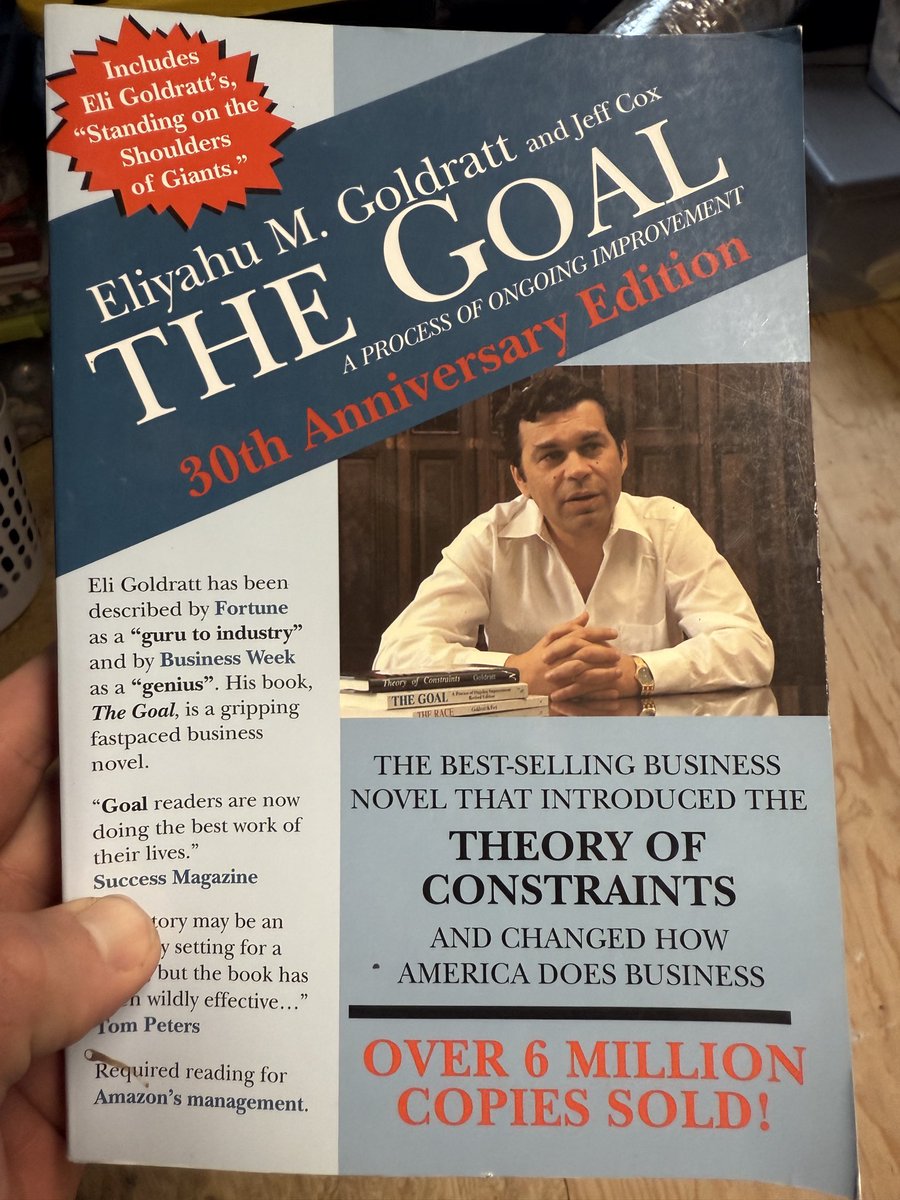
Hokey, but required reading, especially for those in manufacturing.
In my opinion, Theory of Constraints is an underutilized methodology (largely because finance guys don’t love it).
It is a simpler approach to manufacturing for the non-financial.
The two concepts that stuck with me the most were:
1) identify and chase the bottleneck
2) maximize throughput
On the former, pretty straightforward- there is one true constraint in a manufacturing setting. Find that one, remedy, and then find the next one. Repeat.
Throughput has broader implications on customers and pricing. The idea is more about maximizing sales, given your capacity (which is impacted by your bottleneck).
These are obviously intertwined and there is a whole TOC framework but just nailing these two concepts is worth reading the book.
Marc Andreessen on why VCs ignore cold emails — and why that’s not unfair
“The way the top-end venture capitalist firms work is they’ll basically take you seriously if you come in introduced by somebody they’ve worked with before, and they won’t take you seriously if you don’t.”
It might sound harsh.
But Marc says this is your first test.
“It’s the first test of your ability to network your way to the investor… If you can’t figure out a way to network your way to a VC firm—which of course is in the business of meeting founders—then you’re unlikely to be able to network your way into hiring a great team or selling your product to customers.”
He concludes:
“The role of the warm referral is misinterpreted. I think you just need to view it as the first test, and it’s a test that you just want to pass.”
Video source: @ycombinator (2016)
@paulg Interesting. I always wondered if you could use specific employee metrics (e.g., how often sending emails, how often using their keyboard) would actually indicate if you have a high-performing employee.
@PEoperator Thank you for sharing. In the current market environment until summer 2025, I would rather calculate with 12-18 months of sales process, as there are many PE funds trying to sell their assets, meanwhile a lot of dry powder is not used according to Bain.
Several years ago, I went through a failed process to sell the company.
There were a myriad of reasons but what's more interesting is what happened inside the company afterward.
At the end, I included what I would do to mitigate failed process risks if I were an MD.
When you are selling a company, everyone gets very geared up. People are nervous, excited, anxious.
The management team in particular is anxious, because they are closest to the situation. They're the most likely to be replaced but also the most likely to get a nice payday.
So there is this constant nervous excitement in the air.
And it's a huge distraction. Selling a company takes ~6 months from the time you take pitch meetings from bankers to closing.
There's a lot of prep to get the company ready and during that prep, managers - especially the CFO and CEO - are distracted.
To be honest, it's really a recipe for disaster. Distract the leaders of the org from the business at the very moment tensions are highest.
Speaking from experience, when you do sell a company, all those nerves, all that anxiety and extra work seems worth it. You immediately forget the pain - like birthing a baby (I'm told).
But when you don't sell?
The pain only continues. Managers who were expecting a paycheck are disappointed. Folks who have worked hard to prep the company are disheartened. Even the relationship with the PE group is strained.
And most importantly, the business has been distracted from starting new initiatives.
Point is, the fallout is significant.
After our failed process, the mgmt team fell apart. The CEO became complacent, a division president became despondent, and everyone generally had the wind out of their sails.
The company struggled to regain its momentum- wasted a year+ and lost talent in the meantime.
Of course, it doesn't always end badly. Sometimes the right thing to do is to pull back and abandon a sales process and continue along. Many companies have done it.
But recognize that there will be fallout to some extent and try to mitigate the downside.
If I were a PE MD, here's what I would do:
- Minimize demands on the mgmt team. Push work to the bankers and VP/Associate. Some work has to be done at the company level but try to keep it focused on CFO+Controller only.
- Get more involved in the day-to-day. Ensure the CEO, others are driving new initiatives. Pains me to say this as a manager myself, but I think it's necessary so you have a finger on the pulse.
- Be considerate of managers' time. Push the bankers to make the schedule efficient. Try to come to them or work around their schedule for board meetings. I've literally never seen an MD do this and it would go a long way.
- Set clear success/failure metrics. What are your expectations for the process and what is the threshold for selling?
- Install a "process bonus" i.e. something that pays out if the business doesn't sell. Doesn't even have to be crazy significant, but it would go a long way for the folks who are investing in the process.
Those of you who've been through a sales process - good, bad, or otherwise - what did I miss?
In Private Equity, the real edge isn’t in the models, it’s in the operators you back.
Spent ~2 years embedded in a portco turnaround. The magic was empowering the CEO to ditch bureaucracy for speed.
Bet on leaders who execute, not just spreadsheets.
What is a master list of most common value drivers in PE? I will start: 1. Achieve operational and financial efficiency with a) better governance, and reporting, b) promotion of mgmt accountability through incentives, and c) reduction of operational complexity.
@aakashgupta Agreed, but making a meaningful effort to deep dive on other job families helps you to communicate and understand their point of view, and ultimately helps you to become more effective in your work.
@charlesmiller_7 Apart from Marcus Aurelius, Zeno, Diogenes, Cicero, Cato the Younger, Seneca, and Epictetus are note-worthy representatives of stoicism.