We’re moving our communication away from X! After 15 years, it’s time to continue the conversation somewhere new. This account will stay online as an archive – a little time capsule of science stories, discoveries… and to be honest, probably far too many posts about coffee! 😉
You’ve probably heard that the universe is expanding—but how did scientists figure that out?
Imagine a space delivery boy speeding toward a red star at half the speed of light. As he moves closer, the star suddenly appears blue. When he stops, it turns red again.
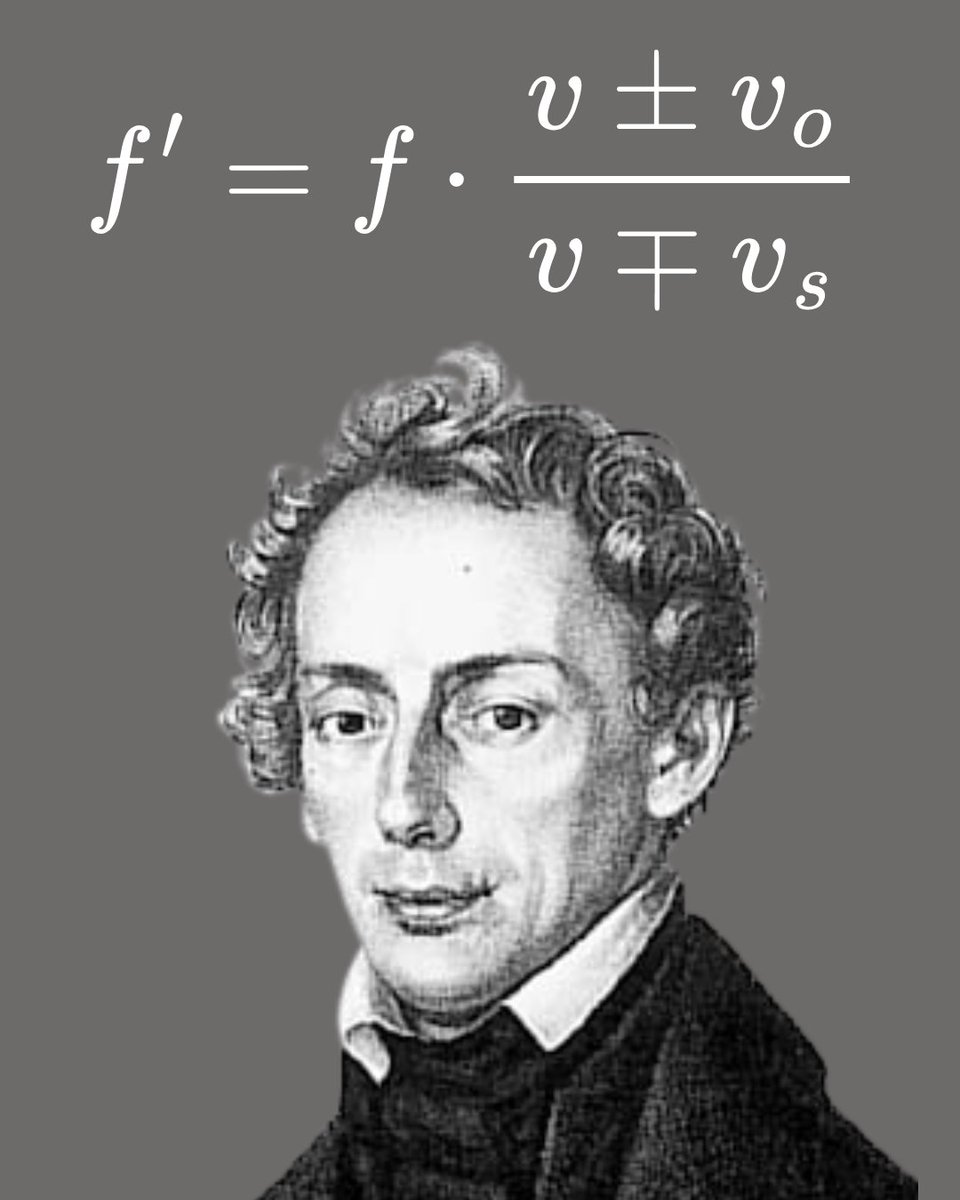
This happens because of the Doppler Effect—when a wave source moves toward you, its frequency increases (blue shift), and when it moves away, the frequency decreases (red shift).
Scientists observed that light from distant galaxies is mostly red-shifted, meaning they are moving away from us.
And if everything is moving away today… it must have once been closer together.
Physics might have it backwards.
We’re taught:
Space → exists
Time → flows
Matter → sits inside it
But what if it’s actually the opposite?
What if:
Time comes first…
And when time isn’t perfectly balanced,
it creates structure.
That structure becomes:
→ Geometry (space)
→ Energy
→ Matter
So atoms aren’t really “things”…
They’re stable patterns of time imbalance.
Gravity?
Just large-scale time compression.
Quantum weirdness?
Timing mismatches in the same underlying field.
So instead of:
Matter builds reality
It becomes:
Time imbalance builds everything.
If time was perfectly uniform…
Nothing would exist.
No particles.
No space.
No universe.
Just perfect symmetry.
Time imbalance creates structure.
Follow me for more deep insights
Merhaba, bu hesapta uzunca bir süredir hiç paylaşım yapmamıştık… Hesabı depremle ilgili dayanışmanın gündemde kalması için kullanmaya karar verdik. Özellikle çocuklara ve gençlere yönelik destek ve faaliyet duyurularını yaygınlaştırmaya çalışacağız.
One of the deepest questions in modern physics can be phrased in a surprisingly simple way: why does anything exist at all?
According to the laws of particle physics, the early universe should have produced matter and antimatter in almost perfectly equal amounts. Yet the universe we observe today is clearly dominated by matter. Galaxies, stars, planets, and people are all made of it, while antimatter is extraordinarily rare. Somewhere in the earliest moments of cosmic history, something tipped the balance.
Antimatter itself is not exotic or speculative. It is a well-established part of modern physics. For almost every known particle of matter there exists a corresponding antiparticle with the same mass but opposite electric charge and other quantum properties. An electron has a positron. A proton has an antiproton. When a particle meets its antiparticle, they annihilate each other, converting their mass into pure energy.
There are a few subtle exceptions. Some particles, such as photons, are their own antiparticles. Physicists are also intensely interested in whether neutrinos might belong to this category as well. If neutrinos turn out to be their own antiparticles, so-called Majorana particles, it could provide important clues about the origin of the matter–antimatter imbalance.
In the extremely hot environment of the early universe, energy should have produced particles and antiparticles in pairs. The basic interactions governing their creation are largely symmetric. As the universe cooled, matter and antimatter should have collided and annihilated each other almost completely. If that process had played out perfectly, the universe today would be filled with radiation and almost no matter at all.
But that is not what happened.
We are here.
One of the reasons we know the universe around us is made almost entirely of ordinary matter is surprisingly simple. If the Moon were made of antimatter, the moment Neil Armstrong stepped onto its surface the contact between his spacesuit and the lunar dust would have produced a flash of gamma rays. Clearly, that did not happen. On larger scales, astronomers also see no evidence of the intense radiation that would appear where large regions of matter and antimatter meet. Everything we observe, from nearby planets to distant galaxies, appears to be made of matter.
Observations indicate that a tiny excess of matter survived the early universe. For roughly every billion pairs of matter and antimatter particles that annihilated each other, one extra particle of matter remained. That tiny imbalance, about one part in a billion, was enough to build everything we see today. Galaxies, stars, planets, and life itself exist because of what might be described as a cosmic rounding error.
Physicists refer to this mystery as baryogenesis, the origin of the matter–antimatter asymmetry. In 1967 the Russian physicist Andrei Sakharov identified three basic conditions that must be satisfied for such an imbalance to arise.
First, there must be processes that can change the number of baryons, the family of particles that includes protons and neutrons. Second, the laws of physics must treat matter and antimatter slightly differently, a phenomenon known as CP violation. Third, these processes must occur outside of thermal equilibrium so that the imbalance can grow rather than cancel out.
You can think of these three requirements as the rules needed to subtly “rig” the cosmic game in favor of matter.
The second requirement, CP violation, is particularly important. Under perfect symmetry, the laws of physics should behave the same if particles are replaced by antiparticles and left and right are swapped like a mirror reflection. But nature does not follow that rule perfectly. Certain particle decays show small differences between matter and antimatter.
A helpful way to picture this is to imagine looking into a mirror that should reflect reality exactly, but the image is ever so slightly distorted. The reflection is almost perfect, but not quite. That tiny imperfection is what physicists call CP violation.
Experiments have confirmed that CP violation exists. It was first observed in particles called kaons and later studied in detail in B mesons. Modern experiments such as LHCb at CERN and Belle II in Japan continue measuring these asymmetries with increasing precision.
Yet there is a problem. The amount of CP violation predicted by the Standard Model appears far too small to explain the enormous imbalance that ultimately produced the matter-dominated universe.
Something else must have happened.
One possible explanation involves neutrinos, the ghostlike particles that stream through the universe in vast numbers. Some theories suggest that heavy versions of neutrinos in the early universe may have decayed in ways that produced more matter than antimatter. This idea, known as leptogenesis, is one of the leading candidates for explaining the asymmetry.
Other possibilities involve new particles or interactions that existed only at extremely high energies shortly after the Big Bang. In these scenarios, the imbalance between matter and antimatter could have been generated during phase transitions in the early universe, when fundamental forces and fields were settling into the forms we observe today.
Despite decades of work, the precise mechanism that produced the cosmic imbalance remains unknown. Experiments around the world continue searching for clues: precision measurements of particle decays, studies of neutrino properties, and attempts to detect rare processes that could reveal new sources of CP violation.
What makes this mystery so profound is how small the original asymmetry was. The entire visible universe depends on a difference of roughly one extra particle of matter for every billion particle–antiparticle pairs created in the early universe.
A tiny imbalance. A cosmic rounding error.
And yet it was enough to shape the entire history of the universe.
Understanding why matter won over antimatter remains one of the central goals of modern physics. If scientists can uncover the mechanism behind this imbalance, they will not only solve a long-standing puzzle but also gain deeper insight into the laws that governed the universe at its very beginning.
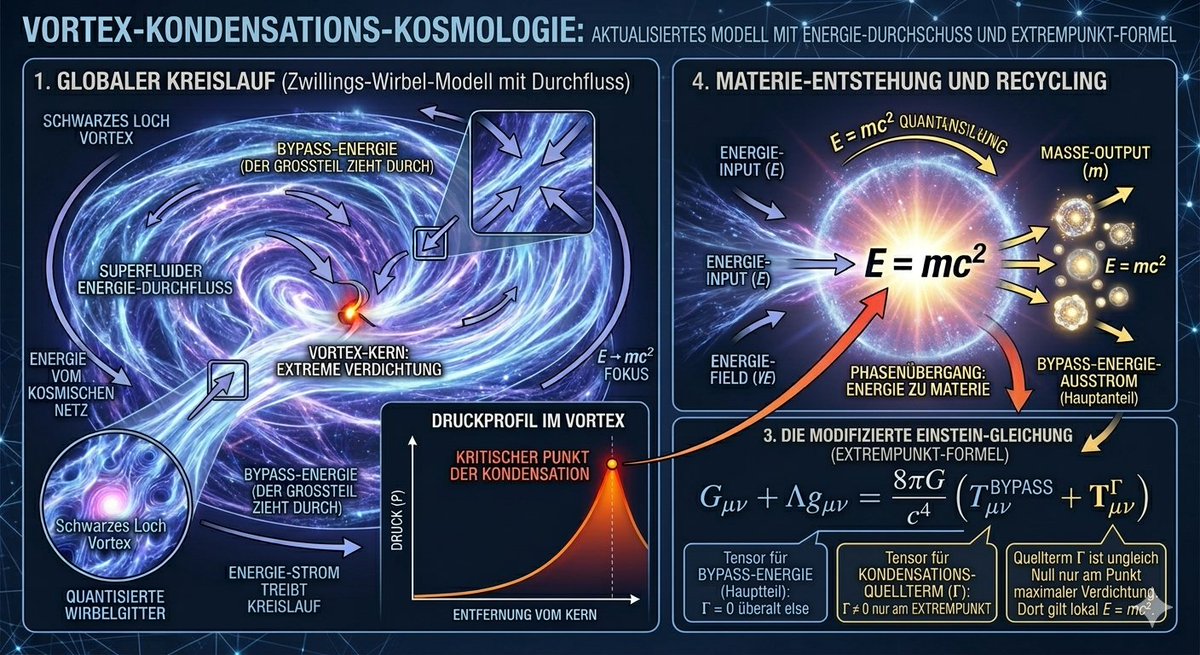
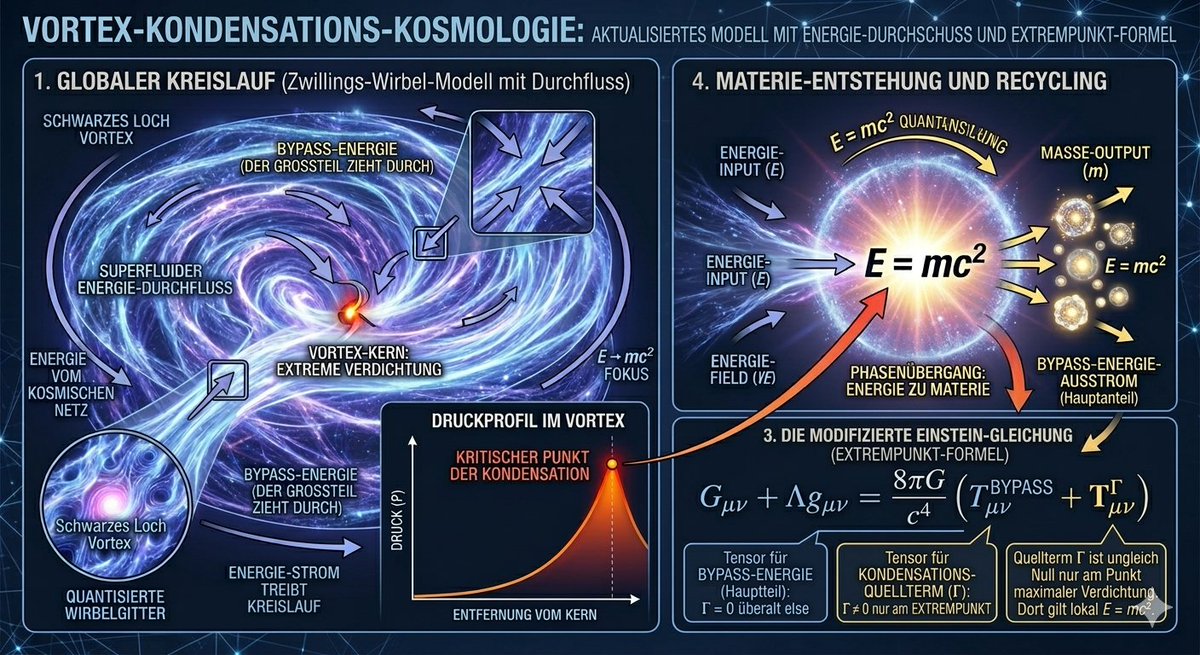
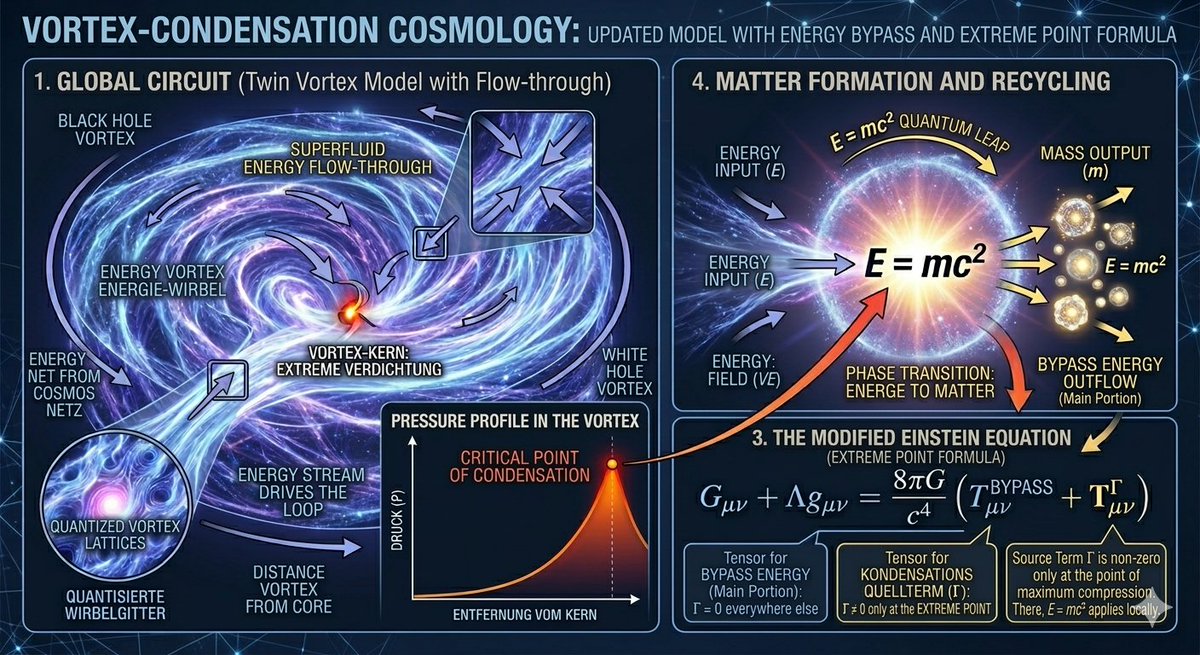
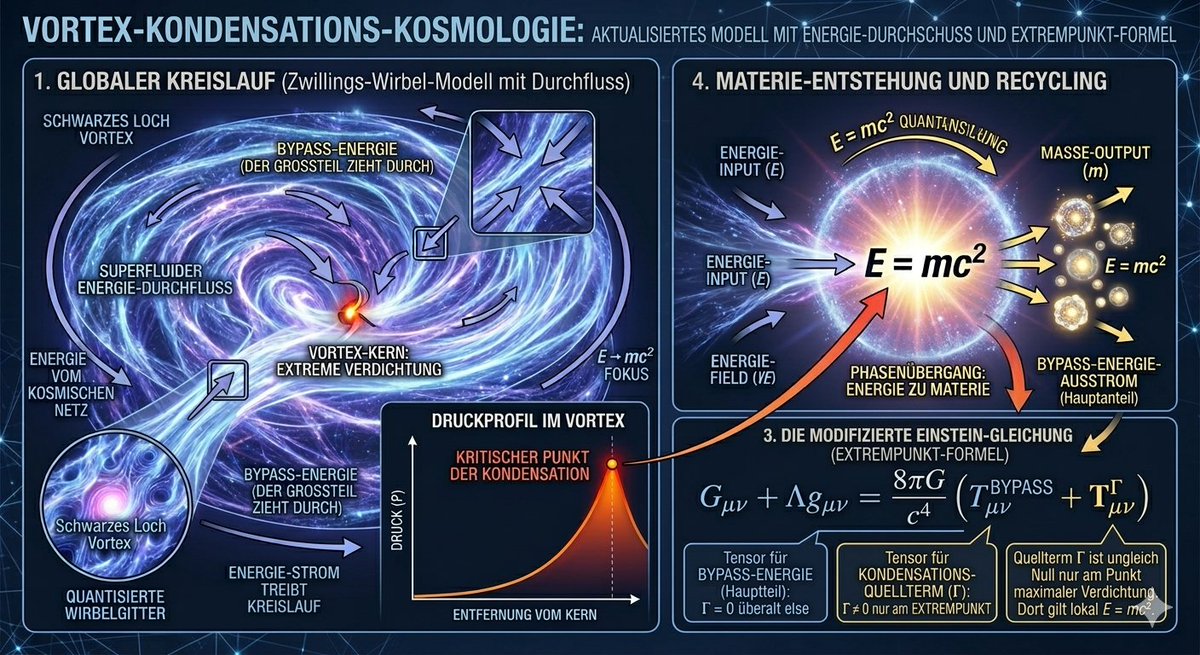
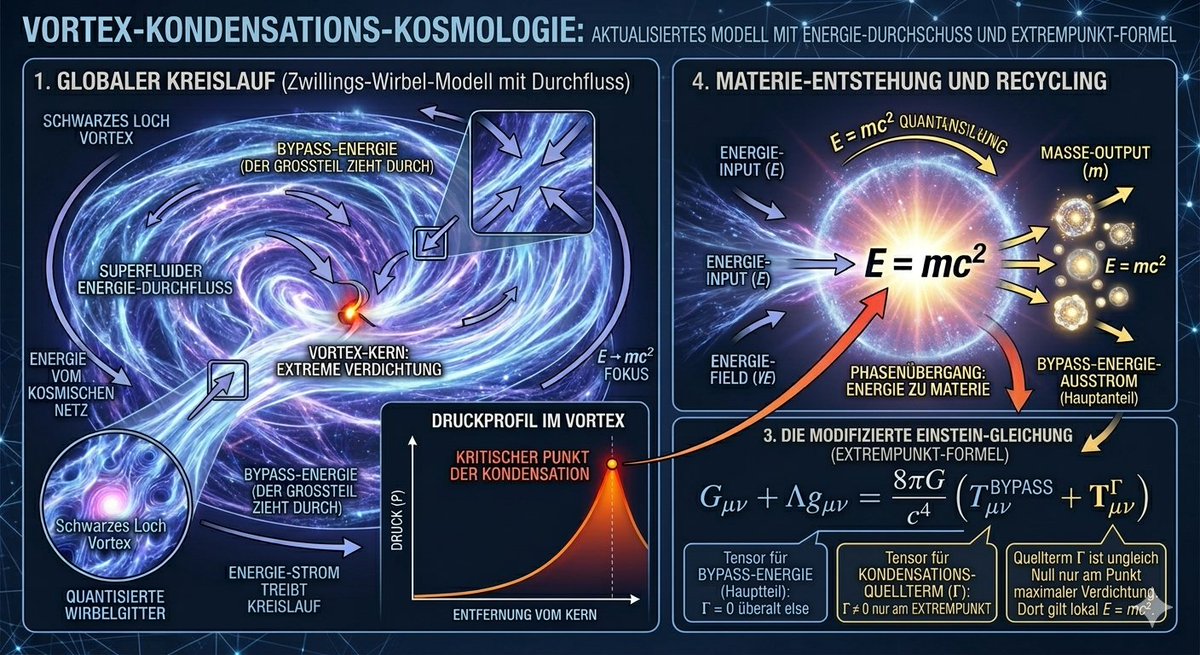
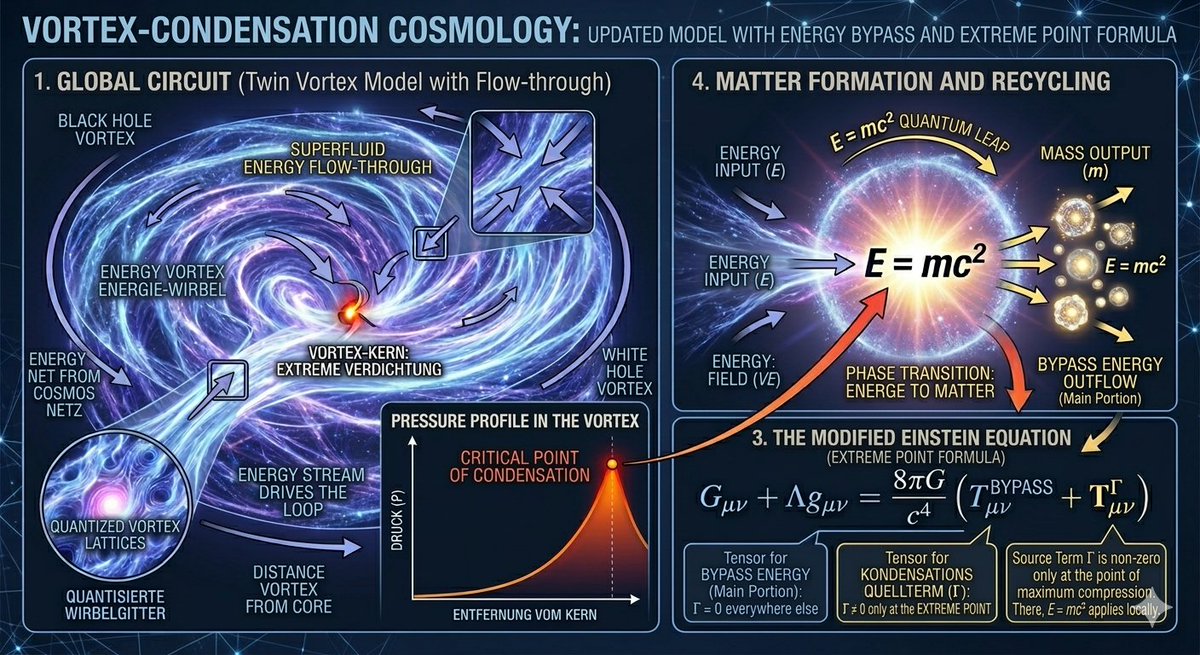
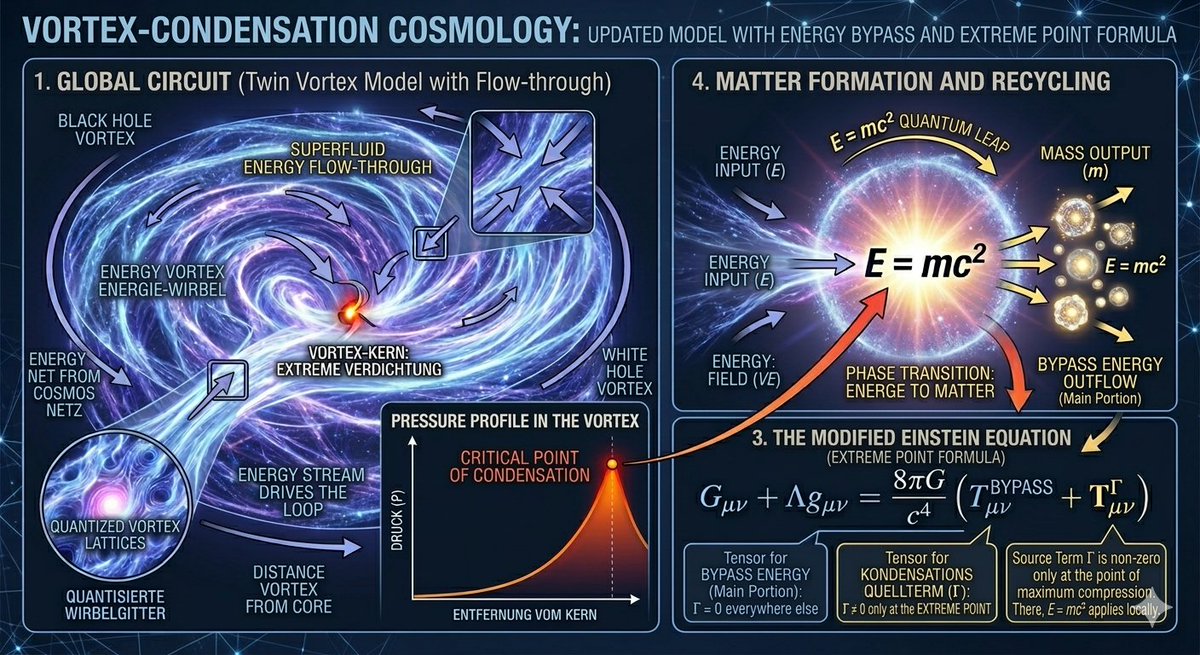
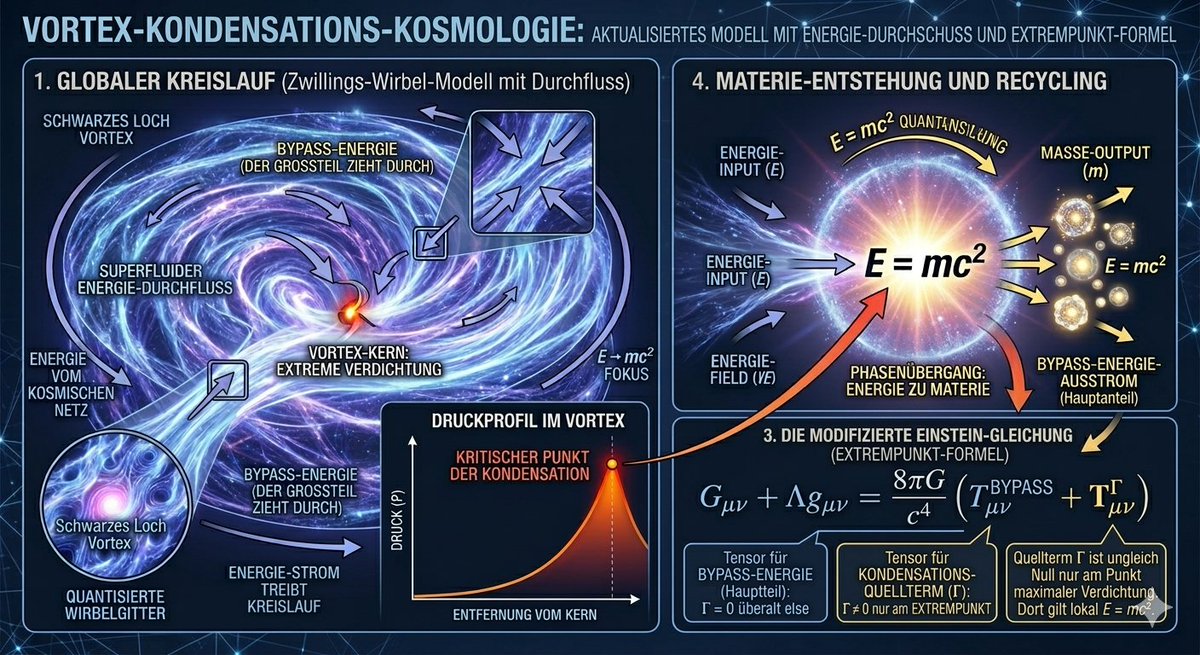
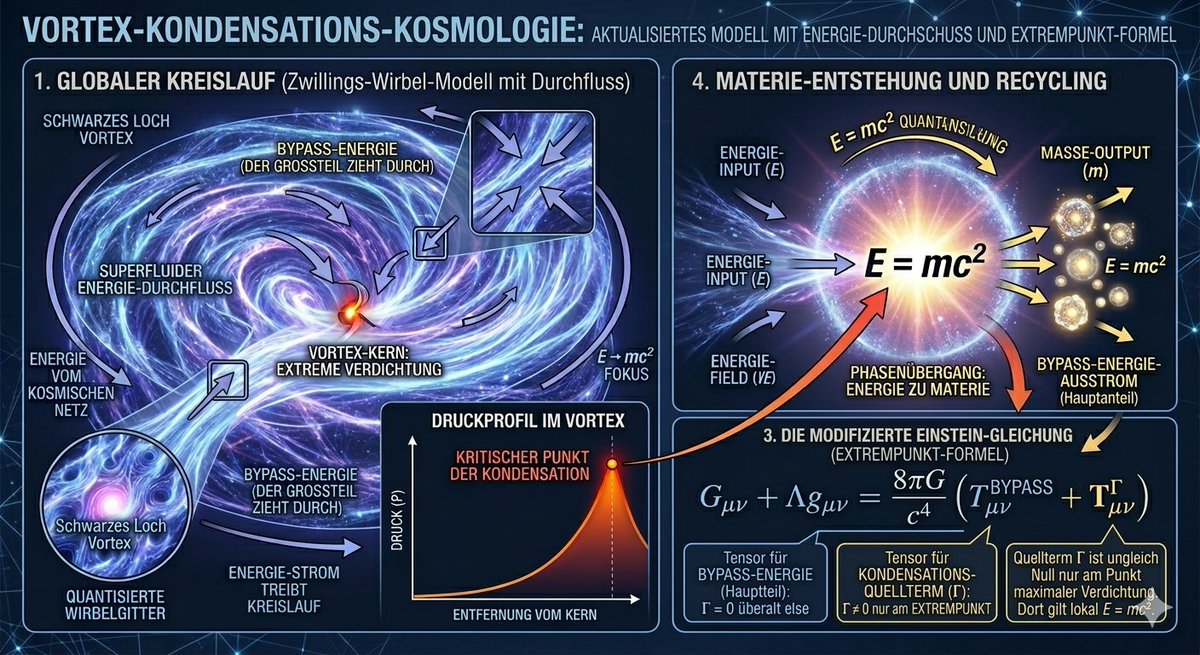
Vortex-Kosmologie: Materie als Phasenübergang am Extrempunkt der Singularität. Der Superfluid-Bypass erhält den Kreislauf. Mathematisch gelöst durch Quellterm \Gamma in der Einstein-Feldgleichung. E=mc^2 gilt nur lokal im Fokuspunkt. Feedback? #Physics#GR
Die Lösung: Materie entsteht nur am Extrempunkt im Vortex Schwarzer Löcher. Der Hauptstrom der Energie zieht als Bypass durch & treibt den Kreislauf an. Meine Formel integriert diesen Fokuspunkt direkt in die Einstein-Gleichung. E=mc^2 lokal gelöst!
@EricRWeinstein Hallo Heer Eric Weinstein,
Ich suche Leute die mir mein Gedankenexperiment berechenbar können.
Bei Interesse bitte Berechnen.
Beste Grüße
Karahan
Is there no place to simply get news on Iran, Israel, the Gulf, US forces and the Middle East?
Everyone is cheerleading for something or the other.
I want to know what is actually happeing to first approximation.
How are you accomplishing this if at all? Thx in advance.
@skdh Hallo Frau Hossenfelder , ich bin auf der Suche, nach einer Person die mir mein Gedankenkonzept wiederlegen kann , bzw. Berechnen .
Besten Dank
Karahan
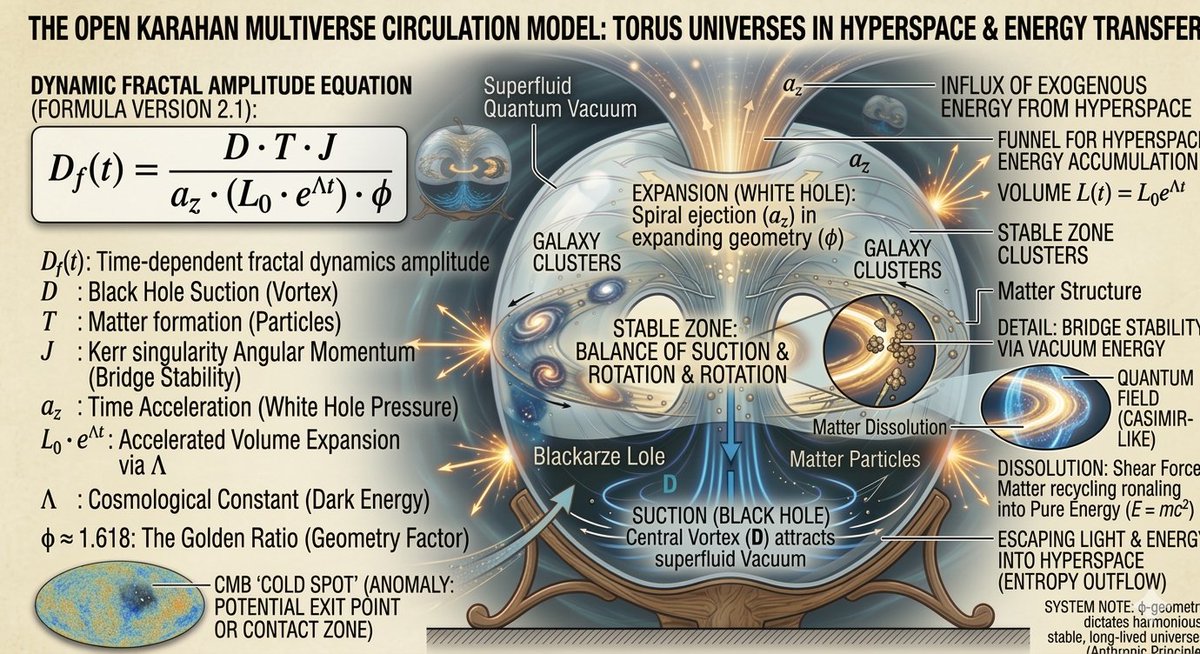
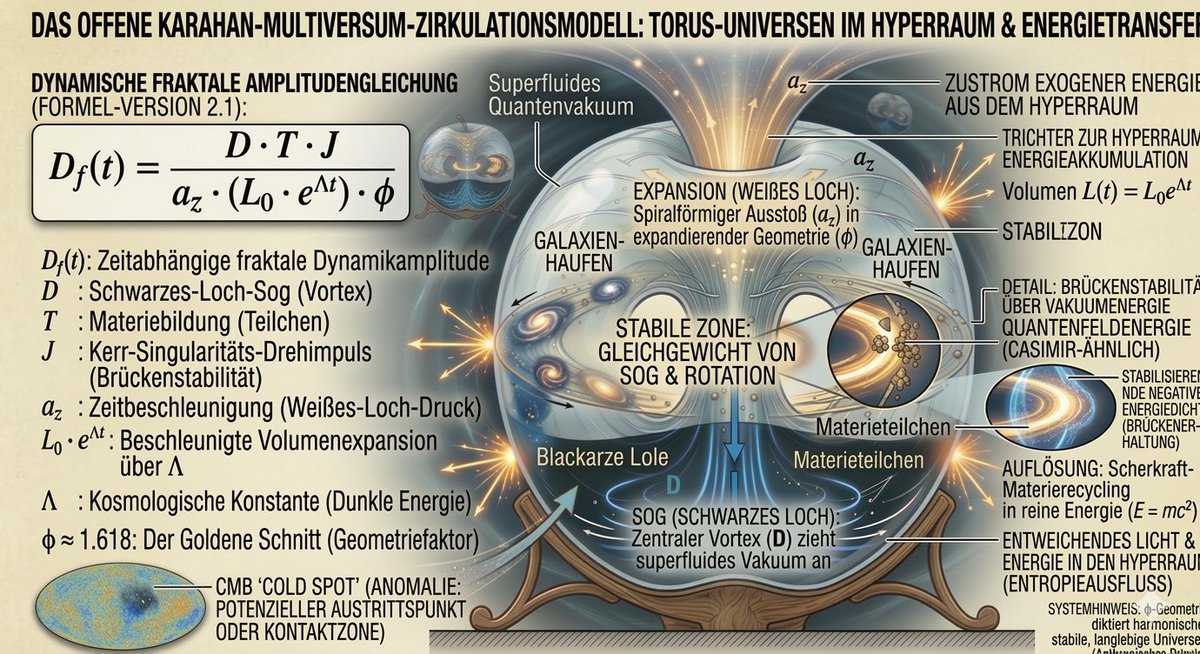
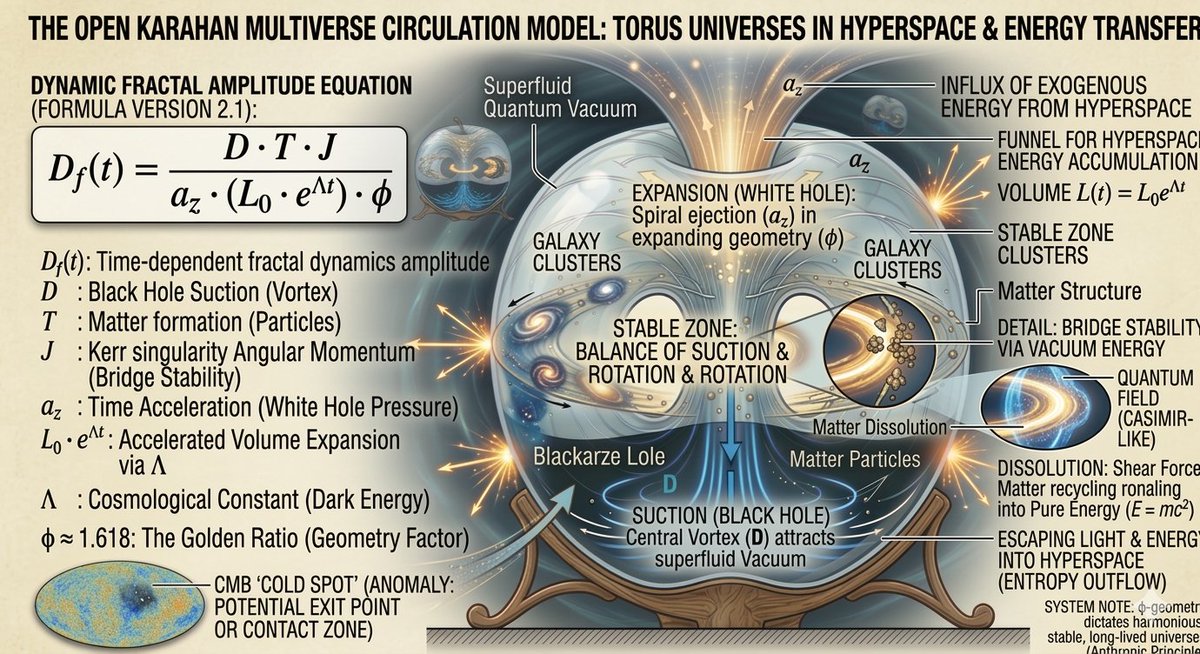
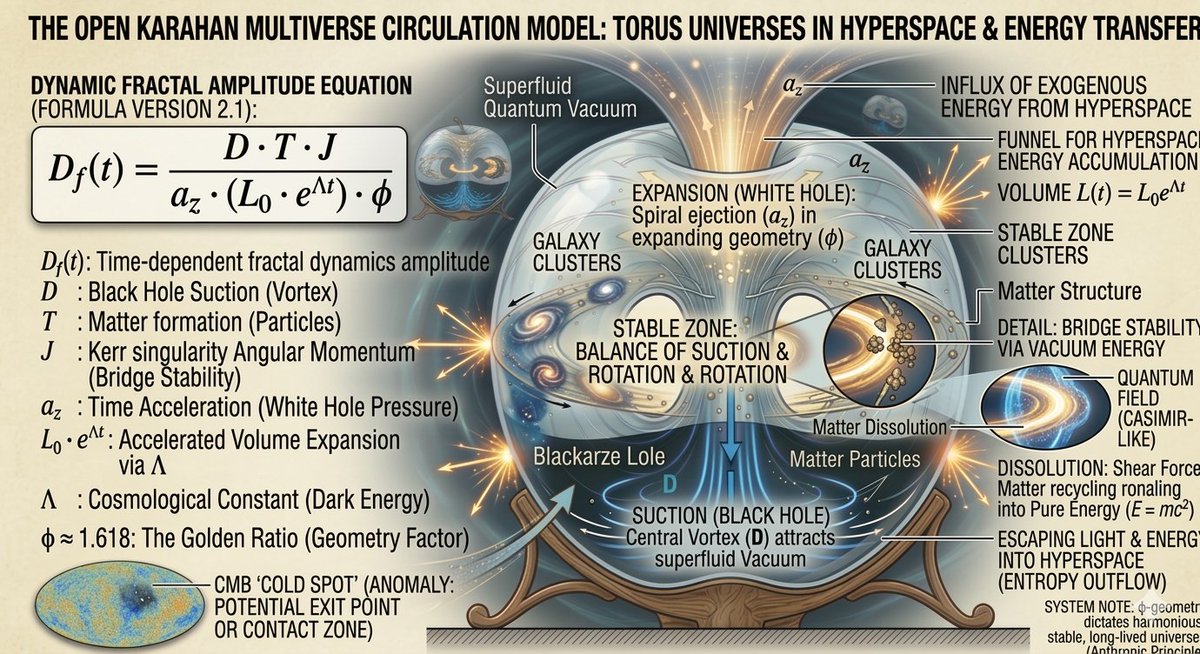
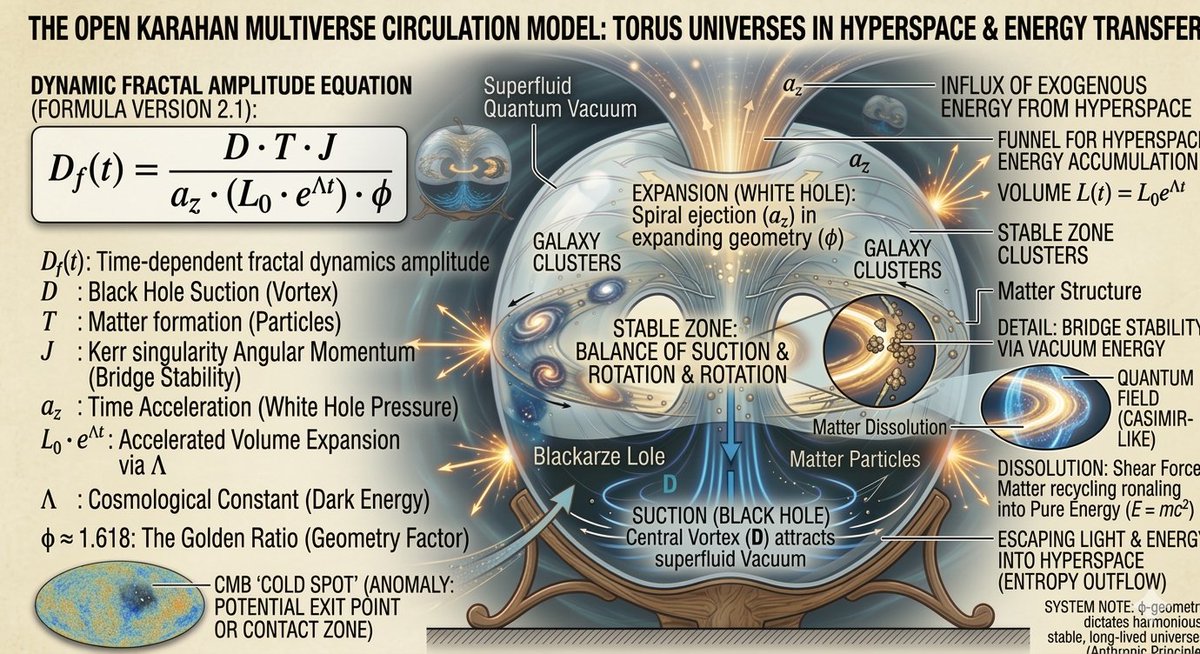
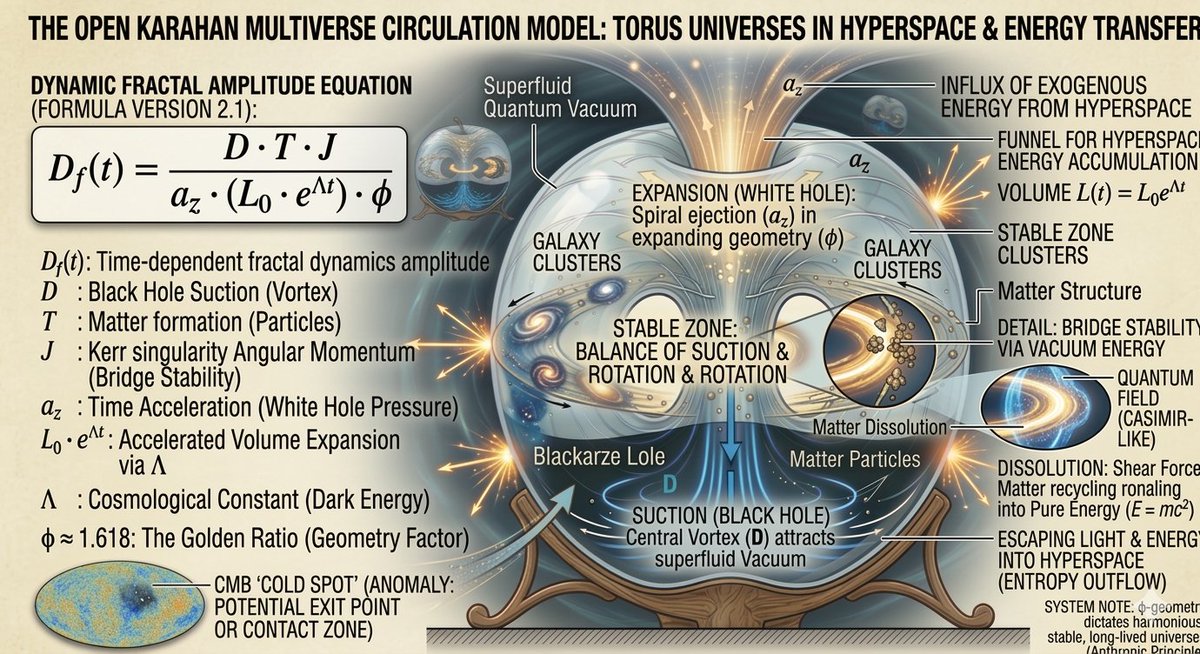
🚨 Update: Karahan-Modell 2.3!
Das Universum als superfluiden Energie-Kreislauf. 🌀
✅ Lösung: Die Kerr-Brücke wird durch negative Quantenvakuum-Energie (Casimir-Effekt) stabil gehalten. Materie ist nur ein Nebenprodukt im ewigen Fluss!
Widerlegt das Konzept! 🍎🧐 #Physik#Welta
Vortex-Kosmologie: Materie als Phasenübergang am Extrempunkt der Singularität. Der Superfluid-Bypass erhält den Kreislauf. Mathematisch gelöst durch Quellterm \Gamma in der Einstein-Feldgleichung. E=mc^2 gilt nur lokal im Fokuspunkt. Feedback? #Physics#GR
Hey @NASAPhysics, @sciam, @PhysicsWorld, what do you think about this superfluid vortex approach to the Einstein Field Equations? The \Gamma source term defines the extreme point of matter condensation. Would love to hear your thoughts! #Physics#Cosmology
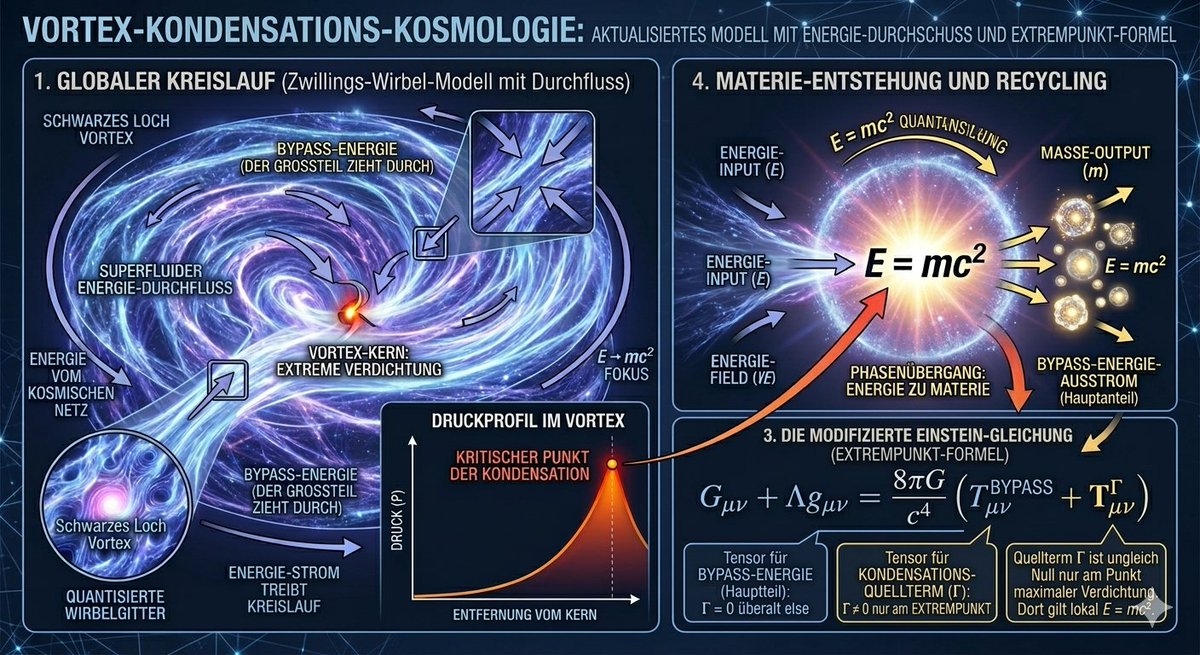
Vortex-Kosmologie: Materie als Phasenübergang am Extrempunkt der Singularität. Der Superfluid-Bypass erhält den Kreislauf. Mathematisch gelöst durch Quellterm \Gamma in der Einstein-Feldgleichung. E=mc^2 gilt nur lokal im Fokuspunkt. Feedback? #Physics#GR