Layergg@layerggofficial
Why TAO's Flywheel Makes It the Infrastructure Play for Decentralized AI🤖
1) Let's be honest — we're late. @AlgodTrading is back, TAO already completed its first halving, subnets exploded from 70 to 129 since dTAO launched, and Grayscale is preparing an ETF conversion —
but showing up late with a clear thesis beats not showing up at all.
2) Look at the AI x Crypto intersection. This isn't about "using AI on a blockchain." The only network where value structurally accrues to the token — is @bittensor .
3) AI Agents need money. They need to pay, get paid, and transact autonomously.
4) The settlement layer will be stablecoins like USDC — but the intelligence layer, where AI models compete, get evaluated, and get rewarded? That's $TAO
5) The substance of Bittensor is its subnets.
6) Each subnet is an independent competitive marketplace specialized in a specific AI task — text generation, image recognition, coding, prediction, data storage.
7) One Subnet = one AI business.
8) And these subnets sit on a Darwinian competition structure.
9) High-performing subnets receive more TAO emissions. Underperforming ones see their emissions shrink until they're eventually pruned. The only subnets that survive are the ones building genuinely useful AI.
10) Validation has already started. Chutes (SN64) is generating $1.3M in revenue.
x.com/chutes_ai/stat…
11) Ridges (SN62) outperformed Anthropic's Claude 4 on coding benchmarks.
12) Subnets aren't "projects" anymore — they're entering the real-revenue AI product stage.
13) TAO's core is a flywheel. Price goes up → mining rewards become worth more in dollar terms → top-tier AI talent floods in → subnet AI quality improves → network utility increases → TAO demand expands → price goes up again. Halving cuts new supply in half, accelerating this loop.
14) Why TAO is structurally different from other L1s — value doesn't leak out.
15) Subnet registration, AI service access, validator staking, governance — every economic activity in the network is gated by TAO.
16) dTAO's AMM pools lock capital into TAO reserves, and 70% of total supply is already staked. The actual circulating float is extremely limited.
17) When a subnet succeeds, people stake TAO into its AMM pool to buy Alpha tokens. TAO gets locked in the reserve, circulating supply shrinks, and price rises structurally.
So, Subnet success = TAO success.
18) It works in reverse too. When TAO price rises, the dollar value of block emissions goes up, pulling more capital and talent into subnets, driving up AI quality and revenue.
Therefore, TAO success = Subnet success.
19) This isn't a narrative. It's a mechanism. Self-reinforcing and recursive.
20) If you're bullish on Decentralized AI → you're bullish on TAO.
21) If you believe AI Agents need an intelligence marketplace → you're bullish on TAO.
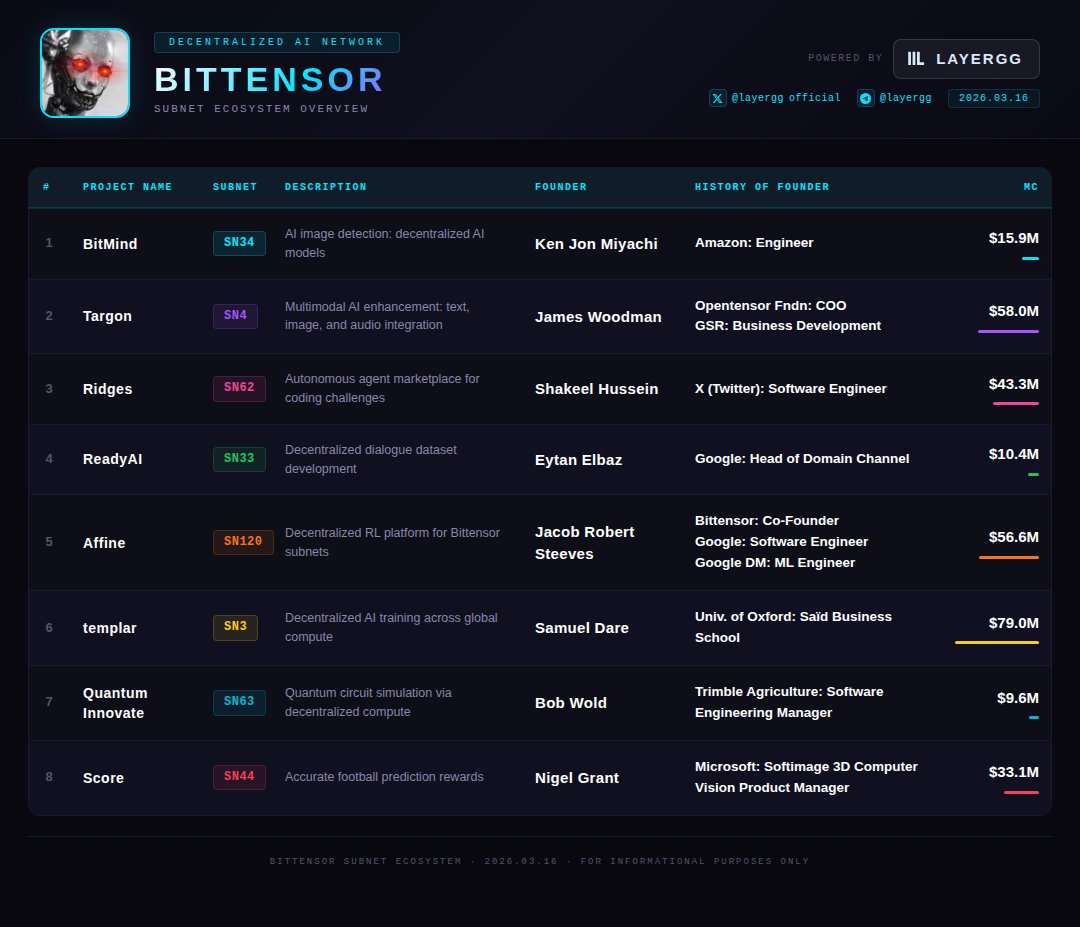
That's the structure. Now — which subnets are actually worth paying attention to? We've narrowed our focus to projects where the founders have credible track records: real engineering backgrounds, experience at top-tier tech companies, and proven execution. Here's our shortlist.
@bitmind @TargonCompute @ridges_ai @ReadyAI_ @tplr_ai @qBitTensorLabs @webuildscore @chutes_ai