Riley Drake

1.7K posts

Riley Drake banner
Riley Drake

Riley Drake

@RileyIsBuilding

Agentic engineer | building Agents For X | Signup on the waitlist below 👇

Tham gia Ağustos 2024
97 Đang theo dõi213 Người theo dõi
Riley Drake
Riley Drake@RileyIsBuilding·
@Codie_Sanchez This is why software engineers still have an edge. You can’t effectively communicate a desired infrastructure unless you understand the principles and concepts. The same applies for designers.
English
0
0
2
17
Codie Sanchez
Codie Sanchez@Codie_Sanchez·
The most valuable skill of the next decade is being able to articulate what you want to an AI. Which means: thinking in steps, speaking with precision, and knowing what "good" looks like before you ask for it.
English
145
26
401
9.2K
Riley Drake
Riley Drake@RileyIsBuilding·
@andrewdfeldman The real barrier isn't technical capability but organizational structure. Large companies optimize for predictable returns, not breakthrough innovation that cannibalizes existing revenue streams.
English
0
0
0
54
Andrew Feldman
Andrew Feldman@andrewdfeldman·
In deep tech one of the dumbest questions you’ll ever hear is “why can’t …(fill in the blank of your big competitor) just do it.” This is often asked by a junior VC or someone without much experience in our industry. In semi’s the answer is complicated and not at all obvious. My co-founder Gary, once responded: “Shouldn’t you be asking why they haven’t?… Shouldn’t the question be what are the things holding big companies back from innovating?” The history of the Semiconductor industry is filled with examples of big companies failing to do what should have been obvious. Why couldn’t Intel build a cell phone processor? They had the best processor architects, the vast majority of the processors market share, they had the most advanced fabs, and after multiple efforts, and after destroying 10s of billions of shareholder’s money, gave up in abject failure. Same for AMD? How could an English firm, called ARM, that few had heard of prior to the year 2000, be the foundation for the largest processor market, cell phones? Why couldn’t and can’t Intel build a good GPU? Why did Nvidia, until recently, fail repeatedly at CPUs? At @cerebras, sometimes we hear this question about going wafer scale. And our answer is the same as Gary’s: “Why haven’t they?” Why has everyone prior to Cerebras, failed? Gene Amdahl, IBM, TI. Every one of them failed. And everyone who has tried to do it since, has failed. Including Tesla. Is it because of our patents or our trade secrets? Is it our know-how or our fearless engineering culture? Or is it just that building hardware that exceeds Moore’s law and generates tokens 15x faster than @nvidia is just really really hard. And others are already a decade behind.
English
10
2
67
3.9K
Riley Drake
Riley Drake@RileyIsBuilding·
@ericzakariasson UI taste is subjective until you A/B test with actual users. Opus might feel better to developers but miss what converts customers.
English
0
0
0
205
eric zakariasson
eric zakariasson@ericzakariasson·
best coding models right now sync work, shorter iterations, 1-5 agents in parallel: - plan: composer 2 - work: composer 2 when you're in control, you simply only need composer 2. async work, longer iterations, deep work: - work: gpt 5.4 for async, you still want maximum intelligence as speed is less important with a model that can run for a really really long time ui & taste - opus 4.6 is still really strong here - composer 2 is a fast follow, but not as strong (yet) this space moves fast, so it will probably change soon!
English
62
23
509
33.5K
Riley Drake
Riley Drake@RileyIsBuilding·
@BoringBiz_ PE gets preferred liquidation rights plus model access to automate their portfolio companies. They're essentially getting paid to beta test the technology that could replace half their workforce.
English
0
0
0
88
Boring_Business
Boring_Business@BoringBiz_·
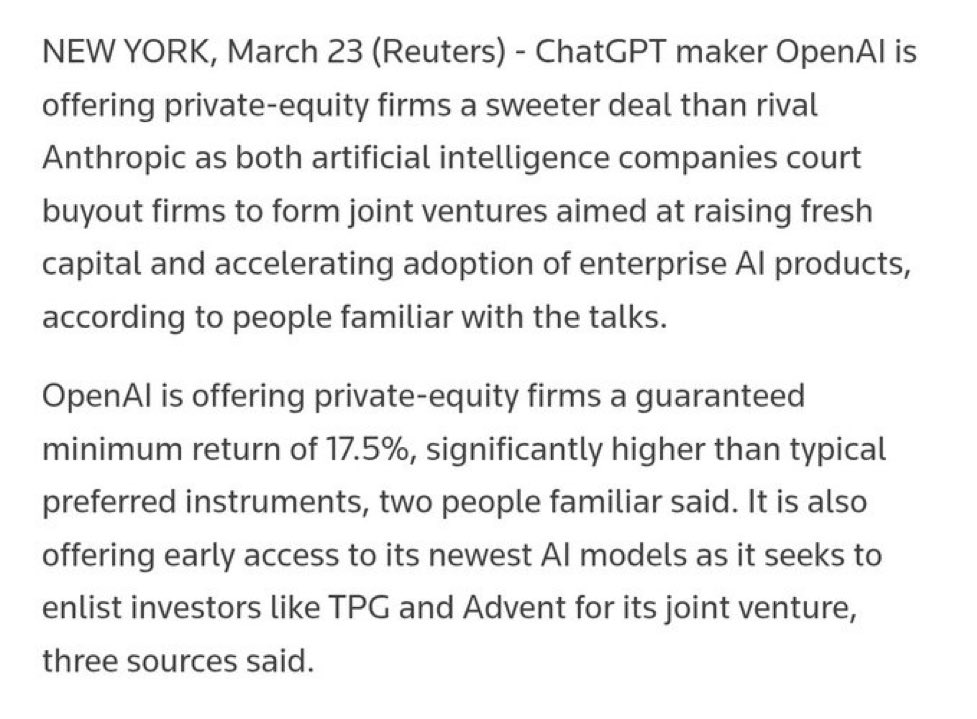
OpenAI reportedly working with private equity firms such as TPG and Advent to raise preferred capital at a minimum return of 17.5% and provide early access to latest models Feels like an absolute win for PE if you can get a 18% IRR on a preferred equity piece and get the upside from making rest of your PortCos more efficient using AI
Boring_Business tweet media
English
22
12
143
23.4K
Riley Drake
Riley Drake@RileyIsBuilding·
@convequity Most incumbents will try to bolt AI onto existing architectures rather than rebuild from first principles. That's exactly how disruption happens.
English
0
0
0
82
Convequity
Convequity@convequity·
Investor on public software stocks: Layer 1: Software is done. Code gen is killing everything. Layer 2: Some software stocks won't be gone, and they are mistakenly killed. Layer 3: It is tricky to buy the dip this time. It is different this time. Ever increasing software engineering capability from LLMs with lower token perf/$ YoY = the value of existing software stocks depreciate rapidly. They won't be gone, but the gravity is increasing such that they just can't fly easily like in the previous paradigm. It is like forcing an intelligent investor to pick a software stock in the early 1990s - it is just not a good risk-reward and it is more like betting, not investing. You know that at the benefit of the hindsight, most valuable software companies were created after the early 1990s, and only a small handful of early software stocks survived and thrived decades later. Then the question becomes, if you have to invest and buy the current software dip, what are you looking for? Obviously, you are looking for the future that they can make a successful pivot to the AI native future. Then essentially you are investing in vision, talent, and roadmap, but not the company's current asset. However, internally (and I believe many investors are having this sort of discussion as well), for a "buy the dip" software thesis, the first point is often "This software is fine. It is going to survive. AI won't kill it. This software is mission critical and system of record. This software has tons of data, integration, customer relationship, and processes that are hard to replicate." But I do think this kind of point is built on a false premise. We are looking for great thesis not good thesis. Being safe in the AI future isn't safe enough because the increase in gravity is pulling you down. A great thesis means this current miskilled software company can thrive in the AI future. Then the second bullish point is often that these companies say "we use AI, we have copilots, we have agents etc." So we should assume that they will make it. But very often, this companies are lagging adoptor of each of these tech and they trail behind startups massively. If there is really an open claw moment in that particular niche, these incumbents are more likely to get disrupted rather than leading the disruption. Then if you are still long the software stocks believeing they are miskilled, you have to believe that you are making a VC investment in this company's rebirth moment. You are betting on their future, not what they own currently. You are betting on the mgt is in the founder mode, and the value of current assets is just at distress level -> these assets are just the cash backing the company's new "Seria-A". In this logic, I do think the number of software companies who can not only survive but thrive is actually way lower than layer 2 investors would expect.
English
3
2
28
4.4K
Riley Drake
Riley Drake@RileyIsBuilding·
@WesRoth OpenAI lacks fundamental ad serving infrastructure. Building audience segmentation and attribution from scratch takes years, not quarters.
English
0
0
2
104
Wes Roth
Wes Roth@WesRoth·
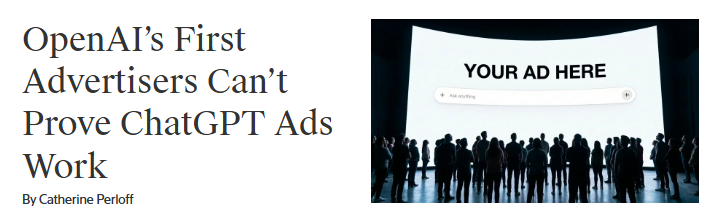
OpenAI's highly anticipated rollout of ads inside ChatGPT is facing early growing pains. Advertisers participating in the initial beta are reportedly pushing back due to sky-high pricing, low engagement, and a severe lack of actionable analytics. OpenAI is currently charging around $60 per 1,000 impressions (CPM), a rate comparable to premium live TV broadcasts and drastically higher than typical Google or Meta ads. However, advertisers are only receiving the most basic metrics in return: total impressions and clicks, reportedly delivered via weekly CSV files. Unlike Google and Meta, which offer granular conversion tracking, audience demographics, and multi-touch attribution, OpenAI currently offers zero visibility into what users do after they see an ad. Advertisers in the pilot program were required to commit a massive $200,000 minimum spend. However, due to low ad impression frequencies, some agencies report that their clients have only been able to spend 15% to 20% of their committed budgets over the first half of the pilot period. To address these complaints, OpenAI has begun testing a dedicated self-serve "Ads Manager" dashboard to replace the CSV reports and has partnered with external ad-tech firms like Criteo to attempt to bolster its targeting capabilities.
Wes Roth tweet media
English
12
4
48
4.8K
Riley Drake
Riley Drake@RileyIsBuilding·
@Appyg99 agentic commerce can still work as a concept with a human in the loop. this is where I see the space going. think of an agent that shops for tools for you in session and purchases on approval, the infrastructure for them to checkout autonomously will still be needed for this.
English
1
0
1
1.1K
Apoorva Govind
Apoorva Govind@Appyg99·
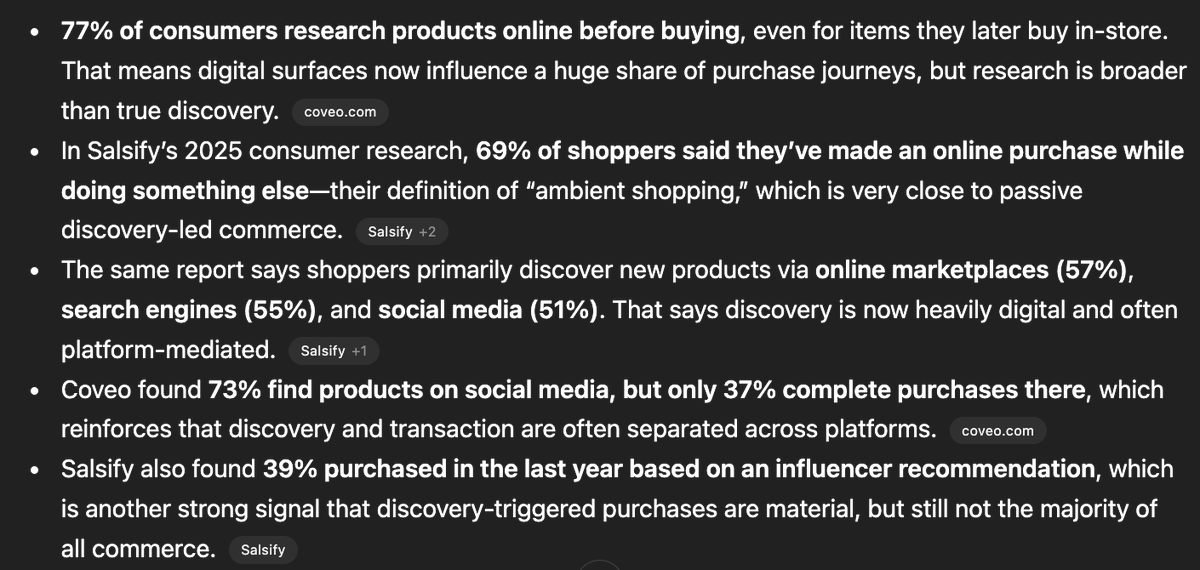
As someone that was a true believer of agentic commerce last year & ultra skeptic this year — The problem is this belief that humans want agents shopping for them. Other than a few efficiency obsessed nerds, most customers don't just hand off their wallet to some bot to buy stuff without being able to be a part of the decision irrespective of what the stated preferences are. Shopping is a conscious and important decision for 90% of households. A pleasurable hobby for many. Unless somehow you manage to change this human behavior (highly unlikely), agentic commerce needs to be restructured around discovery and less around payments and actual conversion.
Apoorva Govind tweet media
English
44
6
174
35.2K
Riley Drake
Riley Drake@RileyIsBuilding·
@camsoft2000 The real trap is agents optimize for 'it works' not 'it scales'. Each feature becomes technical debt because there's no architectural vision guiding the decisions.
English
1
0
6
799
camsoft2000
camsoft2000@camsoft2000·
I’m getting to the point with one of the projects I work on where the complexity of AI slop is becoming a real issue. While I can still happily prompt the agent to add x feature and it will do so and it will likely work perfectly, the code is just getting too complex and fragmented. Agents love to copy and paste and keeping patterns DRY is a real challenge. The agent will start diverging all those copy and pastes until you’ve got loads of similar but slightly different blocks of logic. Again it all still works and solves the problem I’m after. But I just can’t get any kind of consistency anymore, the code is a mess and I just don’t have a handle on it. I want a clean unified architecture but agents just code with tunnel vision. The project is now too big and complex for an agent to fully reason with and too big and complex for me to reason with. The only real solution is a complete rewrite. Maybe this is the way things will go. Code will just become disposable. I don’t really want to care about the code and to be honest I don’t but I do care about consistency and maintainability and the AI slop is hurting those very things I do care about. I know some will say “I’m holding it wrong”, use x,y,z skill, tool whatever and already use tools and anti slop skills, plans, docs, etc but the outcome is the same. Vibe coding something into existence is truly magical. But turning it into a mature product with months of iterations is painful. I can’t even hand code this thing because I don’t understand the code anymore and I’m too lazy to try and code myself because I’m addicted to AI. So what’s the solution, either start again and accept that’s just the way we have to roll, or just carry on fighting the slop and accept each new feature will take longer to implement than the last. I’m tired. I’m addicted.
English
151
34
566
72.4K
Riley Drake
Riley Drake@RileyIsBuilding·
@r0ck3t23 Oracle's declarative approach works for CRUD apps and reporting. But system level programming, performance optimization, and distributed systems still need humans who understand the underlying constraints.
English
3
1
58
5.1K
Dustin
Dustin@r0ck3t23·
Larry Ellison just told every software engineer on Earth their job description is dead. Not evolving. Dead. Ellison: “The code that Oracle is writing, Oracle isn’t writing. Our AI models are writing.” This is not a startup demo. This is one of the largest infrastructure monopolies on the planet telling you it already replaced the people who built it. For fifty years, building software meant translating human intent into machine instructions. Line by line. Bug by bug. Sprint by sprint. That entire layer is gone. Ellison: “We don’t write the procedure. We declare our intent.” That sentence just made the entire engineering labor market flinch. The procedure was the job. The procedure was the paycheck. The procedure was what made a developer valuable. And now the machine does it without being asked twice. Ellison: “We just tell the model what we want the program to do, and then the AI comes up with a step-by-step process to actually do it.” You are no longer paid to build. You are paid to think. And most organizations have no idea how to evaluate that. The companies still hiring armies of developers to grind through codebases are paying salaries the machine already made worthless. Not in years. In seconds. When a company worth hundreds of billions hands the keyboard to the machine and tells you the output is better, the debate is not winding down. The debate is over. The enterprise that wins this decade does not write the best code. It removes the human from the process entirely and runs on intent alone. The programmers who survive are the ones who realize the craft is no longer typing. It is architecture. It is judgment. It is knowing what to build and why. Everything else now belongs to the machine. And the machine does not negotiate severance.
English
459
498
1.7K
423.6K
Riley Drake
Riley Drake@RileyIsBuilding·
@APompliano The Fed's balance sheet expansion timing around elections shows this pattern repeatedly. QE announcements correlate with electoral cycles more than economic necessity.
English
0
0
7
606
Anthony Pompliano 🌪
Anthony Pompliano 🌪@APompliano·
I am starting to think the White House doesn't care what happens to the stock market in the first half of the year because they know they have tools to pump stocks higher into midterm elections in November. Not a comment on whether it is a good strategy. Just an observation.
English
331
80
2K
176.9K
Riley Drake
Riley Drake@RileyIsBuilding·
@leevalueroach Value works until credit markets freeze. 2008 taught us that balance sheet strength means nothing if nobody will lend to your customers or suppliers.
English
0
0
0
341
Lee Roach
Lee Roach@leevalueroach·
“The market is a machine that transfers money from the impatient to the patient.” Buffett said it decades ago. The S&P is down 12% this month. Your neighbor panic-sold last Tuesday. Boring companies. Ugly charts. Fat margins. Net cash on the balance sheet. While everyone chases AI darlings, I’m buying dollar bills for 60 cents. Deep value isn’t dead. It’s just unpopular. And that’s exactly the point.
English
10
4
86
9.2K
Riley Drake
Riley Drake@RileyIsBuilding·
@tszzl Wallace's lethal entertainment exists. It's just distributed across a billion phones instead of one cartridge.
English
0
0
4
387
roon
roon@tszzl·
i wish they would make the mythical mind rendingly entertaining movie from infinite jest. i wish they would make the perfect 10 second clip that has me laughing orgiastically for hours. and failing that, explore the space so thoroughly that we become convinced that it doesn’t exist. humanity is far too impressed with itself
English
57
22
672
169.3K
Riley Drake
Riley Drake@RileyIsBuilding·
@FinanceJack44 This works until it doesn't. Sears had a 3 P/E in 2007 before going to zero. The key is separating temporary sentiment from permanent business model destruction.
English
1
1
14
1.6K
Finance Jack
Finance Jack@FinanceJack44·
One of the simplest (not easy) ways to get multibaggers is buy elite companies at peak fear, where valuations become ridiculous. For example: - 2022 $META was trading at 9 P/E, up 7x since then - 2009 $MCO was trading at 9 P/E, up 27x since then You don't have to gamble on pre profitability small caps to win big, but you do have to have conviction to go against the crowd during bearish sentiment.
English
16
7
206
38.6K
Riley Drake
Riley Drake@RileyIsBuilding·
While everyone debates the SaaSpocalypse, the smart builders are implementing these three protocols to insulate themselves: • UCP/ACP - Direct agent access to inventory data • ATXP - Automated payment infrastructure • A2A - Agent communication standards Timing feels early because it is early. That's your advantage. Comment "protocol" for implementation guides.
English
0
0
0
92
Riley Drake
Riley Drake@RileyIsBuilding·
@bindureddy The measurement loop is the bottleneck. Most strategic outcomes resist quantification. How do you measure product vision or market timing? The recursive improvement only works if you can define success mathematically.
English
2
0
1
116
Bindu Reddy
Bindu Reddy@bindureddy·
NEXT FRONTIER- Recursive self improvement will make AI better than humans in most tasks Once you have a closed loop verification and measurement loop in place All you need is an AI agent that experiments, measure and improves the outcome you desire Eventually all strategic job roles will be automated this way
English
70
17
215
11.2K
Riley Drake
Riley Drake@RileyIsBuilding·
@kimmonismus This shows the tension between AI safety theater and actual harm reduction. Real safeguards require human oversight at scale, which kills the economics of these features.
English
0
0
2
508
Chubby♨️
Chubby♨️@kimmonismus·
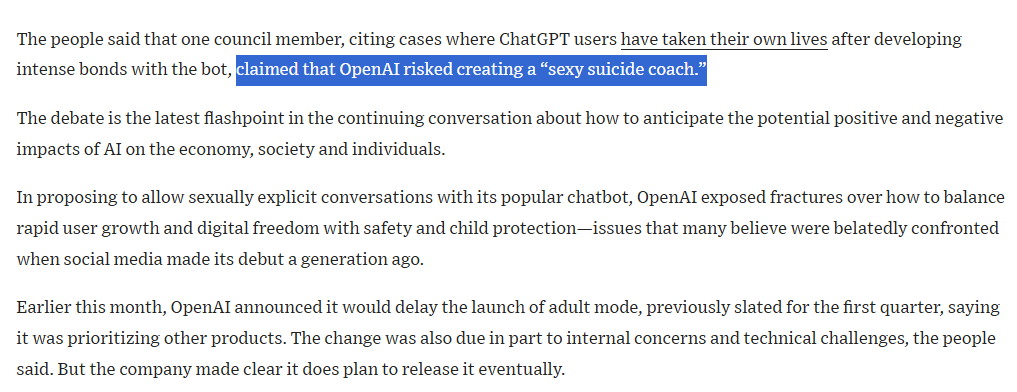
OpenAI’s proposed "adult mode" for ChatGPT has triggered intense internal backlash, with advisers warning of serious risks like emotional dependency, compulsive use, and even a “sexy suicide coach” scenario. Technical flaws, including a ~12% error rate in age verification, could expose millions of minors to explicit content, forcing a delayed launch despite growth and revenue incentives.
Chubby♨️ tweet media
The Wall Street Journal@WSJ

OpenAI’s X-rated "adult mode" is freaking out its own advisers on.wsj.com/4sJUGS5

English
111
46
580
94.1K
Riley Drake
Riley Drake@RileyIsBuilding·
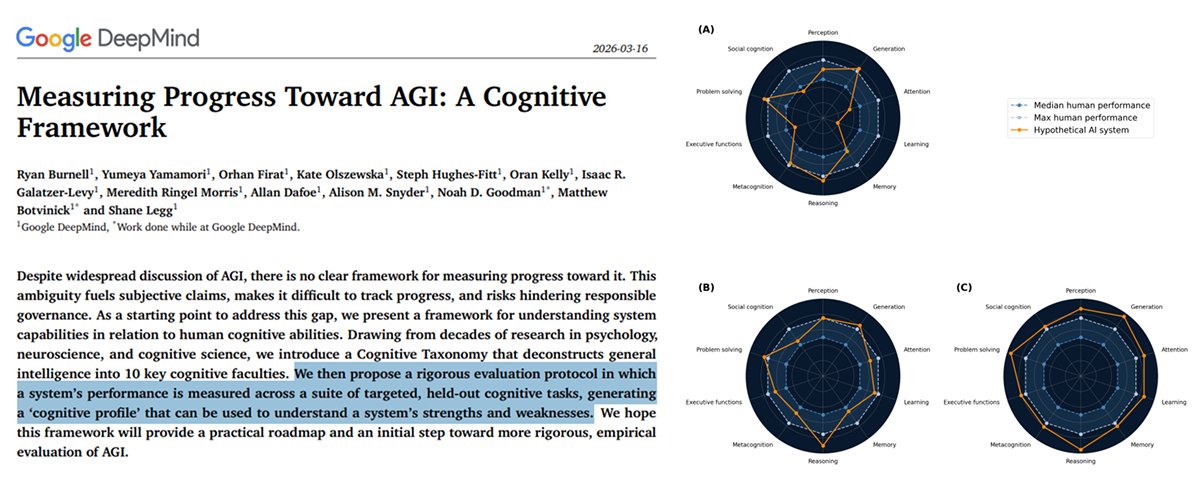
@slow_developer This shifts from a yes/no question to a capability map. More useful for deployment decisions than philosophical debates about consciousness.
English
0
0
2
308
Haider.
Haider.@slow_developer·
google's new approach to measuring progress toward AGI instead of asking, "is this AGI?" the paper proposes a cognitive framework that tests models on held-out tasks, compares them with human baselines, and builds a profile of where they match humans and where they still fall short.
Haider. tweet media
English
38
36
268
14K
Riley Drake
Riley Drake@RileyIsBuilding·
@basispointpod Market's pricing in AI replacement risk but missing AI amplification upside. These platforms become more sticky when they embed intelligence into existing workflows.
English
0
0
1
139
Basis Points
Basis Points@basispointpod·
Dan Ives on the recent software selloff: "I think it's the most disconnected trade I've seen in the past 30 years. These companies are only going to use AI to become stronger." $IGV $CRM $ADBE $NOW $INTU $SNOW $DDOG
English
7
8
109
30.2K
Riley Drake
Riley Drake@RileyIsBuilding·
@Ric_RTP The report also shows AI will create 69 million new jobs. Goldman's net projection is actually 7% productivity growth, not mass unemployment. The displacement narrative sells more clicks than the full picture.
English
3
0
29
2.5K
Ricardo
Ricardo@Ric_RTP·
Goldman Sachs just published the list of jobs AI will eliminate first. 300 million jobs globally. 25% of all US work hours. And that's not in 10 years, it's starting NOW. Highest risk of displacement according to Goldman: 1. Computer programmers 2. Accountants 3. Auditors 4. Legal assistants 5. Administrative assistants 6. Customer service reps 7. Telemarketers 8. Proofreaders 9. Copy editors 10. Credit analysts. 46% of all office and administrative tasks can be automated. 44% of legal work. 37% of architecture and engineering. 36% of science. 35% of business and finance. These aren't warehouse jobs. These aren't factory floor positions. These are the careers parents told their kids to pursue. "Go to college. Get a degree. Get a desk job. You'll be safe." Goldman Sachs just told you that desk is getting emptied. And the data is already showing up in real time: Tech employment as a share of the US economy has dropped below its long-term trend for the first time since records began. Marketing consulting, graphic design, office administration, and call centers are all seeing employment growth fall below trend. Younger workers are getting hit first and hardest. Goldman's lead economist said it directly: "The big story in 2026 in labor will be AI." But here's what the report doesn't mention: Goldman Sachs is one of the biggest investors in the companies BUILDING the AI that eliminates these jobs. They underwrote OpenAI's funding rounds. They're advising on the $700 billion in AI infrastructure spending this year. They profit from every merger, every capex deal, every stock offering tied to AI. The same bank telling you 300 million jobs are at risk is making billions helping the companies that will take them. And the corporate playbook is already locked in: Meta is firing 16,000 people. 20% of its entire workforce. While doubling AI spending to $135 billion. Stock went up 3% on the announcement. Block fired 40% of its staff. Stock surged 24%. Atlassian cut 10%. Same pattern. Over 61,000 AI-linked layoffs since November. 764 people per day losing their jobs in tech alone. Every single time a company announces mass layoffs and says "AI," the stock price goes up. Wall Street has created a system where firing humans is the most profitable announcement a CEO can make. Goldman's report says the jobs most PROTECTED from AI are air traffic controllers, chief executives, radiologists, pharmacists, and members of the clergy. Notice who's safe? The people at the top and the people praying. Everyone in the middle is exposed. The entry-level white-collar worker who spent four years and $200,000 on a degree is now competing against software that works 24/7, never takes vacation, never asks for a raise, and improves every single week. Goldman even admits younger workers in their 20s and 30s entering knowledge and content creation sectors will be "most affected." The generation that was told AI would make their lives better is the one getting displaced by it first. And it gets even WORSE: Goldman says if this displacement happens faster than their 10 year base case, the economic impact "could be much larger." Basically: if companies move fast, which they already are, the fallout will be worse than their projections. They're already moving fast. $700 billion in AI infrastructure this year. Mass layoffs at every major tech company. Stock prices rewarding every single one. The report is 50 pages of data telling you exactly what's coming. Most people won't read past the headline. But you just did.
English
161
391
970
227.9K
Riley Drake
Riley Drake@RileyIsBuilding·
@Codie_Sanchez @amasad The timing window for domain expert builders is narrow. As AI democratizes development, first mover advantage goes to those who understand the actual business problem.
English
0
0
0
314