Thin Float

280 posts

Thin Float

Thin Float

@ThinFloat

New York, NY Tham gia Mart 2026
239 Đang theo dõi91 Người theo dõi
Thin Float
Thin Float@ThinFloat·
6/ Negative 10yr returns. Every insider buyer underwater. Revenue shrinking. Competition not slowing down. China structurally impaired. Buybacks dead. Take-private is a fantasy. I'm not saying Nike the brand is dead. I'm saying Nike the stock has been a terrible investment for a decade and nothing in the data tells me that changes anytime soon. If you're long this, tell me what I'm missing. Genuinely want to hear it 👇
English
0
0
0
11
Thin Float
Thin Float@ThinFloat·
5/ I keep seeing "what if Nike goes private" and I need to put this to rest. Mkt cap is $53B. Slap a 30% premium on that plus $11B existing debt and you're at $80B+. Largest LBO in history was Dell at $24B. Nike's OCF collapsed from $7.4B to $3.7B so the cash flow can't even service that kind of debt. And here's the thing nobody mentions, the Knight family already owns 22% with voting control through Class A shares. They run the company. Why would you pay $80B to buy something you already control? You wouldn't. Take-private is cope. At $44 you're still paying 29x declining earnings and buybacks went from $4.3B to basically zero ($199M). The CEO literally said they're in "middle innings." That's 2-3 more years minimum.
English
1
0
0
15
Thin Float
Thin Float@ThinFloat·
1/ Tim Cook bought $3M of Nike at $59 in December. It's $44 now. The CEO of Apple just lost $750K on a sneaker company in 4 months. This is the stock fintwit keeps telling you to "buy the dip" on. Let me show you why $NKE might be the biggest value trap in the market 🧵
English
1
0
0
23
Thin Float
Thin Float@ThinFloat·
@DimitryNakhla I’m going to leave this here: x.com/thinfloat/stat…
Thin Float@ThinFloat

$DLO why this is un-investable Revenue: $1.1B, up 47%. Amazon, Nike, Uber as clients. EM payments is a massive TAM. The bull case writes itself. The governance makes it un-ownable. General Atlantic, largest shareholder and pre-IPO backer, dumped 17.25M shares in Sept 2025 at $12.75 a 63% loss on their $34.14 avg cost. When your anchor investor is liquidating at a massive loss, that's not "portfolio rebalancing." That's an exit. Top institutional holders outside GA? Marshall Wace, D.E. Shaw, Two Sigma, Renaissance. All quant/hedge funds. Zero fundamental long-only conviction holders in the top 20. TWO separate short seller attacks in 3 years. Muddy Waters (2022): stock halved. Hollenden Square (2025): 500+ pages alleging FX irregularities and undisclosed related parties. Active federal securities fraud class action (Francis v. DLocal, E.D.N.Y.) alleging false statements about Argentine FX compliance. Argentine government investigated for alleged $400M in improper transfers. Rosen Law still investigating as of 2025. C-suite revolving door: founder CEO out. CFO out after ~1 year. Running on an interim CFO today. Zero open-market insider purchases. Not one executive has bought their own stock at 82% off highs. Cayman Islands domicile. 20-F filer. Less transparency than a domestic 10-K. The business might be real. The governance risk makes the risk/reward broken for a defense-first portfolio. $69 → $13. Price doesn't lie.

English
1
0
1
289
Dimitry Nakhla | Babylon Capital®
Charlie Munger famously said: “Invert, always invert.” So let’s apply that to dLocal $DLO. A business with ~$440M in cash, $0 long-term debt, trading at ~14x earnings, operating across ~45 markets in some of the fastest-growing and most underpenetrated payment corridors in the world — LATAM, APAC, and Africa. $DLO has 3 distinct paths to grow: 1️⃣ 𝐂𝐮𝐫𝐫𝐞𝐧𝐭 𝐦𝐞𝐫𝐜𝐡𝐚𝐧𝐭𝐬. 𝐂𝐮𝐫𝐫𝐞𝐧𝐭 𝐦𝐚𝐫𝐤𝐞𝐭𝐬. More volume flowing through an already embedded relationship. No new sales cycle required. 2️⃣ 𝐂𝐮𝐫𝐫𝐞𝐧𝐭 𝐦𝐞𝐫𝐜𝐡𝐚𝐧𝐭𝐬. 𝐍𝐞𝐰 𝐦𝐚𝐫𝐤𝐞𝐭𝐬. dLocal operates across ~40 markets. Most merchants are only using a fraction of them. The cross-sell opportunity is already sitting inside the existing customer base. 3️⃣ 𝐍𝐞𝐰 𝐦𝐞𝐫𝐜𝐡𝐚𝐧𝐭𝐬. 𝐀𝐧𝐲 𝐦𝐚𝐫𝐤𝐞𝐭. Winning business from merchants not yet on the platform — in markets where the digitization tailwind is still in its early stages. 𝐍𝐨𝐰 𝐢𝐧𝐯𝐞𝐫𝐭. What are the odds $DLO fails on all three simultaneously? That existing merchants use them less, don’t expand into new markets, and no new merchants come on board — all at once? That’s a difficult case to make. And this doesn’t even account for the future suite of services $DLO may be able to layer on top as payment volume scales through their platform. More volume means more data, more trust, and more monetization opportunities over time.
Dimitry Nakhla | Babylon Capital®@DimitryNakhla

1/13 $DLO has become one of the more interesting companies in global payments. Since its 2021 IPO, the stock is down -82%, while Revenue & EPS have grown at 35% and 19% CAGR (2022-LTM). Today it trades at 15x earnings and a 6.4% FCF yield. Is this an opportunity or trap?

English
5
0
38
13.9K
Michael Bento
Michael Bento@MichaelPBento·
I spent the morning building a large position of puts across various expirations and strikes. I know I said 660 was my buy level but I wanted to start scaling in this morning given the large put orders that have been coming over all morning. If we move higher than 660 I’ll add to the point of max short. Needless to say right now I’m in a large enough position to hurt if I’m wrong.
English
16
2
218
10.7K
Thin Float
Thin Float@ThinFloat·
Narrow moat, revenue decelerating fast: : Q1’25 +9.2%, Q2’25 -0.7%, Q3’25 +8.3%, Q4’25 +4.0%. Balance sheet is a fortress because the business needs it. Management carries that massive cash cushion specifically to survive the revenue troughs that have historically hit 40–50% peak-to-trough. Revenue durability under stress won’t hold up well compared to $HUBB for example. $POWL is project based cyclical revenue. I would be interested in them at the right price but as of now I can deploy that cash elsewhere with more upside / different exposure. Just not too keen on the business model doesn’t fit my portfolio style. Fortress cash, defensive with moat / monopoly.
English
0
0
0
61
Say No To Trading
Say No To Trading@SayNoToTrading·
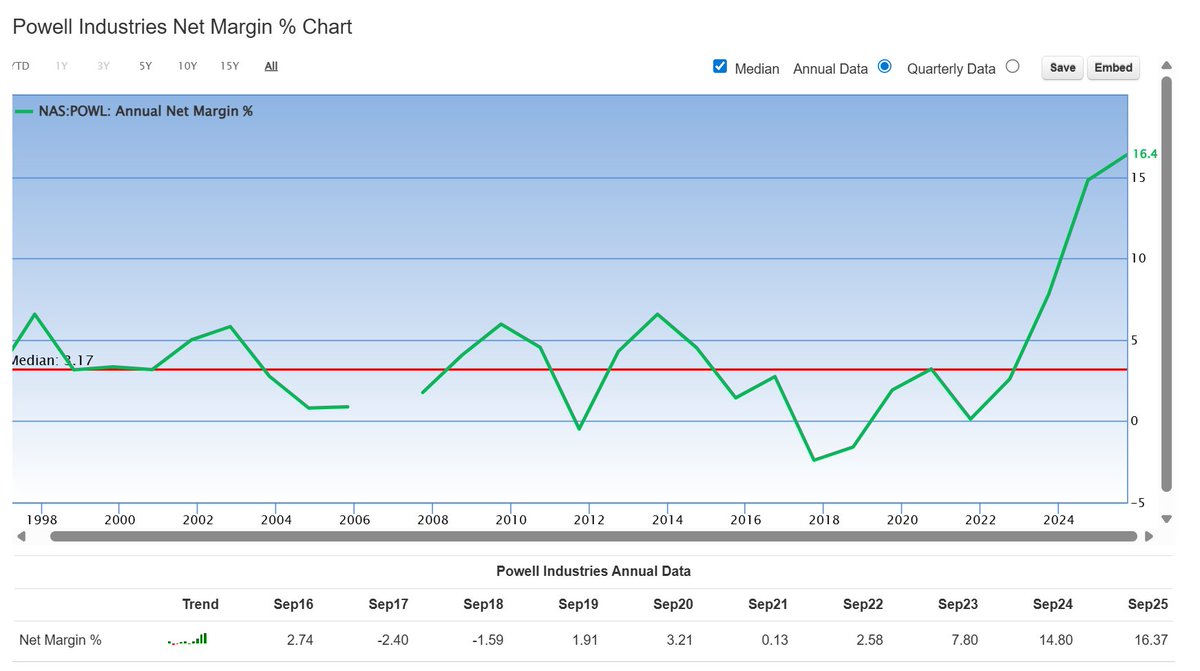
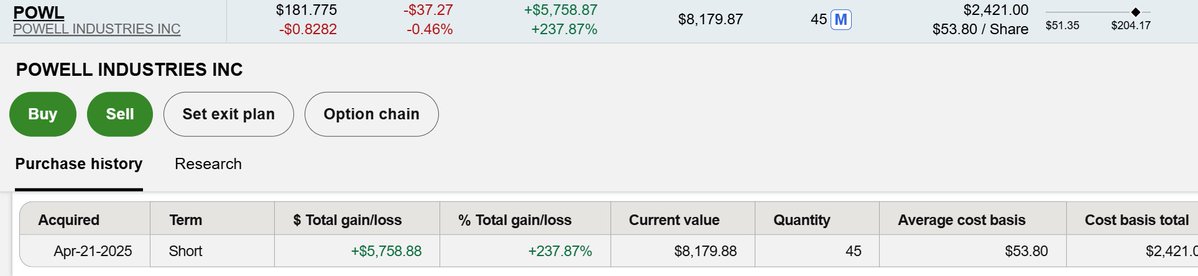
While $BKNG is the most widely followed stock split today, there's also $POWL. Powell Industries is a small cap that makes custom-engineered electrical systems. Large cap peers would be Eaton Corporation $ETN (own), Siemens $SIEGY, ABB $ABBNY, GE Vernova $GE, Schneider Electric $SBGSY $SBGSF. Hubbell $HUBB I still classify as midcap, despite now being $26B market cap. Own it. As with most of these stocks, $POWL looks cheap/reasonable on PE and similar but you don't have to dig deep to realize they have unusually high profit margins right now. Attached from Gurufocus. If data center buildout turns into bust, these names could get hit quite hard, with a small cap like $POWL especially getting pummeled. I have one buy of 15 shares, now 45 after the 3 for 1 split, which is effective today.
Say No To Trading tweet mediaSay No To Trading tweet mediaSay No To Trading tweet mediaSay No To Trading tweet media
English
3
1
17
3.8K
Say No To Trading
Say No To Trading@SayNoToTrading·
@ThinFloat When did you enter them? $ETN and $HUBB my two favorite in this space. Not saying at today's share prices I just mean the companies.
English
1
0
1
88
Thin Float
Thin Float@ThinFloat·
@DimitryNakhla Numbers look great. But literally zero governance. The real question is are these numbers real?
English
0
0
0
21
Dimitry Nakhla | Babylon Capital®
$DLO is quietly putting up some impressive numbers that Mr Market hasn’t fully appreciated. Incremental operating margins over the last 4 quarters tell a compelling story: Q1 2024 → Q1 2025: 171% Q2 2024 → Q2 2025: 112% Q3 2024 → Q3 2025: 57% Q4 2024 → Q4 2025: 181% $DLO is a business with significant operating leverage revealing itself as revenues scale. Revenues have accelerated in each of the last 4 quarters. All of this at: • 14x NTM EPS • 5.8% FCF Yield • Impressive ROCE $DLO has planted the toll booth across some of the most underpenetrated and complex payment markets in the world — LATAM, APAC, and Africa. The hard work of building the infrastructure is done. What you’re seeing in these margins is the business beginning to harvest what it planted. At this valuation, the market is pricing in significant skepticism. The fundamentals are telling a different story.
Dimitry Nakhla | Babylon Capital® tweet mediaDimitry Nakhla | Babylon Capital® tweet mediaDimitry Nakhla | Babylon Capital® tweet mediaDimitry Nakhla | Babylon Capital® tweet media
Dimitry Nakhla | Babylon Capital®@DimitryNakhla

1/13 $DLO has become one of the more interesting companies in global payments. Since its 2021 IPO, the stock is down -82%, while Revenue & EPS have grown at 35% and 19% CAGR (2022-LTM). Today it trades at 15x earnings and a 6.4% FCF yield. Is this an opportunity or trap?

English
4
2
35
6.2K
Thin Float
Thin Float@ThinFloat·
Everyone’s talking about the “Magnificent 7” while the most dominant tech company you’ve never benchmarked against just posted 45% revenue growth. $MELI is not an e-commerce company. It’s a financial system being built across an entire continent. The flywheel: - Marketplace: 94M+ unique buyers, $65B GMV - Payments: Mercado Pago largest fintech acquirer in LatAm by TPV ($278B) - Credit: loan book nearly doubled to $12.5B with 4.4% NPLs - Logistics: 94% of items shipped through its own network - Ads: Mercado Ads grew 67% YoY, commerce take-rate hit 25% LatAm e-commerce penetration is 13% vs 29% in the UK. This market is still being created. And $MELI isn’t just riding it. It IS the infrastructure. Banks can’t compete because they don’t have the commerce data. Amazon can’t compete because it doesn’t have the fintech integration or localized logistics. Shopee and Temu can’t compete because they don’t have the physical network. FY2025: $28.9B revenue. +39% YoY. 27 consecutive quarters above 30% growth. The stock is down 34% from highs. Weekly RSI at 31. Sitting right on the 200-week SMA. The last time $MELI touched its 200W SMA and bounced? It returned over 100% in 12 months. This is the kind of name that punishes you for waiting.
Thin Float tweet media
English
0
0
0
102
Thin Float
Thin Float@ThinFloat·
Wall Street is pricing insurance brokers like they have permanent moats. They don’t. Here’s what nobody on FinTwit is talking about: AI is about to compress the entire insurance advisory layer. The broker’s edge has always been information asymmetry. They know the carriers, the appetite tables, the pricing tiers. You don’t. So you pay them commission to navigate complexity. But AI flattens that overnight. When any MGA can spin up an underwriting model in weeks instead of years, when $LMND is growing revenue 40% YoY ($738M in FY2025, still burning $165M), when an AI agent can parse every carrier’s appetite in seconds… what exactly is the broker selling? The biggest names in the space: $AON (18.7x P/E, $69B) $MMC (22.0x P/E, $90B) $AJG (37.4x P/E, $56B) $WTW (17.0x P/E, $27B) $BRO (21.3x P/E, $22B) Combined market cap: $264B. Built on a model where complexity = margin. AI destroys complexity. The bull case is “relationships matter.” Sure. But relationships don’t survive a 40% price difference when the client’s CFO can see it on a screen. Nobody is modeling this. Not the sell side. Not management teams. Not the analysts on earnings calls. That silence is the signal.
Thin Float tweet media
English
0
0
0
32
Thin Float
Thin Float@ThinFloat·
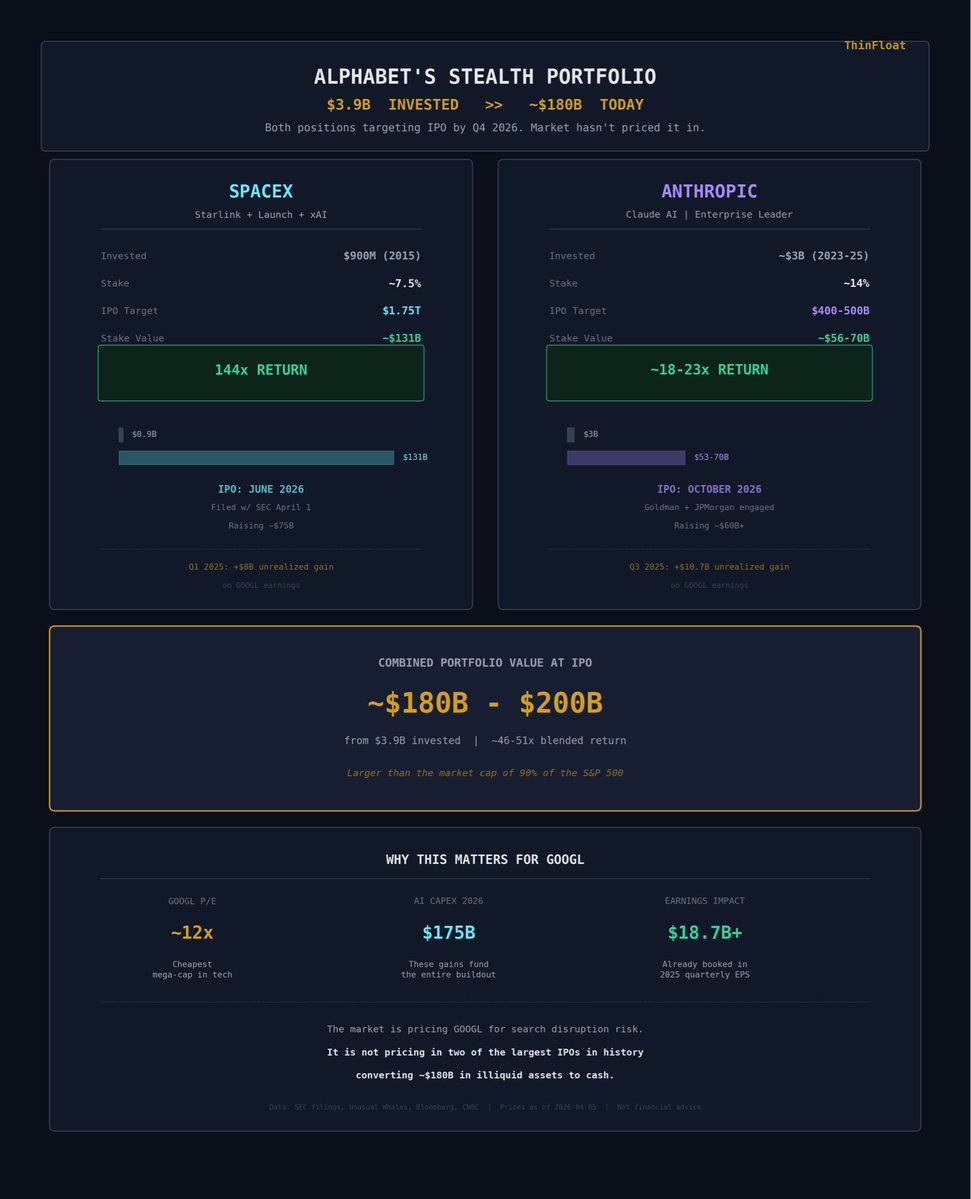
Alphabet turned $3.9B into $180B. Both positions IPO this year. Nobody is pricing it in. $GOOGL trades at 12x earnings. The cheapest mega-cap in tech. The “AI kills Google” crowd accidentally gave you the cheapest entry into the two biggest IPOs of the decade. You don’t need an allocation. You just need to buy $GOOGL.
Thin Float tweet media
English
0
0
2
101
Thin Float
Thin Float@ThinFloat·
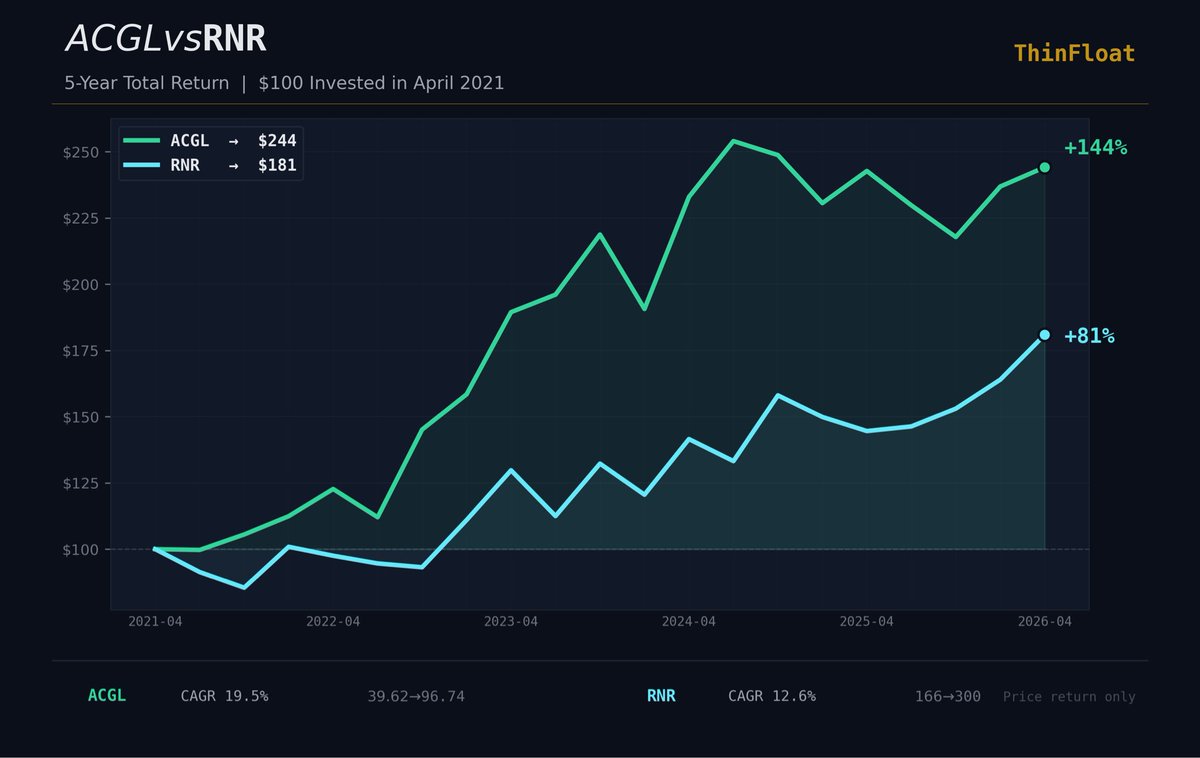
$RNR is the name everyone knows in reinsurance. $ACGL is the one that actually compounds harder. +144% vs +81% over 5 years. ACGL has never posted a loss year. Not during Irma. Not during Ida. Not during Ian. 0.11x debt-to-equity. $24B in equity. Zero drama. RNR had 3 loss years in the same window. Quality shows up in the chart.
Thin Float tweet media
English
0
0
2
38
Thin Float
Thin Float@ThinFloat·
$WM is everyone’s favorite waste stock. Here’s what nobody wants to talk about. They spent $7.7 billion acquiring Stericycle in 2024. Financed almost entirely with debt. The balance sheet before the deal: $16B total debt. After: $23B. Interest expense went from $500M to $912M in two years. Cash on hand? $201 million. Against $23 billion in debt. That’s a 0.9% cash-to-debt ratio. On the “safest sector in the market.” Goodwill jumped $4.6 billion overnight. $13.9B now sits on the balance sheet. That’s management telling you they paid $4.6 billion more than the assets were worth. Gross margin? 29.1%. Lowest among its peers. Waste Connections runs a 39% gross margin on a smaller, more disciplined operation. Everyone loves WM because it’s big. $25B in revenue. Most institutional ownership. Most analyst coverage. Most name recognition. But big is not the same as good. The Stericycle deal loaded up the balance sheet with debt and goodwill in exchange for a medical waste business that was already dealing with EPA compliance issues before the ink dried. $RSG runs tighter margins. $WCN runs better pricing. $CLH owns permits nobody can replicate. All three have cleaner balance sheets. Sometimes the most popular name in a sector is the worst place to park your capital.
Thin Float tweet media
English
0
0
2
54
Thin Float
Thin Float@ThinFloat·
$CLH - Clean Harbors nobody talks about this stock. That’s the point. They own the largest network of hazardous waste incinerators in North America. The EPA stopped issuing new incineration permits decades ago. NIMBY guarantees that never changes. Chemical plant needs to dispose of toxic waste? They call CLH. There is no second option. The permits are the business. It’s a toll road for poison. Record $6B in revenue last year. $509M in free cash flow. 19.7% compounded annually over the last decade vs 12.3% for the S&P. No dividend. Every dollar goes into buybacks and bolt-ons. Their Safety-Kleen subsidiary collects used oil from 100K+ auto shops, re-refines it into base oil, then sells it back to the same customers. They were doing circular economy before anyone had a name for it. Same moat structure as ISRG, WST, HEI. A regulator built the wall. Recurring revenue stacks on top. Nobody can replicate it. $15B market cap. 40x earnings. Not cheap. But there is no second Clean Harbors. When this pulls back 30%+ you buy it and forget about it.
Thin Float tweet media
English
0
0
2
54