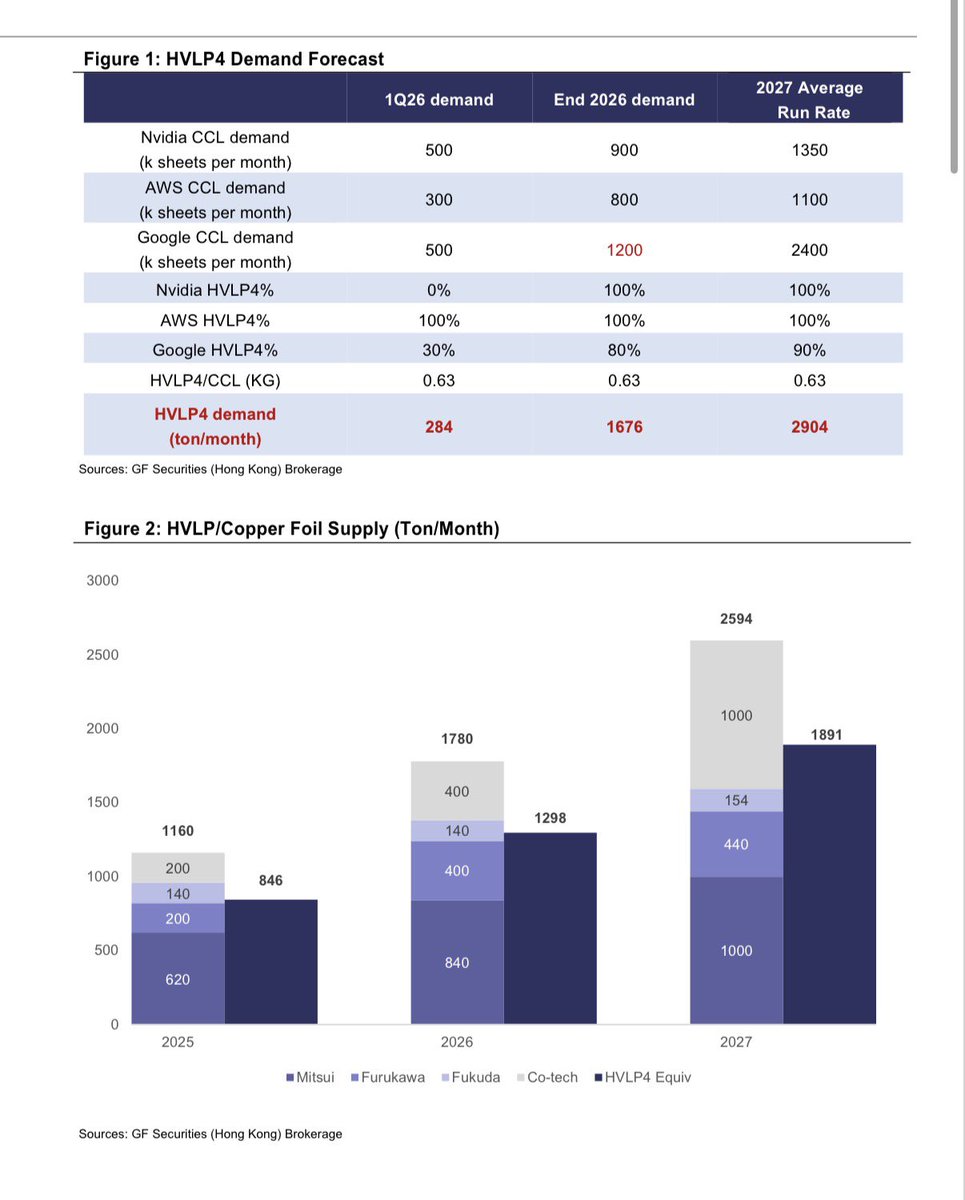
@jukan05 Lotte's discloses 0.8um Rz for HVLP4 vs Kinzoku 0.5um
HVLP5 should be <0.5um. I think Lotte's HVLP4 is more like HVLP3
English
Blaze Pascal
92 posts

@blaze__pascal
the rainmaking mandala

[Exclusive] Lotte Energy Materials to Supply AI Circuit Foil to NVIDIA Starting This Month Lotte Energy Materials will begin supplying AI circuit foil used in NVIDIA's next generation graphics processing units (GPUs) in earnest starting this month. The company had originally planned to begin supply in the second half of this year, but moved up the timeline at NVIDIA's request. In preparation for an aggressive capacity buildout, Lotte Energy Materials is understood to have recently placed a bulk order with a partner for more than ten times its previous volume of copper. According to industry sources on the 1st, Lotte Energy Materials will begin full scale shipments of AI circuit foil from its Iksan plant in North Jeolla Province this month. Circuit foil is an ultra thin metal sheet one twentieth the thickness of A4 paper. It is a foundational material used when AI accelerators process large volumes of data, and its supply price is more than three to four times higher than that of ordinary copper foil for electric vehicle batteries. Having designated AI circuit foil as its next growth driver, Lotte Energy Materials has converted the Iksan plant, which previously produced copper foil for EV batteries, into an AI circuit foil production line. Once Lotte Energy Materials produces the circuit foil, Doosan Electro Materials BG manufactures the copper clad laminate (CCL) based on it, and Isu Petasys produces the printed circuit board (PCB), which is ultimately supplied to NVIDIA. Both companies will ramp up supply to NVIDIA this month. Lotte Energy Materials is reducing the share of its core EV copper foil business and shifting its center of gravity toward AI circuit foil. It is currently producing circuit foil using part of the Iksan plant's production line, but next year it will transform the entire Iksan plant into a dedicated AI circuit foil production base. The company plans to increase capacity from 3,700 tons this year to 16,000 tons next year, and to add further production lines after 2028. The high barriers to entry in the AI circuit foil market are another positive factor. Globally, the only players capable of mass producing AI circuit foil are Japan's Mitsui Mining & Smelting, and Korea's Lotte Energy Materials and Solus Advanced Materials. The frontrunner, Mitsui, has been unable to keep up with explosive demand due to a recently stalled expansion schedule, while Solus Advanced Materials has sold off the relevant subsidiary. An industry official said, "AI circuit foil requires highly advanced rolling technology, so it is difficult to convert a line in a short period of time," adding that "this is effectively an opportunity for Lotte to seize leadership of the market." The market views this as the Lotte Group, which had been sidelined during the AI boom, making a full fledged entry into the NVIDIA value chain. On the day, Lotte Energy Materials closed at 64,300 won, up 14.62% from the previous trading session.
LMAO This will be so fucking funny Big W for my friend @blaze__pascal He called this months ago

Why No Price Hike Despite a Severe Shortage? Why doesn't Nittobo raise prices to reap windfall profits? The AI server boom has triggered an explosion in global demand for high-end glass fiber materials. Yet even as the market tightens into deepening shortage, Nittobo (Nitto Boseki, 日東紡) has opted for a counterintuitive strategy. Management made clear that the company currently has no plans for further price increases on its low-CTE (low coefficient of thermal expansion) glass fabric (T-glass), emphasizing that at this stage it will focus on expanding capacity to "defend market share." According to Japanese media reports, Nittobo is a leading major supplier that commands the critical global supply of high-end low-thermal-expansion glass fiber. The company said it had initially planned to prioritize expanding low-Dk (low dielectric) glass fiber capacity, but as demand from AI servers and edge devices such as smartphones outpaced expectations, the supply-demand gap for low-thermal-expansion T-glass widened sharply. In response, it has decided to accelerate the pace of expansion, adding glass fabric production lines at its Fukushima site in Japan while also installing new glass melting furnace equipment in Taiwan. Nittobo noted that T-glass demand is currently expanding rapidly. Not only is demand for the "thick fabric" used in semiconductor packaging substrates for AI servers continuing to climb, but the growth rate of the "thin fabric" used in edge devices such as smartphones is exceeding initial expectations by an even wider margin. The company emphasized that it has reached an internal consensus to further scale up the relevant capital investment in order to meet the strong demand from both thick-fabric and thin-fabric customers simultaneously. Defending Market Share Over Short-Term Price Hikes On the future price trajectory that the market is watching closely, Nittobo management responded that it currently has no plans to make further price adjustments to either T-glass or low-dielectric glass, and will continue selling at the prices set at the start of this fiscal year. The company reiterated that its top priority at present is expanding capacity to meet customer demand, thereby cementing its leadership position in the high-end materials market. It added that, so long as its products remain competitive and market demand holds firm, it will not hesitate to commit to capacity expansion. Nittobo had previously announced that it would raise the capital expenditure (CapEx) budget in its FY2024–2027 medium-term management plan by a substantial 50%, from the originally planned ¥80 billion to ¥120 billion—a move intended to respond to product demand and shifts in the market environment. Glass fabric is a critical component of IC substrates and printed circuit boards (PCBs), serving as the most fundamental chip-reinforcement layer material in electronic devices. As advanced chip packaging imposes extremely stringent requirements on micro-scale deformation, T-glass—with its low-thermal-expansion properties—can effectively prevent package warpage, establishing itself as a core element in ensuring the stability of high-end computing.



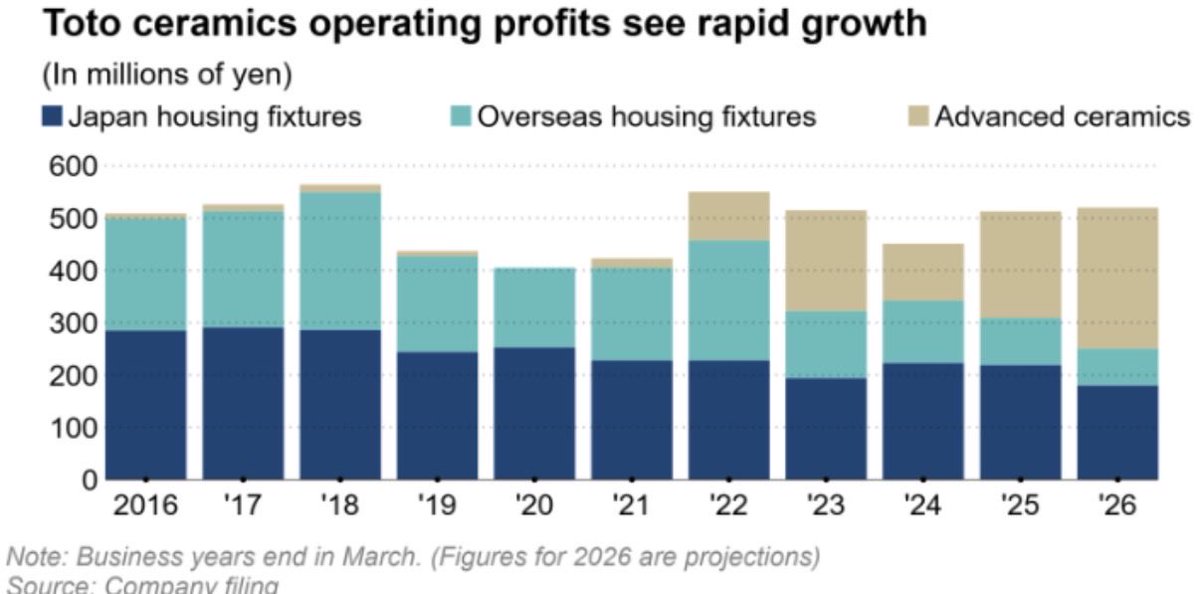
JUST IN: Japanese toilet maker TOTO announces pivot into AI chip components, stock soars +18%.




@zephyr_z9 Isn’t the ABF shortage due to T-Glass vs. lack of ABF capacity?
A striking sentence I read today: We don’t think power is the constraint for TSMC’s chip demand, at least for 2027, but ABF substrate and HBM supply are major gating factors. -Morgan Stanley