Tequehead

21.8K posts

Tequehead

Tequehead

@tequehead

likes computer vision, anime, genetics, machine learning. got a lot of ingenious ideas, just need someone with talent to implement them my philosophy is simula

Tham gia Ekim 2016
1.4K Đang theo dõi334 Người theo dõi
Tequehead đã retweet
Niko McCarty.
Niko McCarty.@NikoMcCarty·
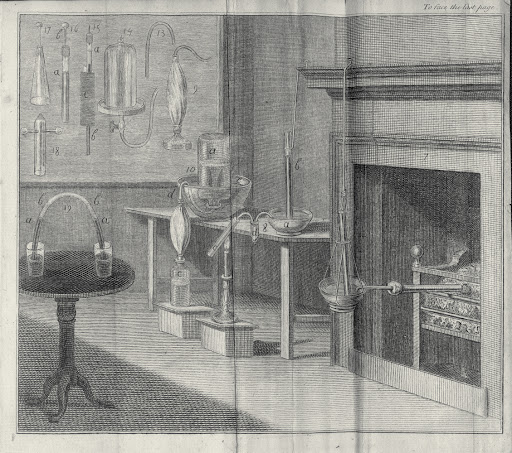
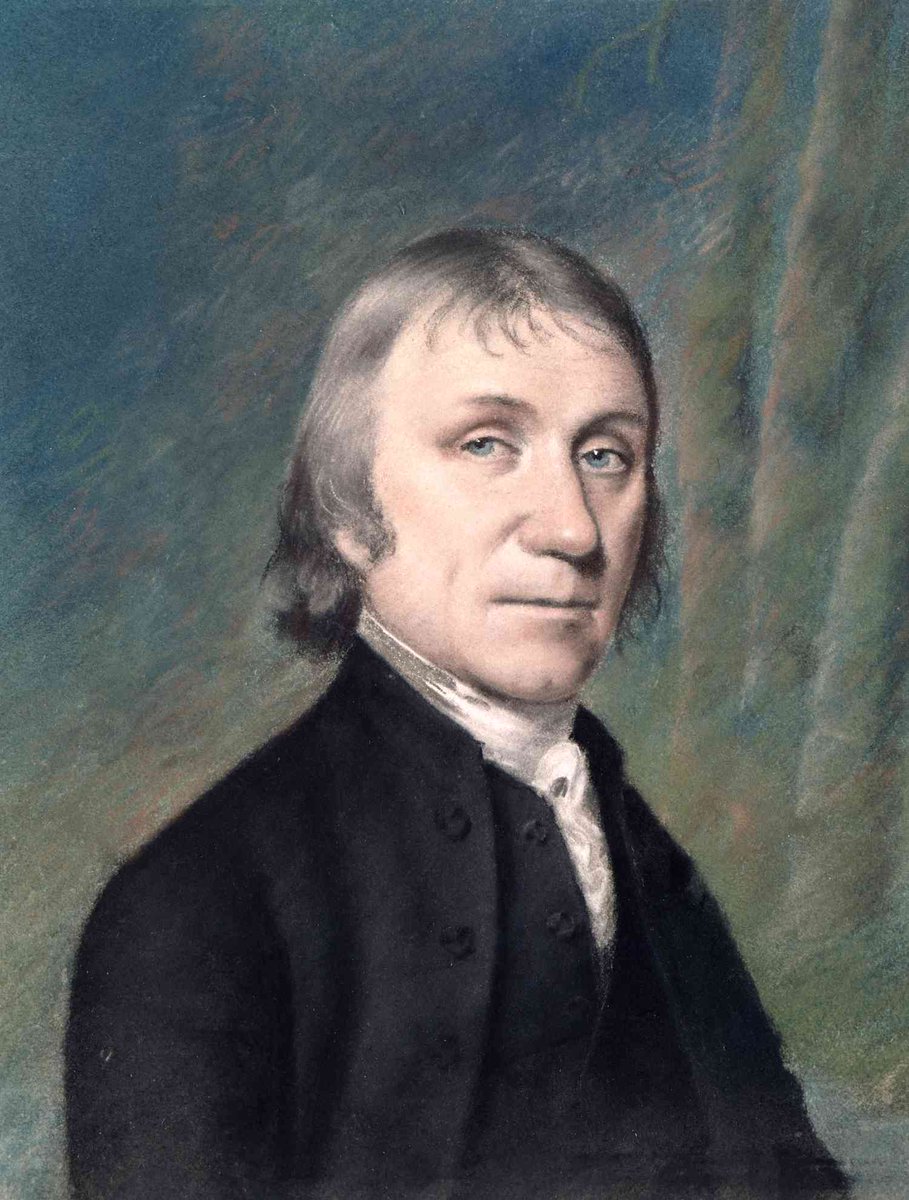
Just finished reading The Invention of Air, a book about Joseph Priestley. I recommend it. Priestley is a fascinating character. He was an amateur scientist in the purest and most beautiful sense of the word. In 1765, aged 32, Priestley was working as a schoolteacher and minister in Warrington, England. He was avidly following electricity experiments at the time and decided to write a “popular history” of the field. To pitch his book, Priestley traveled to London to a coffeehouse meeting of the Honest Whigs, where he first met — and was encouraged by — Benjamin Franklin. Priestley left that meeting with: - Access to Franklin’s personal library and all correspondence on electricity (a kind gesture from the American statesman). - A promise for funding to support the book’s printing. - Encouragement, by the Honest Whigs, to conduct his own experiments while writing the book. This was undoubtedly one of the most important scientific meetings of all time. Priestley went back to Warrington and immediately began working. He wrote his entire 700-page history in a single year, and also began his own experiments. During various attempts to replicate published experiments, Priestley discovered that charcoal conducts electricity, a finding that led to his election to the Royal Society that same year (1766). But I think the most fascinating part of Priestley’s life is not his experiments, but rather the way he supported his work. For a time, Priestley was funded by subscribers, an arrangement which was highly unusual in the late-1700s, when many independent scientists had immense personal wealth or got support from a wealthy patron. Henry Cavendish, for example, inherited two fortunes during his lifetime. He had so much money, in fact, that the French astronomer Jean-Baptiste Biot called him "the richest of all the savants and the most knowledgeable of the rich." Galileo Galilei was funded almost entirely by Cosimo II, a Medici. Tycho Brahe was funded handsomely by King Frederick II of Denmark. (Indeed, the Danish King spent so much money on Brahe’s experiments that it’s been estimated that about 1 percent of the Danish crown’s total revenue went to the scientist. Brahe was also given an entire island for his experiments, on which he constructed an astronomical observatory and alchemy laboratory, called Uraniborg; “the first custom-built observatory in modern Europe,” according to Wikipedia.) But Priestley was not wealthy. He attracted support from wealthy sponsors (including Lord Shelburne, who later became Prime Minister) on occasion, but often struggled for funds. This is why Priestley turned to his network of “subscribers,” who collectively sent him about 200 guineas per year. At the time, one guinea was worth 21 shilling, or roughly £1.05, meaning Priestley’s subscribers sent him about £210 per year. This is a lot, considering a skilled artisan, at the time, made about £50 per year and £100 was enough to maintain a solidly middle-class household with servants. (A seaman sailing with the East India Company only earned about £21 per year!) Subscribers included the Galtons (father and son), Sir George Savile, Josiah Wedgwood, and other figures of the local community. In exchange for about 10 guineas per year, these subscribers received not only the satisfaction of supporting a prominent scientist and hearing about cutting-edge experiments before anybody else, but also early access to Priestley’s books and publications. “Without assistance I could not have carried on my experiments except on a very small scale and under great disadvantages,” Priestley once wrote. Indeed, Priestley thought a good deal about science funding, and was ahead of his time on the subject. In 1767, he also outlined plans for industry-funded research centers. Priestley liked that the large institutes then supporting science, such as the Académie Française, supported research, but "he objected to the centralized nature of those societies,” writes Steven Johnson in The Invention of Air. Priestley didn’t like that a single individual (like Antoine Lavoisier in France) had so much power over the research of the institute. Instead, Priestley proposed “smaller and more nimble clusters,” where many different companies all contribute funds to a research center. Each research center would have a “director of experiments,” who would perform experiments on behalf of the supporting companies. The companies that gave more money would have more control over which experiments got done, and all companies would have proportional votes relative to their funding levels. It seems this idea never panned out (or, at least, I’m not aware of anyone who has tried this.) But the idea of industry-funded R&D is much older than I anticipated, and we owe part of its vision to Joseph Priestley.
Niko McCarty. tweet mediaNiko McCarty. tweet media
English
6
39
170
9.7K
Tequehead đã retweet
Elai Rettig
Elai Rettig@ElaiRettig·
As Trump’s deadline for attacking Iran’s power plants draws near, here are a few brief informational points about the current condition of Iran’s electricity sector, and how prolonged blackouts may affect it: 🧵
Elai Rettig tweet media
English
14
162
583
187.1K
Tequehead đã retweet
John Carmack
John Carmack@ID_AA_Carmack·
So many judging tasks could be improved by aggregating partial orderings, and in the limit, just ordering pairs. The annual Libertarian Futurist Society novel awards discussion is starting, and while I would like to participate on some level, there is no way I have time to read an entire slate of novels. However, I will likely read at least two from the list, and I could give a relative assessment. This cries out for the use of something like ELO ranking, as in chess competition, perhaps with some suggestions to get sufficient coverage. Peer and out-of-chain employee performance calibrations could probably also benefit from a greater quantity of sparse pairwise comparisons
English
24
12
299
37.2K
Tequehead đã retweet
Alice
Alice@AliceFromQueens·
Liberals quitting Twitter in a huff was a weak-minded abdication of political responsibility. Like their nomination of Kamala Harris, the exodus demonstrated that, to them, feeling morally unassailable was more important than beating Trump and combating Trumpism.
Zack Beauchamp@zackbeauchamp

This is a version of the same graphic for BlueSky. I think the average quality of account is higher — a lot of reliable news outlets — but the follower account is much smaller and the ideology almost entirely homogenous

English
83
44
532
47.4K
Tequehead đã retweet
Lukas Freund
Lukas Freund@_LukasFreund_·
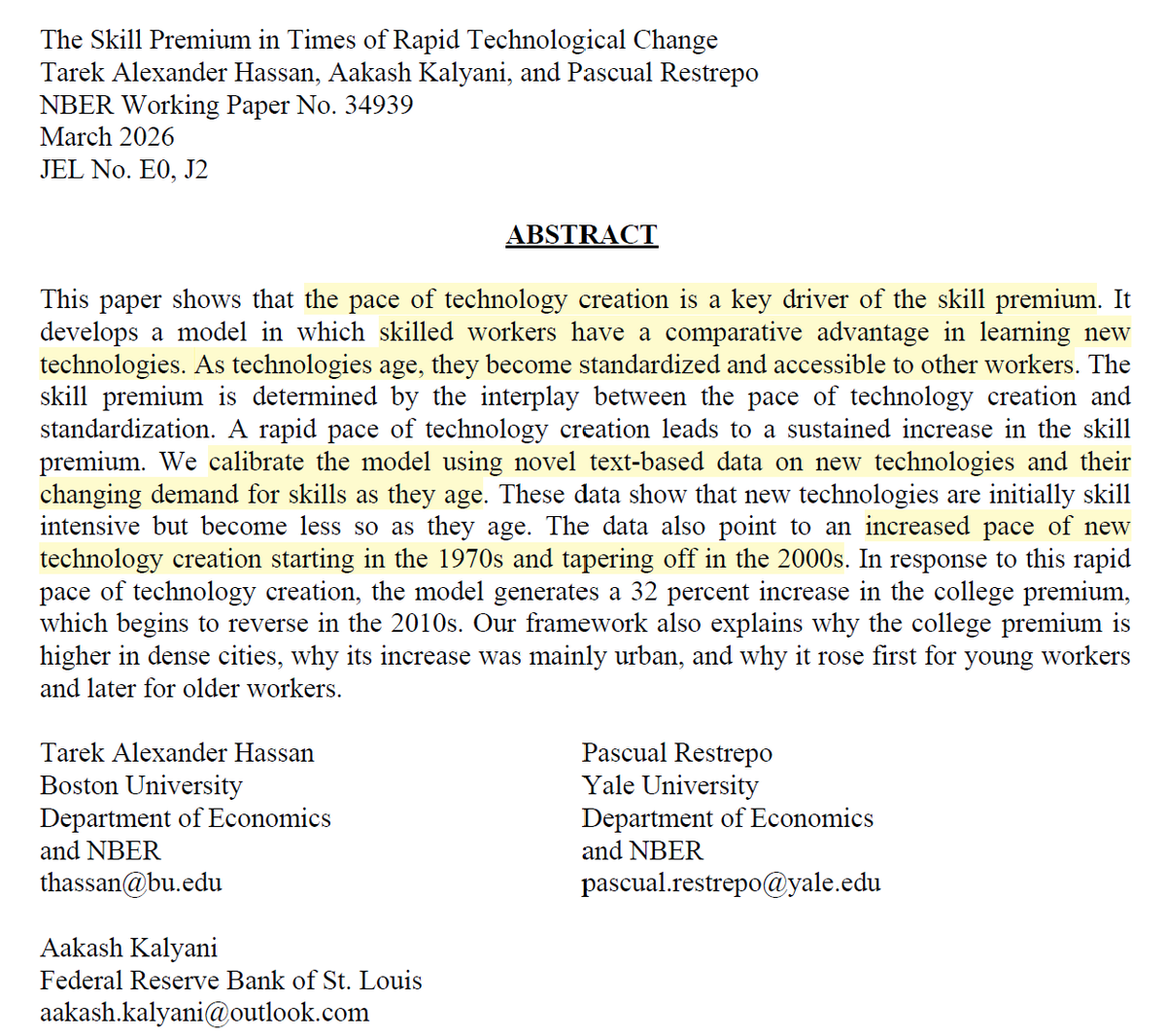
The Skill Premium in Times of Rapid Technological Change Fantastic new @nberpubs WP by @t_a_hassan - @AakashKalyani - Restrepo (@YaleEconomics). 💡In a model where skilled workers have a comparative advantage in learning new technologies, a rapid pace of technology creation leads to a sustained increase in the skill premium. I think of this as a modern application of the "Nelson-Phelps (1966) view of human capital", used to understand the college-wage premium.
Lukas Freund tweet media
English
4
23
91
16.2K
Tequehead đã retweet
Steven Beschloss
Steven Beschloss@StevenBeschloss·
This is an actual post. This is not funny. This is beyond desperate. This is a deeply unwell man who doesn’t belong anywhere near the levers of power. Every member of his cabinet and Congress is complicit in not demanding his removal now.
Steven Beschloss tweet media
English
5K
25.2K
90.6K
1.7M
Tequehead đã retweet
Experimental Philosophy
Experimental Philosophy@xphilosopher·
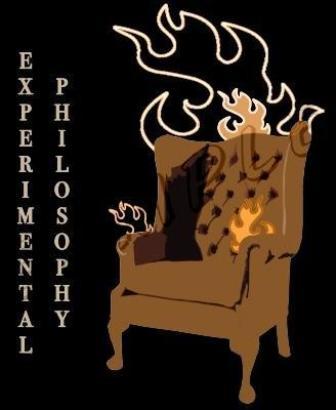
We sometimes think an outcome was caused by two things. We might say Amy got sick because (a) There was cilantro in the soup *and* (b) Amy is allergic to cilantro Beautiful new theory of this kind of "plural causation" from @TadegQuillien direct.mit.edu/opmi/article/d…
English
3
8
22
8.2K
Tequehead đã retweet
Alex Zhavoronkov, PhD (aka Aleksandrs Zavoronkovs)
Anyone who thinks that Longevity Biotechnology is new and in the next 10 years we will find a cure for aging with AI should read Paul Segall's "Living Longer, Growing Younger". 1989. Read "Merchants of Immortality" 2003 next. I think that the first order of business is to build a sustainable business model with aging research at the core to have organizational longevity and growth as the first order of business.
Alex Zhavoronkov, PhD (aka Aleksandrs Zavoronkovs) tweet media
English
11
15
96
11.9K
Tequehead đã retweet
Ruxandra Teslo 🧬
Ruxandra Teslo 🧬@RuxandraTeslo·
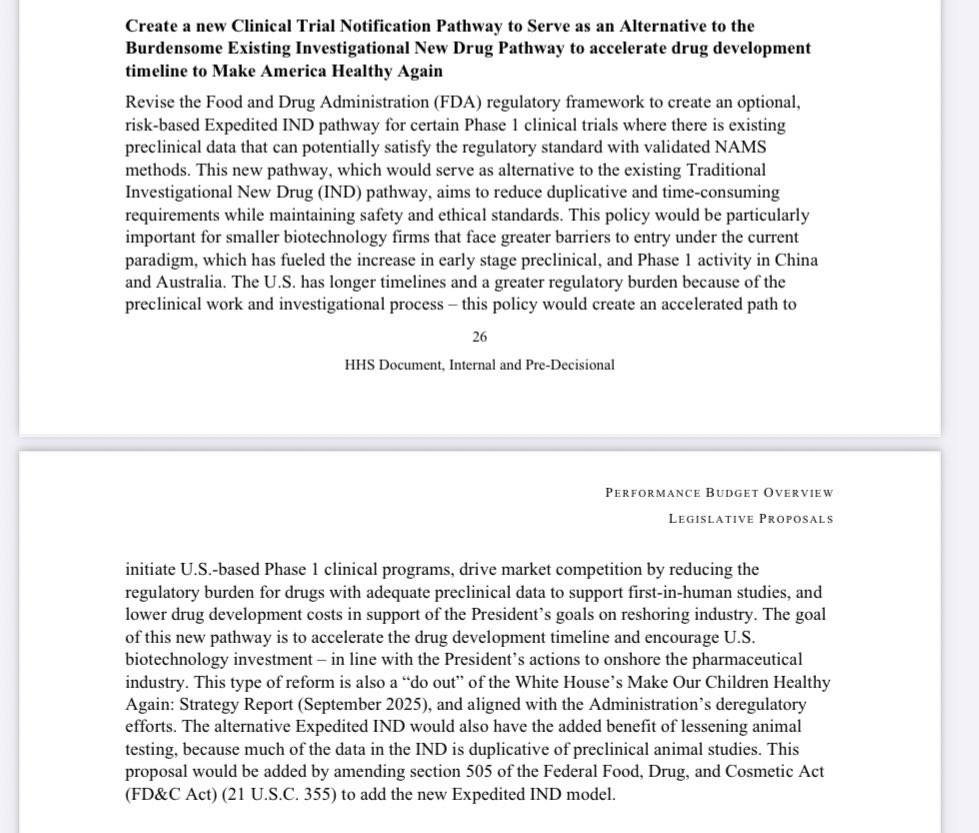
I have written at length about the need to streamline Phase I trials to facilitate biomedical innovation. The President's 2027 Budget makes it the administration's official position that such measures should be implemented. This is tremendous news.
Ruxandra Teslo 🧬 tweet media
English
4
24
212
13.7K
Tequehead đã retweet
Marios Georgakis
Marios Georgakis@MariosGeorgakis·
Does genetic support increase drug success rates by 2–3 times? In a previous post, I revisited the original Nature paper behind this claim. My new post examines additional evidence from 23andMe that is often cited as a replication of the original analysis.
Marios Georgakis tweet media
English
2
6
35
6.4K
Tequehead đã retweet
Saloni
Saloni@salonium·
I’m a disbeliever in accidental discoveries (at least, in biology). Whenever I’ve looked into one, the story turns out to be false. The most famous is penicillin – supposedly, the fungi wafted in through a window, fell into a petri dish of cultured staphylococci, and suppressed the bacteria’s growth. But in a recent article (asimov.press/p/penicillin-m…), @kevinsblake explains that doesn’t really work (grown staphylococci aren’t affected by penicillin; it only works if introduced before the bacteria begin growing); plus, Fleming’s notes on the discovery provide very little detail and the specific results he described couldn’t be replicated by other scientists (even though penicillin does work against staphylococci when introduced correctly.) There are more: Pasteur’s supposedly accidental discovery of a chicken cholera vaccine was more likely the result of systematic work by his then-assistant, Émile Roux. (jstor.org/stable/2332836…) And, as @NikoMcCarty writes, the discovery of GFP, nanopore sequencing, and optogenetics are also often described as accidents, but none of them happened that way either. nikomc.com/2026/04/01/opt… People love serendipity, so why am I bursting their bubble? I don’t think this is limited to accidental discoveries; I think many historical science anecdotes are highly embellished: - Edward Jenner didn’t deliberately expose a young boy with full-blown smallpox to test his vaccine (he used variolation); and he wasn’t the first to try using cowpox bsky.app/profile/scient… - Cobra catching bounties in British India didn’t lead to a rise in the number of snakebites, and there was only hearsay evidence that cobras were bred in response at all twitter-thread.com/t/169650089580… - Barry Marshall didn’t develop stomach ulcers from drinking a concoction of H. pylori (he did develop gastritis though…) cdn.centerforinquiry.org/wp-content/upl… - No one knows who actually found the highly-productive strain of penicillin on a cantaloupe, but it probably wasn’t 'Moldy Mary' scientificdiscoveries.ars.usda.gov/tellus/stories… But in this case it irks me for an additional reason – it gives the impression that innovation happens sporadically, by chance, when there are actually ways that we can systematically speed it up – such as better funding, institutions and incentives. So: are there any true accidental discoveries that hold up to scrutiny?
English
84
327
1.5K
123.3K
Tequehead đã retweet
Neerja Thakkar
Neerja Thakkar@neerjathakkar·
What’s the right representation for a world model? 3D, pixels, or something else? Excited to release our new paper “Forecasting Motion in the Wild” where we propose point tracks as tokens for generating complex non-rigid motion and behavior From @GoogleDeepmind @Berkeley_AI @TTIC_Connect
GIF
English
8
70
434
67.5K
Tequehead đã retweet
dylan matthews 🔸
dylan matthews 🔸@dylanmatt·
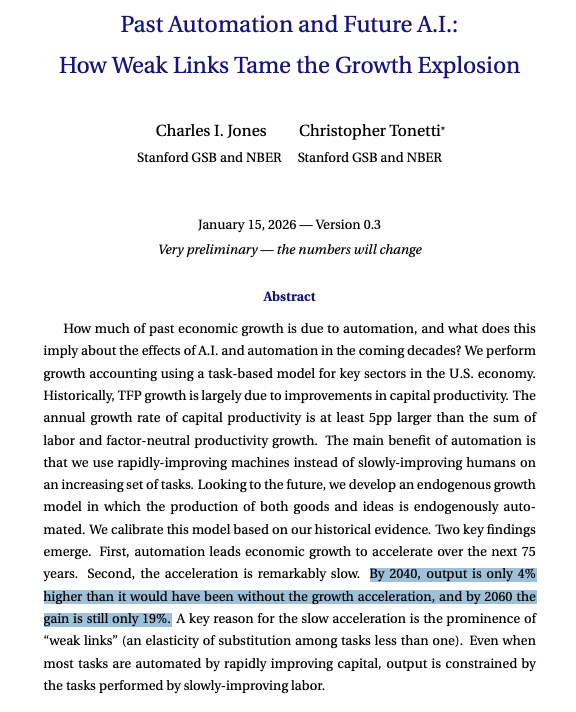
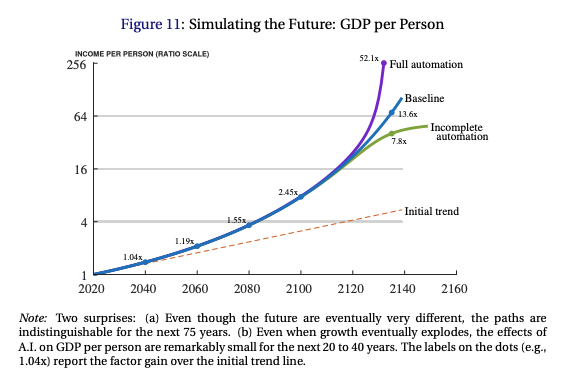
Found this (v preliminary) paper very useful in thinking through what a "fast AI progress / modest growth" scenario might look like. With O-ring style "weak links," even 100% automation doesn't get you explosive growth for a long time
dylan matthews 🔸 tweet mediadylan matthews 🔸 tweet media
English
9
19
142
16.7K
Tequehead đã retweet
Emily Pontecorvo
Emily Pontecorvo@emilypont·
We are launching a big project today with MIT — The Electricity Price Hub! You can view monthly electricity prices per kwh and avg. bills for every major utility in the country going back to Jan 2020. electricity.heatmap.news
Emily Pontecorvo tweet media
English
83
1.2K
5.6K
562.1K
Tequehead đã retweet
gregorein
gregorein@Gregorein·
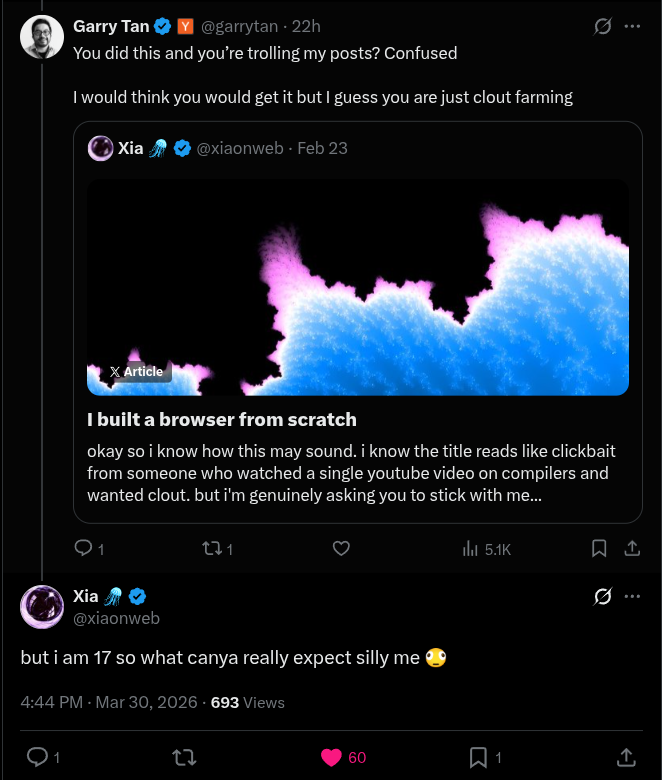
for added context: when a 17yo developer (@xiaonweb) politely pointed out that bragging about LOC is silly, Garry's response was to publicly call them a "clout farmer." the "clout farming" teen... wrote a browser engine in Rust at 17. HTML tokenizer, CSS cascade, box model layout, GPU renderer via wgpu, and published a technical breakdown showing deeper understanding of how the web works than most senior engineers I've worked with (including me, cos I've never dug that low-level). vs the "shipping" guy, the president of Y Combinator, a multi-billion dollar startup kingmaker, who mass-generates code with 113 Claude sessions a week, counts lines like a Duolingo streak, and ships test files, 0-byte AVIFs, and 4 MB uncompressed PNGs to production. right, punch down at a teenager. on main @. x.com/xiaonweb/statu…
gregorein tweet media
English
34
92
2.8K
210.2K