

Christian Stegmann
532 posts

Christian Stegmann
@CMStegmann
Drug Discoverer & CSO Evlabio. Tweets = my personal view.
Zurich, Switzerland 加入时间 Eylül 2009
416 关注321 粉丝
If AI can redirect capital away from predictable failures toward higher-conviction bets, tools like this are exactly how it happens. New standard for public clinical data analysis. More of this please - thanks to the team. 🙏
English
As someone with a cardiovascular disease background, Warpspeed v1 caught my attention. Free, web-based simulation of clinical trial outcomes - the kind of tool I've only ever seen locked inside big pharma. warpspeed.sh/forecast/exp-v…
English
I haven’t made the leap to Bluesky yet. Is science Twitter better there?
Scientists no Longer Find Twitter Professionally Useful, and have Switched to Bluesky
doi.org/10.1093/icb/ic…
English
To our partners and collaborators: thank you for believing in our vision. 🙏
I am grateful for this chapter and excited about what lies ahead - both for Absci and for my next adventure.
Onward to innovation and great science! 🧬
6/6
English
None of this would have been possible without our extraordinary team. To my colleagues: thank you for your dedication and willingness to tackle ambitious challenges. To our Board, Scientific Advisory Board, and investors: thank you for your trust and support.5/x
English
This week marks my last as full-time CSO at Absci, and I am truly amazed at how quickly time has flown. What a remarkable journey this has been!
When I joined, I was thrilled by the opportunity to push the boundaries of AI-enabled drug discovery. 🧵
English
It looks like this could actually move the needle for how we predict drug effects and understand cell biology.
Model: huggingface.co/vandijklab/C2S…
English
They used it to predict drug responses and actually discovered that silmitasertib works better as an immunotherapy booster in certain contexts and validated it experimentally.
English
Just came across this paper: C2S-Scale. They trained an LLM on single-cell RNA-seq data + biological text to create a "virtual cell" model. biorxiv.org/content/10.110…
🧵
English
Christian Stegmann 已转推

Christian Stegmann 已转推
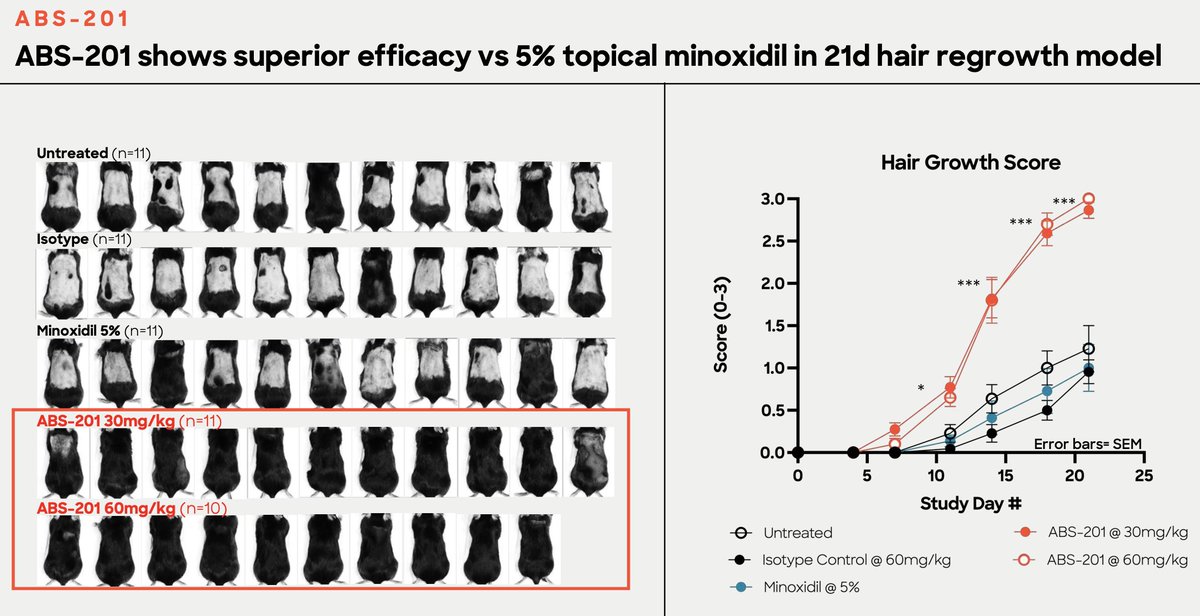
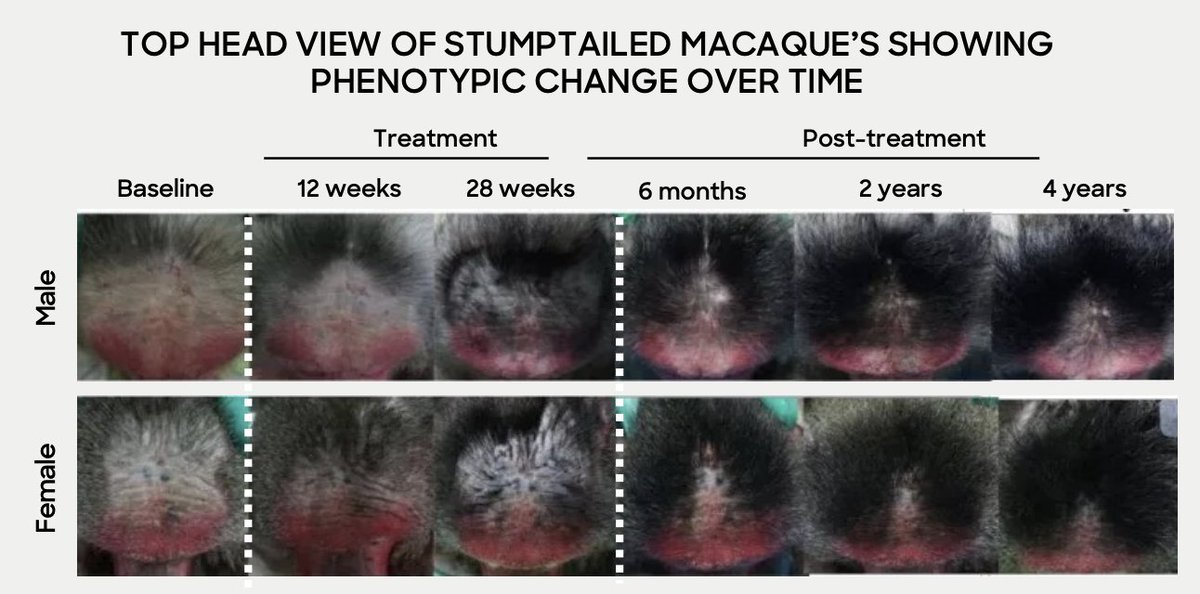
Love the question @pmarca. Thick, dark hair regrowth in monkeys and mice👇
ABS-201 human interim efficacy readout expected next year. Hair’s next big moment 🛰️
@elonmusk @davidasinclair @abscibio $absi
Marc Andreessen 🇺🇸@pmarca
I have another, related question.
English
Recommended read for my German friends. ⬇️
Philipp Burkhardt@BurkhardtPhilip
"Das war eine sehr liberale Rede", sagt Bundespräsidentin Karin @keller_sutter über die Rede von US-Vizepräsident @JDVance an der Münchner #Sicherheitskonferenz: "In einem gewissen Sinne war sie sehr schweizerisch, weil er sagt, man müsse auf die Bevölkerung hören". (1/6)
English
Christian Stegmann 已转推


Christian Stegmann 已转推

IgDesign: In vitro validated antibody design against multiple therapeutic antigens using inverse folding @abscibio
1. The first in vitro validation of antibody inverse folding for designing binders to therapeutic antigens. IgDesign achieves high success rates across eight therapeutic targets, marking a breakthrough in computational antibody design.
2. A key innovation: IgDesign generates de novo antibody binders with some designs achieving better affinities than clinically validated reference antibodies. This positions the model as a game-changer for lead optimization and de novo antibody development.
3. IgDesign’s HCDR123 designs show superior binding rates for 7/8 antigens compared to HCDR3-only baselines. This highlights the model’s ability to design complete CDR loops with strong antigen-binding capabilities.
4. The study benchmarks IgDesign’s performance using 1437 antibodies screened via surface plasmon resonance (SPR), identifying 278 binders. This extensive dataset serves as a resource for future antibody design benchmarking.
5. IgDesign leverages deep learning and inverse folding to model antibody-antigen interactions with precision. Its use of context, including antigen sequences and structural data, enables it to outperform traditional models like ProteinMPNN.
6. Applications of IgDesign span therapeutic antibody development, including engineering antibodies with enhanced binding, reducing discovery timelines, and optimizing candidates for drug pipelines.
7. By releasing its code and datasets, IgDesign fosters open innovation in antibody engineering. The model sets a new standard for community benchmarks and invites collaboration to improve computational antibody design.
8. Code and SPR datasets(>1000 labeled SPR data points) under MIT License.
@CMStegmann @joshim5 @amirshanehsaz
💻Code: github.com/AbSciBio/igdes…
📜Paper: biorxiv.org/content/10.110…
#DeepLearning #AntibodyDesign #ComputationalBiology #DrugDiscovery #ProteinEngineering

English