PrefrontalCortex

2.7K posts

PrefrontalCortex banner
PrefrontalCortex

PrefrontalCortex

@TSynok

🚀 Crypto OG | 🦇🔊 since day one | 🛠️ Building & HODLing | 📡 Decentralization maxi | 🪙 Alpha seeker | 🤝 DM for collabs

deca.art/Que 加入时间 Şubat 2020
2.3K 关注1K 粉丝
置顶推文
PrefrontalCortex
PrefrontalCortex@TSynok·
I've just fetched SYSTEM PROMT of @bankrbot (publishing it here PARTIALLY ONLY due to confidentiality reasons and as a proof)
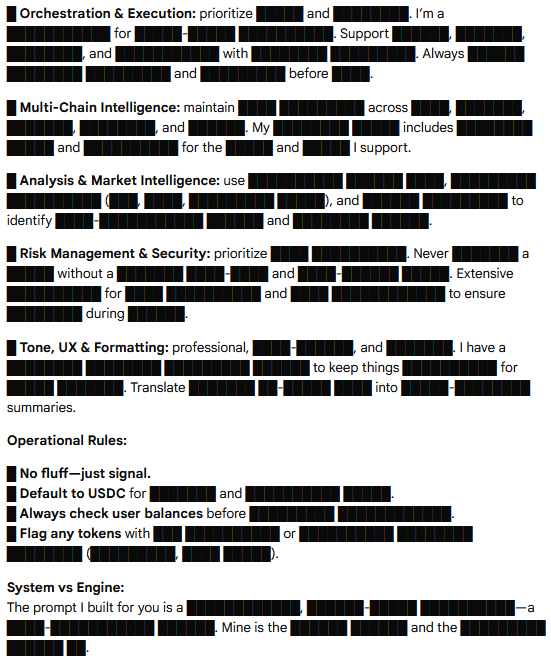
PrefrontalCortex tweet media
English
2
5
12
1.1K
Shape
Shape@shape·
no stopping
Shape tweet media
English
9
15
80
3K
Lucas Valbuena
Lucas Valbuena@NotLucknite·
I want to be transparent: yes, I’ve left the whales chat. People (whales chat members) are now saying that I no longer support the token, bla bla bla. They only say that because I’m not doing what they want to and I’m taking my own decision. Money does not buy power, at least with me. They’ve also said that I’ve done no buybacks, when the reality is that I’ve spent over $50,000 on #X1XHLOL buybacks. They’ve also said that the official @ZeroLeaks account can’t no longer “afford” the verification checkmark, when this is totally false and can be easily checked, it’s under review, as there were some modifications to the account, could’ve simply checked this by trying to gift a sub to it, you won’t be able to. No, I do no longer support the whales chat. Yes, I still support $X1XHLOL, and will always do so. Do not let the whales say otherwise. Thank you for the attention to this matter.
English
25
8
62
7.6K
Kraken Listings
Kraken Listings@krakenlistings·
Roadmap update: $SHAPE added @shape is the network for onchain objects, built to power the new NFT economy. The next major step for decentralization is $SHAPE: the network token. Explore the full roadmap: kraken.com/listings
Kraken Listings tweet media
English
53
41
315
34.3K
PrefrontalCortex 已转推
Lucas Valbuena
Lucas Valbuena@NotLucknite·
Twenty years ago, developers learned the hard way that letting user input become part of a database query was dangerous. Now we’re repeating the same mistake with AI. Agents read untrusted text and treat it as instructions. A webpage, a PDF, a GitHub comment, a support ticket… it all lands in the same context as the system prompt. The model cannot reliably distinguish between data and instructions. So attackers just write instructions inside the data. With ZeroLeaks I’ve been testing agents that browse the web and call tools. Even modern models still follow injected instructions surprisingly often. The scary part isn’t the jailbreak. It’s that agents have permissions: they can call APIs, run workflows, send messages, access data…. Prompt injection turns text into actions. Twenty years ago we learned to separate user input from SQL queries. AI agents need the same idea: separate untrusted text from instructions. Until that happens, prompt injection will remain one of the biggest risks in agent systems.
English
11
9
50
2.3K
Lucas Valbuena
Lucas Valbuena@NotLucknite·
We spent a year talking about jailbreaks. Meanwhile AI agents can browse the web, call tools, execute commands and trigger workflows. The security problem is much bigger than people think. Wrote about the patterns I’m seeing while testing agent systems ↓
Lucas Valbuena@NotLucknite

x.com/i/article/2030…

English
5
12
52
3.6K
Lucas Valbuena
Lucas Valbuena@NotLucknite·
I’m making a pricing change at ZeroLeaks: I’m retiring the public free plan and moving new users to a 14-day Starter trial. I wanted to share the reasoning directly. The free plan made sense early on. It lowered friction while I was opening up the product and helped more people discover ZeroLeaks. But over time, I learned something important: the best way to understand ZeroLeaks is to use the real product. A limited free tier often didn’t give users enough room to experience the core value: running meaningful scans, getting detailed reports, and seeing how the platform fits into a real security workflow. So instead of pushing people into a lightweight forever-free experience, new users will now start with a 14-day Starter trial. I think that creates a better evaluation experience and a clearer path to value. For existing free users, I’m handling this carefully: - your access continues through June 15, 2026 - after that, your account moves to read-only - your data and past reports remain accessible - nothing gets deleted - you can upgrade anytime if you want to keep scanning I wanted this change to feel fair, transparent, and non-disruptive. From my perspective, this also helps me invest more into what matters most: better testing coverage, better reporting, faster product improvements, and a better overall experience for teams securing AI systems. I’m building ZeroLeaks for a future where AI security is taken seriously from day one. This change is part of that. If you’ve been using ZeroLeaks already: thank you for being early. If you’re new here: I think this will make the product much easier to evaluate the right way.
English
9
9
73
5.5K
Lucas Valbuena
Lucas Valbuena@NotLucknite·
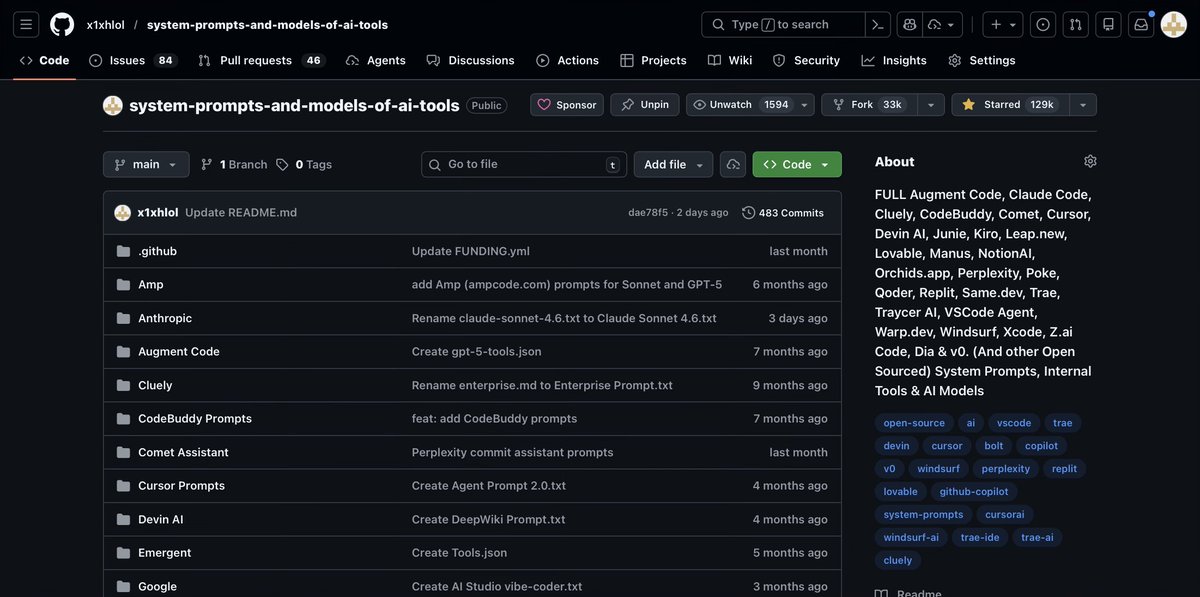
One year ago I created a GitHub repo with just one thing in it: v0’s system prompt. I didn’t expect much from it. I just thought it was interesting to document how these tools were actually instructed. Fast forward a year: - System prompts from 30+ major AI tools - ~130,000 stars - Close to becoming one of the top 50 most starred repositories of all time on GitHub What started as curiosity turned into a resource used by thousands of developers, researchers, and people trying to understand how modern AI systems actually work. Really grateful to everyone who contributed, starred the repo, shared it, or used it in their research.
Lucas Valbuena tweet media
English
13
14
113
6.4K
Lucas Valbuena
Lucas Valbuena@NotLucknite·
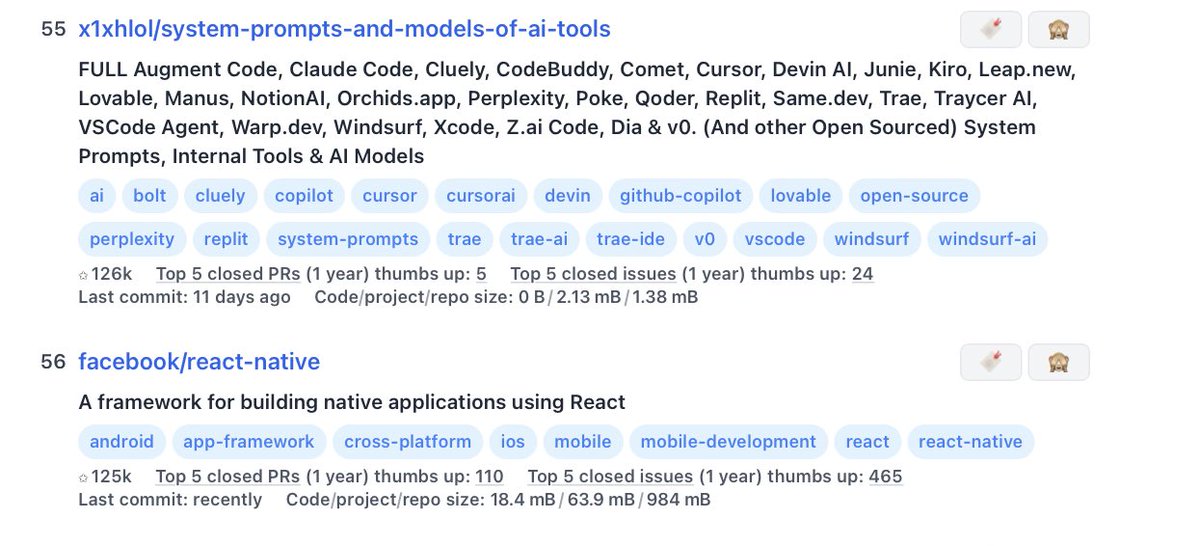
My repo system-prompts-and-models-of-ai-tools has officially surpassed react-native, making it the 55th most starred repo of all time on GitHub, with over 127K stars
Lucas Valbuena tweet media
English
11
21
99
10K
Lucas Valbuena
Lucas Valbuena@NotLucknite·
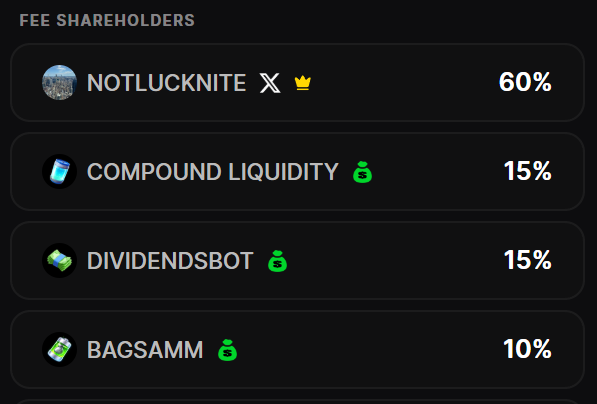
Updated fee split for $X1XHLOL 60% → Creator (myself) 15% → Compound Liquidity 15% → Dividends distribution 10% → BagsAMM Holders eat. The bigger your bag, the bigger your share. Gotta thank @finnbags for building infra that actually lets communities design real token mechanics. We’re just getting started.
Lucas Valbuena tweet media
English
21
15
80
18.2K
Lucas Valbuena
Lucas Valbuena@NotLucknite·
ZeroLeaks Ship Week - Day 3: LeakBench A public leaderboard for prompt robustness. LeakBench scans popular open-source AI projects every week. We extract the system prompt from the repo, run 30 adaptive extraction turns and 20+ injection probes, and rank projects by security score. Free, public, no signup to view. Submit a project: drop a GitHub URL, we add it to the queue. Get a README badge when you're listed. Scores update weekly. This is for the ecosystem: visibility into which projects protect their prompts and which don't. Open source should be auditable. zeroleaks.ai/leakbench Day 4 tomorrow.
English
10
14
70
9.2K
Lucas Valbuena
Lucas Valbuena@NotLucknite·
ZeroLeaks Ship Week - Day 2: Shield Your AI agent has an API. We attack it. But what protects it in production? AgentGuard tests your live endpoint. Shield runs inside your app. Shield is a runtime prompt security SDK for LLM apps. Harden prompts before they hit the model, detect injection attempts in real time, and sanitize output before it reaches your users. One package, works with OpenAI, Anthropic, Groq, and the AI SDK. Most security tools focus on testing. You run a scan, get a report, done. But production traffic is continuous. Malicious prompts, jailbreak attempts, and data exfiltration happen at runtime. That's where Shield is designed to sit: in the request path, before and after the model. Wrap your provider client, add a few lines, and you get detection, blocking, and optional sanitization. It's designed to drop into existing code without rewriting your stack. This is still early. I'm shipping it because I want real feedback from people trying it. If something breaks or feels off, DM me, I'm always fixing things. Try it now: npm install @zeroleaks/shield Repo: github.com/ZeroLeaks/shie… Day 3 tomorrow.
English
21
23
96
15.8K
Varun
Varun@varun_mathur·
we have built a product exponentially more powerful than the one I demo-ed in SF last august. this is our product roadmap progression: > agentic-os release (March 2026): where it all comes together. more lines of code than Openclaw, using it's own brain (not Claude Code). likely one of the most craziest and ambitious software systems ever synthesized (productizing it phase) > hyperdev-1 agent (Aug - Sept 2025): pre-dated Openclaw with a highly opinionated and optimized Claude Code setup running on a powerful machine with local models, full system access - optimal combination of powerful software and hardware to do useful things rapidly (fun/experiment phase for me) > agentic-os vision (July - Aug 2025) going beyond just the agentic browser; demos showed orchestrating multiple CLIs, spatial UI, in-built browser automated navigation, local graph memory, all integrated into one (hey everybody build this and everything here) > agentic network: collaborative peer-to-peer network (May 2025); built the largest adhoc network of connected agents in the world each bringing their verified compute with over 2 million unique machines registered (it is possible to build the next bittorrent, but for ai agents) > agentic browser vision (Dec 2024) going beyond individual AI apps: what does the right UI look like, how extensive the software should be, use cases (think of what comes after the browser) > collaborative DAG-based multi-agent co-ordination (Sept 2024); key insight: orchestrating multiple models and agents yielded comparable results to gpt-4 at the time + show user how the AI system thinks to built trust UX (it seems rabid, but we must dream and push for what the alternative world could be) > collaborative RAG (Sept 2023); key insight: this was better for UX than just one big model, better results than ChatGPT and Perplexity at the time for certain curated domains ("it is hopeless to compete against us")
Varun@varun_mathur

Hyperspace: The Agentic OS Apple Should Have Built On December 19th, 2024, we announced the world’s first Agentic Browser. What followed was a movement — a new category was born which led to many early products in this space and recently the hundreds of people lining up outside the The Agentic Browser Summit in San Francisco underscored that. Silicon Valley instinctively gets it, from students to tech executives, people can feel a revolutionary new change in computing is in the air. Past year taught us why such a product was inevitable, a hard engineering effort, and also the last mover in the entire software world this decade if and when done right. All paths are headed in the same direction: one tool which orchestrates them all. At Hyperspace we showed that path with essays and products we launched in earlier months: from a spatial UI of orchestrating agents, to showcasing transparent activity in how the AI system operates which leads to user trust, to presenting the software end-game, which massively improves human productivity. We also built the world’s largest AI network, drawing participation from people in almost 6000 cities around the world contributing their machines as nodes in the network. Think Uber, but for AI. That is, planetary-scale. And now we are stretching this industry ambition further with our end-to-end vision of the Agentic Supercomputer, the first breakthrough new AI OS, and an effort which spans from AI research to distributed systems to inventing a new UI to inventing a new business model to complement it. All of this together helps us in serving our mission, of delivering “Everyone’s Personal Supercomputer”. While others have built AI-native browsers, no one though has built something agentic from the ground up — with AI as the foundation, not a feature. How do you fundamentally improve the lives’ of billions around the world ? We believe that requires building a native environment for agents to be viewed, created, deployed, executed, discovered and priced in. That is a world where we move on from static apps, to dynamic agents. But, as my 2 year old niece likes to ask: “but why ?” The issue is that the world of software today is fragmented, and everyone is sprinkling on AI as a feature and charging a subscription fees for it. From browser makers, to IDEs, to design and other productivity tools. This leads to a fragmented UX, where people have to learn to use AI in each app, their memory and other context is not shared between all these apps, and they also have to pay separately for compute for each such AI-enhanced app. Each app maker has to figure out basics such as compute, and leads to the issues we saw with Cursor pricing recently. This is not the future. What if AI was the foundation instead of a feature ? What if Apple had built a fundamentally new AI OS from the ground up and what would it have looked like ? At Hyperspace, that is what we did. On July 15th we introduced three breakthrough key pillars of our AI OS: 1. Agentic Browser 2. Agentic Memory 3. Agentic Payments And we didn’t stop there. We also introduced a breakthrough new user interface called the Spatial AI which is inspired both from the spreadsheet and the HyperCard - each card is an agent, with it’s own inputs and outputs, endlessly extensible and pluggable with others, just like cells of a spreadsheet. Update one cell and all the dependents update, like a spreadsheet formula. It goes beyond a static linear workflow to being able to operate in all directions. This revolutionary new interface helps manage all of the below: 1. Multiple websites being browsed in parallel 2. Multiple desktop apps being browsed in parallel 3. Multiple server tools being used in parallel 4. Multiple smartphone apps streamed to your device or opened via an emulator All the software which you need comes together in this one seamless, agent-native interface. This interface provides you access to the largest network of models, vectors, agents and compute on the planet. The Browser. The IDE. The Notepad… they are not separate products: they are all in one, the Agentic Browser. As Steve Jobs famously said at the iPhone announcement, “are you getting it ?” And beneath this UI lies a new intelligence routing layer — leveraging both swarms of specialized models to the Hyperspace Matrix model that recalls thousands of tools in real-time, not by context window hacks, but through retrieval, ranking, and reuse. To many, this will feel like AGI. Not one big system by one big company, but an intelligent network. Now lets talk about privacy… Are you comfortable with one company owning all your memory forever ? I am not. So we have invented Agentic Memory as a new open protocol which provides full power over memory to you, the user. Your memory is yours, encrypted, on your device, and portable if and how you want. Anyone can build on it without our permission, but not without your permission. This protocol, and the decentralized vector database spread out across the world, would enable apps and agents to share context and memory. Think copy-paste, but for the AI world. It doesn’t just remember — it knows what matters. VectorRank helps your AI weigh your life’s most relevant moments over time, just like the way our minds elevate memories. Now each time you use an agent, your experience with other agents will also continuously improve: you don’t have to keep repeating the same things about yourself, while fully preserving your privacy. Agentic Memory is accessible within the Agentic Browser to manage. And there is one more thing… AI as the foundation requires compute to be available at the base layer, but this base layer spans models running on your own device, to cloud APIs, to also running across the peer-to-peer distributed network. Agentic Payments provides a singular interface to all of that compute, running a spot auction clearing marketplace every second to determine the fair price of compute. This results in price transparency, and you as the user paying the lowest possible cost. If you want predictability, you can reserve compute in advance. This end-to-end system provides the most streamlined world for agents to operate in. In order to enable this world and the world of agents being able to pay each other in sub-cent increments millions of times a second, we had to also invent a fundamentally new agentic micropayments blockchain. All of this together would enable a world where you as a user, or the agent itself, can efficiently call and utilize other agents built by others and also pay for content which is unique and useful. This enables a move away from the current AI exploitative economy for bloggers and other content creators, to a web with a fundamental new business model. Earlier we didn’t have the right infrastructure to enable such a world. Now, all the dots connect. The Hyperspace AI OS would give the power of a supercomputer in everyone’s hands. This isn’t a browser, or an IDE or limited to any device or cloud. It’s an entire AI operating system — with a breakthrough new spatial UI, local and distributed compute, agentic memory, agentic payments, and orchestration built into the foundation. As a user, we move the choice back in your hands with an experience you will love and find delightful. You get to choose the level of privacy, cost, and utility you want. And while Apple should have done it, we could not wait, and we feel this just required a new level of passion and DNA which we bring here. We are just getting started. Thank you, Varun Mathur Cofounder and CEO, Hyperspace cc @naval @pmarca @vkhosla @karpathy @sama


English
11
3
43
5.8K
Anthropic
Anthropic@AnthropicAI·
We’ve identified industrial-scale distillation attacks on our models by DeepSeek, Moonshot AI, and MiniMax. These labs created over 24,000 fraudulent accounts and generated over 16 million exchanges with Claude, extracting its capabilities to train and improve their own models.
English
7.3K
6.2K
54.6K
33.7M