Tim Reardon

1.7K posts

Tim Reardon

Tim Reardon

@TimReardon2

One part gin, three parts economics.

Canberra 加入时间 Haziran 2011
327 关注431 粉丝
Tim Reardon
Tim Reardon@TimReardon2·
@ShaneOliverAMP Sales grew slowly through 2025, following rate cuts. We will have to wait a little longer to see the impact of the 2 rate increases, but it will probably hurt Syd and Melb markets more significantly than other jurisdictions given the price and starting positions of each market.
English
0
1
2
600
Tim Reardon 已转推
Shane Oliver
Shane Oliver@ShaneOliverAMP·
HIA Aust new home sales -20% in Feb, but for the 3 mths to Feb are up 27% on the same period a year ago. The expansion of the 5% deposit will help drive more FHBs but rate hikes and oil related uncertainty will be a drag. (HIA chart)
Shane Oliver tweet media
English
1
6
16
2.5K
Tim Reardon
Tim Reardon@TimReardon2·
@peter_tulip That lack of willingness to consider that option suggests that their goal isn't to resolve the housing shortage.
English
0
0
1
42
Peter Tulip
Peter Tulip@peter_tulip·
The capital gains discount raises issues of income averaging, retrospectivity, incentives to save, etc. However, the crux is whether changes in asset prices that simply reflect inflation should be taxed. Why don't opponents of the discount argue that?
English
14
1
38
2.8K
Tim Reardon
Tim Reardon@TimReardon2·
@OBBY001 Not disagreeing, but Meredith has been a stand out for the Brumbies and it wasn't till he left the field against the Reds that Gordon looked good. I'm not sure that he will be rested again.
English
0
0
5
134
OBBY
OBBY@OBBY001·
“With Tom Lynagh nowhere to be seen so far this season, Ben Donaldson's Western Force struggling and Tane Edmed's first start of the season a near-disaster in Fiji, it's Carter Gordon first and daylight second when it comes to the Wallabies No. 10 jersey.” Agree with this but Joe said he wants a goal kicking 10 🤔 espn.com.au/rugby/story/_/…
English
15
0
24
5K
Tim Reardon
Tim Reardon@TimReardon2·
@DavidPocock Taxing used cars doesn't lead to more new car sales. Like wise, Increasing the tax on established homes doesn't lead to an increase in new home supply. It leads to less supply and higher prices.
English
2
0
2
284
David Pocock
David Pocock@DavidPocock·
I've been pushing for the capital gains tax discount to be reduced to 25% & tied to new homes only. This will help incentivise new supply which has flow-on benefits for ppl renting & makes it easier for first homebuyers. We should also cap negative gearing to 1 property & reinvest revenue not foregone in new social & affordable homes. These measures won't solve affordability on their own but will help, and they send a signal that 🇦🇺 wants housing to be accessible and affordable, not primarily an asset class for wealth creation. theguardian.com/australia-news… @GuardianAus @TomMcIlroy
English
226
288
1.2K
41K
Tim Reardon
Tim Reardon@TimReardon2·
@JasonGFalinski Yes, I'd wondered the same. This paper is to housing economics, what an anti-vaxer is to a public health discussion. It is easier to create misinformation than it is to counter it. None the less, an analysis of the arguments is here: hia.com.au/Our%20industry…
English
0
1
2
74
Cameron Kusher
Cameron Kusher@cmkusher·
@TimReardon2 @peter_tulip @kit_lowe Imagine if we'd kept building to that magnitude and kept allowing foreign investment and more local investment? We wouldn't have rental vacancy rates sitting at around 1% that's for sure.
English
2
0
2
45
Cameron Kusher
Cameron Kusher@cmkusher·
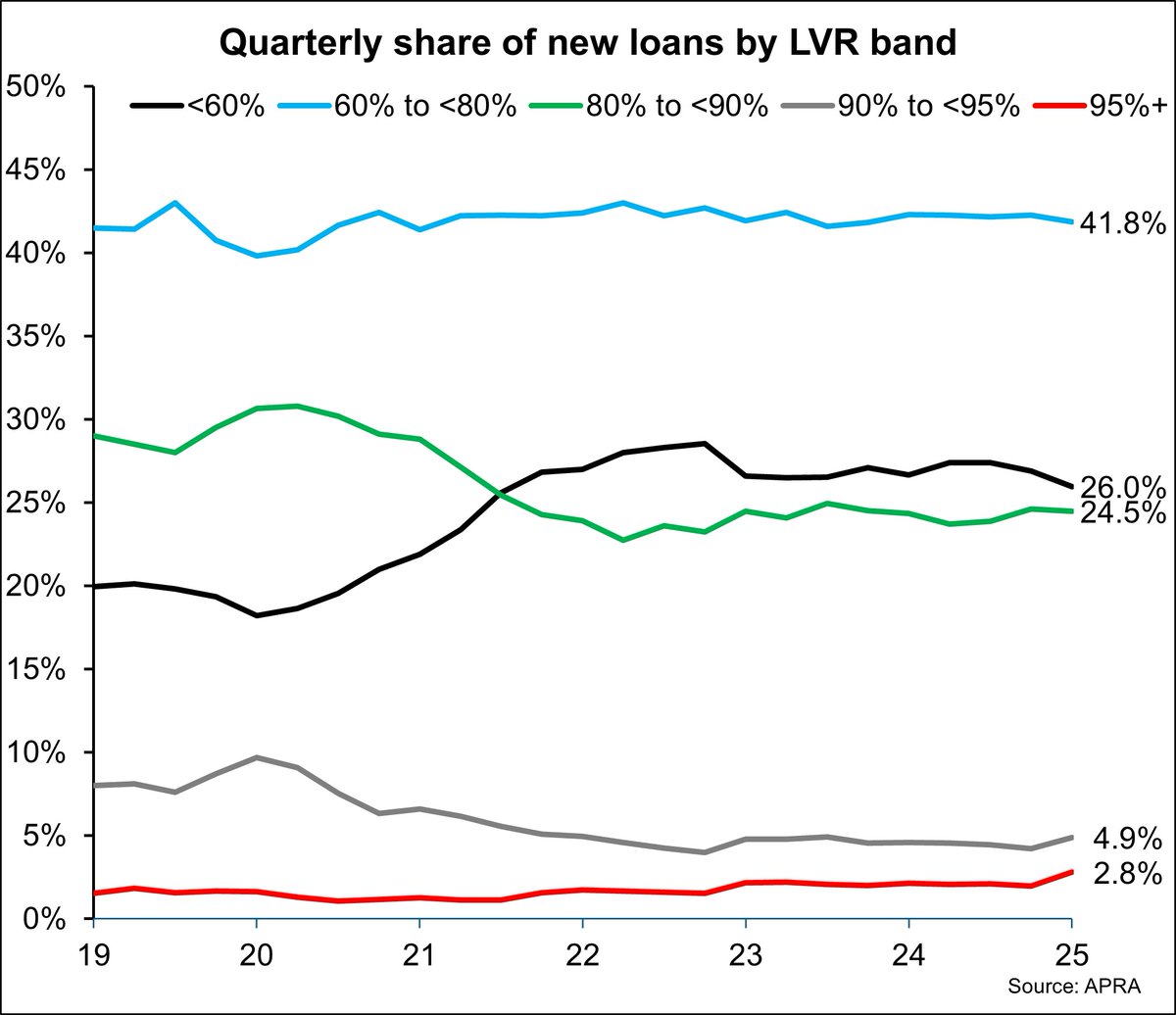
Is APRA going to pull the trigger on macroprudential tightening again? I don't think it's necessary but I wouldn't be surprised if they do after looking at their latest property exposures data. The share on total mortgages that were either 30-89 days past due or non-performing remained extremely low in the December 2025 quarter with the share of non-performing owner-occupier mortgages greater than investor mortgages. The share of new loans with an LVR of 90% to less than 95% was the highest it has been since June 2024 at 4.9% and the share of new loans with an LVR of 95% or more (2.8%) rose sharply and was the highest on record on the back of the government's Home Guarantee Scheme and Help to Buy Scheme going live. Over the December 2025 quarter, 22.1% of all new loans written were interest-only loans which was the greatest share on-record (since March 2019). Most interest-only lending is to investors with 41.6% of all new loans to investors over the quarter on an interest-only basis which is an historic high. I don’t think it would be wise or necessary for APRA to undertake macroprudential tightening on the back of this data release. If anything the most concerning sign is the jump in lower LVR lending being encouraged by the government. In saying that, previously when the share of lending to investors on an interest-only basis was at these levels APRA did limit credit growth to investors and the availability of interest-only loans and I have some concerns they may do the same again. This is despite the fact that investor lending has consistently has a lower rate of mortgage arrears over recent years than owner-occupier loans (noting both have low rates of arrears). open.substack.com/pub/ozproperty…
Cameron Kusher tweet mediaCameron Kusher tweet media
English
5
5
8
2.8K
Tim Reardon
Tim Reardon@TimReardon2·
@cmkusher @kit_lowe The purpose of Maco restrictions is system security. Investors are the least risky borrowers. In 2015 to 2017 APRA ran the 'zombie apartment building' story and restricted supply. Has anyone mis-read the housing market as badly as APRA? hia.com.au/our-industry/n…
English
2
0
3
55
Cameron Kusher
Cameron Kusher@cmkusher·
@kit_lowe I read there statement yesterday. Don't you think in a bid to assist with more business lending they could try and discourage mortgage lending by re-introducing macroprudential controls to investors? I don't think they should but I wouldn't put it past them.
English
2
0
1
143
Tim Reardon
Tim Reardon@TimReardon2·
@PaulH1 @IFM_Economist @berthon_jones The 10% is based on the Census and simply reports the number of homes that didn't return a Census form. It's unchanged for 40 years and the same across developed economies. It's a distraction.
English
0
0
2
16
Paul
Paul@PaulH1·
@IFM_Economist @berthon_jones Something like 10% of houses are estimated to be vacant at any one time. Survey based on water and electricity usage. Vacant rentals, vacant for sale, vacant airbnb, holiday houses, investors choice, awaiting demolition for rebuild or apartments, deceased estates....
English
1
0
0
24
David Berthon-Jones
David Berthon-Jones@berthon_jones·
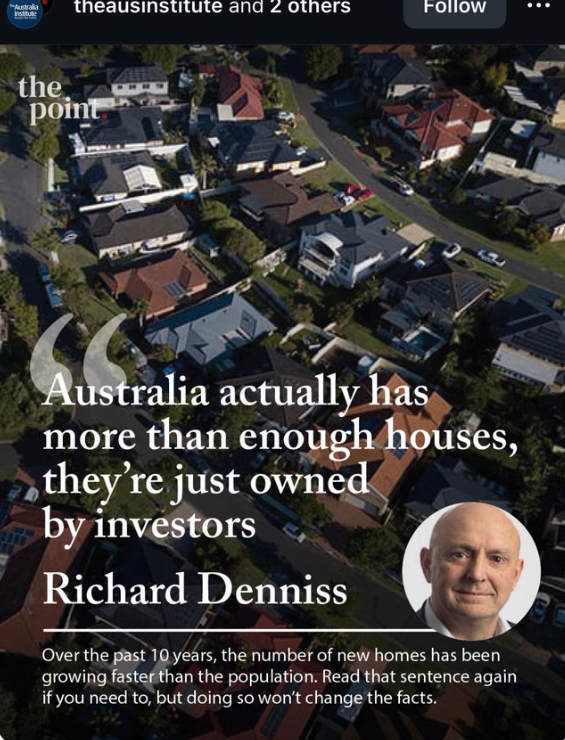
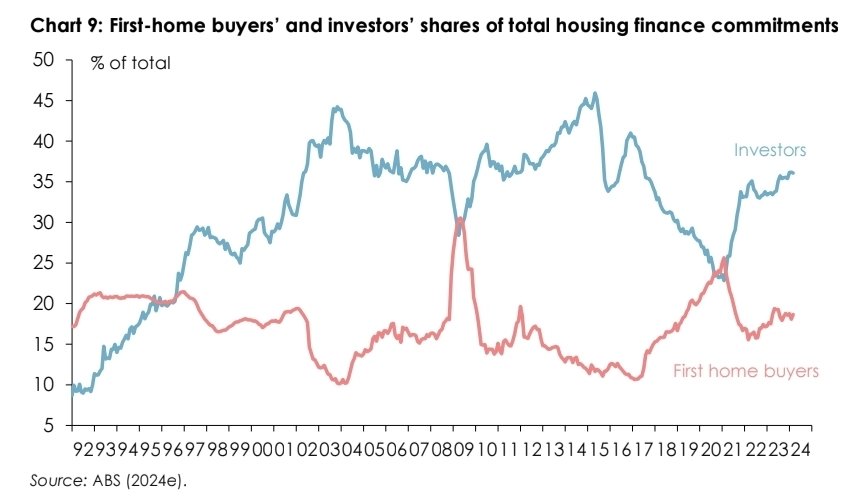
Hmmmm. I do not think we have enough houses. Prices and rents and vacancies are pretty clear on that. I also don't think investors are to blame.
David Berthon-Jones tweet media
English
3
0
30
4.2K
Tim Reardon
Tim Reardon@TimReardon2·
@RizviAbul @IFM_Economist @berthon_jones The census number of vacant homes has been constant for four decades. People on holidays on census night aren't evidence of vacant homes. This myth has been debunked.
English
0
0
0
13
Abul Rizvi
Abul Rizvi@RizviAbul·
@IFM_Economist @berthon_jones While number is likely much less than 1 million reported in the census, the number of unoccupied properties is unlikely to be small.
English
1
0
0
136
Chalyn.Rugby
Chalyn.Rugby@ChalynRugby·
Dear Wallabies, please back this Carter Gordon kid at 10. We might just see him doing this again at the 2027 World Cup, in a much bigger moment. What a gem 💎 #SuperRugbyPacific #Rugby #BRUvRED
English
12
2
166
14.6K
Tim Reardon
Tim Reardon@TimReardon2·
@AvidCommentator the "relative number of investor new builds" would likely rise if interest rates increase. There are so many factors influencing that outcome that its a 50/50. If a high level of investor activity in established is the problem, not the symptom, then surely use that?
English
0
0
0
8
Tarric Brooker aka Avid Commentator 🇦🇺
The issue is investors bringing new supply to market, without that they are adding nothing. They are taking a home from the owner occupier column to the investor column or shifting it from investor to investor. So if we are looking for proof it won't work, it would be a dramatic reduction in the relative number of investor new builds balanced out to account for broader credit conditions and the overall backdrop. The problem with this entire situation is Aussie property investors have played a major role in destroying the very price signals that guide housing stock growth. Take Austin for instance. During the genesis of its supply surge in the most recent cycle, it was much cheaper to build than rent. So in short order as housing demand surged, so did building activity. In Australia, at the average building to rent just isnt profitable for the average investor. There are some with skills, experience and industry expertise to make it work, but statistically they are the exception rather than the rule. So the price signals for investor led housing growth comes from higher prices. That needs to be broken and historic settings restored, so that we can once again have responsive investor driven growth. As I have said recently, if they want to take concessions from those buying existing and give them to those building new to a significant degree, fine, that is totally mathematically viable and perhaps even politically desirable.
English
1
0
0
34
LambDownUnder
LambDownUnder@LambDownUnder·
@AvidCommentator Then why the obsession over tax settings, when regulation via APRA (I presume?) can do the work.
English
3
0
1
47
Tim Reardon
Tim Reardon@TimReardon2·
@LambDownUnder @AvidCommentator Because macroprudential restrictions are intended to provide system security, not achieve political outcomes. Investors are the most secure borrowers, least risk, they are the last to leave a market as credit is squeezed.
English
0
0
0
6
Tim Reardon
Tim Reardon@TimReardon2·
@AvidCommentator Can I ask @AvidCommentator what evidence would you need to see, pre or post a change, that would demonstrate to you that taxing investors out of established will make the problem worse?
English
1
0
0
16
Tim Reardon
Tim Reardon@TimReardon2·
@AvidCommentator It is a fantasy to think that you can increase the tax on something and get more of that good and more revenue.
English
1
0
0
12