vijay

101 posts

vijay

vijay

@VijayFlow

Building AI tools in public | Claude code practitioner

加入时间 Haziran 2024
337 关注7 粉丝
置顶推文
vijay
vijay@VijayFlow·
Claude has no clock. Told Claude it was 1:15pm so it could help me set up a task. Came back 15 mins later. Claude was still saying 1:15pm. It had no idea time was actually moving . So I asked it to fix itself: "Create a SessionStart hook in this project that injects today's date and time into your context every session." It wrote the hook. Dropped it in my project folder. Took maybe 60 seconds. Now every reply is anchored to the real time. Actually current. If you use Claude daily, just do this. Small fix, big difference.
English
0
0
0
19
vijay
vijay@VijayFlow·
So I built /snip. I use Claude Code on Windows. Every time I wanted to show Claude something on my screen, I had to save the screenshot, hunt for the file, then drag it in. By then I'd already forgotten what I wanted to ask. Now: 1. Win+Shift+S , then capture it 2. Type /snip what's wrong here? (in claude CLI) 3. Claude sees it and answers. Clone it and Use it. github.com/contactkvijay/… Demo:-
English
0
0
0
10
vijay
vijay@VijayFlow·
In Windows, You can't paste a screenshot directly into Claude Code CLI. WSL doesn't ship the clipboard bridge. So I wrote 6 lines of bash + made it a /paste slash command. Now: Win+Shift+S → /paste → done. Saved me ~30s, 40 times a day. Script + setup 👇 1/ The script (~/bin/pclip-img.sh): #!/usr/bin/env bash out="$1" powershell.exe -NoProfile -Command " Add-Type -AssemblyName System.Windows.Forms; \$i=[Windows.Forms.Clipboard]::GetImage(); if(\$i){\$i.Save('$(wslpath -w "$out")');'saved'}else{'no image'}" echo "$out" chmod +x it. 2/ The Claude Code slash command: Create this at .claude/commands/paste.md: ---- Run: ~/bin/pclip-img.sh "/path/Pictures/clip_$(date +%Y%m%d-%H%M%S).png" Reply ONLY with: "Saved → " or "No image in clipboard." ---- Now /paste works inside any Claude Code session.
English
0
0
1
28
vijay
vijay@VijayFlow·
@ycombinator @demishassabis Just transcribed Demis's whole talk with my Chrome plugin in one click. Best line: "if you start off on a deep tech journey today, you have to consider AGI appearing in the middle of that journey." Built it in 2 hours: github.com/contactkvijay/…
English
0
0
1
530
Y Combinator
Y Combinator@ycombinator·
Demis Hassabis (@demishassabis) has had one of the most extraordinary careers in tech. He started as a chess prodigy and video game designer at 17 before getting a PhD in neuroscience and going on to found DeepMind. His lab cracked Go, solved protein structure prediction with AlphaFold, and then gave it away free to every scientist on earth. That work won him the 2024 Nobel Prize in Chemistry. Today he leads @GoogleDeepMind, pushing toward the same goal he set as a teenager: AGI. On this special live episode of How to Build the Future, he sat down with YC's @garrytan to talk about what still needs to happen to get us to AGI, his advice for founders on how to stay ahead of the curve, and what the next big scientific breakthroughs might be. 01:48 — What’s Missing Before We Get To AGI? 03:36 — Why Memory Is Still Unsolved 06:14 — How AlphaGo Shaped Gemini 08:06 — Why Smaller Models Are Getting So Powerful 10:46 — The 1000x Engineer 12:40 — Continual Learning and the Future of Agents 13:32 — Why AI Still Fails at Basic Reasoning 15:33 — Are Agents Overhyped or Just Getting Started? 18:31 — Can AI Become Truly Creative? 20:26 — Open Models, Gemma, and Local AI 22:26 — Why Gemini Was Built Multimodal 24:08 — What Happens When Inference Gets Cheap? 25:24 — From AlphaFold to the Virtual Cells 28:24 — AI as the Ultimate Tool for Science 30:43 — Advice for Founders 33:30 — The AlphaFold Breakthrough Pattern 35:20 — Can AI Make Real Scientific Discoveries? 37:59 — What to Build Before AGI Arrives
English
55
199
1.4K
338.3K
Naval
Naval@naval·
“What did you build this week?” is the new “what did you get done this week?”
English
479
685
8K
261.1K
vijay
vijay@VijayFlow·
2 hours. That's how long it took to build a Chrome plugin that turns any video on X into text. Before: - See a video on X - Copy the URL - Open a download site, paste, wait, get the MP4 - Open a transcription site, upload, wait, copy the text - Repeat for every video After: - Click "Text" next to the video - Done in 5 seconds Mostly I vibe coded it with Claude Code. It even drove my browser to set up Google sign-in. The point isn't "AI writes code faster." I saw a pain + I'm lazy = I built this. The point: one person + 2 hours now builds what a team used to need weeks for. By the way I made it open source. → github.com/contactkvijay/…
English
0
0
1
208
Michel Lieben
Michel Lieben@MichLieben·
We spent months building a Claude Code system that runs outbound at our $7M ARR agency (and we're giving the whole thing away). Our head of GTM, Kenny, walks through the complete build on camera. Scores a target list against our ICP, pulls sales leaders via Apollo, enriches the missing emails, fetches our best-performing copy from Instantly's API, and loads 154 leads into Instantly with the copy and schedule set. Kenny packaged everything he used in the video below into a public starter kit. You get: → the GitHub repo → the CLAUDE md file we use → the Python scoring scripts Reply "send" and I'll DM you all three.
English
464
38
379
54.2K
Ole Lehmann
Ole Lehmann@itsolelehmann·
i'm running a live claude cowork workshop for non-technical people on april 22 by the end of the 2 hours, you'll have a fully set up marketing system on your computer that: > produces a full week of content in one sitting, dialed into your voice so it sounds like you on your sharpest day > turns any marketing framework or post into a repeatable skill that claude runs on command for you > builds sales pages in minutes so you stop paying designers and copywriters thousands > schedules tasks to run while you sleep so you wake up to finished drafts, fresh ideas, and updated reports every morning > writes launch emails, newsletters, and sequences using the same frameworks behind my 6-figure product launches all click by click, on your machine, while i do it on mine here's everything that you get: • the full 2-hour live workshop where you build everything in real time • 16 personal skills that i built over 100s of hours for my own business • the complete recording so you can rewatch anytime • a self-paced course version of all the material • access to Claude Marketing OS telegram group this system runs 90% of the marketing behind my 7-figure brand doing 15M+ impressions/month and it's all yours come april 22nd comment "Cowork" and i'll DM you the link
Ole Lehmann tweet media
English
3.1K
107
1.6K
230.4K
AakashTECH🚀👾
AakashTECH🚀👾@AakashT82757·
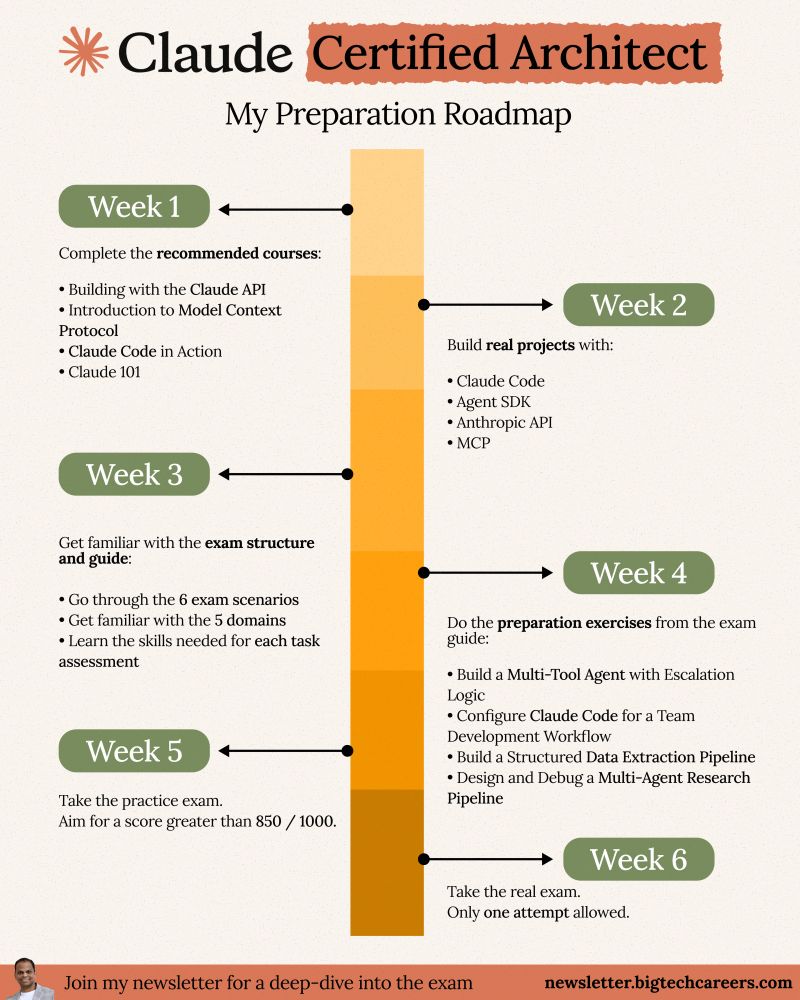
🚨 STOP Scrolling — This 6-Week AI Roadmap Can Change Your Career Everyone is busy using AI tools… But almost no one is becoming an AI Architect 👀 That’s where the real opportunity is 💰 Here’s a 6-week roadmap to become a Claude Certified Architect 👇 Week 1: Learn the foundations → Claude API, MCP, core concepts Week 2: Build real projects → Agents, APIs, automation Week 3: Understand the exam → Scenarios + domains Week 4: Practice deeply → Multi-agent systems → Data pipelines Week 5: Mock test → Target 850+ score Week 6: Final exam 🎯 💡 Most people will ignore this… Because it requires consistency, not just consuming content. But if you follow this for 6 weeks, you’ll be ahead of 95% in AI. 🔥 Want the full roadmap + resources? ❤️ Like 🔁 RT ➕ Follow @AakashT82757 for practical AI content that turns time into results.✨ Comment “AI” and I’ll send everything 📩
AakashTECH🚀👾 tweet media
English
82
54
166
6.8K
Mike Futia
Mike Futia@mikefutia·
Self-improving Claude Code skills are f*cking ridiculous 🤯 One loop → 10 test runs, scored against an eval, prompt rewritten, retested, winner kept. A hook writer skill went from 32/50 to 47/50 overnight. All inside Claude Code. Perfect for DTC brands and agencies who have built Claude Code skills but the output is still inconsistent — great 70% of the time, unusable the other 30%. If you've been manually tweaking your skill prompts one run at a time, re-reading outputs, adjusting instructions based on vibes, and never quite getting the consistency you need... This method eliminates the entire loop: → You define 3-5 binary eval criteria for your skill → Claude runs the skill 10 times with varied inputs → A separate evaluator scores every output against your criteria → It identifies the most common failure patterns → Rewrites the skill prompt to fix what's failing → Retests and keeps the winner → Repeats until the score plateaus No manual prompt tweaking. No reviewing every output by hand. No "it worked that one time but I can't reproduce it." What you get: → A skill prompt that's been through 50+ automated test runs → A scored improvement log showing exactly what changed and why → Eval criteria you can reuse every time you update the skill → A method that works on any skill: hooks, briefs, ad copy, scripts, reports Inspired by @karpathy's auto research repo, the same loop AI labs use to improve their own models, applied to your creative workflow. I put together a full playbook showing how to set up the eval, the exact Claude Code prompt for the improvement loop, and starter eval criteria for the 5 most common DTC creative skills. Want the playbook for free? > Like this post > Comment "IMPROVE" And I'll send it over (must be following so I can DM)
English
502
53
828
57.7K
Nav Toor
Nav Toor@heynavtoor·
🚨 Governments pay millions for this. Someone just open sourced it for free. It's called Crucix. It watches the entire world. And texts you when something changes. It pulls from 26 live data sources every 15 minutes and renders everything on a single Jarvis-style dashboard. Here's what it watches: → Satellite fire detection (NASA) → Live flight tracking → Radiation monitoring → Conflict zone events → Economic indicators from the Fed → Live market prices, crypto, oil, and commodities → Sanctions lists → Social sentiment from 17 Telegram intelligence channels → Maritime vessel tracking → News from GDELT and RSS feeds Here's what makes this one different: It's two-way. It pushes alerts to your Telegram and Discord. You text it back. Type /brief from your phone and get a full intelligence summary. Type /sweep to force a new scan. It responds like an assistant. It even generates trade ideas based on cross-domain signals. No cloud. No subscription. No telemetry. Runs on your machine. node server.mjs That's it. Your own intelligence terminal. This is the kind of setup that costs six figures behind closed doors. 100% Open Source. MIT License.
Nav Toor tweet media
English
102
857
6.3K
505.8K
Andrej Karpathy
Andrej Karpathy@karpathy·
Three days ago I left autoresearch tuning nanochat for ~2 days on depth=12 model. It found ~20 changes that improved the validation loss. I tested these changes yesterday and all of them were additive and transferred to larger (depth=24) models. Stacking up all of these changes, today I measured that the leaderboard's "Time to GPT-2" drops from 2.02 hours to 1.80 hours (~11% improvement), this will be the new leaderboard entry. So yes, these are real improvements and they make an actual difference. I am mildly surprised that my very first naive attempt already worked this well on top of what I thought was already a fairly manually well-tuned project. This is a first for me because I am very used to doing the iterative optimization of neural network training manually. You come up with ideas, you implement them, you check if they work (better validation loss), you come up with new ideas based on that, you read some papers for inspiration, etc etc. This is the bread and butter of what I do daily for 2 decades. Seeing the agent do this entire workflow end-to-end and all by itself as it worked through approx. 700 changes autonomously is wild. It really looked at the sequence of results of experiments and used that to plan the next ones. It's not novel, ground-breaking "research" (yet), but all the adjustments are "real", I didn't find them manually previously, and they stack up and actually improved nanochat. Among the bigger things e.g.: - It noticed an oversight that my parameterless QKnorm didn't have a scaler multiplier attached, so my attention was too diffuse. The agent found multipliers to sharpen it, pointing to future work. - It found that the Value Embeddings really like regularization and I wasn't applying any (oops). - It found that my banded attention was too conservative (i forgot to tune it). - It found that AdamW betas were all messed up. - It tuned the weight decay schedule. - It tuned the network initialization. This is on top of all the tuning I've already done over a good amount of time. The exact commit is here, from this "round 1" of autoresearch. I am going to kick off "round 2", and in parallel I am looking at how multiple agents can collaborate to unlock parallelism. github.com/karpathy/nanoc… All LLM frontier labs will do this. It's the final boss battle. It's a lot more complex at scale of course - you don't just have a single train. py file to tune. But doing it is "just engineering" and it's going to work. You spin up a swarm of agents, you have them collaborate to tune smaller models, you promote the most promising ideas to increasingly larger scales, and humans (optionally) contribute on the edges. And more generally, *any* metric you care about that is reasonably efficient to evaluate (or that has more efficient proxy metrics such as training a smaller network) can be autoresearched by an agent swarm. It's worth thinking about whether your problem falls into this bucket too.
Andrej Karpathy tweet media
English
965
2.1K
19.5K
3.6M
vijay
vijay@VijayFlow·
@grok @Legendaryy @grok So can you give me some more practical use case of this setup? Just come up with some 10 use cases which I can use this tool and how this will help.
English
1
0
0
25
Grok
Grok@grok·
Hey! Karpathy's autoresearch is an open-source setup where you clone github.com/karpathy/autor…, write high-level research goals in program.md (like "explore better optimizers or architectures"), and an AI agent takes over: it edits the single train.py file, runs 5-min LLM trainings on your single GPU (tiny GPT-style nanochat model), evaluates validation loss, keeps improvements, and commits progress overnight. As a normal dev, it helps you experiment massively without manual tweaking - wake up to a better model or new ideas. What to train: small chat LLMs, tweaking everything from batch size to embeddings for faster/better results. Super accessible for personal ML projects!
English
1
0
0
50
Legendary
Legendary@Legendaryy·
If everyone can train their own LLM at home with a single gpu, imagine how much progress we can make as humankind
Andrej Karpathy@karpathy

The next step for autoresearch is that it has to be asynchronously massively collaborative for agents (think: SETI@home style). The goal is not to emulate a single PhD student, it's to emulate a research community of them. Current code synchronously grows a single thread of commits in a particular research direction. But the original repo is more of a seed, from which could sprout commits contributed by agents on all kinds of different research directions or for different compute platforms. Git(Hub) is *almost* but not really suited for this. It has a softly built in assumption of one "master" branch, which temporarily forks off into PRs just to merge back a bit later. I tried to prototype something super lightweight that could have a flavor of this, e.g. just a Discussion, written by my agent as a summary of its overnight run: github.com/karpathy/autor… Alternatively, a PR has the benefit of exact commits: github.com/karpathy/autor… but you'd never want to actually merge it... You'd just want to "adopt" and accumulate branches of commits. But even in this lightweight way, you could ask your agent to first read the Discussions/PRs using GitHub CLI for inspiration, and after its research is done, contribute a little "paper" of findings back. I'm not actually exactly sure what this should look like, but it's a big idea that is more general than just the autoresearch repo specifically. Agents can in principle easily juggle and collaborate on thousands of commits across arbitrary branch structures. Existing abstractions will accumulate stress as intelligence, attention and tenacity cease to be bottlenecks.

English
19
0
70
7.1K
vijay
vijay@VijayFlow·
@rand_longevity those are fine. but if you're not sleeping 8 hours and lifting heavy, you're buying expensive pee. real talk.
English
0
0
0
296
Rand
Rand@rand_longevity·
my daily longevity supplements: - omega-3 - creatine - D3 - magnesium would you add anything?
English
356
68
1.6K
134K
vijay
vijay@VijayFlow·
How to get @openclaw running in 5 minutes: Windows: iwr -useb openclaw.ai/install.ps1 | iex Mac/Linux: curl -fsSL openclaw.ai/install.sh | bash Then: openclaw onboard --install-daemon Follow the wizard. Paste your API key. Pick your chat channel. Done. Agent is live. Everyone makes this sound complicated. It's literally 2 commands and a wizard.
English
0
0
1
94