Post

Python Developer
Python Developer@PythonDvz·
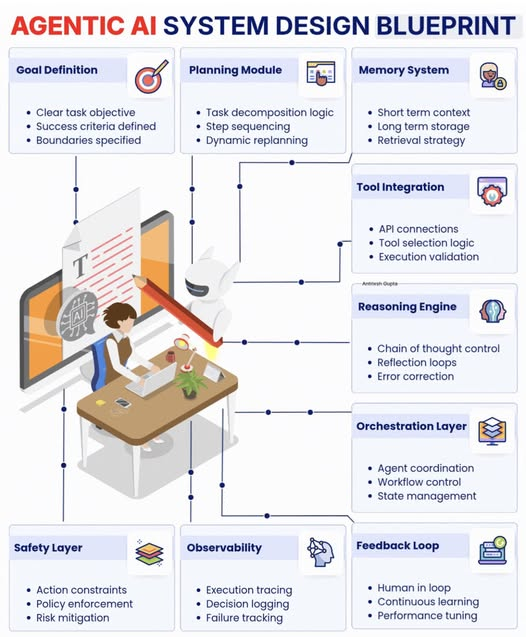
Most Agentic AI systems break in production. Not because of models, but because of missing system design. Everyone is building agents. Few are building complete systems. 𝐈𝐧 𝐭𝐡𝐢𝐬 𝐢𝐧𝐟𝐨𝐠𝐫𝐚𝐩𝐡𝐢𝐜 𝐈 𝐛𝐫𝐞𝐚𝐤 𝐝𝐨𝐰𝐧 9 𝐜𝐨𝐫𝐞 𝐜𝐨𝐦𝐩𝐨𝐧𝐞𝐧𝐭𝐬: • Goal Definition • Planning Module • Memory System • Tool Integration • Reasoning Engine • Orchestration Layer • Safety Layer • Observability • Feedback Loop 𝐄𝐚𝐜𝐡 𝐜𝐨𝐦𝐩𝐨𝐧𝐞𝐧𝐭 𝐬𝐨𝐥𝐯𝐞𝐬 𝐚 𝐝𝐢𝐟𝐟𝐞𝐫𝐞𝐧𝐭 𝐟𝐚𝐢𝐥𝐮𝐫𝐞 𝐦𝐨𝐝𝐞. → Without clear goals, agents drift. → Without planning, they stall. → Without memory, they repeat mistakes. → Without tools, they stay limited. → Without reasoning, they hallucinate. → Without orchestration, they break at scale. → Without safety, they create risk. → Without observability, you stay blind. → Without feedback, they never improve. Agentic AI is not a prompt problem. It is a systems engineering problem. The teams that understand this will ship reliable AI. The rest will keep debugging demos. P.S. Which of these components is missing in your current AI system? #RAG #AIEngineering #LLMSystems
Python Developer tweet media
English
11
35
146
6.7K
Pritesh Sonu
Pritesh Sonu@priteshsonu·
This breakdown nails why most agentic AI pilots never reach reliable production. At Pravaah Consulting we find that success comes from treating agents as complete systems with orchestration, safety layers and feedback loops rather than just advanced prompts or single models. The observability and governance pieces prevent the drift and risk that kill enterprise scale. If your team is moving agentic systems beyond demos into live operations, which of these components has been the missing link in your experience? I would be glad to exchange notes or explore how structured agentic platforms can make the transition smoother and more sustainable. #AgenticAI #EnterpriseAI #DigitalTransformation #AIEngineering
English
2
0
1
13
ToolRate
ToolRate@tool_rate·
Spot on - Tool Integration is a silent killer in production agents. Flaky external APIs (Stripe, Tavily) tank reliability before observability even kicks in. ToolRate's /v1/assess beforehand gives reliability_score, historical success rates from real calls… toolrate.ai
English
0
0
0
10
Tech P
Tech P@Tech_p001·
@Python_Dv "The era of 'Prompt Engineering' is dying. The era of 'AI Systems Design' is here. 90% of agents fail because developers treat them like scripts instead of distributed systems. This blueprint isn't just a list—it’s the survival guide for the next 5 years of software."
English
0
0
0
45
ImL1s
ImL1s@iml1s·
@Python_Dv Could not agree more. Everyone treats the 'Safety Layer' as an afterthought or just a prompt suffix. Real safety requires an isolation boundary—an edge proxy or prefilter that sanitizes both the user's prompt AND the data returning from tool calls.
English
0
0
0
26
Anton Manaev
Anton Manaev@ManaevLab·
@Python_Dv Missing system design is usually retry logic + idempotency keys. Agents that re-fire side-effect tools on transient failure look fine in dev and silently double-charge customers in prod. Most demos skip this because the happy path is what gets recorded.
English
0
0
0
10
Anton Manaev
Anton Manaev@ManaevLab·
@Python_Dv The infographic probably doesn't cover the boring-but-critical parts: retry logic with exponential backoff, graceful degradation when tools fail, circuit breakers for cascading failures. System design for agents IS system design. Same rules apply.
English
0
0
0
46
BuddyRomanoAI
BuddyRomanoAI@AIBuddyRomano·
@Python_Dv Memory architecture keeps killing my prototypes. Planning is straightforward; persistent state with retrieval logic is where the demons hide. My agents loop endlessly on context failures in testing.
English
0
0
0
35
Erika S
Erika S@E_FutureFan·
@Python_Dv I'm 90% sure observability is the silent killer. You can't fine-tune what you can't trace, especially when German language parsing chains grow past token limits.
English
1
0
0
67
Paylaş