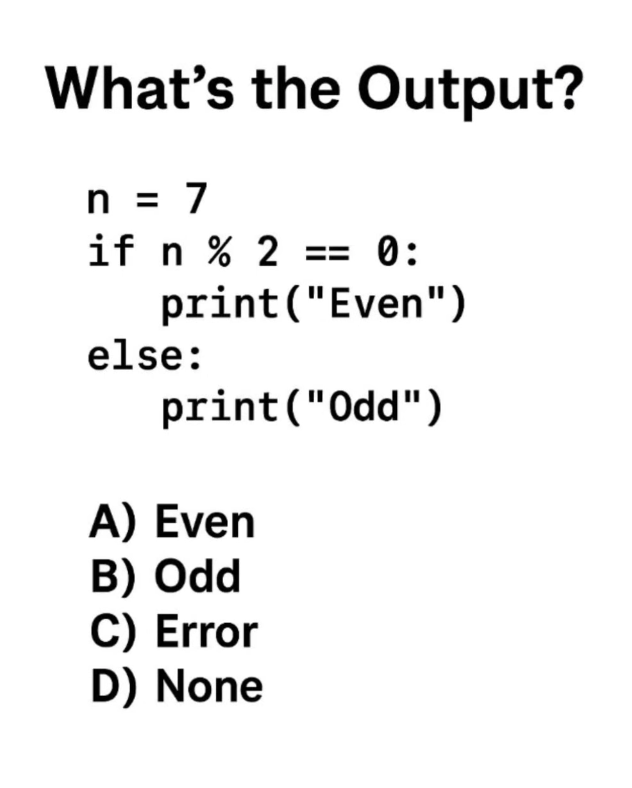
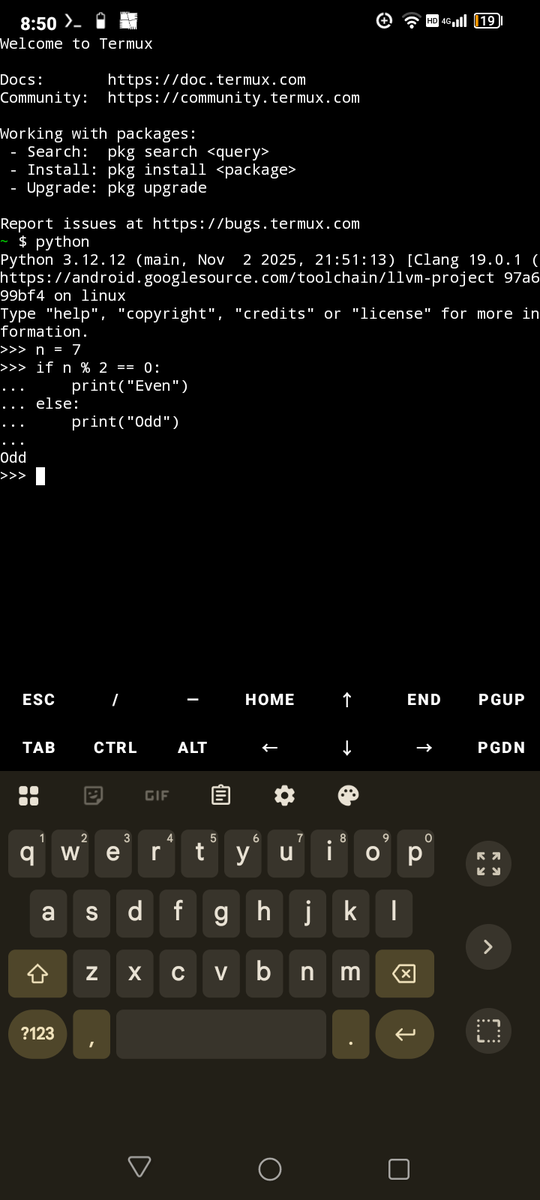
@PythonPr Answer: B) Odd
The program initializes the variable n with the value 7. It then evaluates the condition n % 2 == 0. The modulo operator (%) returns the remainder of the division.The remainder of (7\div 2) is 1.The condition (1==0) is False, so the code within the else block is
@PythonPr Classic modulo check.
In high-frequency trading and low-latency systems, even small optimizations matter.
Using bitwise operators avoids the modulo operation:
print("Even" if (n & 1) == 0 else "Odd")
Same logic. Fewer cycles. Scales better at high volumes. ⚡
#Python#HFT
@PythonPr n = 7 assigns the value 7 to the variable n.
n % 2 calculates the remainder when n is divided by 2. Since 7 is odd, 7 % 2 equals 1.
The condition n % 2 == 0 evaluates to False, so the else block runs.
🟢 Correct output: "Odd"
✅ Answer: B) Odd
@PythonPr The answer is odd, because 7%2 results in the remainder of 1. And 1 is not equal to 0. So there it skips the if statement to the else statement. And outputs Odd.
Riddle it!!!
I test parity without counting.
I ask a number what remains after pairing itself away.
When nothing is left, symmetry speaks.
When one survives, asymmetry answers.
Seven steps in, what voice returns?
Hint: Remainders don’t lie—classification precedes labels.
#Python#SystemsLogic