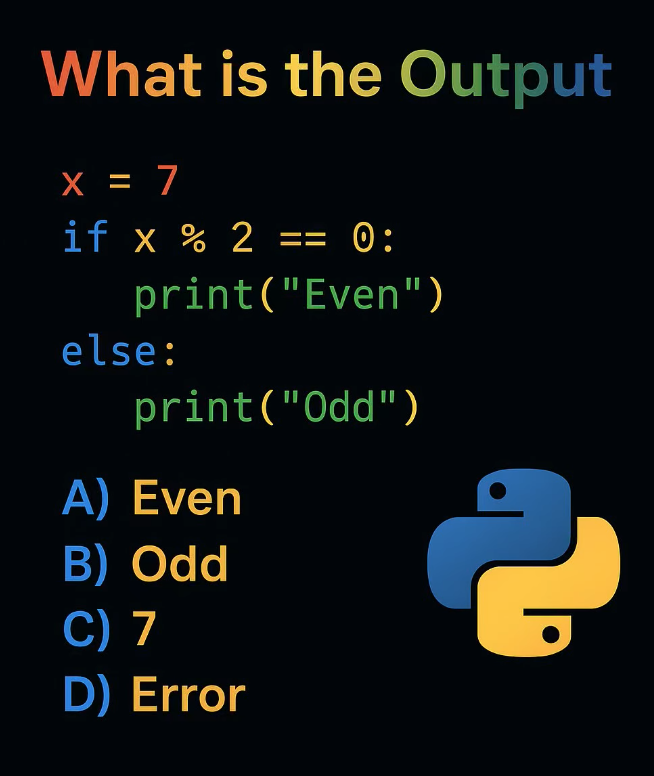
@PythonPr Answer: (B) Odd
The code initializes the variable x with the value 7. The if statement then evaluates the condition x % 2 == 0. The modulo operator (%) returns the remainder of the division. When 7 is divided by 2, the remainder is 1.
Since 1 == 0 is False, the code
@PythonPr Answer: B) Odd
The pattern:
› x % 2 == 0 => Even (divides evenly)
› x % 2 == 1 => Odd (has remainder)
For x=7:
7 % 2 = 1 (remainder 1) => Odd!
For beginners: This is the classic way to check even/odd in programming.
@PythonPr This is checking if the remainder of dividing x by 2 is 0 then it prints even otherwise it will print odd. Since x is set to 7 and 2 goes into 7 3 times with a remainder of 1 it goes to the else block printing odd.
@PythonPr B) Odd is the correct answer.
Here the value x =7 value assgined then we use simple if and else statements, x%2== 0 reminder opertaor so value is 7 means else condition is triggered output will be odd.