I was considering relapsing and then Lena Dunham put out a memoir which will make me feel equally as uncomfortable so I’m just gonna do that instead. Also it’s cheaper.
Little Maliha’s bright eyes and innocent smile are now just memories. What began as a fever and measles quickly turned fatal—her family unable to get timely medical care, proper guidance, or urgent ICU support.
This is not just one child’s story. It reflects a growing crisis. A disease once nearly eliminated is now resurging—costing young lives.
Behind this tragedy lies more than illness:
⚠️ Hospital mismanagement
⚠️ Delayed treatment
⚠️ Systemic negligence
When healthcare systems fail, it is the most vulnerable who pay the price. Maliha’s death is a painful reminder of what happens when responsibility is ignored.
🕯️ How many more lives must be lost before action is taken?
#Bangladesh#Measles
Pro-#BNP#lawyers elected unopposed in the Shariatpur Bar Association #election, amid serious allegations of candidate obstruction and intimidation.
This seems to reflect a broader political strategy or “plan” associated with PM #TariqueRahman and the Bangladesh Nationalist Party (BNP), aimed at consolidating control over bar associations across #Bangladesh. The approach involves ensuring BNP-aligned lawyers are elected unopposed by preventing pro-#AwamiLeague and independent candidates from participating in the electoral process.
This concern is not limited to Shariatpur. Recent reporting by BD Watch highlighted similar allegations surrounding the upcoming Dhaka Bar Association (DBA) election, where pro-Awami League and independent candidates have reportedly been obstructed from collecting nomination forms, raising fears of a one-sided race with predetermined outcomes. See:
x.com/bdwatch2024/st…
The developments in Shariatpur suggest that such incidents may represent a growing nationwide pattern rather than isolated cases. On the final day for collecting and submitting nomination papers, the election commission overseeing the Shariatpur Bar polls published the list of winners for all 15 executive committee positions, declaring them elected unopposed. Those elected are all reportedly local leaders of BNP and affiliates.
The election process was marred by allegations of #violence and intimidation. Lawyer Muslim Uddin Khan was reportedly assaulted while attempting to collect nomination papers, while another lawyer, Murad Hussain, was allegedly attacked inside his chamber. These incidents have raised serious concerns about the integrity of the electoral environment. See:
sayalwaystruth.com/en/local/pro-b…
Observers point out that a similar situation occurred in February last year, when pro-BNP lawyers and local BNP figures allegedly prevented rival candidates, including those aligned with the Awami League and independents, from submitting nominations. As a result, several BNP-backed candidates secured uncontested victories.
Further concerns have been raised regarding the broader implications of these practices. Critics argue that restricting participation to specific political alignments, including BNP, #JamaatEIslami, and the National Citizen Party (#NCP), undermines the principles of competitive elections and institutional independence.
Analysts suggest that this pattern mirrors concerns seen in other recent electoral processes in Bangladesh, including the last parliamentary election, where limited competition and barriers to participation took away the “competitive” aspect of elections. Such trends, they argue, risk eroding trust in democratic and professional institutions alike.
One-sided politics. One-sided elections. Pre-determined outcomes.
That seems to be Tarique Rahman’s “plan”.
….
#BangladeshCrisis#Democracy@IBAnews@IBAHRI@barandbench@SRjudgeslawyers@TheDavidBergman
#Bangladesh is experiencing a sharp increase in #measles transmission. As of 7 April 2026, 9,883 suspected cases and 1,398 lab-confirmed cases have been reported nationwide, with at least 128 suspected deaths.
So, what’s behind this recent deadly outbreak?
According to the @UNICEF’s “Bangladesh Measles Outbreak Situation Report No. 1, 08 April 2026”, young #children are disproportionally affected, with children under-5 accounting for 81% of cases, including 34% among infants under nine months, who are not yet eligible for routine #immunization and remain especially vulnerable.
Most cases are among unvaccinated or under-vaccinated children, with 72% zero-dose and 16% partially vaccinated, reflecting significant #immunity gaps. National Measles-Rubella (MR) #vaccine stocks are depleted, constraining both response efforts and routine immunization.
See: reliefweb.int/report/banglad…
A Governance Failure
Bangladesh had been extremely successful among the least developed countries (LDCs) in terms of #vaccination programmes, including the measles-rubella one. Official figures indicate about 96% coverage for the first dose and over 90% for the second.
Apart from the general vaccination programme for children under the Expanded Immunization Programme (EPI), the government also conducted special drives every four years to address immunization gaps.
It was during the Interim Govt led by Muhammad #Yunus that Bangladesh missed the last special measles vaccination drive. Under the IG’s Health Adviser Nurjahan Begum, whose only qualification for the job was being Yunus’s friend and colleague at #GrameenBank, the national measles vaccination campaign scheduled for late 2024 was cancelled. Even more concerning, procurement contracts for vaccines were cancelled without securing alternative sources.
See: counterpointbd.com/When-Measles-K…
The failures in #immunisation efforts are evident from the vaccination rates. Under the Interim Govt, the rate dropped to 57.1% in 2025, compared to 89.4% in 2023 and 97.9% in 2022 under the #AwamiLeague Govt. Even during the #COVID19 pandemic, the country maintained a rate of 81.7%.
However, these failures, which we submit constitute criminal #negligence, extended beyond immunisation. Since 1998, Bangladesh’s health #infrastructure, #disease prevention, health services, and welfare activities have been governed under structured five-year plans.
The Interim Govt cancelled 36 Operational Plans (OPs) without any valid reasons or justifications. This decision severely reduced attention to critical areas such as rabies, AIDS, and vaccination programs.
According to former Director of Disease Control at the DGHS, Dr. Benazir Ahmed:
“The OPs have delivered significant successes in the country’s public health progress. The decision to stop them was whimsical and has led to vaccine shortages.”
See: shorturl.at/TGadY
Public health experts and observers say these lapses reflect serious shortcomings in planning and implementation, with devastating consequences for vulnerable children and their families. They stress that accountability and urgent corrective measures are essential to prevent further loss of life and to restore confidence in the national immunisation system.
Let us be unequivocal: the failures of the Interim Govt are too severe to be dismissed as mere oversights. They reflect a pattern of criminal negligence that has already claimed many young lives and may endanger more in the future.
Accountability is essential.
….
#BangladeshCrisis@WHO@DrTedros@WHOSEARO@UNICEFBD@gavi@bbchealth@HarvardHealth@CDCGlobal@JohnsHopkinsSPH@icddr_b
#Bangladesh has once again slipped back into that dark era
-----
There is no electricity, no water, no gas.
Amid all these shortages, ordinary people are suffering unbearable hardship — yet there is no one to listen to their grievances or solve their problems.
That is why, ignoring all obstacles, people have taken to the streets.
#Dhaka#BangladeshCrisis
Fertilizer factories shutting down.
Irrigation pumps running dry.
Farmers can’t get fertiliser.
Fuel shortages mean no water for crops.
No fertiliser. No irrigation. No harvest.
A once food self-sufficient Bangladesh is now facing a growing risk of food crisis. If production drops, prices will rise — and every household will feel it.
This isn’t just an agriculture issue.
This is a food security emergency.
Raise awareness. Act now.
#Bangladesh#Agriculture#FuelCrisis
Planned efforts at a controlled #election at the Dhaka Bar Association (#DBA) sparks democratic concerns among the legal fraternity.
An emerging alignment among the Bangladesh Nationalist Party (#BNP), #JamaatEIslami, and the National Citizen Party (#NCP), seeks to obstruct a fair and democratic electoral process at DBA.
The DBA, one of the oldest and largest bar associations in #SouthAsia, is scheduled to hold elections on April 29–30, 2026, to elect its Executive Council (EC) for the 2026–27 term.
Under existing rules, any lawyer with at least five years of practice after enrollment is eligible to contest for EC positions.
However, this year’s election process has come under scrutiny.
Lawyers affiliated with the #AwamiLeague, as well as independent candidates, have reportedly been prevented from collecting nomination forms. Critics suggest that this may be part of a deliberate effort to engineer a one-sided polls like the recently concluded parliamentary #election.
Several aspiring candidates have claimed that they were explicitly told that only #lawyers aligned with the BNP, Jamaat, and NCP would be allowed to obtain nomination forms and participate in the election.
Further concerns have been raised over newly imposed restrictions in the nomination process. Among the most controversial is a requirement for prior approval from the DBA President before a candidate can even collect a nomination form. Many legal professionals have described this condition as unprecedented, lacking transparency, and fundamentally undemocratic.
Observers note that this approach mirrors concerns raised in other recent electoral processes, where restricted competition has led to outcomes favoring specific political alignments. In this context, a limited or exclusionary candidate pool could effectively ensure that lawyers aligned with BNP, Jamaat, and NCP dominate the Executive Council, while systematically sidelining those associated with the Awami League or those running independently.
As the election date approaches, unease continues to grow among members of the Dhaka Bar. There are increasing calls from within the legal community for a transparent, inclusive, and politically neutral electoral process, one that upholds the principles of fairness, equal opportunity, and institutional integrity.
Sources:
thevoice.news/2026/04/10/415…facebook.com/share/v/18EJgz…
…..
#BangladeshCrisis#Governance#Democracy@IBAnews@IBAHRI@justiceinfonet@barandbench@SRjudgeslawyers
Pohela Boishakh Greetings from Bangladesh Awami League President and Daughter of Bangabandhu, Sheikh Hasina
——
“Let all shame be erased, let decay be removed,
Let the world be purified through the fire’s cleansing.”
Dear fellow citizens,
Warm greetings to everyone on the Bengali New Year.
Pohela Boishakh is the foremost festival of Bengali national heritage. On this day, with the message of renewal, people awaken in joy, leaving behind sorrow, decay, failure, and gloom. What began as a harvest-based calendar during the Mughal era has, over time, evolved into a defining cultural celebration for all Bengalis. Regardless of religion or ethnicity, it is now a festival of the global Bengali community.
In undivided Bangladesh, the Pakistani government attempted to sever Bengalis from their roots by obstructing the celebration of Pohela Boishakh. They also tried to prevent the centenary celebration of Rabindranath Tagore, the foremost literary figure of the Bengali language. As a result, in independent Bangladesh, Pohela Boishakh became a symbol of national awakening, unity, and harmony among the people.
Dear brothers and sisters,
The Mangal Shobhajatra of Pohela Boishakh is now part of world heritage. Through the efforts of the Awami League government, UNESCO recognized it as an element of world cultural heritage. On the occasion of Pohela Boishakh, our government introduced the “Boishakhi allowance” for employees.
We have observed that anti-liberation and unconstitutional forces have sought to undermine this festival—efforts that continue even today. They have even dared to attempt renaming the Mangal Shobhajatra. Rooted in the agrarian traditions of harvesting new crops, this celebration has evolved over centuries into the New Year festival. In many countries—such as China and Iran—New Year celebrations remain the principal national festivals. The Boishakhi festival is another reflection of this anthropological tradition. Using religion as a tool to obstruct this celebration is simply another form of division.
Dear citizens,
We believe that through the continued celebration of Pohela Boishakh, a secular Bangladesh will re-emerge.
Once again, Happy New Year to all.
Victory to Bengal, Victory to Bangabandhu.
Let darkness give way to dawn.
May Bangladesh live forever.
#Bangladesh#PohelaBoishakh
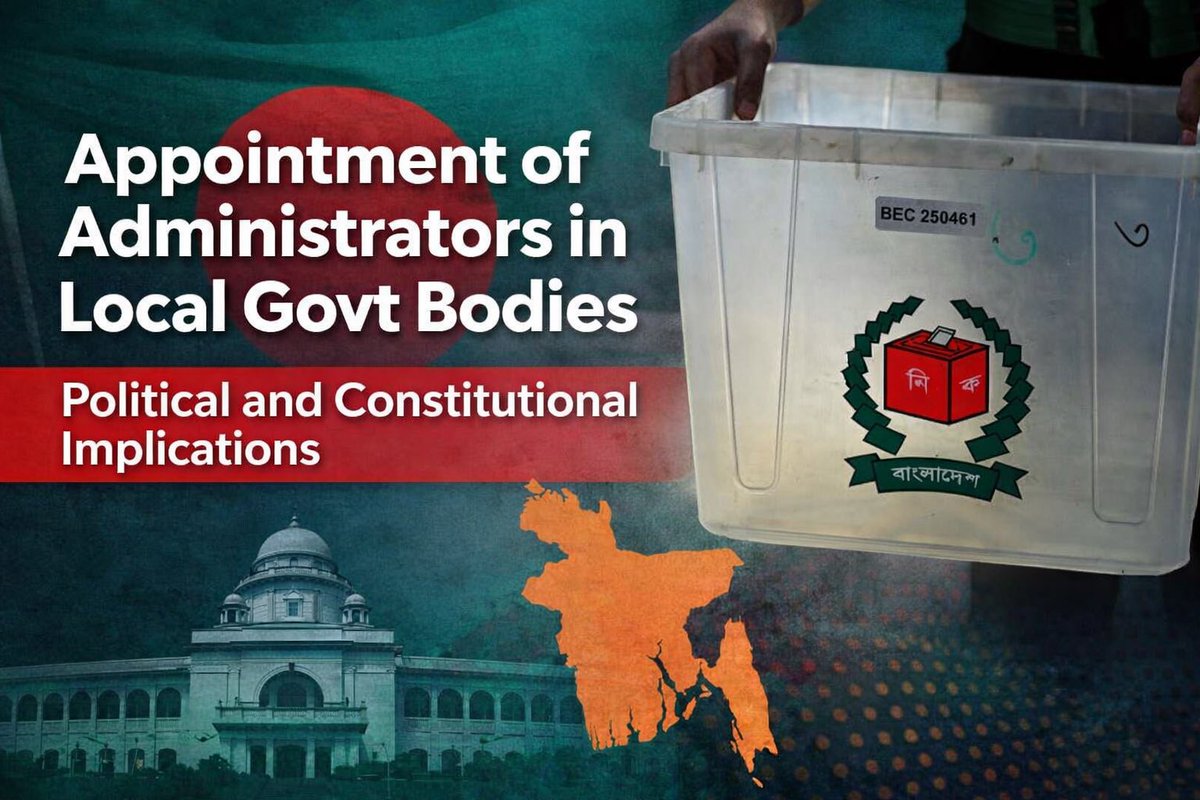
Throughout March–April 2026, the #BNP Govt led by PM #TariqueRahman has appointed several party members and leaders as administrators of local government bodies, contrary to both constitutional provisions and its own stated commitments. These actions include:
- The appointment of party members to 42 district councils on March 15, 2026;
- The appointment of party leaders as administrators to 11 city corporations on February 23 and March 14, 2026.
These appointments directly contradict the BNP’s own pledge to discontinue the practice of appointing administrators to local govt bodies. Point 21 of BNP’s “31-Point Outline for Structural Reforms in Bangladesh” clearly states:
“The appointment of govt administrators to local govt bodies will be discontinued, except in cases of vacancy due to the incumbent's death or a court order”.
See:
bnpbd.org/31-points
Moreover, in April 2026, the BNP-majority #parliament passed four laws allowing the govt to appoint administrators to local govt bodies for an indefinite period under so-called “special circumstances.” These provisions apply to district councils, municipalities, sub-district councils, and city corporations.
The laws grant the executive substantial discretion, as “special circumstances” remain undefined. Additionally, while the legislations state that “an appropriate person” may be appointed as an administrator, they do not clarify who qualifies as such. This ambiguity creates significant scope for appointing party loyalists under virtually any situation the govt deems “special.”
News:
tbsnews.net/bangladesh/law…
It is also important to note that the BNP has also retained the power to dismiss elected local govt officials, thereby undermining their security of tenure and reinforcing subservience to the executive.
The amendments allow for the removal of officials and the dissolution of governing bodies without prior notice in district and sub-district councils, as well as in municipal and city corporations.
A notable aspect of these four ordinances is that they override other legal provisions, enabling the direct exercise of executive power regardless of existing statutory safeguards. As a result, the govt may remove individuals at will, without the prior requirements of specific charges, investigation, or judicial process.
This position too, contradicts BNP’s own pledge to strengthen local govt institutions, as articulated in Point 21 of their “31-Point Outline for Structural Reforms in Bangladesh”, which states:
“An elected local govt representative shall not be suspended, dismissed, or removed by executive order unless sentenced by a court”.
Furthermore, these developments appear inconsistent with the Constitution of Bangladesh. Article 59(1) provides that local govt in every administrative unit “shall be entrusted to bodies, composed of persons elected in accordance with law,” clearly emphasizing governance by elected representatives rather than govt-appointed administrators.
These measures may also be viewed as undermining the democratic principles enshrined in the Constitution. Article 11 affirms that Bangladesh is a democracy in which “effective participation by the people through their elected representatives” shall be ensured at all levels.
It should also be noted that several Supreme Court decisions have reinforced the primacy of governance by elected representatives over party-affiliated administrators.
The BNP Govt’s recent actions represent a significant departure from both its own reform commitments and Bangladesh’s constitutional. By enabling the indefinite appointment of administrators, concentrating discretionary power in the executive, and weakening the tenure and autonomy of elected local bodies, BNP has managed to undermine the principle of representative local governance.
Taken together, these developments suggest a shift toward centralised executive control at the expense of grassroots democracy and institutional accountability.
….
A widow in Faridpur, already struggling to survive, was allegedly lured with false promises and brutally assaulted. The accused has been arrested, but her fight for justice has just begun.
In Kushtia, a sixth-grade student was found in critical condition after a suspected assault inside her school premises. She is now out of danger, but the perpetrator remains unidentified.
These incidents are a stark reminder of the urgent need for accountability, safety, and justice. Survivors deserve protection—not promises.
#Bangladesh#BangladeshCrisis
Despite having stringent laws like the Women and Children Repression Prevention Ordinance, Bangladesh continues to see a troubling rise in violence against women and children. Hundreds of reported cases highlight a persistent failure in enforcement, accountability, and victim protection.
Critics argue that while legislation exists on paper, the reality on the ground tells a different story—one where survivors struggle for justice and safety remains uncertain. The issue is no longer about the absence of laws, but the inability or unwillingness to implement them effectively.
👉albd.org/articles/news/…#ViolenceAgainstWomen#Bangladesh
The political parties represented in #Bangladesh’s largely one-sided #parliament may disagree on issues such as the July Charter or institutional reforms. Yet, there appears to be a striking consensus on one matter: the systematic violation of #humanrights of #AwamiLeague-associated individuals.
Nowhere is this convergence more evident than in the state’s policy and practice of arbitrary detention targeting AL leaders, activists, and supporters.
Scale and Mechanisms of Detention
Since August 2024, thousands of AL activists and supporters have been subjected to arrest under sweeping criminal cases linked to the violence of July–August 2024. According to data from Police HQ, 1,785 criminal cases have been filed nationwide in connection with these events.
These cases collectively name over 100,000 individuals as accused, with hundreds of thousands more listed as “unnamed accused.” In many instances, a single case includes between 400 and 500 individual.
Although these cases were formally filed under the #Yunus-led Interim Govt, it was local-level leaders of the Bangladesh Nationalist Party (#BNP) who played a significant role in drafting First Information Reports (FIRs) in coordination with local police stations. Individuals were named arbitrarily, often without credible evidence, with a clear pattern of targeting AL members.
In some areas, actors linked to #JamaatEIslami and the National Citizen Party (#NCP) were also involved in implicating political rivals.
Arrests, Bail Denial, and “Shown Arrest”
There is no official govt data on the total number of arrests over the past twenty months. However, the AL claims that approx. 150,000 of its leaders, activists, and supporters have been detained. While the exact figure remains uncertain, it is widely believed to be substantial.
For many detainees, arrest marks only the beginning of prolonged legal hardship. Senior leaders have remained in custody for over a year, with bail applications repeatedly denied. Others, even when granted bail in one case, are immediately “shown arrested” in another case arising from the same or similar events.
The practice of “shown arrest” involves re-arresting an already detained individual in a new case, often based on vague or questionable allegations, immediately after bail is granted in a previous one. This tactic effectively ensures indefinite pre-trial detention, undermining the very purpose of judicial relief.
Given the extremely limited number of releases on bail, it is estimated that tens of thousands, potentially around 100,000 individuals, remain incarcerated across the country.
Conditions of Detention and Custodial Deaths
Reports on detention conditions are deeply concerning. Over the past twenty months, at least 45 AL-affiliated political detainees have died in custody. Families of the deceased have consistently alleged torture by law enforcement, denial of adequate medical care, and inhumane prison conditions as contributing factors to these deaths.
A Pattern of Systemic Abuse
Taken together, these developments suggest a troubling and coordinated pattern:
- Politically motivated actors, in collaboration with corrupt elements of law enforcement, file sweeping criminal cases naming hundreds of individuals, often without clear evidence;
- Law enforcement agencies carry out mass arrests under these cases, disproportionately targeting opposition actors;
- Judges and magistrates frequently deny bail under apparent political pressure, rather than exercising independent judicial discretion;
-Detainees face prolonged pre-trial detention, abuse in custody, and inadequate access to medical care.
Despite their frequent rhetoric on democracy, reforms, rule of law, and human rights, there has been no criticism at all of these practices from major political actors, including the BNP, Jamaat, and NCP.
At least one this issue, they seem to be clearly united.
…
#BangladeshCrisis#HumanRights#ArbitraryDetention@hrw
Ban on #AwamiLeague: What the Experts Say
In May 2025, Bangladesh’s Interim Govt, led by Muhammad #Yunus, banned the activities of the Awami League, one of the country’s largest political parties, under the Anti-#Terrorism Act of 2009. Notably, the provision used to impose the ban was not part of the original law; it was introduced through an ordinance issued by the IG.
This amendment was later ratified by the current #BNP-dominated parliament in April 2026, effectively maintaining the ban.
So, how is this development being viewed by legal and political experts?
Dr. Farid Uddin Ahmed, Professor of Political Science at Dhaka University, argues that restricting the activities of a political party is fundamentally undemocratic. He states,
“It would not be right to ban the Awami League as a political party. This is not even possible… You can try individuals, but you cannot outlaw ideology. How can you institutionalize multi-party democracy by excluding a major political party like the Awami League?”
Dr. Ahmed also warns of potential consequences. He notes that such a ban may push the party to reorganize outside public scrutiny, potentially turning it into an “underground” movement. This raises serious concerns about the implications for Bangladesh’s political stability if a significant segment of the population is forced into such a position.
Echoing similar concerns, Barrister Mahbub Shafique, a leading lawyer of the Supreme Court of Bangladesh, emphasizes that decisions about political participation should not rest with the executive. “It is not democratic to restrict or ban political activities,” he says.
“Such decisions are incompatible with the constitutional rights to freedom of association, formation of political parties, and expression of political views. The choice should be left to the people—the electorate alone should decide whether to accept or reject a party.”
Political analyst and historian Mohiuddin Ahmed highlights the absence of due judicial process in the ban. “No case has been filed against the Awami League as a party. No court has banned it,” he observes. “It is arguable that leaving the matter to the electorate would be a more appropriate course than imposing a state-led ban.”
He further raises concerns about the motivations behind the move, suggesting it may be perceived as politically retaliatory. “The Awami League was banned in 1971 as well. If there were legal grounds, a court verdict should have determined the outcome. Instead, the government has chosen the executive route. This makes it natural to view the move as retaliatory or politically motivated.”
Dr. Zobaida Nasreen, Professor of Anthropology at Dhaka University, warns of the long-term consequences of such actions. She notes that Bangladesh’s history shows that banning political parties often leads to instability, and those responsible are ultimately judged by history.
“There are many supporters and voters of the Awami League in Bangladesh,” she explains. “The interim government has eliminated the opportunity to assess the party’s public support through democratic means. While banning a party may offer temporary satisfaction or a sense of retribution, it is ultimately a disastrous decision for the country’s political future and stability.”
Sources:
@bbcbanglabbc.com/bengali/articl…?
@dwnewsp.dw.com/p/5BtzZ
…
#BangladeshCrisis@DrSJaishankar@MEAIndia@State_SCA@USAmbIndia@USAmbBangladesh@HCSarahCooke@YvetteCooperMP@FCDOGovUK@SecRubio@kajakallas@ApsanaBegumMP@GERonSouthAsia@UNinBangladesh@CarolFloreUN@commonwealthsec@AyorkorBotchwey@volker_turk@antonioguterres@UNHumanRights@hrw. @amnestysasia@PearsonElaine@ESandersFCDO@StateDRL
On April 10, 1971, amid war, uncertainty, and unimaginable sacrifice, Bangladesh took a decisive step toward nationhood. On this day, the Provisional Government of the People’s Republic of Bangladesh was formed—grounded in the historic mandate of the 1970 election and the declaration of independence by Sheikh Mujibur Rahman on March 26. Though imprisoned, Bangabandhu was declared President, with Syed Nazrul Islam serving as Acting President, and Tajuddin Ahmad leading the government as Prime Minister—carrying the weight of a nation’s struggle on his shoulders.
From exile, with courage and clarity, these leaders built the administrative and political foundation of a free Bangladesh. The Proclamation of Independence, formally read by M. Yusuf Ali, was more than a document—it was a solemn pledge to uphold equality, human dignity, and justice, even in the face of genocide and war. It affirmed that the will of the people would prevail, and that Bangladesh would stand as a sovereign republic among nations.
This day is not just a milestone in history—it is a reminder of vision, unity, and unwavering resolve.
👉 albd.org/articles/news/…#Mujibnagar#LiberationWar1971#Bangladesh#SheikhMujib